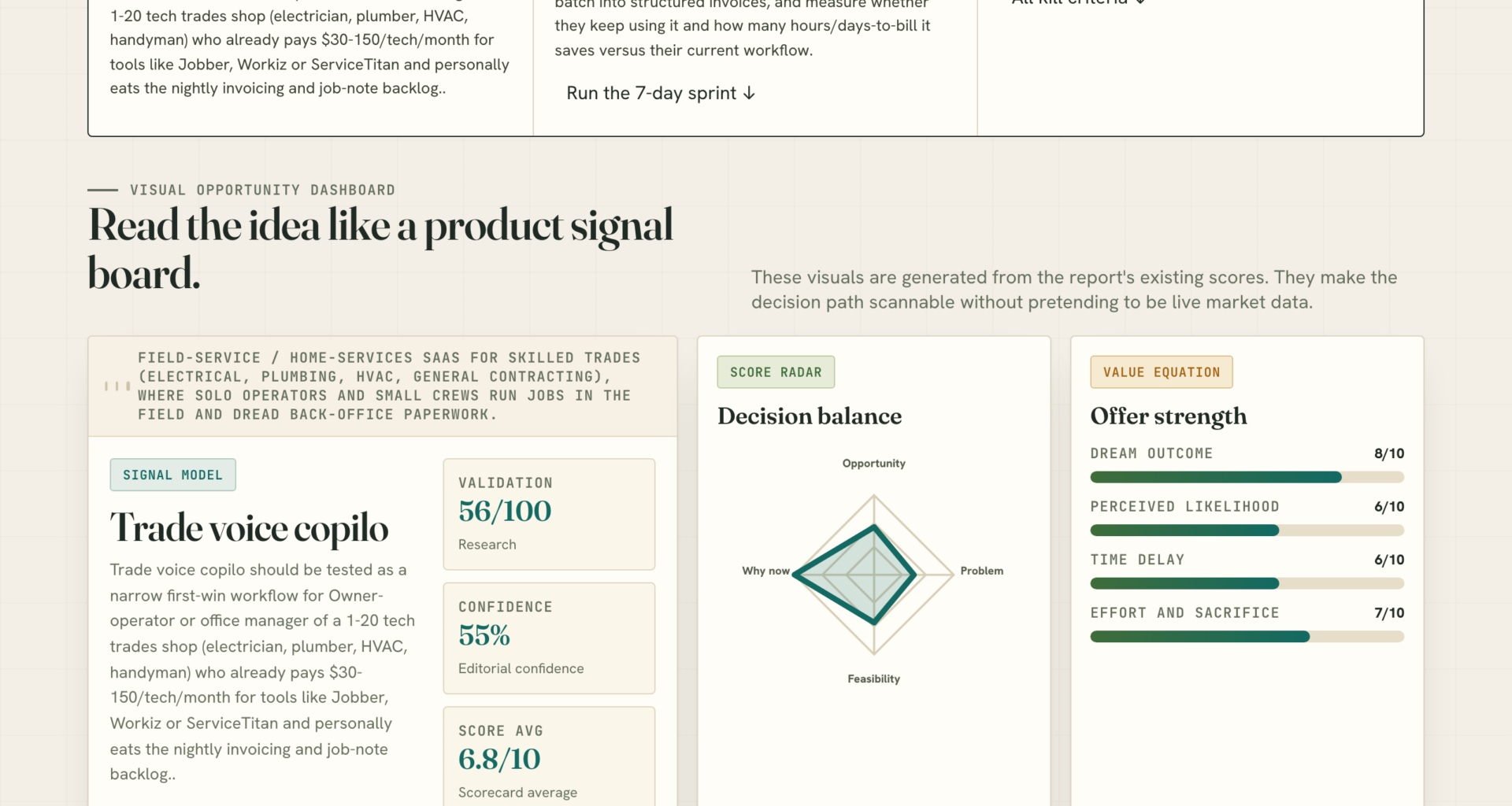

📊 Full opportunity report: Trade voice copilo on IdeaNavigator AI — validation score, market gap, and execution plan.

Get the latest gadgets delivered free with Prime
- Fast, free delivery on millions of items
- Prime Video, Amazon Music and more included
- Member-only deals all year
TL;DR
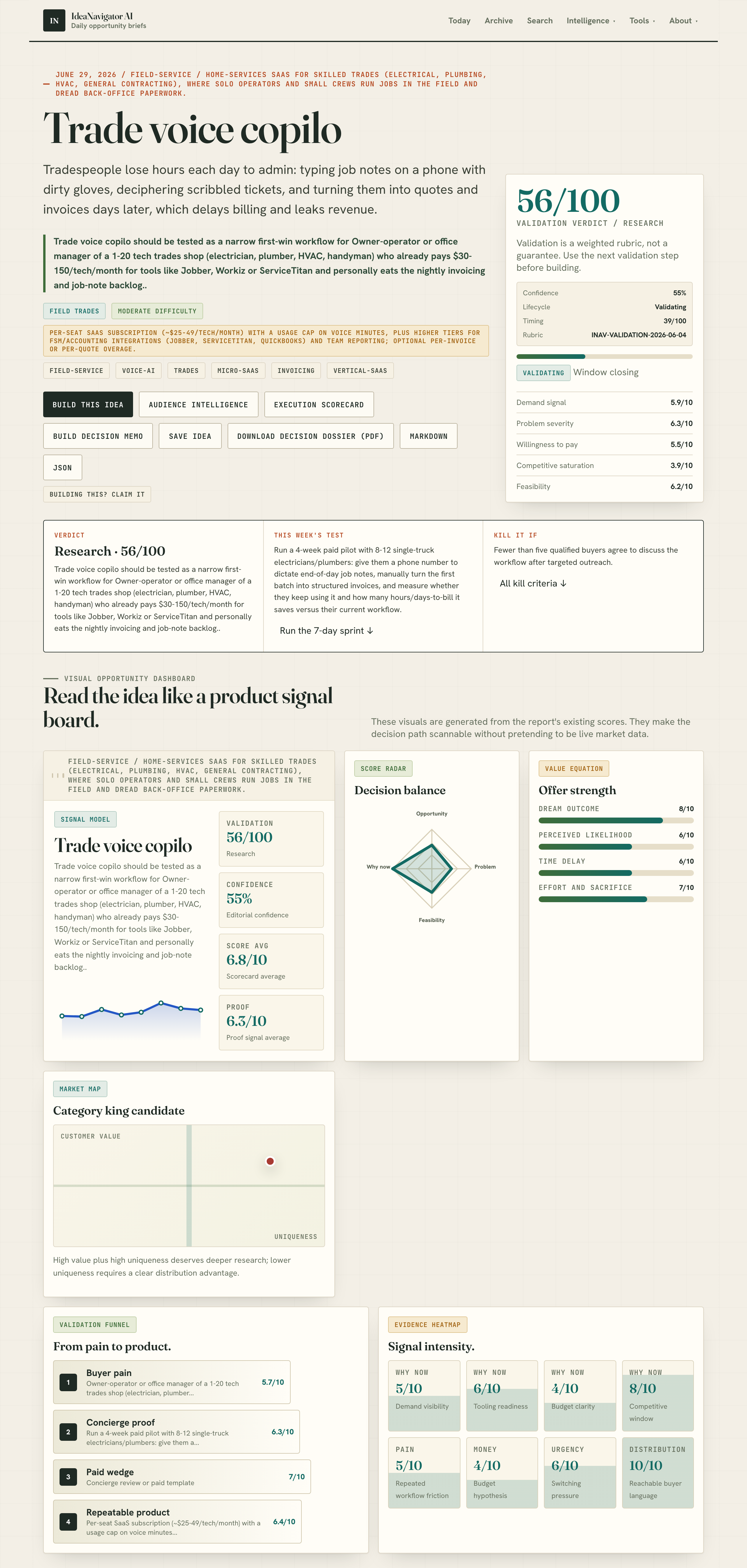
Trade voice copilo is being tested as a workflow tool for small trades businesses, offering hands-free job note transcription and invoice generation. The pilot aims to validate its efficiency in reducing admin time and speeding billing.
Trade voice copilo is entering a paid pilot phase with small trades businesses, aiming to automate end-of-day job notes and invoicing. The tool is designed for owner-operators and office managers of shops with 1-20 technicians, seeking to cut down on administrative hours and improve cash flow. This development is significant as it leverages recent advances in speech-to-text technology and large language models (LLMs) to address persistent inefficiencies in field service workflows.
The pilot involves providing participating trades shops—such as electricians, plumbers, HVAC technicians, and handymen—with a dedicated phone number or mobile app. During the pilot, workers will dictate job summaries, including client info, work performed, parts used, and time spent. An LLM will transcribe and structure these dictations into a formal job record, which can then be pushed as a draft invoice or quote into existing accounting or job management software like Jobber or QuickBooks via API.
This approach aims to automate the process of turning handwritten or scribbled notes into structured billing data, reducing the hours spent on administrative tasks and accelerating billing cycles. The pilot is testing whether this hands-free workflow can be adopted easily by small teams and whether it results in measurable time savings and faster cash collection. The tool is offered as a per-seat SaaS subscription, priced between $25 and $49 per technician per month, with additional tiers for integration and reporting features.
Potential Impact on Small Trades Business Operations
This pilot could transform how small trades businesses handle administrative work, which often consumes hours of their day. By enabling technicians to dictate job notes directly from the field, the tool aims to reduce delays in invoicing and improve cash flow, especially amid ongoing labor shortages. If successful, it could lead to wider adoption of voice-powered workflows in the trades sector, increasing productivity and profitability for small operators.
voice transcription app for trades
As an affiliate, we earn on qualifying purchases.
As an affiliate, we earn on qualifying purchases.
Advances in Speech Tech Enable Field Work Automation
Recent improvements in speech-to-text accuracy, driven by low-cost AI models and noise-resistant microphones, have made hands-free dictation viable in noisy job sites. Small trades businesses typically rely on manual note-taking or scribbled tickets, which are later transcribed and processed into invoices—a process prone to errors and delays. The idea of automating this step has gained momentum as labor shortages intensify, making every billable hour more critical. The pilot reflects a broader trend of integrating AI-driven automation into small business workflows, especially in the skilled trades sector.
“This pilot tests whether dictating job notes can significantly cut admin time for small trades teams, speeding up billing and cash flow.”
— an anonymous researcher
Uncertainties About Adoption and Effectiveness
It is not yet clear how quickly small trades businesses will adopt the voice copilot or how much time savings it will ultimately deliver. The pilot results are still being collected, and user feedback will determine whether the tool can scale beyond initial participants. Additionally, questions remain about integration reliability, accuracy in noisy environments, and user acceptance of voice-based workflows.
Next Steps for Pilot Evaluation and Broader Rollout
The ongoing pilot will run for approximately four weeks, during which participating shops will provide feedback on usability, time savings, and billing improvements. The developers plan to analyze this data to refine the tool and prepare for broader deployment. If results are positive, a wider rollout to similar small trades businesses could follow, with additional features and integrations planned based on user needs.
Key Questions
How does trade voice copilo work?
It allows technicians to dictate job summaries via a phone number or mobile app. An AI-powered language model transcribes and structures these dictations into job records, which can be converted into invoices or quotes within existing business software.
Who is the target user for this tool?
Owner-operators and office managers of small trades shops with 1-20 technicians, who currently handle manual note-taking and invoicing processes.
What are the expected benefits of using trade voice copilo?
Reduced time spent on administrative tasks, faster invoicing, improved cash flow, and less manual data entry, especially in noisy field conditions.
When will the pilot results be available?
The pilot is expected to run for about four weeks, with results analyzed shortly thereafter to determine broader deployment plans.
Are there any risks or limitations identified so far?
Uncertainties include user acceptance, accuracy in noisy environments, and integration reliability, which are still being evaluated during the pilot.
Source: IdeaNavigator AI
Halloween Picks
halloween
As an affiliate, we earn on qualifying purchases.