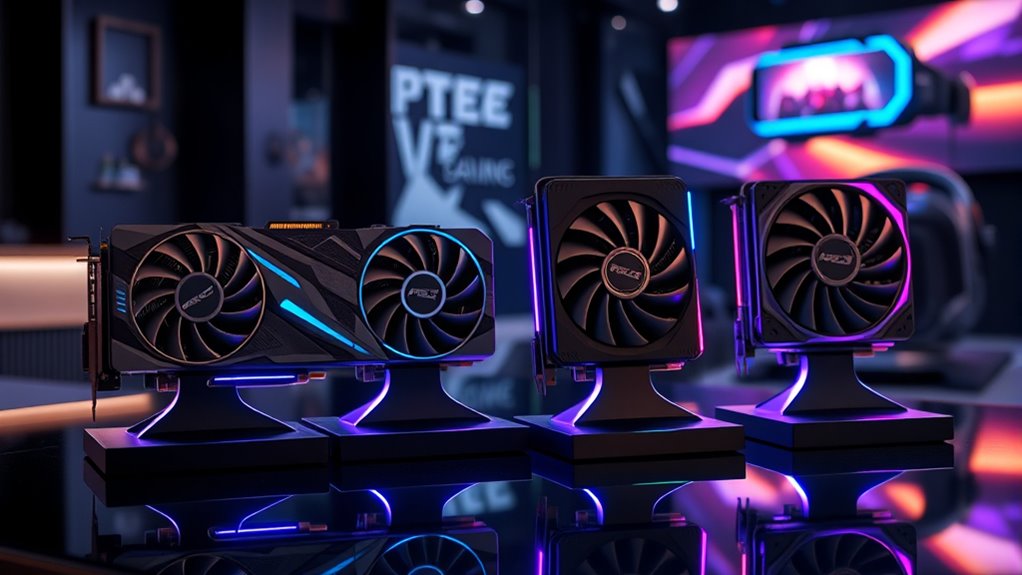

If you’re serious about VR flight sims in 2026, I recommend the GIGABYTE GeForce RTX 3060 for its solid performance and 12GB VRAM, or the ASUS RTX 3050 for good value and VR support. For top-tier visuals, the GIGABYTE AORUS RTX 3090Ti Xtreme Waterforce offers unbeatable power, while the MSI RTX 2060 remains a capable option for budget-conscious users. Keep going to discover detailed insights on choosing the best GPU to enhance your flight experience.
Key Takeaways
- Prioritize GPUs with at least 8GB VRAM to ensure smooth, high-resolution VR flight simulation.
- Opt for models with DisplayPort 1.4 or HDMI 2.1 for optimal VR headset compatibility.
- Choose high-performance GPUs like the GIGABYTE RTX 3060 or AORUS RTX 3090Ti for stable 90 FPS or higher.
- Ensure robust cooling solutions and sufficient power supplies (650W+ with proper connectors) for long VR sessions.
- Select GPUs supporting DirectX 12 or Vulkan to maximize API compatibility and rendering efficiency.
| GIGABYTE GeForce RTX 3060 Gaming OC 12G Graphics Card | 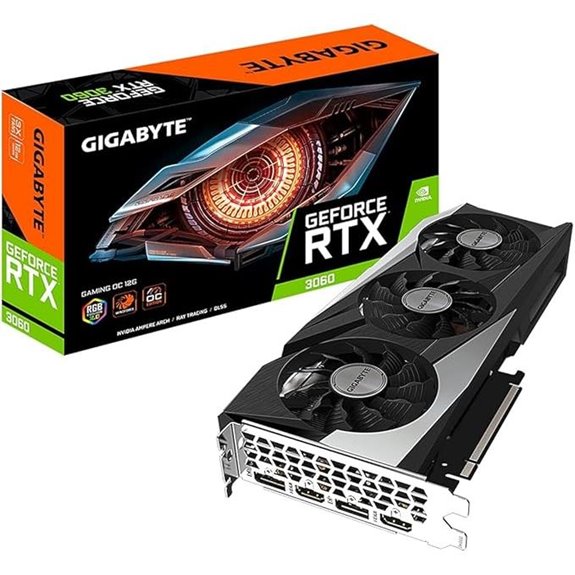 | High-Performance Gaming | Memory Size: 12GB GDDR6 | Memory Interface: 192-bit | Connectivity Ports: 2x HDMI 2.1, 2x DisplayPort 1.4 | VIEW LATEST PRICE | See Our Full Breakdown |
| ASUS GeForce RTX 3050 Gaming Graphics Card | 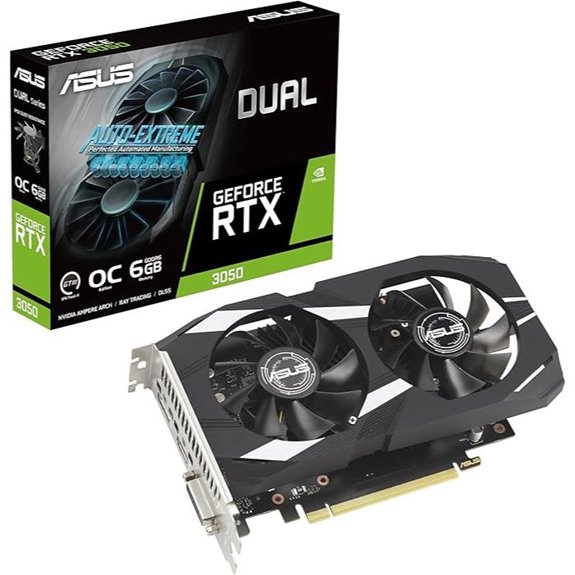 | Compact Powerhouse | Memory Size: 6GB GDDR6 | Memory Interface: 192-bit | Connectivity Ports: 1x HDMI 2.1, 1x DisplayPort 1.4a | VIEW LATEST PRICE | See Our Full Breakdown |
| GIGABYTE AORUS RTX 3090Ti Xtreme Waterforce Card | 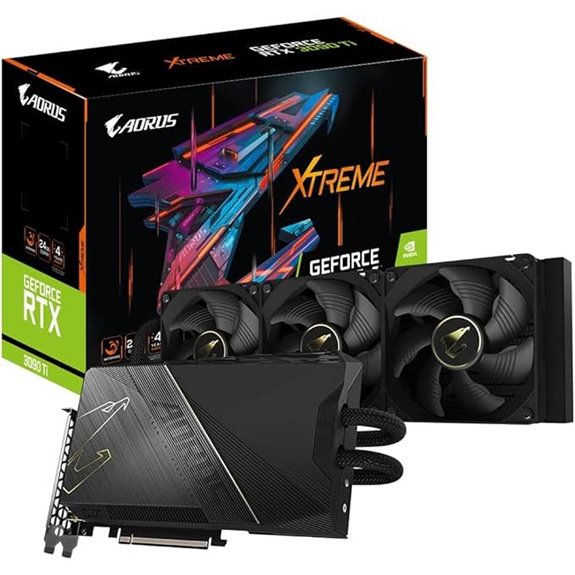 | Top-Tier Creator | Memory Size: 24GB GDDR6X | Memory Interface: 384-bit | Connectivity Ports: HDMI, DisplayPort (unspecified number) | VIEW LATEST PRICE | See Our Full Breakdown |
| MSI GeForce RTX 2060 Gaming Graphics Card |  | Budget VR Ready | Memory Size: 6GB GDDR6 | Memory Interface: 192-bit | Connectivity Ports: 1x HDMI, 3x DisplayPort | VIEW LATEST PRICE | See Our Full Breakdown |
More Details on Our Top Picks
GIGABYTE GeForce RTX 3060 Gaming OC 12G Graphics Card
If you’re looking for a reliable GPU that balances performance and affordability for VR flight simulators in 2026, the GIGABYTE GeForce RTX 3060 Gaming OC 12G is a solid choice. It features NVIDIA’s Ampere architecture with second-generation Streaming Multiprocessors, RT Cores, and Tensor Cores, ensuring smooth visuals and AI capabilities. With 12GB GDDR6 memory and a core clock of 1837 MHz, it handles demanding VR workloads with ease. The WINDFORCE 3X cooling system keeps temperatures in check, while multiple HDMI 2.1 and DisplayPort 1.4 outputs support high-resolution displays. Overall, it’s a dependable option for immersive VR flight experiences.
- Memory Size:12GB GDDR6
- Memory Interface:192-bit
- Connectivity Ports:2x HDMI 2.1, 2x DisplayPort 1.4
- Cooling System Type:WINDFORCE 3X cooling
- Architecture:NVIDIA Ampere
- Ray Tracing Support:Yes
- Additional Feature:RGB Fusion 2.0 lighting
- Additional Feature:WINDFORCE 3X cooling system
- Additional Feature:Metal backplate protection
ASUS GeForce RTX 3050 Gaming Graphics Card
The ASUS GeForce RTX 3050 Gaming Graphics Card stands out as an excellent choice for VR flight sim enthusiasts seeking budget-friendly yet capable performance. It features NVIDIA’s Ampere architecture with 2X FP32 throughput and second-generation RT cores for enhanced ray tracing. The 6GB GDDR6 memory guarantees smooth visuals, while the Axial-tech fans provide effective cooling in compact systems. Connectivity options like HDMI 2.1 and DisplayPort 1.4a support high-resolution displays, and the steel bracket offers durability. Its power efficiency, quiet operation during low loads, and 2-slot design make it a dependable, versatile option for immersive VR flight simulations without breaking the bank.
- Memory Size:6GB GDDR6
- Memory Interface:192-bit
- Connectivity Ports:1x HDMI 2.1, 1x DisplayPort 1.4a
- Cooling System Type:Axial-tech fan design
- Architecture:NVIDIA Ampere
- Ray Tracing Support:Yes
- Additional Feature:Axial-tech fan design
- Additional Feature:2-slot form factor
- Additional Feature:0dB noise technology
GIGABYTE AORUS RTX 3090Ti Xtreme Waterforce Card
Enthusiasts seeking top-tier performance for immersive VR flight simulations in 2026 should consider the GIGABYTE AORUS RTX 3090Ti Xtreme Waterforce Card, especially given its advanced cooling system. This card features a WATERFORCE all-in-one cooling setup with a 360mm radiator and three 120mm fans, ensuring ideal thermal management during intensive VR sessions. Powered by NVIDIA’s second-generation Ampere architecture, it boasts 24GB of GDDR6X memory and enhanced ray tracing and AI capabilities. Its robust design, including a metal backplate, makes it durable and suitable for overclocking. It’s a powerhouse that elevates your VR flight experience to new heights.
- Memory Size:24GB GDDR6X
- Memory Interface:384-bit
- Connectivity Ports:HDMI, DisplayPort (unspecified number)
- Cooling System Type:Water cooling (WATERFORCE)
- Architecture:NVIDIA Ampere
- Ray Tracing Support:Yes
- Additional Feature:Waterforce all-in-one cooling
- Additional Feature:360mm radiator included
- Additional Feature:Designed for overclocking
MSI GeForce RTX 2060 Gaming Graphics Card
For budget-conscious gamers seeking smooth VR flight simulation experiences, the MSI GeForce RTX 2060 Gaming Graphics Card offers an impressive mix of performance and affordability. It features 6GB of GDDR6 memory with 14 Gbps speed, ensuring crisp visuals and fast rendering. The card’s boost clock reaches 1710 MHz, providing solid gaming power, while ray tracing technology enhances realism. With three DisplayPorts and an HDMI output, it supports high resolutions up to 7680×4320. As VR-ready hardware, it delivers immersive experiences without breaking the bank, making it a strong choice for those seeking quality performance at a budget-friendly price point.
- Memory Size:6GB GDDR6
- Memory Interface:192-bit
- Connectivity Ports:1x HDMI, 3x DisplayPort
- Cooling System Type:Air cooling (ventus fans)
- Architecture:NVIDIA Turing (RTX 2060)
- Ray Tracing Support:Yes
- Additional Feature:VR Ready certification
- Additional Feature:1710 MHz boost clock
- Additional Feature:3 DisplayPort outputs
Factors to Consider When Choosing a GPU for VR Flight Sim

When choosing a GPU for VR flight sim, I focus on several key factors to guarantee a smooth experience. Things like VR compatibility, enough graphics memory, and high frame rates are essential, along with good cooling and the right connectivity options. These points help me pick a GPU that delivers both performance and reliability.
VR Compatibility Requirements
Choosing the right GPU for VR flight simulators hinges on making certain compatibility requirements that make sure smooth, immersive gameplay. First, verify the GPU supports VR headsets with at least DisplayPort 1.4 or HDMI 2.0/2.1, which handle high-bandwidth video output essential for clarity and responsiveness. Next, confirm the GPU has a minimum of 6GB VRAM to manage high-resolution textures and complex virtual environments without lag. Compatibility with VR-specific APIs like DirectX 12 or Vulkan is essential for peak performance. Additionally, the GPU should meet or exceed the recommended processing capabilities of your flight sim software. Finally, look for support for low latency and high frame rates—ideally 90Hz or higher—to maintain smoothness and prevent motion sickness during immersive VR experiences.
Graphics Memory Capacity
Having enough graphics memory is crucial for a smooth VR flight sim experience because it directly affects how well high-resolution environments and detailed textures are rendered in real time. A GPU with at least 8GB of VRAM is recommended to handle complex textures and scenery, ensuring smooth gameplay without lag or stuttering. Insufficient VRAM causes textures to load slowly or revert to lower quality, which can break immersion. Larger VRAM capacities enable higher in-game resolution settings and advanced graphical features, greatly enhancing visual fidelity. The ideal amount depends on your VR headset’s resolution and the complexity of your flight simulation software. Investing in a GPU with ample VRAM ensures your VR experience remains seamless, realistic, and visually stunning.
Frame Rate Performance
Ensuring a high and stable frame rate is crucial for an immersive VR flight sim experience, as it directly influences how smooth and realistic the simulation feels. Ideally, you’ll want a frame rate of 90 FPS or higher to prevent motion sickness and visual discomfort during extended sessions. The GPU’s ability to consistently deliver these high frame rates depends on its processing power, VRAM capacity, and driver optimization for VR workloads. If the frame rate drops below the ideal threshold, you’ll notice stuttering or lag, which breaks immersion and hampers realism. Achieving stable performance often requires balancing graphical settings with your GPU’s capabilities. Prioritizing GPUs that can maintain high, consistent frame rates ensures a smoother, more enjoyable flight simulation experience.
Cooling and Noise Levels
Effective cooling solutions are essential for maintaining ideal GPU performance during long VR flight sessions. Proper cooling prevents overheating and thermal throttling, ensuring smooth visuals and responsiveness. Multiple fans or water cooling systems efficiently dissipate heat, especially during demanding workloads. Lower noise levels are equally important; larger fans spinning at lower speeds produce less noise, reducing distractions. Advanced technologies like vapor chambers and heat pipes further enhance heat dissipation without increasing noise. Additionally, noise-dampening features such as vibration reduction mounts and insulated enclosures help minimize fan noise and vibrations that could interfere with immersion. Striking the right balance between cooling efficiency and noise output is critical—excessive cooling can lead to loud fan operation, disrupting the immersive experience.
Connectivity Options Needed
Choosing the right GPU for VR flight simulations means paying close attention to its connectivity options. I look for GPUs with multiple high-speed HDMI 2.1 ports to make certain reliable video and audio transfer to my headset. DisplayPort 1.4a or higher is essential for high-resolution, high-refresh-rate visuals, so I verify the GPU supports these standards. It’s also important to check if the GPU has enough outputs to connect multiple VR devices or extra monitors, which enhances my setup. If my VR headset uses USB-C or VirtualLink, I confirm the GPU supports these connections for seamless power and data transfer. Ensuring compatibility between the GPU’s connectivity options and my VR headset’s specifications prevents signal bottlenecks and guarantees smooth, immersive flight simulation experiences.
Power Supply Compatibility
To get the most out of my VR flight simulator, I need to make sure my power supply can handle the GPU’s demands. I check that it provides at least 650W of wattage, especially for high-end GPUs, to guarantee stable performance. I also verify that it has the necessary 8-pin or 6-pin PCIe power connectors required by the GPU model I choose. Additionally, I look at the +12V rail’s current capacity in amperes, as this ensures my system gets enough power during intense VR sessions. Compatibility with my motherboard’s power delivery system is also essential for peak performance. Finally, I opt for a power supply with an efficiency rating of 80 Plus Gold or higher for reliable, consistent power without risking overheating or failure.
Frequently Asked Questions
How Does VR Headset Resolution Impact GPU Choice?
Higher VR headset resolution means I need a more powerful GPU to maintain smooth performance. When the resolution increases, the GPU has to work harder to render detailed images quickly, reducing lag and motion sickness. I look for GPUs with more VRAM and higher processing power because they handle the extra pixel load better, ensuring a more immersive and comfortable experience without sacrificing frame rates.
Are Power Supply Requirements Different for High-End VR GPUS?
Oh, absolutely, high-end VR GPUs do require different power supplies, and not just because I said so! These beasts often demand more wattage, better quality connectors, and sometimes even extra power cables. Skimping on your PSU might mean crashes or worse. So, if you’re eyeing top-tier VR performance, I’d double-check your power supply’s specs—because a GPU is only as good as the juice it gets!
What GPU Features Improve Immersion in Flight Simulation?
High refresh rates and low latency are key features that boost immersion in flight simulation. I look for GPUs with high frame rates to keep visuals smooth, reducing motion sickness. VR-specific technologies like variable refresh rate support and fast memory help handle complex scenes seamlessly. Additionally, a powerful GPU with wide bandwidth guarantees detailed environments load quickly, making me feel truly immersed and responsive during my virtual flights.
How Important Is VRAM Size for Future VR Flight Sims?
VR flight sims in 2026 will demand more VRAM to handle higher-res textures and complex environments smoothly. I believe VRAM size is essential because it guarantees seamless performance without stuttering or lag, especially as games become more detailed. I recommend at least 12GB or more, as future VR titles will push these boundaries. Investing in a GPU with ample VRAM guarantees you’ll enjoy immersive, lag-free experiences for years to come.
Do Cooling Solutions Affect VR Performance Stability?
Cooling solutions are like the heartbeat of your VR setup—they keep everything running smoothly. Yes, they do affect VR performance stability; good cooling prevents overheating, which can cause frame drops or crashes that ruin your immersive experience. I’ve seen how a well-ventilated system keeps my VR flights seamless, allowing me to explore the skies without interruptions. Reliable cooling is essential for consistent, high-quality VR performance.
Conclusion
In 2026, choosing the right GPU for VR flight simbing feels like steering a labyrinth of tech choices. With the right card, you’ll soar through virtual skies like a modern Daedalus, experiencing smooth, immersive gameplay. Remember, it’s not just about raw power but how well your GPU harmonizes with your setup. So, pick wisely and prepare to take off—this is your quest for the ultimate VR experience.