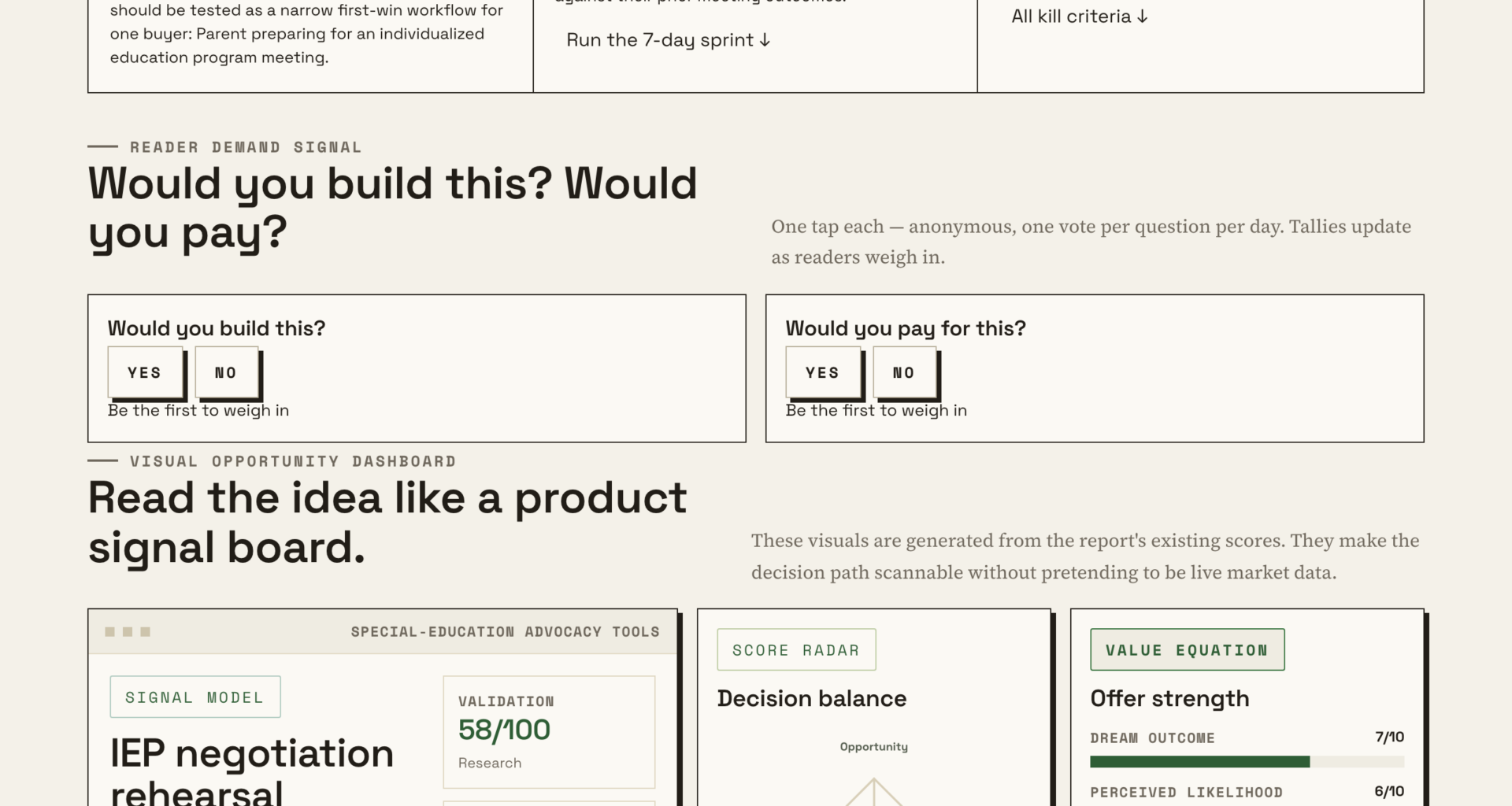

📊 Full opportunity report: The Role Of Rehearsal Simulators In IEP Negotiation Prep on IdeaNavigator AI — validation score, market gap, and execution plan.

Get the latest gadgets delivered free — and shop member deals
- Fast, free delivery on millions of items
- Access to Prime Big Deal Days deals on October 6–7
- Prime Video, Amazon Music and more included
TL;DR
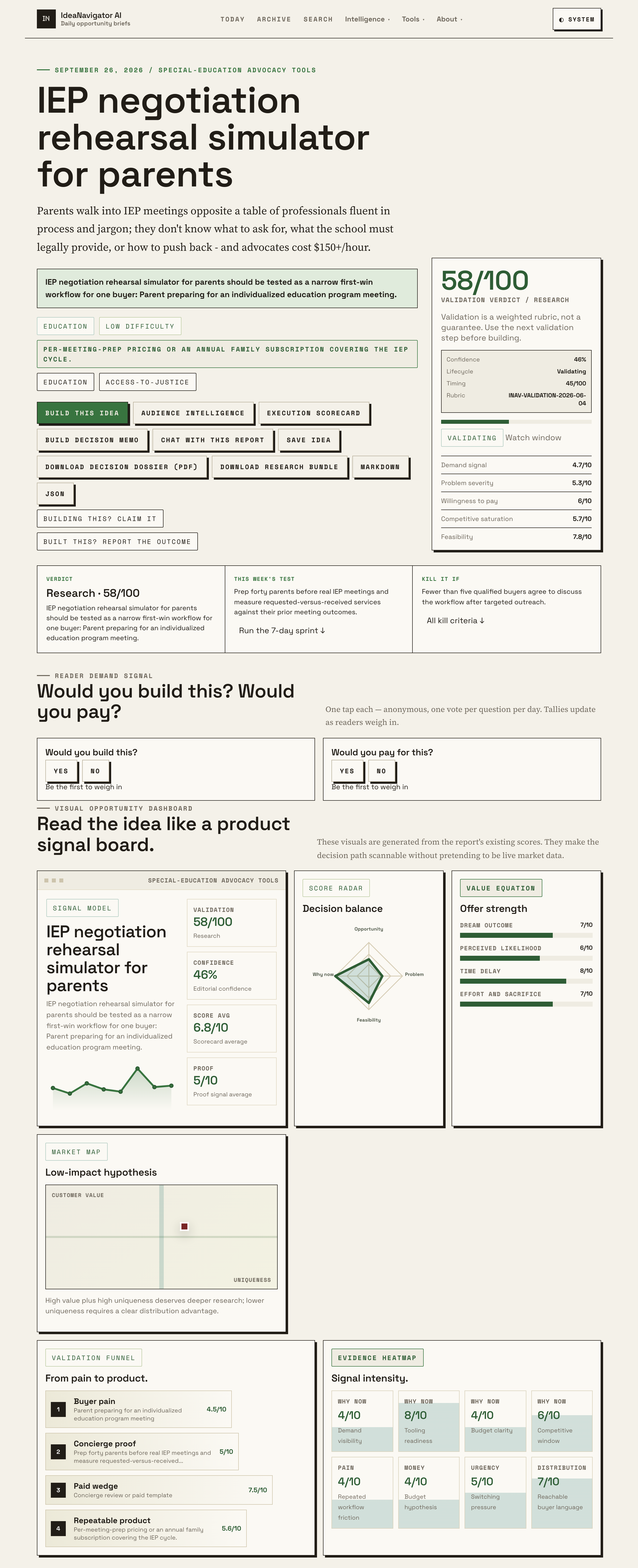
IdeaNavigator AI has outlined a proposed simulator to help parents prepare for individualized education program meetings through document review and role-play. The proposal describes a possible product and a test involving 40 parents; it does not report a launch, trial results or evidence that the tool improves services.
IdeaNavigator AI has outlined a proposed simulator for parents preparing for individualized education program (IEP) meetings, where they could review school documents, develop requests and rehearse responses to possible objections. The listing presents a product concept and a proposed test, not a launched service or a finding that rehearsal changes meeting outcomes.
The proposed workflow is aimed at one group: a parent preparing for an IEP meeting. A parent would upload a current IEP and evaluation reports. The tool would then explain the documents in plain language, identify potential requests with legal grounding, and conduct a simulated meeting that includes realistic pushback. The concept says the practice would continue until the parent could maintain their positions.
The listing suggests two possible payment models: a fee for each meeting preparation or an annual family subscription covering an IEP cycle. It does not name a product, describe a development team, give a release date or state that either pricing approach has been adopted. No working version, demonstration or customer data is reported.
To test the idea, the listing proposes preparing 40 parents before real IEP meetings and comparing the services they request with those they receive, against their outcomes in earlier meetings. It does not provide a study design, define how services or outcomes would be measured, or report that the proposed test has begun.
Preparing Parents for IEP Meetings
The proposal addresses an information gap that can arise when parents meet with school staff who regularly work with IEP procedures and terminology. Practice explaining a request or responding to disagreement could help a parent feel more prepared to participate. That is a potential benefit of the proposed format, not an established result.
The listing also points to the cost of outside advocacy, stating that advocates can cost $150 or more per hour. It gives no location, date, sample of providers or pricing method for that figure, so it should be read as a claim in the product pitch rather than a universal rate. Whether an automated tool could provide useful preparation at a lower cost would depend on its price, accuracy and ability to handle a family’s circumstances.
For families, the practical question is whether preparation helps them communicate their concerns and secure appropriate services. For schools and developers, it is whether a tool can give accurate, accessible information without presenting itself as a substitute for individualized advice. The suggested comparison of requested and received services could offer an initial measure, but those figures alone would not show why a request was accepted or declined or establish that the simulator caused any change.
How the Proposed Tool Works
An IEP sets out a student’s educational program and related supports. Parents may review evaluations and proposed services with school personnel, and the preparation task can involve understanding documents, identifying concerns and discussing possible changes. The IdeaNavigator AI listing focuses on that meeting-preparation stage; it does not describe a tool for writing IEPs or making decisions on behalf of a school.
The concept links its timing to two broad conditions: improvements in language-model role-play and rising special-education identification alongside tighter district resources. The listing does not cite data, dates or independent evaluations for those claims. It therefore supplies a rationale for exploring the product, but does not establish how common adversarial meetings are or whether current AI systems can reliably simulate them.
The proposed product combines document explanation, request generation and practice conversation. Those functions would require different forms of accuracy. Plain-language summaries need to reflect the uploaded records; legal explanations need to account for applicable rules and individual facts; and role-play needs to be realistic without steering families toward unsupported demands. The listing does not explain how the tool would verify legal content, protect uploaded records or handle errors.
Evidence and Safeguards Remain Open
No trial results are reported. The proposed 40-parent test has no stated start date, recruitment plan or comparison method. It is unclear how prior meeting outcomes would be documented, how differences between students and schools would be accounted for, or whether the measure would track services received over time.
The listing also leaves unanswered how the simulator would ground legal explanations, keep guidance current or distinguish a general explanation from advice tailored to a student’s situation. It gives no information about privacy protections for uploaded evaluations and education records, data retention, or who could access them. These details matter because the concept depends on sensitive documents and presents legal grounding as part of its proposed output.
Finally, it is unknown whether parents, educators or special-education advocates have evaluated a prototype. The claims about role-play capability, demand and district resource pressure are not accompanied by supporting evidence in the listing. Until a product and evaluation are described, the likely quality, cost and effect of the service remain uncertain.
A Test Would Establish the Baseline
The next stated step is to prepare 40 parents ahead of actual IEP meetings and compare their requested and received services with their own prior meeting outcomes. The listing does not say when this work will begin or who would run it. Before results could be interpreted, the test would need to explain how it defines a comparable outcome and accounts for differences in student needs, school decisions and available services.
Further details about a prototype, pricing, document privacy and the review of legal explanations would help families judge whether the proposal is ready for use. Any eventual findings would need to show what was measured and how participants were selected. For now, IdeaNavigator AI has presented a product hypothesis and a possible validation plan; whether a simulator will be built or improve parent meeting outcomes is not established.
Source: IdeaNavigator AI
Key Questions
Has an IEP rehearsal simulator launched?
The IdeaNavigator AI listing describes a product concept. It does not report a launch, a working product or a release date.
What would the proposed simulator do?
Parents would upload an IEP and evaluation reports. The proposed tool would explain the documents, generate possible requests with legal grounding and simulate a meeting with pushback.
Has the tool been shown to improve services?
No results are reported. The listing proposes testing the idea with 40 parents and comparing requested and received services with prior meeting outcomes.
How much would it cost?
No price is given. The listing mentions per-meeting preparation and an annual family subscription as possible payment models.
Source: IdeaNavigator AI
Fall Picks
fall essentials
As an affiliate, we earn on qualifying purchases.