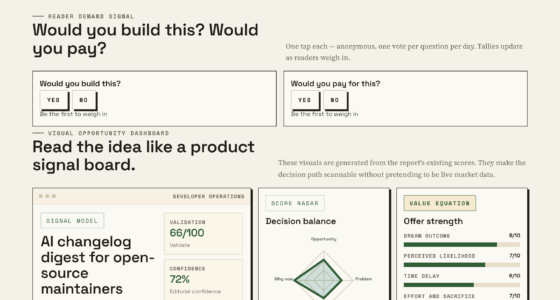

📊 Full opportunity report: The 27% Problem: Why Google Wrote a $750M Check to Catch Anthropic on ThorstenMeyerAI.com — validation score, market gap, and execution plan.

Get the latest gadgets delivered free with Prime
- Fast, free delivery on millions of items
- Prime Video, Amazon Music and more included
- Member-only deals all year
TL;DR
Google announced a $750 million partner fund and rebranded Vertex AI as Gemini Enterprise Agent Platform to compete with Anthropic’s dominant enterprise AI share. The move aims to secure enterprise distribution and governance control in a rapidly evolving market.
Google has committed $750 million to a new partner fund and rebranded its AI platform as Gemini Enterprise Agent Platform on April 22, 2026, in a strategic move to challenge Anthropic’s dominant 40% share of enterprise AI market, signaling a significant shift in industry competition.
Google’s $750 million fund aims to boost enterprise AI adoption through partner enablement, prototyping subsidies, workforce training, and high-visibility enterprise launches. The rebranding of Vertex AI to Gemini Enterprise Agent Platform emphasizes a focus on governance and control of AI agents across organizations, addressing the growing complexity of agent sprawl in large enterprises.
Anthropic currently holds a 40% share, having gained a five-year lead through a strategic focus on safety, alignment, and enterprise-led releases. Google’s move is motivated by the decline of OpenAI’s enterprise API share from 50% in 2023 to 27% in early 2026, and its belief that distribution and governance will determine market leadership.
Why Google’s $750M Investment Could Reshape Enterprise AI Leadership
This move signals a decisive effort by Google to regain enterprise AI dominance, which has shifted away from OpenAI and toward Anthropic. The $750 million fund aims to solidify Google’s distribution network and governance platform, which are critical in managing the complex sprawl of AI agents in large organizations. If successful, Google could dramatically increase its market share, influencing the future landscape of enterprise AI adoption and control.
As an affiliate, we earn on qualifying purchases.
Industry Shift Toward Agent Governance and Distribution Control
Over the past three years, enterprise AI has seen a shift from model performance to distribution and governance. Anthropic’s success stems from its focus on safety, predictable behavior, and enterprise-led releases, capturing 40% of the market. Meanwhile, OpenAI’s share has declined significantly, partly due to trust and product positioning issues. Google’s renewed focus on enterprise agent control reflects industry recognition that managing agent sprawl and governance is now the key battleground, with the upcoming Gemini platform designed to address these challenges.
“Google’s $750 million fund and rebranding of Vertex AI as Gemini Enterprise Agent Platform mark a strategic effort to recover lost ground in enterprise AI, emphasizing governance and distribution control.”
— Thorsten Meyer
Unclear Impact of Google’s $750M Fund on Market Dynamics
It remains uncertain whether Google’s $750 million investment will successfully shift enterprise market share away from Anthropic within the next 24 months. The effectiveness of the partner ecosystem, enterprise adoption rates, and Anthropic’s potential counter-moves, such as vertical specialization or aggressive discounting, are still developing factors that could influence outcomes.
Next Steps for Google and Industry Stakeholders
Google will likely accelerate its partner enablement programs, deploy enterprise agent governance solutions, and launch high-profile enterprise integrations, such as Merck. Industry observers will monitor whether Google’s distribution efforts translate into increased market share. Meanwhile, Anthropic may respond with vertical productization and regional sovereignty strategies, and OpenAI will consider pricing and governance adjustments to maintain relevance.
Key Questions
What does the $750 million fund aim to achieve?
The fund aims to expand Google’s enterprise AI distribution, improve agent governance, and increase market share by supporting partner enablement, proofs of concept, workforce training, and high-profile enterprise deployments.
How does this move affect Anthropic’s market position?
While Anthropic currently holds 40% market share, Google’s investment aims to challenge that dominance through improved distribution and governance tools. Anthropic may respond with vertical specialization or regional sovereignty strategies.
Will the $750 million fund guarantee Google’s market recovery?
Not necessarily. Success depends on enterprise adoption, competitive responses from rivals, and how effectively Google can execute its partner ecosystem and governance platform. The impact remains uncertain in the short term.
What is the significance of the Gemini Enterprise Agent Platform?
It represents Google’s strategic focus on managing the complexity of AI agent sprawl in enterprises, positioning Google as the central control point for governance, permissions, and lifecycle management of AI agents.
Source: ThorstenMeyerAI.com
Columbus Day / Indigenous Peoples' Day Picks
long weekend sales
As an affiliate, we earn on qualifying purchases.