
📊 Full opportunity report: AI Changelog Digest For Open-source Maintainers on IdeaNavigator AI — validation score, market gap, and execution plan.

Get the latest gadgets delivered free with Prime
- Fast, free delivery on millions of items
- Prime Video, Amazon Music and more included
- Member-only deals all year
TL;DR
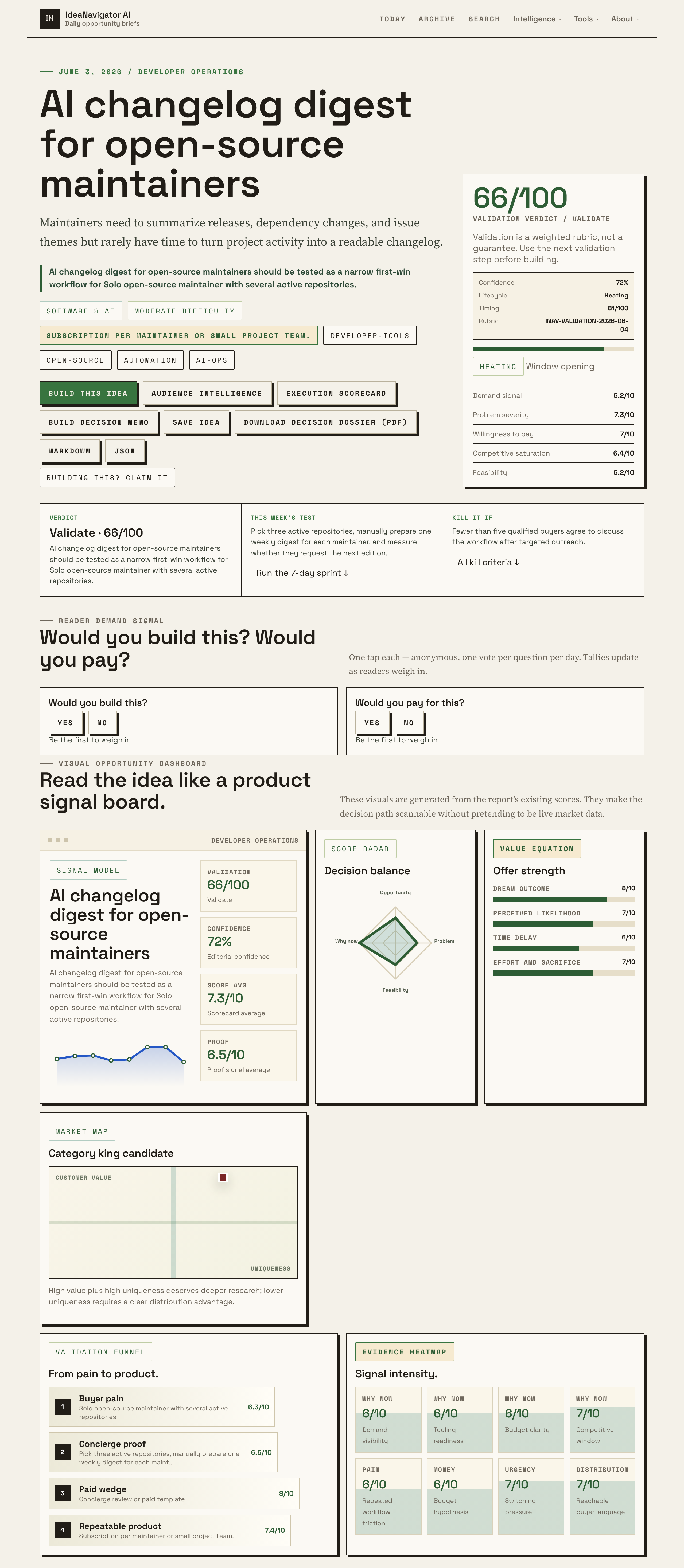
An initiative to develop an AI-driven changelog digest for solo open-source maintainers is entering testing. It aims to automate release summaries and dependency updates, helping maintainers manage multiple repositories more efficiently.
An AI changelog digest for open-source maintainers is currently in the testing phase, targeting solo maintainers managing multiple repositories. The tool aims to automate the summarization of releases, dependency changes, and top issues, reducing manual effort and streamlining project management.
The initiative, led by IdeaNavigator AI, proposes a weekly digest generator that reads repository data such as release feeds, merged pull requests, and prominent issues. The goal is to produce a concise, maintainable changelog email that maintainers can review and approve.
This approach leverages AI summarization technologies and repository metadata to create a narrow, focused report tailored to each project. The MVP (minimum viable product) involves testing with three active repositories, where maintainers will manually review the generated digest and provide feedback.
The project is designed to serve solo open-source maintainers who often lack dedicated developer relations teams but need efficient ways to communicate updates to users and contributors. Revenue is expected to come from subscriptions per maintainer or small project teams.
Potential Impact on Solo Maintainers’ Workflow
This development could significantly reduce the time and effort required for maintainers to produce release notes and track project activity. Automating digest creation helps maintainers stay organized, improves communication with users, and may encourage more active open-source participation. If successful, it could set a new standard for project management tools tailored for small-scale maintainers.
As an affiliate, we earn on qualifying purchases.
Current Trends in Automated Open-Source Project Management
Recent advances in AI summarization and data aggregation have made it feasible to automate routine project updates. Open-source projects often rely on manual effort to compile changelogs, which can be time-consuming, especially for solo maintainers juggling multiple repositories. The idea of an AI-powered digest aligns with broader trends toward automation in developer operations, aiming to streamline workflows and reduce overhead.
Earlier efforts in automated release notes have focused on larger teams or integrated solutions, but this initiative targets individual maintainers, filling a gap in the market for lightweight, automated tools.
“Leveraging AI to automate changelog summaries can free up significant time for solo maintainers, allowing them to focus more on development rather than documentation.”
— an anonymous researcher
Unresolved Questions About the Digest’s Effectiveness
It is not yet clear how accurately the AI will summarize complex release notes or distinguish important issues from minor ones. The success of the MVP depends on maintainers’ feedback, which is still being gathered. Additionally, the scalability of the solution across diverse repositories and programming languages remains to be seen.
Next Steps for Validation and Development
The project will proceed with testing the digest generator on three repositories, collecting feedback from maintainers to refine the AI algorithms. Future plans include expanding the number of repositories, improving summarization accuracy, and exploring subscription-based monetization models. The team expects to release a beta version within the next few months and gather broader user feedback.
Key Questions
How will the AI determine what to include in the digest?
The AI will analyze repository data such as release notes, pull requests, and issues to identify significant updates and themes, focusing on what maintainers and users need to know.
Will maintainers be able to customize the digest content?
Yes, initial plans include options for maintainers to adjust the focus areas, such as prioritizing security updates or dependency changes.
Is this tool suitable for large, complex projects?
The current focus is on solo maintainers managing multiple repositories. Its effectiveness for large, enterprise-scale projects remains to be tested.
How much will the subscription cost?
Pricing details are still being determined, but the model will likely be a small monthly fee per maintainer or team, aimed at affordability for individual developers.
Source: IdeaNavigator AI
Columbus Day / Indigenous Peoples' Day Picks
long weekend sales
As an affiliate, we earn on qualifying purchases.