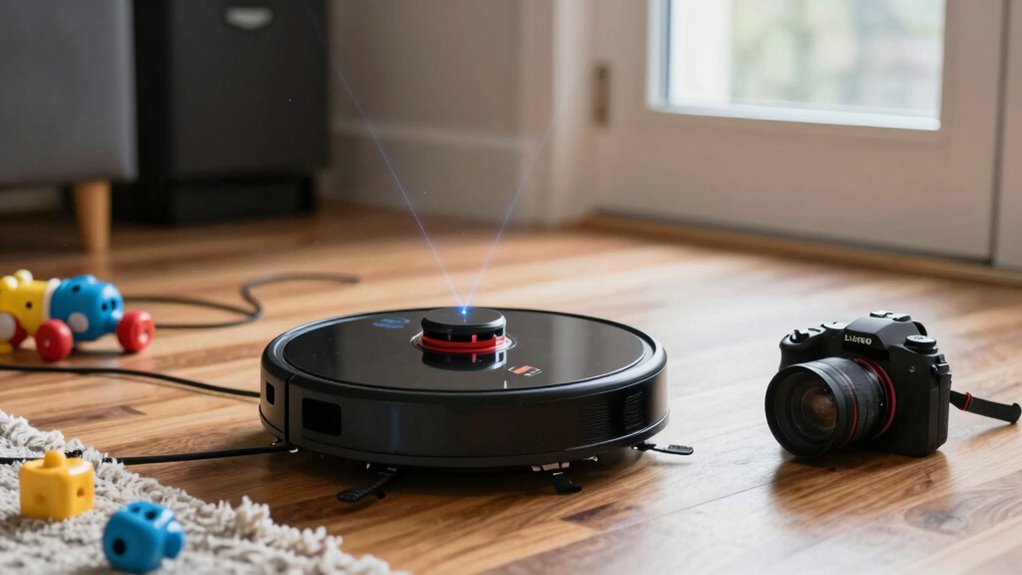

If you’re wondering why some robot vacuums get lost, it’s usually because of their sensors. LiDAR models create detailed, real-time maps that help avoid obstacles and navigate accurately, reducing the chances of getting lost. Camera-only vacuums rely on images, which can be less reliable in poor lighting or cluttered spaces. To understand how sensor types impact navigation and which might suit your home best, keep exploring this topic.

Get the latest gadgets delivered free — and shop member deals
- Fast, free delivery on millions of items
- Access to Prime Big Deal Days deals on October 6–7
- Prime Video, Amazon Music and more included
Key Takeaways
- LiDAR provides precise, real-time 3D mapping, reducing the risk of getting lost, unlike cameras that struggle in poor lighting or cluttered environments.
- Continuous LiDAR scanning updates environmental understanding dynamically, ensuring better navigation and fewer missed spots than camera-only systems.
- Advanced obstacle detection with LiDAR allows smoother navigation around small objects, preventing stuck or lost scenarios.
- Camera-based systems are more prone to errors in low light or complex backgrounds, increasing chances of navigation failures.
- Overall, LiDAR enhances reliability and coverage, making vacuums less likely to get lost during cleaning tasks.
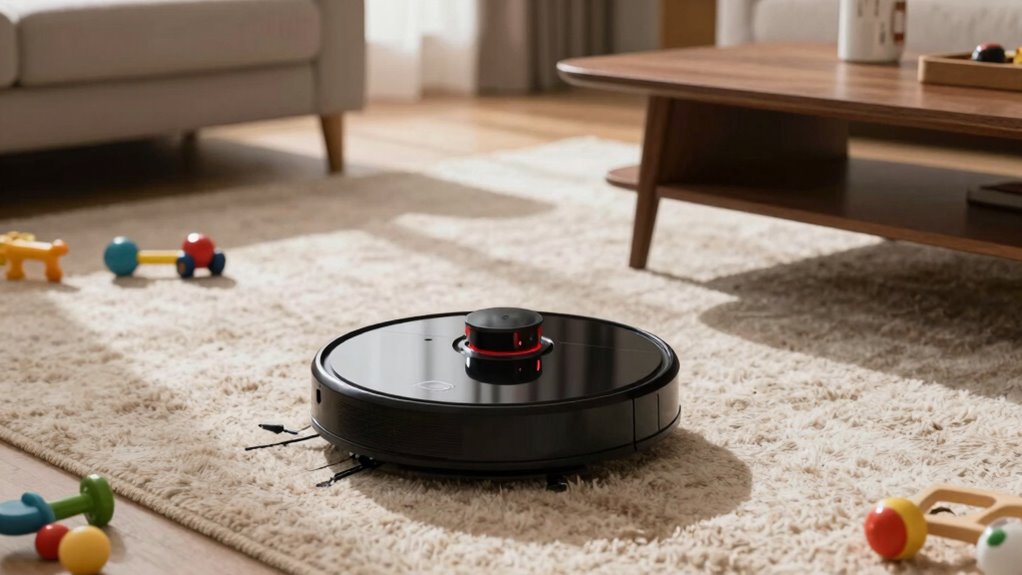
Have you ever wondered how robot vacuums efficiently clean your entire home without getting lost? The secret lies in their navigation systems, which rely heavily on technologies like LiDAR and cameras. These systems determine how well a vacuum can map your space, detect obstacles, and avoid getting stuck or lost. When it comes to mapping accuracy, LiDAR stands out because it uses laser beams to create precise, real-time 3D maps of your environment. This allows the vacuum to understand the layout of your rooms, identify furniture, walls, and other obstacles with high precision. As a result, it can plan efficient cleaning routes, cover all areas methodically, and seamlessly return to its charging dock. Conversely, camera-based systems often struggle with mapping accuracy, especially in low-light conditions or cluttered spaces, where visual cues can be obscured or misinterpreted.
Additionally, LiDAR’s ability to perform real-time environment mapping ensures the vacuum remains aware of its surroundings at all times, further reducing the risk of getting lost. Obstacle detection is another critical factor that influences whether a robot vacuum “gets lost.” LiDAR sensors excel at detecting objects in the vacuum’s path, even small ones like cables or toys, thanks to their distance measurement capabilities. This means they can navigate around obstacles smoothly, reducing the chances of bumping into things or getting stuck. Cameras, however, rely on image recognition, which can be less reliable if lighting changes or if objects blend into the background. Cameras might misjudge the size or position of an obstacle, leading to collisions or missed spots. This can cause a vacuum to become confused about its surroundings, increasing the likelihood of it getting lost or missing areas during cleaning.
The combination of high mapping accuracy and advanced obstacle detection makes LiDAR-powered vacuums generally more reliable. They “know” where they are at all times, updating their maps dynamically as they move. This real-time awareness helps prevent common navigation pitfalls, like revisiting the same spots unnecessarily or missing sections of your home. Meanwhile, camera-based models might need more manual intervention or multiple passes to ensure full coverage, especially in complex layouts. If you want a robot vacuum that navigates confidently and covers your entire home efficiently, models with LiDAR tend to perform better because their sensors provide a clearer, more detailed understanding of the environment. That’s why some models ‘get lost’ more often—if they rely only on cameras or less accurate sensors—highlighting the importance of sensor technology in effective robot vacuum navigation.
As an affiliate, we earn on qualifying purchases.
Frequently Asked Questions
How Do Robot Vacuums Handle Moving Obstacles?
You can trust that robot vacuums handle moving obstacles through obstacle detection and adaptive navigation. They use sensors like LiDAR or cameras to identify objects in real-time, adjusting their paths to avoid collisions. While mapping accuracy might be challenged by fast-moving items, many models quickly reroute, ensuring efficient cleaning. Active obstacle detection helps them stay on course, even when unexpected movements occur, so your floors stay clean with minimal interruption.
Can Lidar and Camera Systems Work Together?
Think of LiDAR and camera systems as a dynamic duo, working hand-in-hand like a well-choreographed dance. Sensor fusion combines their strengths, enhancing navigation accuracy and reducing blind spots. When you use both, your robot vacuum becomes more adept at mapping your home, avoiding obstacles, and not getting lost. This synergy guarantees smoother cleaning, making your life easier and your floors cleaner with less chance of missteps.
What Is the Impact of Lighting on Camera Navigation?
Lighting conditions directly impact camera navigation by affecting visual clarity. Poor lighting, like dim or overly bright environments, can cause your robot vacuum’s camera to struggle with sensing obstacles and mapping accurately. In well-lit spaces, the camera performs better, providing clearer images for navigation. To guarantee ideal performance, keep lighting consistent and avoid extreme brightness or darkness, helping your vacuum navigate smoothly without getting lost.
Are There Privacy Concerns With Camera-Based Navigation?
You should be aware that camera-based navigation can open a can of worms regarding privacy invasion and data security. While it offers better mapping, it also captures images of your home, raising concerns about sensitive information. Manufacturers may store or transmit this data, so always check privacy policies. To keep your privacy safe, choose models with robust security measures and clear data handling practices—better safe than sorry.
How Do Robot Vacuums Recover From Getting ‘Lost’?
When your robot vacuum gets lost due to mapping errors or sensor blind spots, it typically pauses and recalibrates. It may perform a localized scan or return to its charging dock to reset its position. Some models then re-map the area, updating their navigation data to prevent future issues. Regularly clearing obstacles and ensuring sensors are clean can also help prevent it from getting lost again.
Conclusion
In the end, choosing between lidar and camera navigation depends on your home’s layout and your expectations. Just like the compass guided explorers through uncharted waters, advanced sensors help your robot vacuum find its way—so don’t get lost in the details. Remember, even the most modern models can stumble without proper mapping. So, pick wisely and give your smart cleaner the tools it needs to navigate smoothly—lest it end up like the Ark trying to find its way home.
Fall Picks
fall essentials
As an affiliate, we earn on qualifying purchases.