
TL;DR

Get the latest gadgets delivered free with Prime
- Fast, free delivery on millions of items
- Prime Video, Amazon Music and more included
- Member-only deals all year
Mistral’s sovereign AI bet is best treated as a strategy-and-positioning story rather than a simple who is biggest contest. The company is aiming at governments, banks, insurers, and regulated enterprises that care about open weights, self-hosting, European control, and lower vendor lock-in, even if that means it does not beat OpenAI, Anthropic, or Google on every frontier benchmark.
The sharpest question about Mistral is not whether it is smaller than OpenAI. It is whether being smaller has forced a better strategy, or exposed a ceiling.
You can read Mistral’s sovereign AI push two ways. One reading says the Paris company found a rich vein of demand: banks, governments, insurers, and industrial firms that want capable AI without handing the steering wheel to a US platform.[3][4]
The other reading is colder. Maybe Mistral is talking about sovereignty because the frontier-model race has become too expensive to win. This piece helps you decide which reading fits the facts, and why the answer may be both.
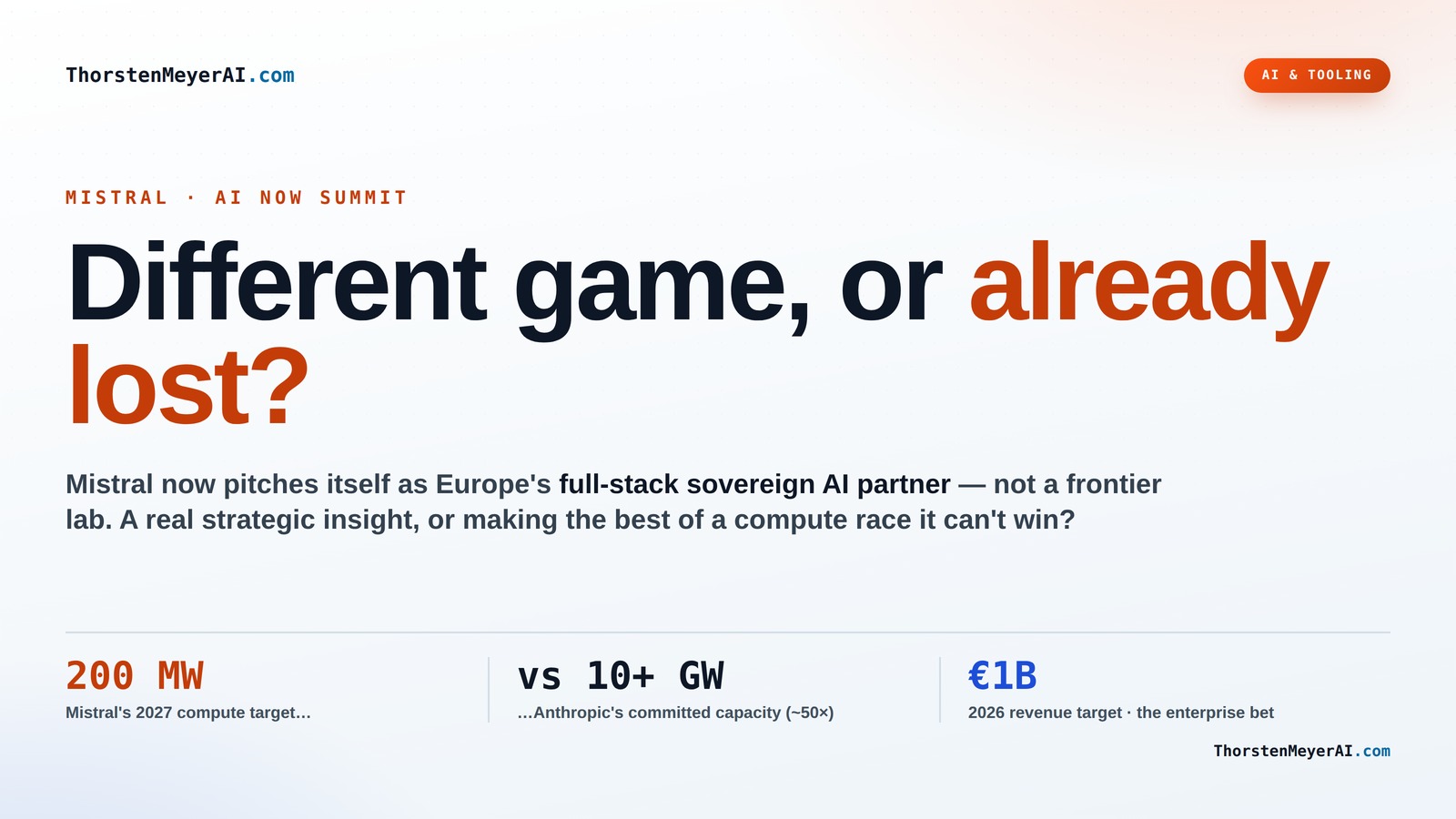
Different game, or already lost?
Mistral now pitches itself as Europe’s full-stack AI provider — compute, models, platform, consultancy — not a frontier-model lab. Is that a real strategic insight, or making the best of a race it can’t win? Both readings fit the same facts.
From model lab to full-stack provider
The clearest signal from the summit wasn’t a model — it was a posture. Heavy on enterprise logos and partnerships (ASML, BNP Paribas, Alexa+), light on new-model announcements. That absence is exactly what skeptics seized on.
Compute
40MW Paris DC + Sweden build · 200MW target by 2027
Models
Open & custom · efficient · you own and run them
Platform
Forge for custom models · Vibe for Work agent
Consultancy
Sales teams, integrators, EU provenance & support
Small & focused, or large & general?
Mistral bets on specialized small models. The claim isn’t that they win a reasoning leaderboard — they don’t. It’s that on the metrics that matter in production agent systems, a purpose-built small model wins. Flip the metric to see the case reverse.
Small specialized vs large general — by what you measure
In token-heavy agentic apps making hundreds of calls, speed/energy/cost compound. Toggle the metric.
Narrow models doing real work
Each is one model doing one thing efficiently — the tangible version of the strategy. Strong on their own terms; the open question is whether the bundle beats a free Chinese open-weight download.
On-prem KYC compliance
Mistral models run inside the bank’s walls for know-your-customer checks. Sensitive financial data never leaves. (BNP was Mistral’s first customer, 2023.)
Voxtral multilingual voice
A focused voice model powering Alexa+ across Europe — speed and efficiency over raw size.
Robostral industrial robotics
Plus a “physics AI” push (via the Emmi acquisition) into aerospace, automotive & semiconductor design and simulation.
Document AI / OCR at scale
Large-scale text extraction — the unglamorous, high-volume enterprise work small models excel at.
The strategy is downstream of the compute gap
Once you see the raw numbers, “why is Mistral behind?” answers itself — and the specialized-small-model strategy starts looking partly like a smart adaptation to a binding constraint, not a pure philosophical choice.
Compute & capital · Mistral vs a frontier leader, this same week
Not a knock — it’s the constraint that forces the efficiency-first, sovereignty-wedge strategy. Adapting intelligently to your position is what good strategy is.
“I want them to win, but I’m worried”
That ambivalence is the most accurate read of where Mistral sits. The enterprise pivot gets read two opposite ways — and both deserve airing.
On-prem, real sales teams, the Koyeb deployment acquisition, EU provenance — exactly what regulated enterprises want, and stickier than consumer mindshare. Targeting €1B revenue in 2026 with 1,000 staff, up from 15 people and one customer in 2023. US closed-API labs structurally can’t match the sovereignty axis.
“Software consultancy with a data center,” not a foundation-model moat. Enterprise B2B is where European startups go when they can’t win consumer or world-scale SaaS. Why pay Mistral on-prem when you could run Qwen free? One paying Le Chat Pro user said the quality gap with frontier labs is now hard to ignore.
Key Takeaways
- Mistral’s sovereign AI bet is strongest for buyers that need control over data, hosting, model versions, and vendor risk.
- Open weights help Mistral build trust, but they also expose it to competition from other downloadable models.
- Small, focused models can win production workflows when latency, cost, and repeated model calls matter more than broad reasoning power.
- The frontier race still matters because sovereignty cannot rescue models that fall too far behind on real tasks.
- The best way to judge Mistral is by production expansion in regulated enterprises, not by headline size alone.
enterprise AI open source platform
As an affiliate, we earn on qualifying purchases.
As an affiliate, we earn on qualifying purchases.
Why This Mistral Debate Feels So Different
Different Game, or Already Lost? Reading Mistral's Sovereign is a question about strategy, not just speed, size, or leaderboard bragging rights. Mistral is asking buyers to value control, open weights, and local deployment, while critics ask whether that framing hides weaker frontier-model momentum.[3][4]
That tension gives the whole debate its crackle. You are not just comparing model scores. You are comparing two ideas of what AI companies are for.
Imagine a French bank reviewing an AI vendor in a glass meeting room at 8:30 a.m. The coffee is hot, the compliance team looks tired, and someone asks where customer data will live. A closed API answer may sound slick, but an on-prem answer can land with a much heavier thud.
The Mistral debate is not really “who is biggest?” It is “who can a cautious buyer trust when the data cannot leave the building?”
That is why this piece about Mistral is best treated as a market-positioning read rather than a sports table. If you only ask whether Mistral can match the largest US labs model for model, you miss the part of the story where procurement, sovereignty, latency, and control shape the sale.

What Mistral Is Really Selling When It Says Sovereign AI
Sovereign AI is AI that a country, company, or institution can run with meaningful control over data, infrastructure, model access, and vendor dependence. For Mistral, the promise is simple: use powerful models while keeping more of the machinery inside your own legal, technical, and political walls.[3][4]
This matters most when the stakes smell like paper files, locked cabinets, and fluorescent-lit compliance reviews. A bank handling know-your-customer checks cannot treat data movement like a casual file upload. A defense contractor cannot shrug and say the API is probably fine.
Mistral’s pitch fits that room. The company is headquartered in Paris and has become tied to Europe’s wider debate over digital sovereignty and dependence on non-EU technology providers.[3][4]
The strongest version of the argument is not “Europe needs a local mascot.” It is sharper than that. Some buyers need AI they can inspect, adapt, host, and govern without waiting for a foreign platform to change its pricing, policy, or product roadmap.
- Control: You can decide where the model runs and who touches the data.
- Deployment flexibility: You can host in your own cloud, private cloud, or on-prem setup.
- Lower lock-in: You reduce the risk of building your workflow around one closed vendor.
- Policy fit: You can align AI adoption with local rules, audits, and procurement standards.
The tradeoff is real. You may give up some convenience compared with a polished closed API platform. You may also need stronger internal engineering muscle. Sovereignty gives you the keys, but you still have to drive the car.

How Open Weights Change the Buyer’s Risk Math
Open-weight models let you download and run model weights instead of sending every request to a vendor-controlled black box. Mistral gained early credibility with releases such as Mistral 7B and Mixtral 8x7B under Apache 2.0 terms, which made fine-tuning and self-hosting practical for serious teams.[3]
That changes the mood inside an enterprise buying process. A closed API can feel like renting a spotless apartment where the landlord keeps the master key. Open weights feel more like buying the workshop, hanging your own tools on the wall, and hearing the clack of your own servers at night.
For a startup, the API route may still win. You can ship fast, skip infrastructure work, and let someone else handle the heat, fans, and GPU bills. For a national health agency or insurer, the calculation bends differently.
| Buyer Concern | Closed API Platform | Mistral-Style Open-Weight Path |
|---|---|---|
| Data control | Data often leaves your direct environment unless special terms apply. | Data can stay inside your chosen infrastructure. |
| Model upgrades | The vendor can change models, pricing, or access rules. | Your team can pin, test, and roll out versions on its own schedule. |
| Customization | Fine-tuning may be available but bounded by platform rules. | Teams can fine-tune and host models with more internal control. |
| Speed to launch | Usually faster for teams without infrastructure depth. | Slower at first, but stronger fit for regulated workflows. |
| Lock-in risk | Higher if your product depends on one vendor’s API behavior. | Lower if your architecture can swap models or host variants. |
The table is not a verdict. It is a map. If your product is a lightweight writing assistant, convenience may beat control; if your workflow touches passports, bank transfers, medical notes, or factory telemetry, control may beat convenience.

Why Regulated Buyers May Pay for Control
Different Game, or Already Lost? Reading Mistral's Sovereign makes the most sense when you look at buyers with strict data rules and high switching costs. Governments, banks, insurers, and regulated enterprises do not buy AI like consumers download a chat app; they buy against audits, procurement rules, legal exposure, and political pressure.[3][4]
Take a bank rolling out an AI tool for compliance analysts. The team wants faster document review, but the files contain names, addresses, suspicious transaction notes, and years of sensitive history. The wrong architecture can turn a productivity win into a risk memo with red ink all over it.
For those buyers, Mistral’s value is not only model accuracy. It is the ability to shape deployment around internal policies. That can mean on-prem hosting, private cloud use, custom model behavior, and tighter control over upgrades.
This is where the “rather than a” framing matters. Mistral is selling an operating model rather than a single magic model. The model still has to be good, but the full package includes trust, support, compliance fit, and a story executives can defend in front of regulators.
- Banks care about customer data, audit trails, and system stability.
- Insurers care about claims records, pricing models, and explainable governance.
- Public agencies care about procurement, national control, and citizen data.
- Industrial firms care about trade secrets, plant data, and operational uptime.
The catch is that these buyers move slowly. A sovereign AI sale can feel less like a product demo and more like a long train pulling out of a station: heavy, noisy, and slow at first. But once it moves, it can carry a lot of weight.

Where the Skeptics Have a Point
The skeptical case against Mistral is that sovereignty may be a strong story but a weak moat if cheaper open models keep improving. If a company wants self-hosting, critics ask why it should pay Mistral instead of running another capable open-weight model, including fast-moving alternatives from outside Europe.[2][4]
That question bites because open weights cut both ways. They helped Mistral build trust and developer love, but they also trained buyers to compare freely available models. Once procurement teams learn that a model can be downloaded, they may ask why the invoice is so high.
The Hacker News-style critique is blunt: if the model is open and the infrastructure is yours, what exactly are you buying?[2] The answer has to be more than a flag, a logo, or a warm feeling about European tech.
Mistral needs to prove that its bundle is worth paying for. That bundle includes model quality, support, tuning tools, enterprise contracts, deployment help, and comfort for buyers who want a European provider in the room.[3][4]
Sovereignty gets Mistral invited to the meeting. Performance, support, and price decide whether it gets the contract.
This works well, except when buyers have strong internal AI teams. A company with excellent engineers, spare GPU capacity, and a high tolerance for model tinkering may prefer the cheapest capable open-weight option. Mistral’s paid story gets stronger when the buyer wants control but does not want to stitch the whole machine together alone.

How Small Models Can Win Big Production Work
Small, specialized models can beat larger general models in production when speed, cost, energy use, and repeated calls matter more than raw reasoning rank. Mistral’s framing is that many enterprise workflows need fast, focused tools that run close to the data, not a giant model answering every question at premium cost.[3][4]
Think of an insurance claims workflow. One model reads a PDF. Another extracts dates. Another checks policy language. Another drafts a response. The screen may look quiet, but behind it you can hear the soft tick-tick-tick of dozens or hundreds of model calls.
In that world, cost per token is not a footnote. Latency is not cosmetic. If each step waits on a huge model, the workflow can feel like pushing a filing cabinet through wet cement.
A smaller model tuned for one job can be the sharper tool. It may not write the best poem or solve the hardest puzzle, but it can classify invoices all day without burning the budget down to ash.
- Pick the repeated task: Find the workflow that happens thousands or millions of times, such as OCR cleanup or customer-message routing.
- Measure the real constraint: Decide whether speed, privacy, cost, accuracy, or auditability hurts most.
- Test a focused model: Compare a smaller tuned model against a large general model on your actual documents.
- Track the full bill: Count hosting, tokens, staff time, retries, and latency.
- Scale only when boring works: Production AI should feel steady, not theatrical.
The qualification matters. Small models do not replace frontier models everywhere. If your task needs broad reasoning, messy context, or complex planning, a larger model may still earn its keep.

Why the Frontier Race Still Matters
Different Game, or Already Lost? Reading Mistral's Sovereign cannot dodge the frontier-model question because model quality still sets the ceiling on many products. Sovereign positioning helps Mistral stand apart, but if its models fall too far behind, control starts to look like a consolation prize.[4]
This is the uncomfortable part. Buyers may want local control, but they do not want clumsy answers, brittle agents, or tools that freeze when the work gets messy. A sovereign model that fails the job is still a failed model.
Frontier labs also create gravity. When OpenAI, Anthropic, or Google releases a stronger model, developers notice. Product teams notice. Executives notice, especially when demos sparkle like chrome under showroom lights.
That does not mean Mistral must win every public benchmark. It does mean the gap cannot become so large that buyers feel they are choosing governance over usefulness. The best sovereign AI pitch says, “You get enough capability, plus control,” not “Please lower your expectations.”
The “you can scale a small model down, but not up” argument captures one real risk. If Mistral cannot build or access very strong base models, its smaller models may have less raw material to inherit. Distillation, tuning, and clever deployment can do a lot, but they cannot conjure missing capability from thin air.

The European Sovereignty Story Gives Mistral Real Tailwind
Europe’s digital sovereignty debate gives Mistral a tailwind because dependence on non-EU digital providers has become a boardroom and policy concern. According to recent commentary, Mistral’s growth is increasingly read through Europe’s desire for AI independence and a stronger local technology base.[3]
You can feel why this lands. A minister does not want to explain that a public service depends entirely on a foreign vendor’s model access. A hospital network does not want patient data tied to a platform it cannot fully inspect. A manufacturer does not want process secrets drifting into someone else’s cloud.
This does not make Mistral the automatic winner. European buyers still care about price, reliability, and performance. Patriotism may open a door, but procurement teams still count euros with cold fingers.
Still, Mistral has a story that US labs cannot copy cleanly. A US company can offer European data centers, stronger contracts, or private deployments. It cannot become a Paris-based European AI champion overnight.
That identity becomes part of the product. Not in a sentimental way, but in the way legal teams and public buyers think about strategic dependence. The vendor’s passport is not the whole answer, but it is no longer background noise.

How to Tell Whether Mistral Is Playing a Better Game
- Watch enterprise retention: A strong sovereign strategy should turn pilots into long contracts, not just glossy announcements.
- Track real deployment depth: Look for self-hosted, regulated, production use cases rather than demo-only partnerships.
- Compare task-level performance: Judge Mistral on the workflows it targets, such as document AI, voice, compliance, and industrial use.
- Measure switching costs: A durable position should make customers better off staying because the system fits their rules and data.
- Check model freshness: The company still needs strong releases, even if it is not chasing every headline benchmark.
The cleanest way to judge Mistral is to watch whether sovereign-conscious customers expand usage after the first contract. If banks, agencies, and industrial firms move from pilots into daily workflows, the strategy has teeth. If the story stays stuck at conference slides, the skeptics gain ground.
A practical example helps. Suppose a public agency starts with a document-search pilot for internal policy files. Six months later, the real signal is whether staff use it every morning, whether IT trusts the hosting setup, and whether legal approves a wider rollout.
The best metric is not social media heat. It is workflow gravity. Does the product become part of the working day, like a badge tap at the office door or the low hum of a server closet?
That is also how you avoid the “who is biggest” trap. A smaller company can build a valuable business if it owns a hard, specific buyer problem. But a niche becomes a trap if it stays narrow because the product cannot compete anywhere else.

What This Means If You Are Choosing an AI Vendor
If you are choosing an AI vendor, start by deciding whether your main risk is model weakness, data exposure, lock-in, or slow deployment. Mistral makes the most sense when control, self-hosting, and European sovereignty matter enough to justify extra architecture and evaluation work.[3][4]
For a small marketing team, a closed API tool may be the easy answer. You want drafts, summaries, and campaign ideas by Friday. You do not want to manage model weights, hosting, or upgrade tests.
For a bank, public agency, insurer, or industrial company, the answer can shift. Your data may be too sensitive, your audit needs too specific, and your vendor-risk review too strict for a simple SaaS choice.
- Choose Mistral-style deployment when you need self-hosting, model control, European alignment, or strict data residency.
- Choose a closed frontier API when speed, ease, and top general capability matter more than infrastructure control.
- Choose a hybrid setup when routine work can run locally, but rare hard tasks need a stronger external model.
The hybrid path may become the most common one. Picture a factory where routine inspection notes run through a local model, while rare engineering questions go to a stronger frontier model under tight controls. Not elegant in a slide deck, perhaps, but very real.
The smart buyer does not ask which vendor is cooler. You ask where the model runs, what happens to the data, how upgrades work, what the exit path looks like, and whether the tool still performs when the work gets ugly.

So, Different Game or Already Lost?
The best answer is that Mistral is playing a different game, but the game only works if its models stay good enough. Its sovereign AI strategy is not empty spin; it matches real demand from customers who care about control, deployment flexibility, and European data independence.[3][4]
But “different game” should not become a shield against hard questions. Mistral still has to prove that buyers will pay for its models and platform when free or cheaper open-weight options keep getting better. It also has to keep the quality gap from widening too much.
The framing is that Mistral is not trying to be a smaller copy of OpenAI. It is trying to become the trusted AI layer for organizations that want capability without full dependence on closed US platforms.[4]
That can be a durable business. It can also become a polite way of describing lost ground. The difference will show up in production usage, renewal rates, model releases, and whether customers treat sovereignty as a buying requirement or a nice line in a press release.
For now, the honest read is neither victory lap nor obituary. Mistral has found a sharper question than “Can we be the biggest?” The sharper question is whether enough powerful buyers would rather own the machine than rent the magic.
Frequently Asked Questions
What does sovereign AI mean in Mistral’s case?
Sovereign AI means AI that a company or country can run with more control over data, hosting, model access, and vendor dependence. For Mistral, it means offering open-weight and flexible deployment options that appeal to European governments and regulated enterprises.[3][4]
Is Mistral trying to compete directly with OpenAI and Anthropic?
Mistral competes with US frontier labs in some areas, but its clearest strategy is different. It is aiming at customers that care about control, self-hosting, compliance, and European sovereignty rather than only the strongest general-purpose model.[4]
Why would a company pay Mistral instead of using a free open model?
A company may pay Mistral for support, tuning, enterprise contracts, deployment help, European provenance, and a model stack shaped for regulated use. The hard question is whether that bundle stays valuable as other open-weight models improve.[2][3]
Are open-weight models always better for enterprise AI?
No. Open-weight models are better when control, auditability, customization, or self-hosting matter. Closed APIs can still be better when a team wants fast launch, low infrastructure work, and access to the strongest general models.
What should readers watch next in Mistral’s strategy?
Watch for production deployments, renewals, stronger model releases, and customer expansion in banks, governments, insurers, and industrial firms. Those signals will say more than conference buzz or simple size comparisons.
Conclusion
Remember this: Mistral does not need to beat every frontier lab at its own game to matter, but it does need to make sovereignty feel like a working advantage rather than a softer story for slower growth.
Watch where the models run, who controls the data, and whether cautious buyers keep expanding after the first pilot. That is where the real signal will be, humming behind the locked door of the server room.

Halloween Picks
halloween
As an affiliate, we earn on qualifying purchases.