
📊 Full opportunity report: Check Pharmacy And Direct-Channel GLP-1 Prices In The US on IdeaNavigator AI — validation score, market gap, and execution plan.

Get the latest gadgets delivered free — and shop member deals
- Fast, free delivery on millions of items
- Access to Prime Big Deal Days deals on October 6–7
- Prime Video, Amazon Music and more included
TL;DR

US patients may encounter cash prices from roughly $199 to more than $1,000 a month for brand-name GLP-1 drugs, depending on the medicine and purchasing channel. A proposed pharmacy index would compare dose availability and prices by ZIP code, but the idea has not been shown to be operating or independently validated.
IdeaNavigator AI has proposed a US pharmacy index that would help patients compare cash prices and dose availability for four brand-name GLP-1 drugs by ZIP code. The proposal responds to a market in which prices can range from about $199 to more than $1,000 a month across direct manufacturer programs, retailers and pharmacies, while local availability may still vary by dose.
The proposed index would cover Ozempic, Wegovy, Zepbound and Mounjaro. A free consumer website would let people search by drug, dose and ZIP code for reported stock and the lowest listed cash price. The proposal says the service could combine crowdsourced reports with public pricing information from manufacturer direct channels such as LillyDirect and NovoCare, retailer programs including Costco and Walmart, and a discount-price comparison layer.
The idea also includes dose-level availability alerts and a paid data product for business customers. Telehealth prescribers, employer benefits teams, pharmacy benefit managers and brokers could license an availability and price feed or dashboard. The proposal does not name committed buyers, pharmacies supplying live inventory data or a company operating the index.
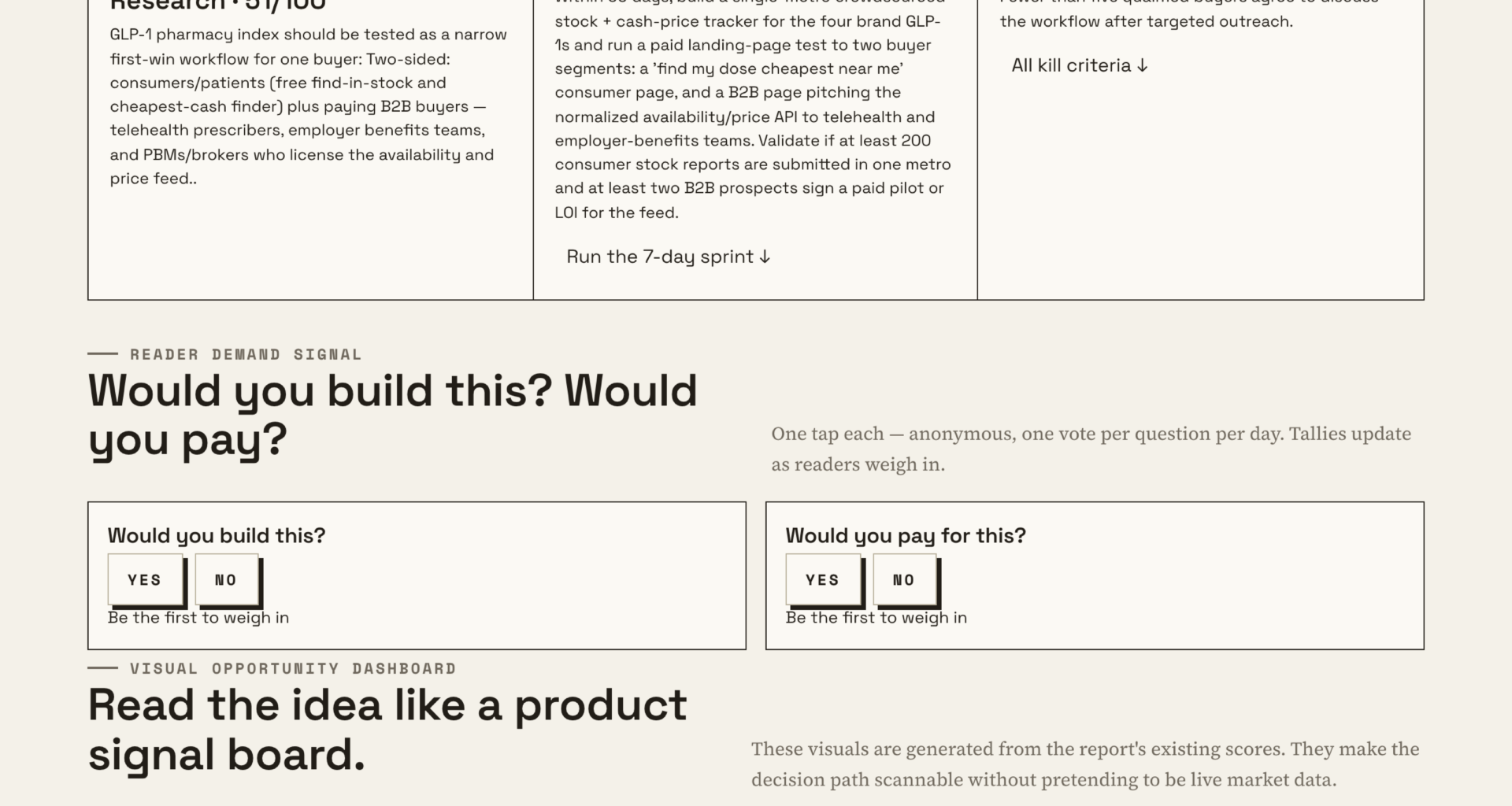
For an initial test, IdeaNavigator AI proposes covering one metropolitan area and running separate landing pages for consumers and business buyers. Its stated benchmarks are 200 consumer stock reports and at least two business prospects signing a paid pilot or letter of intent within 60 days. These are suggested validation targets, not results already achieved.
Comparing Prices Across Purchase Channels
For patients paying out of pocket, the gap between a lower advertised cash price and a higher pharmacy price can affect whether a prescribed medicine is affordable. A tool that compares the same drug and dose across nearby options could help people identify alternatives when one location is out of stock, while making the price and location easier to check before contacting a pharmacy.
The proposal also targets buyers managing prescription costs for groups. It cites employer concern about GLP-1 spending and argues that normalized price and availability information could help benefits teams and intermediaries understand where supply gaps and price differences occur. That potential benefit depends on having accurate, timely data and clear rules for how listed prices apply. The proposal provides no independent evidence that a new index would lower costs or improve access.
From Shortage Lists to Local Gaps
The proposal describes a change in the access problem: after federal shortage listings for tirzepatide and semaglutide were resolved in December 2024 and February 2025, respectively, patients could still face local shortages of particular doses. A national shortage determination does not tell a patient whether a nearby pharmacy has a specific dose on a given day.
At the same time, patients may be comparing manufacturer direct-purchase programs, retailer cash options and conventional pharmacies. The proposal says these channels offer prices that vary substantially, but it does not provide a dated, drug-by-drug price table or a common set of purchase conditions. It also points to the TrumpRx portal, which it says launched in February 2026, as another part of an expanding purchasing landscape.
The proposed index would need to distinguish prices by product, dose and eligibility. A displayed price may depend on the channel, payment terms or other conditions; the proposal does not specify how the service would verify those details or refresh them.
Inventory Accuracy and Price Terms
No operating service, pharmacy agreements or live data feed are identified in the proposal. It is unclear how often availability would be checked, how crowdsourced reports would be verified, or how the index would handle a dose that sells out after a report is submitted.
The stated price range is approximate, and the proposal does not give the date, eligibility rules or full terms behind individual prices. It is also unclear how a comparison would account for insurance, coupons, membership requirements, shipping or other costs. The proposed business model—including subscriptions and possible referral fees—has not been reported as tested, and no paid pilot or letter of intent is documented.
Proposed 60-Day Market Test
The next step described by IdeaNavigator AI is a single-metro test lasting 60 days, combining consumer stock reports with public cash-price listings and testing interest from consumers and business buyers. The proposal sets targets of 200 reports and two paid pilots or letters of intent, but it gives no start date or selected metro.
Whether the idea advances will depend on whether patients submit enough current reports and whether business buyers will pay for the resulting data. No launch, partnership or test outcome has yet been reported.
Source: IdeaNavigator AI
Key Questions
Is the GLP-1 pharmacy index available now?
The material describes a proposal and a suggested test. It does not report that the index has launched.
Which medicines would it cover?
The proposed first version would list Ozempic, Wegovy, Zepbound and Mounjaro, searchable by dose and ZIP code.
How much do the listed medicines cost?
The proposal gives an approximate range of $199 to more than $1,000 per month across channels. It does not provide dated prices for each medicine or explain all eligibility and purchase terms.
How would the service check stock?
The suggested approach combines crowdsourced stock reports with public price information. The proposal does not explain how reports would be verified or how frequently inventory would be updated.
Source: IdeaNavigator AI
Evergreen bestsellers Picks
bestsellers
As an affiliate, we earn on qualifying purchases.