📊 Full opportunity report: Spatial Focus Room: Make Distraction Impossible on ThorstenMeyerAI.com — validation score, market gap, and execution plan.

Get the latest gadgets delivered free with Prime
- Fast, free delivery on millions of items
- Prime Video, Amazon Music and more included
- Member-only deals all year
TL;DR
Spatial Focus Room is a deep-work app designed for Apple Vision Pro that creates immersive environments to eliminate distractions. It replaces traditional timers with environments that physically remove interruptions, aiming to improve focus and productivity.
Spatial Focus Room, a new deep-work application for Apple Vision Pro, offers a distraction-free environment by immersing users in virtual spaces that remove external interruptions. This development shifts focus from digital timers to environmental design, aiming to improve concentration and productivity.
The app creates three distinct immersive environments—CalmBeach, Rainforest, and DeepSpace—that users can select based on their preference or task. These environments are generated procedurally, ensuring consistency and affordability. Users can choose between fully immersive settings, where the real world is completely replaced, or passthrough modes that overlay calming visuals and audio on their actual workspace. The app logs every session, tracking focus time, streaks, and specific tasks, fostering habits of sustained deep work. Before each session, users can attach specific goals, making the experience goal-oriented and accountable. The core innovation is the physical removal of distractions, rather than resisting them within a digital interface, which is believed to be more effective for maintaining focus.Make Distraction Impossible
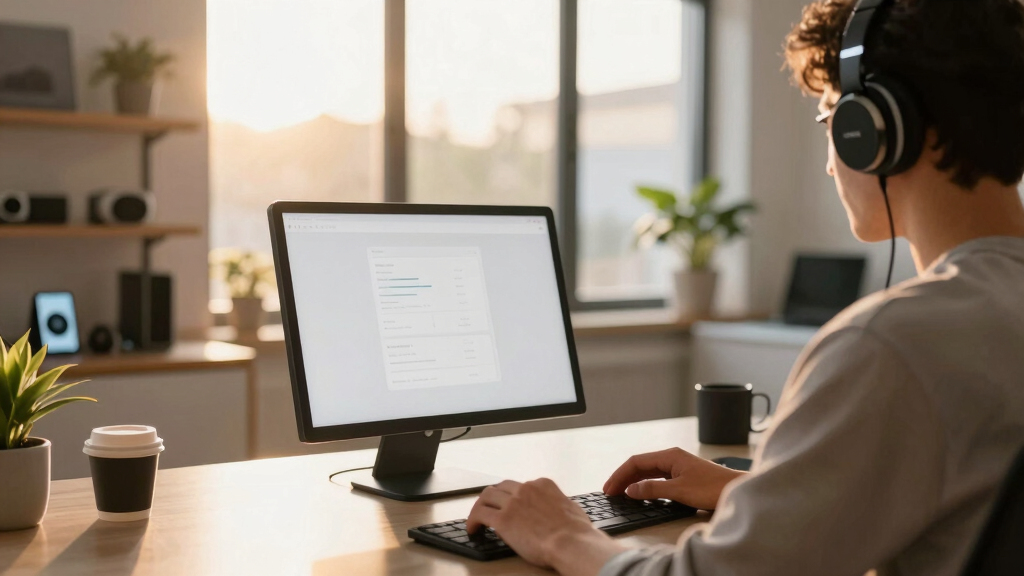
We protect deep work with a timer that lives on the same glowing rectangle holding every feed and notification engineered to pull us out. Spatial Focus Room’s premise: the most reliable way to remove a distraction is to make it physically unavailable — and a headset is the first device that can.
A phone can tell you that you got distracted. A headset can make distraction impossible.
Each is a seamless 360° skybox + a 60-second ambient loop that masks your real room and becomes a cue: “focus starts now.” None of it is licensed stock — every skybox and soundscape is generated procedurally, so the catalog is cheap to expand.
Intent, attached to every session: name one concrete task and it floats in view inside the immersive space. Twenty-five minutes against one named thing — checked off and logged when the session ends. A calm environment becomes accountable deep work.
and becomes a place you go.
Independent commentary, produced with AI assistance under human editorial oversight. The views are the author’s own and may change. This describes a product’s design, features, and business rationale — not business, financial, legal, technical, or medical advice; cost and retention figures are the product’s own framing, not independently verified. Spatial Focus Room is a forthcoming app for Apple Vision Pro (visionOS 26); described features, pricing, and availability are stated by the product and may change. Names are trademarks of their respective owners; mention does not imply endorsement.
Potential Impact on Deep Work Practices
This development could significantly change how individuals approach concentration by shifting the environment from a source of distraction to a dedicated space for focus. It offers a new model where distractions are physically inaccessible, potentially increasing productivity and reducing reliance on willpower. If widely adopted, it may influence workplace habits and the design of focus tools, emphasizing environmental control over digital management alone.
Apple Vision Pro virtual reality headset
As an affiliate, we earn on qualifying purchases.
As an affiliate, we earn on qualifying purchases.
Limitations of Current Focus Tools and the Environmental Shift
Traditional focus tools, such as timers and app blockers, rely on users resisting distractions within their existing environment, which is often ineffective due to constant digital interruptions. The idea behind Spatial Focus Room builds on the understanding that environment design can be more reliable than willpower. Previous attempts to improve focus have largely focused on digital management, but this app introduces a physical dimension, leveraging the capabilities of Apple Vision Pro to create distraction-free zones. The concept aligns with ongoing research emphasizing environmental control as a key factor in sustained concentration.
“By physically removing distractions, we shift the focus from resisting interruptions to creating environments where deep work is the default.”
— Thorsten Meyer, developer
Uncertainties About Effectiveness and Adoption
It is still unclear how effective these immersive environments are in improving long-term focus and productivity compared to traditional methods. User acceptance, hardware costs, and practicality for everyday use remain unconfirmed. Additionally, empirical data validating the approach’s superiority over existing tools has yet to be published.
Next Steps for Validation and Adoption
Further user testing and research will determine the app’s effectiveness in diverse work settings. The company plans to gather feedback during beta testing phases and may expand the environment options or integrate with other productivity tools. Monitoring adoption rates and measuring productivity gains will be critical in assessing its future impact.
Key Questions
How does Spatial Focus Room differ from traditional focus timers?
It replaces digital timers with immersive environments that physically remove distractions, creating a distraction-free zone rather than just signaling when to focus.
Can users still see their real workspace while using the app?
Yes, in passthrough mode, users can keep their real desk visible with calming visuals and audio layered over it, maintaining access to physical tools.
Is this app compatible with other VR headsets?
Currently, it is designed specifically for Apple Vision Pro, leveraging its spatial computing capabilities. Compatibility with other devices has not been announced.
What are the environmental options available in the app?
Users can choose among CalmBeach, Rainforest, and DeepSpace, each providing a unique visual and auditory setting optimized for focus.
Will this approach be effective for all types of work?
Effectiveness may vary depending on the task and individual preferences. More data is needed to confirm its benefits across different work scenarios.
Source: ThorstenMeyerAI.com
Halloween Picks
halloween
As an affiliate, we earn on qualifying purchases.