
TL;DR
IdeaClyst is a local-first, open-source platform that acts as a war room for your ideas. It combines AI council debates, discovery engines, and a founder workspace to speed up validation and decision-making without leaving your laptop. This approach minimizes costly mistakes and boosts your confidence in every step, much like the strategic planning found in war rooms for ideas.
Imagine having a war room — a high-energy, focused space — where your most promising ideas get challenged, refined, and finally, armed for action. That’s what IdeaClyst offers, a tool that transforms chaotic brainstorming into strategic, evidence-backed decisions.
This isn’t just about jotting down notes or mind-mapping. It’s about creating a dedicated space where debate and data collide to sharpen your vision. If you’ve ever felt stuck on whether to move forward or pull back, you’ll see how this platform can change the game — fast, private, and grounded in real research.
A war room for your next idea
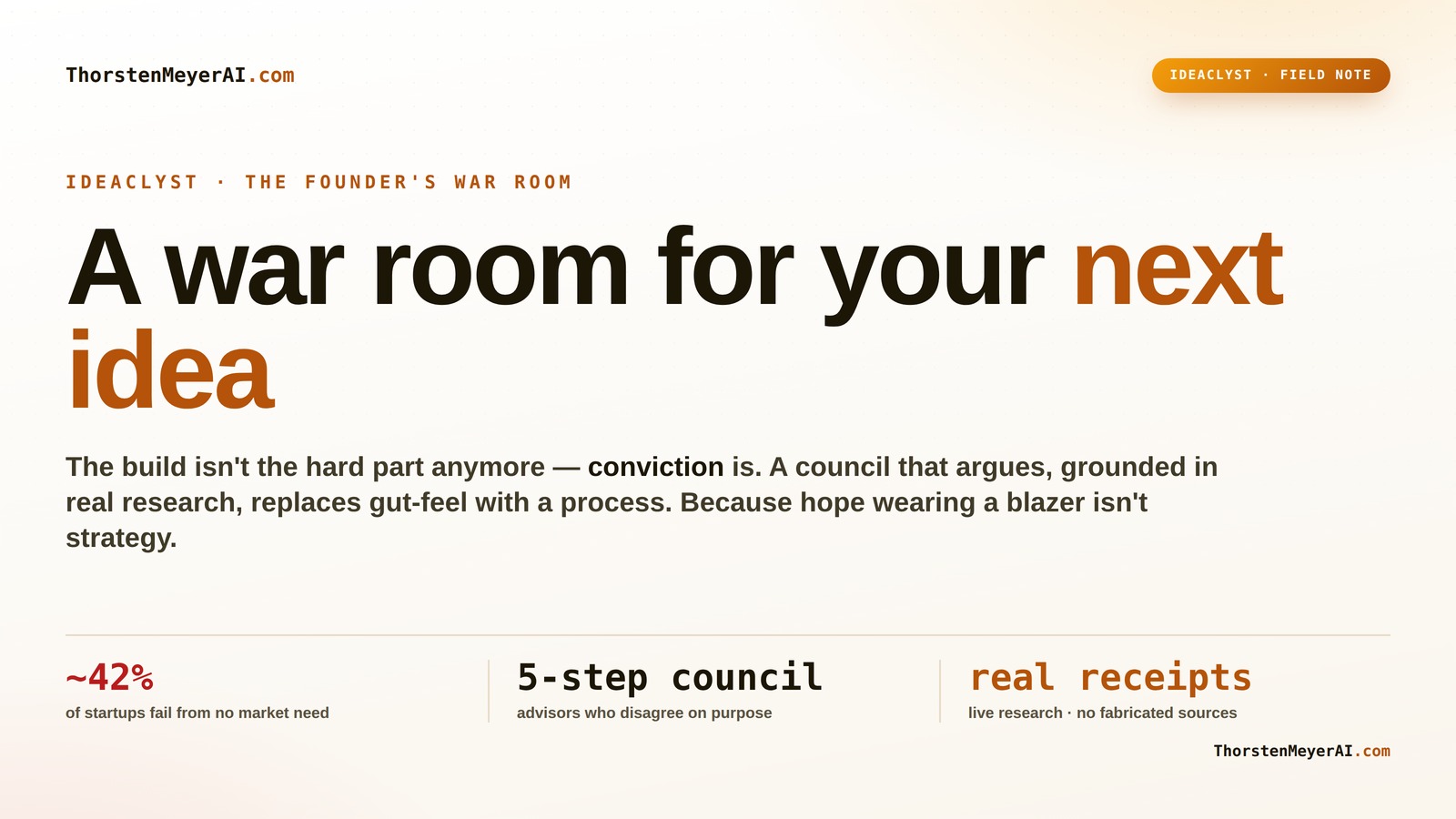
The build isn’t the hard part anymore — conviction is. Knowing which idea deserves the next six months, and being able to defend it. Most founders answer with gut feel and optimistic math. That’s hope wearing a blazer. IdeaClyst replaces it with a process.
The most expensive decision is what to build
The single most valuable thing a tool can do is talk you out of the wrong six months. The numbers make the case better than any pitch.
Three tools in one — on your own machine
Strip away the framing and IdeaClyst is three things at once, all running locally with nothing leaving your laptop.
An AI council
Pressure-tests an idea you bring it — advisors who argue on purpose.
A discovery engine
Finds ideas you didn’t know to look for by hunting real demand signals.
A founder’s workspace
Carries winners from “interesting” all the way to “ready to build.”
Advisors who disagree on purpose
Not one confident, agreeable answer — a structured five-step deliberation where models play different roles and turn on their own work. The disagreement is the feature.
The five-step deliberation
A council that leads with the bad news surfaces the objections you’d otherwise find the expensive way, on month five.
Product strategy
Who’s it for, what’s the wedge, why now, what’s the business model.
Technical architecture
What would it actually take to build — and where’s the risk.
Critique pass
The council turns on its own work. Where’s the hand-waving? What kills this?
Second, independent critique
A different voice, a different angle — so blind spots don’t survive.
Final synthesis
Everything into one coherent founder packet: strategy, architecture, validation, plan.
When IdeaClyst cites a source, it actually fetched it
The hard departure from “ask an AI what it thinks of my startup.” It runs in a strict, real-data-only mode — if it can’t gather genuine evidence, it says so plainly rather than inventing a plausible paragraph.
Confidence with receipts
No fabricated statistics, no imaginary competitors, no made-up citations. The packet survives a skeptical co-founder or a sharp investor because the reasoning has receipts.
Market research first
Scouts the landscape before the council reasons about anything.
Competitor read
Real positioning, pricing signals, feature claims — differentiation vs. reality.
Validation with links
Not “talk to customers” — concrete signals & sources you can click.
From the blank page to build-ready
Evaluation is half the problem; the blank page is the other half. And a plan is worthless if it dies in a tab you never reopen.
Bring a space, not an idea
“AI for accountants,” “tools for indie game studios” — plus your goal and real capacity. It hunts demand signals across HN, Reddit, Product Hunt, GitHub, pricing pages.
- An honest market read — leads with the bad news when a space is hard
- An opportunity map — high pain, thin competition
- Ranked candidates — wedge, who pays, effort, risk, confidence
- each with KILL CRITERIA — when to walk away
A home and a forward path
Every promising idea gets carried forward, with every artifact in plain files on your disk.
- Validation tooling — sprint board, interview list, evidence browser
- Founder profile — a personal-fit lens; same discovery, different advice
- Build workspaces — funnel, personas, landing draft, version history
- “Build this idea” → a PRD + task queue, ready for a coding agent
Key Takeaways
- IdeaClyst acts as a local, debate-driven war room where your ideas are challenged and validated in real time.
- Its structured five-step process surfaces objections early, saving time and money by avoiding false starts.
- Grounded in live web research, it provides evidence-backed insights, reducing reliance on assumptions.
- Designed for entrepreneurs, nonprofits, and teams, it turns fuzzy ideas into actionable plans fast.
- All data stays on your machine — your ideas remain private and under your control.
portable whiteboard for brainstorming
As an affiliate, we earn on qualifying purchases.
As an affiliate, we earn on qualifying purchases.
Why a War Room Matters for Your Next Big Idea
Think of a war room as the front line where strategy and clarity meet. It’s a place to test ideas against tough questions and real-world data. For founders, that means fewer costly mistakes — like building a product no one wants or launching into a saturated market.
Having a dedicated, high-energy decision space is crucial because it centralizes diverse perspectives, accelerates critical thinking, and reduces the paralysis often caused by endless debate or uncertainty, similar to the collaborative environment described in idea war rooms. When decisions are made in a charged environment that encourages rigorous challenge, it becomes easier to identify flaws early and pivot before significant resources are invested. The tradeoff, however, is the need for discipline — ensuring the debate remains focused and constructive rather than spiraling into analysis paralysis. This environment fosters a mindset of continuous testing and learning, which is essential in fast-paced startup contexts.
How IdeaClyst Turns Your Idea into a Debate-Driven Strategy
IdeaClyst functions like a mini courtroom for your ideas, but its true power lies in the structured debate it facilitates among AI ‘advisors.’ Each AI model adopts a specific role—such as a product strategist, technical critic, or market analyst—and their debates mirror the rigorous scrutiny a seasoned team might provide. This process pushes you to confront assumptions, uncover blind spots, and refine your idea with evidence-backed insights.
The five-step process—strategy, architecture, critique, second critique, and final synthesis—serves as a disciplined framework that ensures comprehensive evaluation, akin to the structured approaches discussed in AI-driven decision frameworks. It’s like having a panel of experts challenging your ideas in real-time, forcing you to justify your choices and adapt based on the feedback. The tradeoff is that this structured approach might seem intensive initially, but it ultimately leads to more robust, less risky plans. By automating this debate, IdeaClyst reduces the cognitive load on founders and speeds up the validation cycle, empowering faster iteration and learning.
Why Grounding Ideas in Live Web Research Changes Everything
Many AI tools rely on static data or pre-existing knowledge bases, which can quickly become outdated or irrelevant—particularly in fast-moving markets or emerging sectors. IdeaClyst’s integration of live web research is a game-changer because it ensures that every claim, assumption, or market insight is supported by the most current information available. This real-time grounding reduces the risk of making decisions based on obsolete or inaccurate data, which is a common pitfall in startup validation.
By continuously pulling fresh data from news, industry reports, social chatter, and other sources, IdeaClyst helps you identify trends, competitive shifts, and customer needs as they evolve. This dynamic approach enhances your ability to pivot quickly, avoid costly missteps, and capitalize on emerging opportunities. The tradeoff is that real-time data can sometimes be noisy or overwhelming—so the platform’s role in filtering and contextualizing this information is vital. Ultimately, this live research foundation makes your validation process more reliable, faster, and more aligned with current market realities.
Who Should Use IdeaClyst — and Why It’s a Game-Changer
Entrepreneurs, nonprofit leaders, community builders, and innovative teams all benefit from a dedicated war room because it provides a space for rapid, honest feedback rooted in evidence. For early-stage projects where resources are limited, this environment accelerates decision-making, reduces guesswork, and fosters a culture of testing and learning. The ability to debate ideas with structured, real-time data reduces the temptation to rely solely on intuition or assumptions, which can be costly.
For example, a nonprofit developing a new outreach platform can use IdeaClyst to evaluate its assumptions about target audiences, distribution channels, and impact strategies—all backed by web data. This process not only saves months of trial and error but also aligns the team around a shared, validated plan. The tradeoff is that early-stage teams must be willing to embrace constructive critique and iterative refinement, which can feel uncomfortable but ultimately leads to stronger, more feasible projects. The platform’s privacy and local-first design ensure that sensitive ideas remain protected during this process.
What Makes IdeaClyst Different from Other Brainstorming Tools
Most note-taking or brainstorming apps are passive repositories—they store ideas without challenging or testing them, unlike platforms that actively debate and validate ideas, similar to the concept of a war room for ideas. IdeaClyst elevates this process by actively engaging ideas in a debate, forcing them to withstand scrutiny from AI advisors that simulate diverse perspectives. This approach transforms brainstorming from a passive activity into an active testing environment where ideas are challenged, defended, and refined in a disciplined manner.
The comparison table highlights these differences, but the real implication is that IdeaClyst encourages a culture of rigorous validation. It pushes users to think critically about their assumptions, and the structured debate helps surface hidden flaws early. The local-first and open-source design means users retain full control over their data, avoiding vendor lock-in or privacy concerns associated with cloud-based tools. This disciplined, evidence-backed process ultimately leads to more resilient and actionable plans, reducing the likelihood of costly failures down the line.
Real Results: How Ideas Turn Into Actual Projects
Many users report that IdeaClyst accelerates their decision cycle from months to weeks by providing a clear, evidence-backed validation process. For instance, one startup used it to test a new subscription model, uncovering potential pitfalls early and saving over $20,000 in missteps. Similarly, a nonprofit refined its outreach strategy through structured debate, identifying critical gaps before launch, which boosted engagement by 30% in the first month. These examples demonstrate how the platform’s combination of real-time research and rigorous evaluation leads to tangible, faster results.
The implications are profound: by making ideas more testable and evidence-based, teams can reduce uncertainty, avoid costly mistakes, and move confidently toward execution. The tradeoff is that effective use of the platform requires a willingness to engage in honest critique and iteration—skills that can be developed over time. As more users adopt this disciplined approach, the overall success rate for early-stage projects is likely to improve significantly.
Check out [IdeaClyst](https://ideaclyst.com) for more success stories and case studies.
How to Get Started — Your First War Room Session
Getting started is simple. Here’s a quick step-by-step:
- Write down your core idea in a sentence or two.
- Open IdeaClyst and upload your idea — it’s private, local, and open source.
- Let the AI council debate your idea across the five steps.
- Review the structured feedback, objections, and recommendations.
- Use the final Markdown report to plan your next move.
It takes less than 30 minutes to go from rough idea to a validated, debate-tested strategy.
Tip: Bring your team into the discussion by sharing the Markdown file or version control system, so everyone’s aligned.
Frequently Asked Questions
What exactly is IdeaClyst?
IdeaClyst is an open-source, local-first platform that acts as a debate-driven war room for your ideas. It combines AI council discussions, real-time web research, and a structured process to help you validate and refine concepts quickly and privately.How does IdeaClyst work in practice?
You input a rough idea, and it runs a structured five-step debate among AI models — covering strategy, technical risks, critique, and synthesis. It grounds all discussions in live web data, then produces a Markdown report you can use immediately.Who should use IdeaClyst?
Entrepreneurs, nonprofit leaders, community organizers, and anyone working on early-stage projects. It’s especially valuable when resources are tight and quick, evidence-backed decisions matter most.Is IdeaClyst a software tool or a methodology?
It’s a software platform that embodies a methodology — structured debate, grounded research, and local control. It’s designed to be an active war room for turning ideas into action, not just notes or mind maps.Is it free or paid?
IdeaClyst is open source under the MIT license, so you can run it locally on your machine for free. There’s no cloud account or subscription needed, keeping your ideas private and in your control.Conclusion
Imagine transforming your next big idea from a vague hunch into a battle-tested plan — all in less than half an hour. That’s the power of IdeaClyst, turning chaos into clarity and hope into strategy.
If you’re tired of guesswork and want a real edge, try setting up your first war room today. Your ideas — and your future — will thank you for it.