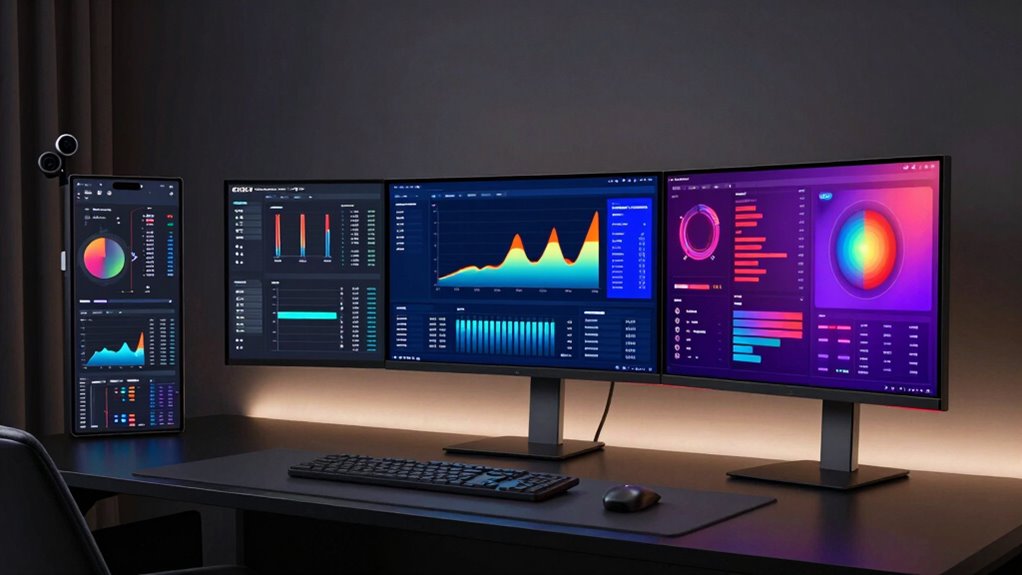

If you’re looking for the best OLED monitors for productivity in 2026, I recommend the INNOCN 13.3″ OLED Portable Monitor for its sharp clarity and portability. The InnoView 14″ OLED 4K Portable Monitor offers stunning color accuracy with vibrant visuals, perfect for detailed work. The UPERFECT 16″ 3K OLED Portable Gaming Monitor combines speed and vividness, ideal for multitasking. Keep in mind these options excel in resolution, color, and response time—stay tuned to learn more about each!
Key Takeaways
- Look for OLED monitors with high resolution (4K or higher) for sharp, detailed visuals essential for productivity tasks.
- Prioritize models with excellent color accuracy (ΔE below 2) and wide color gamuts like DCI-P3 for precise work.
- Ensure compatibility with your device’s ports (USB-C, HDMI) and support for high refresh rates for smooth performance.
- Choose compact, lightweight OLED screens (under 2 pounds) for portability and ergonomic flexibility.
- Consider monitors with high brightness (400+ nits), deep contrast ratios, and fast response times (1ms or less) for optimal clarity.
| INNOCN 13.3″ OLED Portable Monitor with USB-C | 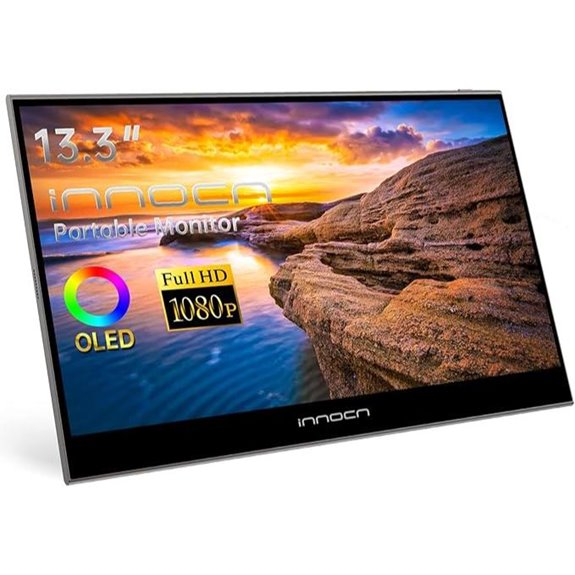 | Best Portable Display | Screen Size: 13.3 inches | Resolution: 1080P (Full HD) | Contrast Ratio: 100,000:1 | VIEW LATEST PRICE | See Our Full Breakdown |
| InnoView 14″ OLED 4K Portable Monitor with Speakers | 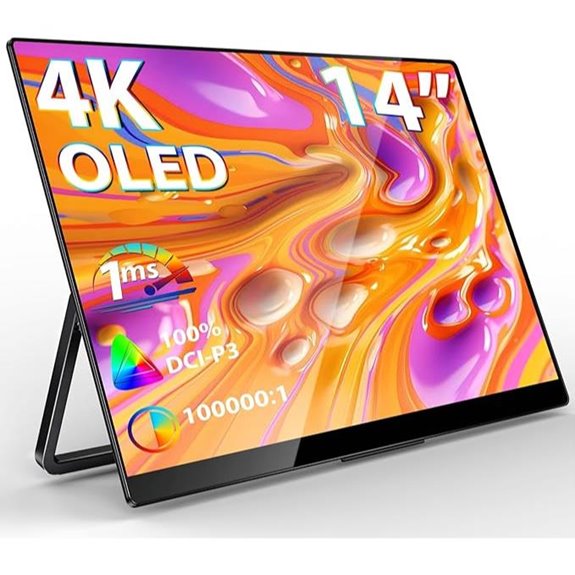 | Best 4K Visuals | Screen Size: 14 inches | Resolution: 4K UHD (3840×2400) | Contrast Ratio: 100,000:1 | VIEW LATEST PRICE | See Our Full Breakdown |
| UPERFECT 16″ 3K OLED Portable Gaming Monitor | 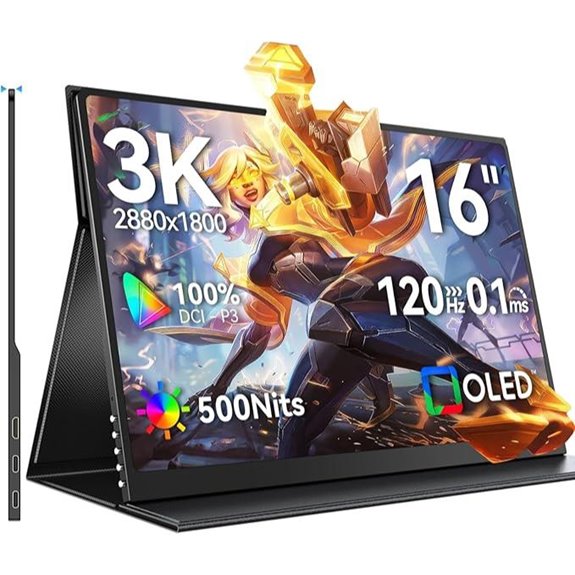 | Best Gaming OLED | Screen Size: 16 inches | Resolution: 3K (2880×1800) | Contrast Ratio: 100,000:1 | VIEW LATEST PRICE | See Our Full Breakdown |
More Details on Our Top Picks
INNOCN 13.3″ OLED Portable Monitor with USB-C
If you’re a mobile professional or digital creator who needs high-quality visuals on the go, the INNOCN 13.3″ OLED Portable Monitor is an excellent choice. Its 1080P Full HD resolution combined with self-lit OLED IPS technology delivers bright, vivid, and immersive images. With 100% DCI-P3 color coverage, a 100,000:1 contrast ratio, and 400 nits brightness, it shows true-to-life colors and sharp details. The monitor supports USB-C and Mini HDMI, making it compatible with laptops, tablets, gaming consoles, and more. Its ultra-slim, lightweight design makes it perfect for travel, and plug-and-play setup guarantees quick, seamless connection wherever you are.
- Screen Size:13.3 inches
- Resolution:1080P (Full HD)
- Contrast Ratio:100,000:1
- Connectivity Options:USB-C, Mini HDMI
- Portability:Ultra-slim, 0.28 inches, 1.39 lbs
- Intended Use:Productivity, media, creative work
- Additional Feature:Ultra-slim 0.28-inch profile
- Additional Feature:100% DCI-P3 color gamut
- Additional Feature:Supports gaming consoles (Switch, Xbox, PS)
InnoView 14″ OLED 4K Portable Monitor with Speakers
Looking for a portable monitor that combines stunning visuals with ultimate convenience? The InnoView 14″ OLED 4K Portable Monitor with Speakers is perfect. Its OLED self-luminous screen delivers rich colors, deep blacks, and high contrast thanks to an 100,000:1 ratio and 4K resolution. Weighing just 1.24 pounds with a slim 0.15-inch profile, it’s easy to carry anywhere. The adjustable stand offers flexible angles, and built-in speakers enhance multimedia. With quick response times and multiple connectivity options, it’s ideal for creative professionals, gamers, and remote workers alike. Its compact design makes it a versatile travel companion for work, entertainment, and on-the-go productivity.
- Screen Size:14 inches
- Resolution:4K UHD (3840×2400)
- Contrast Ratio:100,000:1
- Connectivity Options:USB-C, HDMI
- Portability:Slim, 0.15 inches, 3.08 lbs
- Intended Use:Creative, professional, travel
- Additional Feature:Factory calibrated with ΔE<2
- Additional Feature:180° adjustable stand
- Additional Feature:Supports 4K 60Hz performance
UPERFECT 16″ 3K OLED Portable Gaming Monitor
The UPERFECT 16″ 3K OLED Portable Gaming Monitor stands out for gamers and content creators who need a portable yet high-quality display. Its OLED panel with 2880×1800 resolution offers vibrant, detailed visuals, while a 100,000:1 contrast ratio delivers deep blacks and vivid colors. Brightness reaches up to 500 nits, making it perfect for outdoor use. The 120Hz refresh rate and 0.1ms response time ensure smooth gameplay and editing. With Type-C and HDMI ports, it’s versatile, though HDMI limits refresh rate at full resolution. Its ultra-slim, lightweight design makes it easy to carry everywhere, blending portability with exceptional performance.
- Screen Size:16 inches
- Resolution:3K (2880×1800)
- Contrast Ratio:100,000:1
- Connectivity Options:USB-C, HDMI
- Portability:Ultra-slim, 0.15 inches, 1.6 lbs
- Intended Use:Gaming, creative, portable entertainment
- Additional Feature:120Hz refresh rate (via Type-C)
- Additional Feature:0.15-inch ultra-slim design
- Additional Feature:100% DCI-P3 color coverage
Factors to Consider When Choosing an OLED Monitor for Productivity
When choosing an OLED monitor for productivity, I focus on display resolution and color accuracy to guarantee sharp images and true-to-life colors. Connectivity options matter too, so I can easily connect my devices without hassle. Additionally, I consider size, brightness, and contrast to optimize comfort and visibility during long work sessions.
Display Resolution Clarity
Choosing the right display resolution is vital for maximizing productivity with an OLED monitor. Higher resolutions like 4K deliver sharper images and finer details, which is essential for tasks like editing, design, or detailed visual work. While monitors below 1080p can offer vibrant colors, they often lack the clarity needed for precise work, leading to potential eye strain or the need to zoom excessively. Pixel density, measured in pixels per inch (PPI), plays a significant role in how crisp images and text appear. Matching your resolution to your work requirements guarantees clarity without unnecessary scaling. For most professional tasks, a minimum of 1080p is recommended, with 4K or higher preferred for detailed visual accuracy and sharper text.
Color Accuracy Standards
Color accuracy is vital when selecting an OLED monitor for productivity, as it directly impacts the fidelity of your work. I look for monitors that measure color precision using Delta E (ΔE), with values below 2 indicating excellent accuracy suitable for professional tasks. The 100% DCI-P3 color gamut is another key factor, ensuring vibrant, true-to-life colors that enhance my workflow. Factory calibration and advanced calibration technologies are essential, as they maintain consistent and reliable color reproduction across different viewing conditions. Higher contrast ratios, such as 100,000:1, improve color depth and contrast, making images more vivid and accurate. When choosing an OLED monitor, I verify it supports industry-standard color accuracy metrics and calibration features to guarantee my work remains precise and true-to-life.
Connectivity Options Available
Selecting the right OLED monitor depends heavily on its connectivity options, as these determine how easily it integrates with my devices. Most OLED monitors offer multiple ports like USB-C, HDMI, and sometimes mini HDMI, ensuring compatibility across various gadgets. USB-C ports are especially useful because they handle both video transmission and power delivery, simplifying connections with laptops, smartphones, and peripherals. HDMI ports are versatile, allowing me to connect gaming consoles, cameras, or desktop computers for multimedia tasks. Some monitors feature dual input ports, making it easy to switch between devices without unplugging cables, saving time and hassle. Ensuring the monitor has the right ports for my setup means smoother workflows, fewer interruptions, and a more seamless productivity experience.
Portability and Size
When considering an OLED monitor for productivity, size and portability play a significant role in how well it fits into my workflow and lifestyle. OLED monitors come in various sizes, from compact 13-inch models to larger 16-inch or more, affecting both workspace setup and mobility. Smaller screens are perfect for on-the-go use, weighing under 2 pounds, making them easy to carry in a bag or case. Larger screens offer more space for multitasking but tend to be bulkier and heavier, reducing portability. The slim profile, around 0.15 to 0.28 inches thick, enhances portability without sacrificing display quality. When choosing, I consider dimensions and weight to ensure the monitor easily fits into my bag and suits my mobility needs.
Brightness and Contrast
Brightness and contrast are critical factors when choosing an OLED monitor for productivity because they directly impact visibility, color accuracy, and eye comfort. Higher brightness levels, like 400 nits or more, make it easier to see details in well-lit environments and reduce eye strain during long work sessions. A contrast ratio of at least 100,000:1 ensures deep blacks and vibrant colors, resulting in clearer images and more accurate color representation. OLED monitors excel here, offering self-lit pixels that provide superior contrast and brightness uniformity compared to traditional LCDs. Additionally, adjustable brightness and contrast settings allow me to tailor the display to different lighting conditions and tasks, optimizing both visual clarity and comfort throughout the workday.
Response Time Speed
Fast response times are essential for maintaining smooth visuals and accurate interactions on an OLED monitor, especially during demanding tasks. A response time of 1ms or lower markedly reduces motion blur and ghosting, which is crucial for clear, sharp images during fast-paced activities like video editing or gaming. These quick response times also minimize input lag, ensuring real-time responsiveness that boosts productivity and precision. For even better clarity, some OLED monitors offer near-instant pixel changes at 0.1ms, providing sharper images and smoother color transitions. When choosing an OLED monitor for productivity, prioritizing models with response times of 1ms or less guarantees fluid visuals and minimizes visual artifacts, making your workflow more efficient and enjoyable.
Compatibility Requirements
Choosing an OLED monitor that fits seamlessly into your setup requires careful attention to compatibility requirements. First, check that your device’s input ports, like USB-C or HDMI, match the monitor’s options to avoid connection issues. Next, confirm your graphics card supports the monitor’s resolution and refresh rate for smooth performance. It’s also vital to verify that your monitor’s power needs align with your device’s output to prevent flickering or black screens. Compatibility with your operating system and driver support is essential for hassle-free setup and use. Lastly, consider the monitor’s physical size and mounting options to fit your workspace and ergonomic preferences. Addressing these factors helps you choose an OLED monitor that integrates effortlessly and enhances your productivity.
Frequently Asked Questions
How Do OLED Monitors Impact Eye Strain During Prolonged Use?
OLED monitors can reduce eye strain during long use because they offer better contrast and deeper blacks, which lessen eye fatigue. Their faster response times also minimize flickering, making viewing more comfortable. I find that with adjustable brightness and blue light filters, OLED screens are gentler on my eyes over extended periods. Overall, they help me work longer without discomfort, making them a great choice for productivity.
Are OLED Monitors Suitable for Professional Color Grading Tasks?
Absolutely, OLED monitors are excellent for professional color grading. Their ability to display true blacks and a wide color gamut makes every detail pop, turning your work into a visual masterpiece. I’ve found that their precision inspires confidence in my edits, helping me achieve perfect color accuracy. If you’re serious about color fidelity, OLED is a game-changer, elevating your workflow and ensuring your visuals look just as stunning on every screen.
What Is the Typical Lifespan of an OLED Monitor’s Display?
The typical lifespan of an OLED monitor’s display is around 5 to 7 years, depending on usage and care. I’ve found that frequent static images can cause burn-in over time, so I always use screen savers and adjust brightness settings to prolong the display’s life. With proper maintenance, I believe OLED monitors can remain vibrant and functional well beyond the average lifespan, making them a solid investment for productivity.
How Do OLED Monitors Compare to LCDS in Terms of Energy Efficiency?
OLED monitors are generally more energy-efficient than LCDs, especially when displaying darker images. This is because OLEDs light up only the pixels needed, reducing power consumption. In contrast, LCDs use a backlight that’s always on, consuming more energy regardless of the displayed content. I’ve noticed that when working with darker themes or images, OLEDs save more power, making them a smarter choice for energy-conscious users.
Can OLED Monitors Be Easily Repaired or Replaced if Damaged?
Think of OLED monitors as delicate works of art—they’re beautiful but can be a bit fragile. If damaged, repairs aren’t always straightforward; they often require specialized technicians, making them less DIY-friendly. Replacing a damaged OLED screen can be costly and tricky, like changing a fine glass sculpture. So, I’d handle these screens with care, knowing that repairs or replacements aren’t as simple as swapping out parts in more durable displays.
Conclusion
If you want your productivity to skyrocket and make your work feel like a breeze, these OLED monitors are game-changers. With stunning visuals, portability, and crystal-clear displays, you’ll wonder how you ever worked without them. Whether you’re on the go or at your desk, these monitors are the secret weapon to turning your workspace into a powerhouse. Trust me, once you go OLED, ordinary screens will seem like a dull dream in comparison!