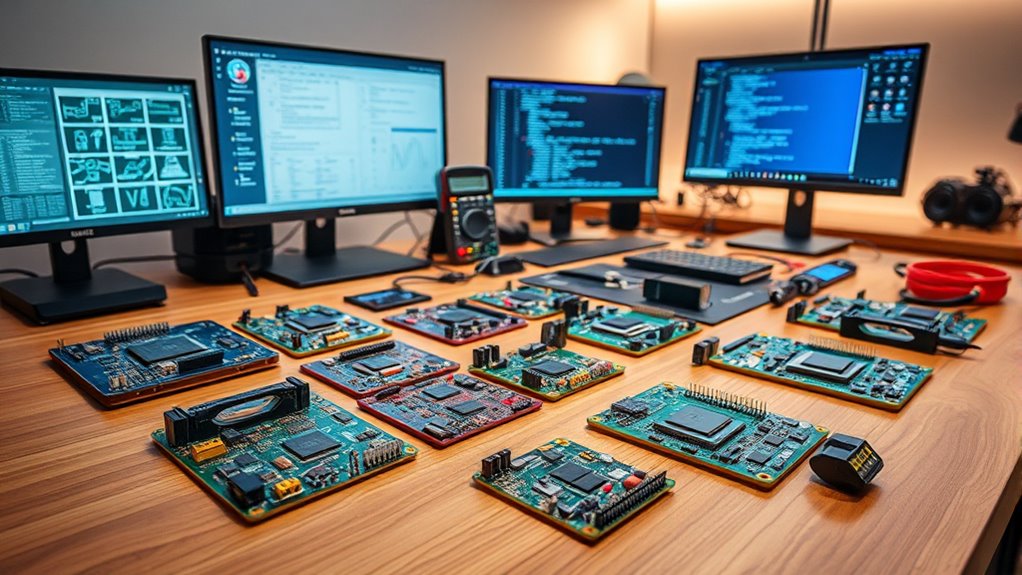

RISC-V development kits are gaining popularity for their open architecture and versatility in embedded and IoT projects. Among the options, the Seeed Studio XIAO ESP32C6 stands out for its compact size and robust connectivity features, making it ideal for IoT enthusiasts. The Waveshare ESP32-C5 Dual-Band Wi-Fi 6 Development Board offers high-performance processing with its 240MHz RISC-V core, perfect for more demanding applications. However, buyers face tradeoffs between price, feature set, and ease of use—more advanced kits tend to be pricier and more complex, while budget options may lack some modern connectivity features. Continue reading for a detailed breakdown of each kit to find the best fit for your project.
Complete the kit



Key Takeaways
- The top picks balance performance, connectivity, and affordability, with the Seeed Studio XIAO ESP32C6 being the most versatile overall.
- Most kits feature Wi-Fi 6 and Bluetooth 5.x, reflecting the push toward modern wireless standards in embedded development.
- Compact and multi-protocol boards like the ESP32-C5 variants excel for IoT projects requiring multiple connectivity options.
- Higher-end options like the Waveshare board provide more RAM and processing power, suitable for more complex applications.
- Compatibility with popular development environments like Arduino or ESP-IDF remains a key factor influencing ease of adoption.


| riscv development kit | Connectivity |
|---|---|
| M5Stack NanoC6 Development Kit | — |
| ESP32-C5 WiFi6 Development Boa | Zigbee, Thread |
| 3PCS ESP32-C5 Development Boar | Wi-Fi 6, Bluetooth 5, Zigbee, Thread |
| 3PCS ESP32-C5 Development Boar | — |
| Waveshare ESP32-C5 Dual-Band W | — |
| Seeed Studio XIAO ESP32C6 | WiFi 6, Bluetooth 5.3, Zigbee, Thread |
| ESP32-C5 5GHz/2.4GHz Dual-Band | USB Type-C |
| XIAO ESP32C3 3-Pack | Wi-Fi, Bluetooth 5.0 |
| ESP32-C6-DevKitC-1-N8 Developm | USB |
More Details on Our Top Picks
M5Stack NanoC6 Development Kit – Compact ESP32-C6 IoT Board with Wi-Fi 6, Zigbee, Thread, and IR Emitter
The M5Stack NanoC6 stands out for its compact design combined with advanced wireless protocols like Wi-Fi 6 and Zigbee, making it ideal for space-limited smart home or industrial automation setups. Compared with the ESP32-C5 WiFi6 Development Board, it offers a more integrated package with built-in IR and expandable Grove interface, but this comes with a tradeoff: its onboard storage is limited to 4MB, which might restrict complex firmware. Its small form factor and versatile connectivity options make it perfect for projects where size matters most, yet its need for GPIO-based programming and limited storage require some technical skill. This kit is best suited for developers needing a ready-to-go, space-efficient IoT solution with multiple wireless options.
Pros:- Supports Wi-Fi 6, Zigbee, Thread, and IR for versatile connectivity
- Compact and lightweight design suitable for small projects
- Includes IR emitter and RGB for multi-device control and visual feedback
- Expandable via Grove interface for additional hardware
Cons:- Requires GPIO key for entering download mode, adding setup complexity
- Limited onboard storage (4MB) may restrict larger applications
- Setup demands technical knowledge, especially for expansion
Best for: Developers working on smart home or industrial automation projects with tight space constraints
Not ideal for: Users needing large onboard storage or simple plug-and-play development without technical setup
- Memory Storage Capacity:4 MB
- Processor Speed:160 MHz
- Connectivity Technology:Infrared, USB, Wi-Fi
- Operating System:MicroPython
- Processor Brand:Espressif
- Wireless Compatibility:802.11ax
Our verdict“This kit is best for developers needing a compact, multi-protocol IoT platform with expansion options, willing to handle some setup complexity.”
ESP32-C5 WiFi6 Development Board with Dual-Band 2.4GHz/5GHz, RISC-V Processor, 32MB Flash, BLE 5, Zigbee, Thread
The ESP32-C5 WiFi6 Development Board offers a robust RISC-V core running at 240MHz, supporting dual-band Wi-Fi 6 alongside Bluetooth 5, Zigbee, and Thread, making it a strong choice for complex IoT gateways or multi-protocol devices. While the Waveshare ESP32-C5 provides similar wireless features, it distinguishes itself with dual USB Type-C ports and a solderable castellated module for easy integration. However, setting up and programming the board can be challenging for beginners, and it lacks advanced onboard power management features, which might affect portable applications. This board excels in scenarios demanding high processing power and multiple wireless standards, but it demands a certain level of technical familiarity.
Pros:- Powerful 240MHz RISC-V processor with ample memory (32MB Flash, 8MB PSRAM)
- Supports dual-band Wi-Fi 6, BLE 5, Zigbee, and Thread for flexible connectivity
- Dual USB Type-C ports facilitate versatile connections and debugging
- Easy soldering with castellated module for custom enclosures
Cons:- Requires technical expertise for setup and programming
- Limited onboard power management features may hinder portable use
- No onboard battery or power supply included
Best for: Experienced developers designing multi-protocol IoT gateways or data-intensive projects
Not ideal for: Beginners or hobbyists seeking simple, out-of-the-box solutions without extensive setup
- Processor:RISC-V 32-bit, 240MHz
- Flash:32MB
- PSRAM:8MB
- Wi-Fi:Dual-band Wi-Fi 6
- Bluetooth:BLE 5
- Connectivity:Zigbee, Thread
Our verdict“This board is ideal for advanced users needing high processing power and multi-protocol support in IoT gateways or complex devices.”
3PCS ESP32-C5 Development Board RISC-V Dual-Band Wi-Fi 6 Bluetooth 5 Thread Zigbee with 4MB Flash
The 3PCS ESP32-C5 Development Kit provides three identical boards, each equipped with a 32-bit RISC-V core at 240MHz, supporting Wi-Fi 6, Bluetooth 5, Zigbee, and Thread. This multi-board setup offers great value for prototyping or educational projects, especially since all boards are compatible with Arduino IDE, lowering the barrier to entry. Compared to more expensive single-board solutions like the Waveshare ESP32-C5, this kit excels in providing multiple units for parallel testing or multi-device networks. Its main tradeoff is that detailed user reviews and extensive documentation are scarce, and utilizing all features requires some technical skill. It suits teams or learners wanting multiple boards at a lower cost, with room to scale.
Pros:- Includes three development boards, cables, and wires for versatile projects
- Supports Wi-Fi 6, Bluetooth 5, Zigbee, and Thread for multi-protocol connectivity
- Compatible with Arduino IDE simplifies programming for newcomers
- Cost-effective solution for multi-device testing
Cons:- Limited detailed reviews or community resources available
- Requires some technical knowledge to fully utilize all features
- Lacks onboard power options or batteries
Best for: Students, educators, or small teams needing multiple IoT boards for experimentation and learning
Not ideal for: Absolute beginners without prior microcontroller experience or those seeking plug-and-play setups
- Processor:32-bit RISC-V, 240 MHz
- Flash Memory:4MB
- Connectivity:Wi-Fi 6, Bluetooth 5, Zigbee, Thread
- Included:3 development boards, 1 Type-C cable, 40 DuPont wires
Our verdict“This kit is well-suited for educational purposes or multi-device prototyping with a budget-friendly multi-board package.”
3PCS ESP32-C5 Development Board | Dual-Band Wi-Fi 6 & Bluetooth 5 Thread & Zigbee, Single-Core Processor with 4MB Flash 32Pin Type-C & CP2102 Chip, ESP32-C5 Devkit for Arduino
The ESP32-C5 Devkit offers three single-core RISC-V boards with a maximum clock of 240MHz, supporting dual-band Wi-Fi 6, Bluetooth 5, Zigbee, and Thread. Its extensive GPIO pins and included Type-C cable make it a flexible choice for a variety of IoT projects, from sensor arrays to displays. Compared with the Seeed Studio XIAO ESP32C6, this kit provides more GPIO options and a familiar Arduino environment, which benefits beginners. However, its detailed feature set can be overwhelming for newcomers, and the lack of detailed user reviews may pose some challenges for troubleshooting. This kit suits those seeking a multi-board, easy-to-program solution for diverse IoT prototypes, especially with Arduino compatibility.
Pros:- Includes three boards, USB Type-C, and DuPont wires for quick setup
- Supports Wi-Fi 6, Bluetooth 5, Zigbee, and Thread for multi-protocol projects
- Compatible with Arduino IDE and easily expandable
- Versatile GPIO pins support various peripherals
Cons:- Requires some technical skill to utilize all features fully
- Limited detailed user reviews and community support
- No onboard power supply or battery options
Best for: Beginners and educators aiming to learn or teach multi-protocol IoT development with multiple boards
Not ideal for: Advanced users requiring high processing power or specialized hardware features
Our verdict“This development kit is perfect for beginners or educators seeking multiple boards for multi-protocol IoT prototyping with easy programming options.”
Waveshare ESP32-C5 Dual-Band Wi-Fi 6 Development Board, 240MHz RISC-V Processor, ESP32-C5-WROOM-1 Module, Multi-Protocol RISC-V MCU, 8MB PSRAM
The Waveshare ESP32-C5 emphasizes high memory capacity with 8MB PSRAM, supporting demanding multi-protocol IoT applications that require extensive data processing. Its single board offers a streamlined package centered on performance, making it suitable for real-time data collection or scalable network nodes. In contrast to the earlier multi-board kits, it focuses on a single, high-memory solution rather than multiple units, which is ideal for projects demanding large buffers or complex computations. The main limitation is the limited information about additional peripherals or features, and it assumes a level of technical competence. This board is ideal for developers targeting scalable, future-proof IoT systems requiring significant memory and fast Wi-Fi 6 connectivity.
Pros:- 8MB PSRAM supports complex, multi-tasking applications
- Wi-Fi 6 provides faster, more reliable wireless connectivity
- Single-board design simplifies deployment in scalable networks
- Suitable for real-time analytics and data-heavy IoT systems
Cons:- Limited details on peripherals or expandability
- Lacks bundled accessories or multi-board options
- Requires advanced technical understanding for optimal use
Best for: Developers building scalable, memory-intensive IoT applications or real-time data processing systems
Not ideal for: Beginners or projects requiring multiple boards or simple setups
- Processor:240MHz RISC-V
- Memory:8MB PSRAM
- Module:ESP32-C5-WROOM-1
- Protocols:Wi-Fi 6
Our verdict“This board is best for developers needing high memory capacity and scalable Wi-Fi 6 connectivity for demanding IoT projects.”
Seeed Studio XIAO ESP32C6 – WiFi 6, Bluetooth 5.3, Zigbee, Thread, Smart Home Development Board
This compact board stands out for supporting a broad range of wireless protocols, including WiFi 6, Bluetooth 5.3, Zigbee, and Thread, making it highly versatile for smart home applications. Compared with the ESP32-C6-DevKitC-1-N8, the Seeed Studio XIAO ESP32C6 offers a smaller form factor, ideal for space-constrained designs, but its security features are more comprehensive, with on-chip encryption and secure boot. The main tradeoff is that it offers limited external antenna options, which could impact range or signal quality in certain setups. This pick makes the most sense for developers seeking a compact, multi-protocol IoT device with strong security, especially in smart home contexts.
Pros:- Supports multiple wireless protocols including WiFi 6, Bluetooth 5.3, Zigbee, and Thread
- Very compact size suitable for space-limited applications
- Enhanced security features with encrypted on-chip security
Cons:- Limited information on external antenna options which may impact range
- Requires familiarity with IoT protocols for optimal configuration
Best for: IoT developers focused on building secure, compact smart home or wearable devices needing multiple wireless protocols.
Not ideal for: Users requiring extensive external antenna options or detailed protocol customization, as the board’s antenna options are limited.
- Connectivity:WiFi 6, Bluetooth 5.3, Zigbee, Thread
- Security:Encrypted on chip, secure boot, encryption, TEE
- Range:Up to 80m BLE/Wi-Fi
- Power Modes:4 modes, deep sleep at 15 μA
- Processors:Dual RISC-V, up to 160 MHz and 20 MHz
- Form Factor:21 x 17.5 mm, single-sided mount
Our verdict“This board is best suited for developers needing a secure, multi-protocol IoT device in a tiny footprint.”
ESP32-C5 5GHz/2.4GHz Dual-Band Wi-Fi 6 Development Board, 240MHz RISC-V Processor,Onboard ESP32-C5-WROOM-1 Module,Supports BLE 5 / Thread/Zigbee Wireless Communications, 16 MB Flash and 8 MB PS-RAM
The ESP32-C5 development board makes a compelling case for users who need dual-band Wi-Fi 6 alongside multi-protocol support, similar to the Seeed Studio XIAO ESP32C6 but with a focus on handling medium-load applications more comfortably thanks to 16 MB of Flash and 8 MB PS-RAM. Its onboard module simplifies assembly, and the USB Type-C port benefits ease of use, especially over the XIAO’s minimal footprint. However, detailed specifications on flash and RAM are less prominent than on the ESP32-C6, which might concern those needing precise performance metrics. Compared to the ESP32-C6, this board is better suited for applications that require more onboard memory but less focus on security features.
Pros:- Supports dual-band Wi-Fi 6 for flexible connectivity
- Onboard ESP32-C5-WROOM-1 module simplifies integration
- Large onboard storage with 16 MB Flash and 8 MB PS-RAM
Cons:- Less information on hardware variants and detailed specs
- No explicit mention of external antenna options or RF performance metrics
Best for: Developers creating smart home hubs or gateways that demand stable multi-protocol communication with ample onboard memory.
Not ideal for: Projects requiring the tiniest form factor or advanced security features, where the ESP32-C6’s security suite could be a better fit.
- MCU:ESP32-C5 RISC-V
- Wi-Fi:Wi-Fi 6 dual-band
- Memory:16 MB Flash, 8 MB PS-RAM
- Connectivity:USB Type-C
- Protocols:BLE 5, Thread, Zigbee
- Form Factor:Standard module size
Our verdict“This board suits medium-scale IoT applications needing reliable dual-band Wi-Fi 6 and ample memory for multi-protocol tasks.”
XIAO ESP32C3 3-Pack – RISC-V Tiny MCU Board with Wi-Fi and Bluetooth 5.0
The XIAO ESP32C3 3-Pack offers a highly portable solution for developers wanting small, power-efficient boards supporting Wi-Fi and Bluetooth 5.0. Its tiny 21 x 17.5 mm form factor makes it ideal for embedded applications or rapid prototyping, especially when multiple units are needed. Compared to the ESP32-C6 and ESP32-C5, the C3 chip emphasizes low power consumption and simplicity, but it lacks the advanced security features of the C6 and the dual-band capabilities of the C5. This makes it better suited for small-scale, battery-powered devices rather than high-performance gateways. Its compatibility with multiple programming environments like Arduino, MicroPython, and ESP-IDF enhances its versatility.
Pros:- Extremely compact and lightweight for embedded use
- Supports multiple programming environments including Arduino and MicroPython
- Low power consumption with deep sleep modes
Cons:- Limited to small-scale or portable applications
- No onboard peripherals, requiring additional components for complete systems
Best for: Developers working on small, battery-powered projects or bulk prototyping requiring multiple tiny nodes.
Not ideal for: Applications demanding high security, dual-band Wi-Fi, or extensive external antenna options—these are less supported here.
- Chip:ESP32-C3 32-bit RISC-V
- Operating Frequency:up to 160 MHz
- Dimensions:21 x 17.5 mm
- Connectivity:Wi-Fi, Bluetooth 5.0
- Power Modes:4 modes, deep sleep as low as 44 μA
- Compatibility:Arduino IDE, MicroPython, ESP IDF, others
Our verdict“This set is well-suited for bulk deployment of small, power-efficient IoT devices in embedded projects.”
ESP32-C6-DevKitC-1-N8 Development Board
The ESP32-C6-DevKitC-1-N8 stands out for showcasing the latest Wi-Fi 6 and Bluetooth 5 (LE) standards in a development platform that emphasizes ease of use, with USB connectivity and comprehensive SDK support. While it shares the RISC-V architecture with the other boards, its focus is on providing a straightforward experience, making it ideal for prototyping new Wi-Fi 6 applications. Compared with the ESP32-C5, this board is more geared toward experimental or early-stage product development rather than deployment, especially since detailed hardware specs like flash and PSRAM sizes are less explicit. Nonetheless, its open-source SDK and example applications streamline the development process.
Pros:- Supports the latest Wi-Fi 6 and Bluetooth 5 standards
- Open-source SDK with example applications simplifies development
- USB connectivity for easy programming and debugging
Cons:- Limited information on flash and PSRAM capacities
- Requires technical knowledge for hardware setup and integration
Best for: Engineers and researchers exploring Wi-Fi 6 and Bluetooth 5 applications, especially those new to RISC-V or Wi-Fi 6 development.
Not ideal for: Mass production or projects needing extensive hardware customization, as detailed hardware specs are less documented here.
- MCU:32-bit RISC-V
- Wi-Fi:Wi-Fi 6
- Bluetooth:Bluetooth 5 (LE)
- Connectivity:USB
- Supported Protocols:Wi-Fi 6, Bluetooth 5
- Hardware:N8 variant
Our verdict“This board is perfect for early-stage Wi-Fi 6 and Bluetooth 5 experiments, especially for developers familiar with open-source SDKs.”

How We Picked
I evaluated these development kits based on criteria that matter most to embedded developers and IoT enthusiasts: processing power, connectivity options, build quality, ease of integration, and value for money. Each product was compared for its feature set relative to its price, with special attention to how well it supports modern wireless protocols like Wi-Fi 6 and Bluetooth 5.3. The ranking reflects a balance between performance, user-friendliness, and versatility, ensuring both beginners and advanced users find a suitable option. Kits with broader protocol support, better documentation, and community backing earned higher positions.| riscv development kit | Connectivity |
|---|---|
| M5Stack NanoC6 Development Kit | — |
| ESP32-C5 WiFi6 Development Boa | Zigbee, Thread |
| 3PCS ESP32-C5 Development Boar | Wi-Fi 6, Bluetooth 5, Zigbee, Thread |
| 3PCS ESP32-C5 Development Boar | — |
| Waveshare ESP32-C5 Dual-Band W | — |
| Seeed Studio XIAO ESP32C6 | WiFi 6, Bluetooth 5.3, Zigbee, Thread |
| ESP32-C5 5GHz/2.4GHz Dual-Band | USB Type-C |
| XIAO ESP32C3 3-Pack | Wi-Fi, Bluetooth 5.0 |
| ESP32-C6-DevKitC-1-N8 Developm | USB |
Factors to Consider When Choosing Riscv Development Kits
Choosing the right RISC-V development kit involves more than just looking at specs. Consider your project’s specific needs, budget, and your experience level. A good kit should provide enough processing power, connectivity, and expansion options without overwhelming you with complexity or cost. Here are key factors to guide your decision-making process:Processing Power and Performance
Look for a kit with a RISC-V core that matches your application’s demands. For simple IoT sensors, a lower-clocked processor might suffice, but more complex tasks like multimedia or edge computing benefit from higher clock speeds and larger RAM. Keep in mind that higher performance usually comes with increased cost and power consumption, so select accordingly.
Connectivity Options
Ensure the kit supports the wireless protocols you need, such as Wi-Fi 6, Bluetooth 5.x, Zigbee, or Thread. Multi-protocol support can simplify your hardware setup and expand your project’s capabilities. Be cautious about kits that lack essential connectivity features for your use case, as upgrading later can be costly.
Ease of Use and Compatibility
Check if the development kit is compatible with familiar development environments like Arduino IDE or ESP-IDF. Well-documented kits with active community support reduce the learning curve and troubleshooting time. Avoid overly complex kits if you’re new to embedded development, as they might require more setup and configuration.
Build Quality and Expansion
Durability and reliable connectors are important, especially for long-term projects. Consider kits with accessible GPIO pins, headers, and expansion slots for attaching sensors or peripherals. A sturdy design minimizes physical damage and eases prototyping.
Price and Value
Balance your budget against the feature set you need. Sometimes, paying a bit more for a kit with better documentation, more RAM, or additional protocols can save time and frustration later. Be wary of very cheap kits that may lack essential features or have questionable build quality.
Frequently Asked Questions
Can I use these RISC-V kits for AI or machine learning projects?
While most RISC-V development kits are optimized for IoT and embedded applications, some higher-performance options like the Waveshare ESP32-C5 with 8MB PSRAM and 240MHz core can handle lightweight AI tasks. However, for intensive machine learning, you might need specialized hardware with GPU acceleration or more powerful processors. These kits are best suited for deploying pre-trained models or simple AI functionalities rather than training large models from scratch.
Are these kits suitable for beginners with no prior embedded development experience?
Yes, many of these kits, especially those with Arduino compatibility or extensive documentation like the XIAO ESP32C6, are designed with beginners in mind. They often come with beginner-friendly SDKs, tutorials, and active communities. However, some advanced kits with multiple protocols and high-speed cores may require a steeper learning curve, so it’s wise to pick a kit aligned with your current skill level.
Do I need additional accessories or modules to start using these development kits?
Most kits come with the essential components for basic projects, but you’ll likely need sensors, power supplies, and possibly external antennas depending on your application. Check the included accessories carefully and consider what peripherals you might require for your specific project. Investing in a starter kit with expansion options can save time and money later.
How future-proof are these RISC-V development kits?
These kits generally support current wireless standards like Wi-Fi 6 and Bluetooth 5.3, which are expected to remain relevant for several years. However, embedded hardware tends to evolve rapidly, so selecting a kit with multiple protocols and upgrade paths can help extend its usefulness. Also, consider the ecosystem and community activity, as ongoing software updates are vital for long-term viability.
Is it worth paying more for higher-end RISC-V development kits?
Investing in higher-end kits pays off if your project demands more processing power, RAM, or advanced connectivity like Wi-Fi 6 and Bluetooth 5.3. These kits often provide better documentation, more reliable hardware, and future compatibility, which can reduce development time. For simple prototypes or educational purposes, more affordable options may be sufficient, but for commercial or complex use cases, the extra investment can be justified.
Conclusion
For those just starting out or working on basic IoT projects, the XIAO ESP32C6 offers a balanced mix of size, connectivity, and ease of use. Developers seeking high performance for more demanding applications should consider the Waveshare ESP32-C5 with its powerful processor and RAM. Budget-conscious buyers will find value in the ESP32-C3 3-Pack, while advanced users with specific protocol needs might prefer specialized boards like the ESP32-C6-DevKitC-1-N8. Ultimately, your choice depends on your project complexity, experience level, and future scalability requirements. Use this guide to identify the kit that best aligns with your goals and technical needs.