For perfect talking head videos in 2026, I recommend the Sigma 50mm f/1.4 for natural, flattering shots with beautiful background blur, the VILTROX 85mm f/1.8 for more compression and focus on your face, and the Sigma 35mm f/1.4 to capture a versatile, slightly wider perspective. These lenses offer sharp focus, excellent low-light performance, and smooth bokeh. Keep exploring to see how each one can elevate your video quality even further.
Key Takeaways
- Choose lenses between 50mm and 85mm for natural, flattering perspectives ideal for talking head videos.
- Opt for wide apertures like f/1.4 or f/1.8 to achieve shallow depth of field and excellent low-light performance.
- Prioritize lenses with fast, accurate autofocus and eye-tracking to maintain sharp focus during recordings.
- Select lenses with high-quality optics and rounded aperture blades for smooth, pleasing background bokeh.
- Ensure lenses have consistent aperture performance and minimal distortion for professional, polished video results.
| Sigma 16mm f/1.4 DC DN Sony E Lens Bundle | 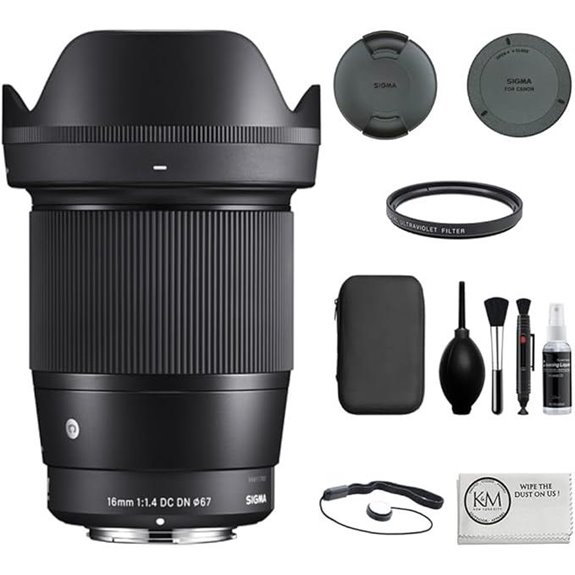 | Creative Wide-Angle | Focal Length: 16mm (APS-C, 24mm FF equivalent) | Aperture: f/1.4 to f/16 | Compatibility: Sony E-mount APS-C | VIEW LATEST PRICE | See Our Full Breakdown |
| VILTROX 50mm F2.0 Lens for Sony E-Mount Cameras | 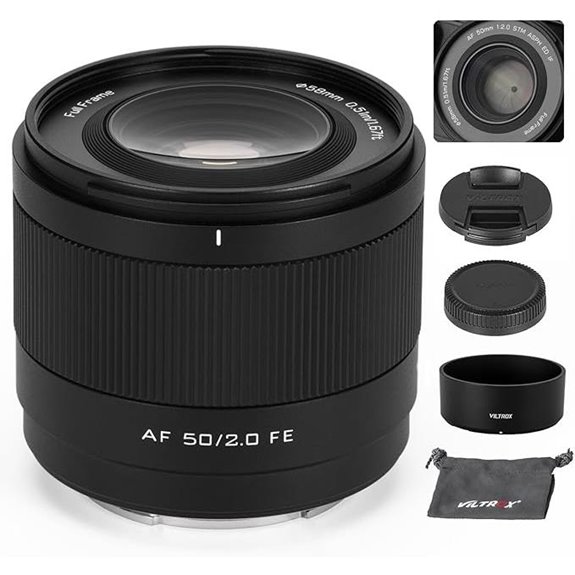 | Versatile Portrait | Focal Length: 50mm (Full-frame, standard portrait) | Aperture: f/2.0 to f/16 | Compatibility: Sony E-mount full-frame | VIEW LATEST PRICE | See Our Full Breakdown |
| Sigma 16mm 30mm 56mm f1.4 Lens Bundle for Sony | 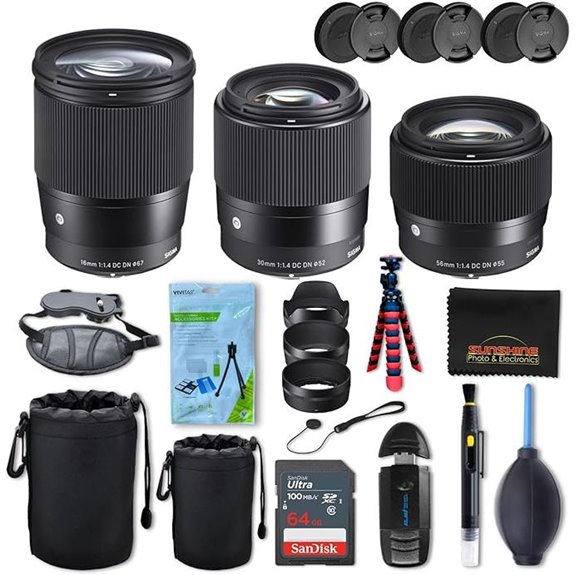 | Complete Prime Set | Focal Length: 16mm, 30mm, 56mm (APS-C, 24mm, 45mm, 84mm equivalents) | Aperture: f/1.4 to f/16 (all three lenses) | Compatibility: Sony E-mount APS-C | VIEW LATEST PRICE | See Our Full Breakdown |
More Details on Our Top Picks
Sigma 16mm f/1.4 DC DN Sony E Lens Bundle
If you’re looking for a prime lens that excels in talking head videos, the Sigma 16mm f/1.4 DC DN Sony E Lens Bundle is a top choice. Designed specifically for Sony E-mount cameras with APS-C sensors, it offers a versatile 24mm full-frame equivalent focal length. The lens features a bright f/1.4 aperture, ideal for low-light situations and creating beautiful background blur. Its weather-sealed construction boosts durability, while the quiet autofocus guarantees smooth operation. The bundle includes essential accessories like a UV filter, microfiber cloth, and a starter kit, making it perfect for beginners and professionals alike.
- Focal Length:16mm (APS-C, 24mm FF equivalent)
- Aperture:f/1.4 to f/16
- Compatibility:Sony E-mount APS-C
- Autofocus System:Stepping motor AF
- Weather Sealing:Weather-sealed
- Special Elements:Aspherical, SLD, FLD elements
- Additional Feature:Bright f/1.4 aperture
- Additional Feature:Weather-sealed construction
- Additional Feature:Complete starter kit included
VILTROX 50mm F2.0 Lens for Sony E-Mount Cameras
The VILTROX 50mm F2.0 lens is an excellent choice for talking head videos because its 50mm focal length provides a natural, flattering perspective that keeps your subject well-separated from the background. Its optical design includes 13 elements, including ED low-dispersion and aspherical lenses, delivering sharp, vibrant images with minimal distortion. The wide F2.0 aperture creates beautiful bokeh and excels in low-light conditions. Equipped with fast, accurate autofocus via STM motor and supporting in-body stabilization, this lens guarantees smooth focus transitions and steady footage. Its compact, lightweight build makes it perfect for handheld shooting and versatile enough for various shooting scenarios.
- Focal Length:50mm (Full-frame, standard portrait)
- Aperture:f/2.0 to f/16
- Compatibility:Sony E-mount full-frame
- Autofocus System:STM stepping motor
- Weather Sealing:Not specified
- Special Elements:ED, high-refractive, aspherical, SLD
- Additional Feature:Compact, lightweight design
- Additional Feature:Built-in STM autofocus motor
- Additional Feature:Supports in-body stabilization
Sigma 16mm 30mm 56mm f1.4 Lens Bundle for Sony
For content creators focusing on talking head videos, the Sigma 16mm, 30mm, and 56mm f/1.4 lens bundle stands out thanks to its ultra-fast apertures and quiet autofocus. These lenses deliver sharp images, cinematic depth, and excellent low-light performance. The versatile trio covers wide-angle, street, and portrait shots, making it perfect for various filming scenarios. Advanced autofocus guarantees near-silent, precise focusing, ideal for smooth video. Built with high-quality optics and weather sealing, they’re durable and portable. This bundle offers great value, backed by a 4-year warranty, making it an excellent choice for professional and aspiring videographers alike.
- Focal Length:16mm, 30mm, 56mm (APS-C, 24mm, 45mm, 84mm equivalents)
- Aperture:f/1.4 to f/16 (all three lenses)
- Compatibility:Sony E-mount APS-C
- Autofocus System:Advanced stepping motor autofocus
- Weather Sealing:Weather-sealed
- Special Elements:Aspherical, SLD, FLD elements
- Additional Feature:Versatile focal length trio
- Additional Feature:High-quality optical glass
- Additional Feature:4-year USA warranty
Factors to Consider When Choosing a Prime Lens for Talking Head Videos
When choosing a prime lens for talking head videos, I focus on key factors like focal length, aperture, and autofocus accuracy. These elements directly impact image quality, your ability to shoot in different lighting conditions, and how well the background blurs. Let’s explore how each factor influences your final video.
Focal Length Selection
Choosing the right focal length for a prime lens is essential because it influences how your face appears on camera and how comfortable you feel during recordings. Typically, lenses between 50mm and 85mm are ideal for talking head videos, offering flattering perspective and proper subject separation. A 50mm lens provides a natural look with minimal distortion, perfect for close-up shots of the speaker. An 85mm lens offers more compression, making backgrounds appear more blurred and emphasizing the subject’s prominence, which adds a professional touch. Both focal lengths allow for a comfortable working distance, helping you stay relaxed and maintain eye contact with your audience. Selecting the right focal length ensures your presentation looks polished without feeling awkward or unnatural.
Aperture Capabilities
The aperture capabilities of a prime lens considerably impact the look and quality of your talking head videos. A wider aperture, like f/1.4 or f/1.8, creates a shallow depth of field that beautifully blurs the background, making your subject stand out. It also enhances low-light performance, allowing you to shoot sharper videos in dim environments without extra lighting. Controlling the aperture lets you achieve a cinematic, professional look by adjusting the background blur and focus. The design of aperture blades influences bokeh quality; rounded blades produce smoother, more pleasing backgrounds. Additionally, a lens with consistent aperture performance across its focal range ensures reliable artistic control, so your videos look polished regardless of shooting conditions.
Autofocus Precision
Have you ever struggled with your camera’s autofocus slipping off your subject’s face during a recording? Precise autofocus is essential for talking head videos to keep the face sharp and in focus. A lens with fast autofocus motors, like stepping or ultrasonic motors, responds quickly to facial movements, reducing focus hunting. Eye-tracking autofocus technology takes this a step further by automatically detecting and maintaining focus on the eyes, ensuring sharpness where it matters most. Reliable autofocus performance in various lighting conditions means you won’t have to constantly adjust manually, saving time and frustration. This consistency allows you to focus on your delivery and framing without worry. When choosing a prime lens, prioritize autofocus precision to produce smooth, professional-looking videos that keep your audience engaged.
Low-Light Performance
When filming in low-light environments, selecting a prime lens with a wide maximum aperture becomes vital. A lens with an aperture like f/1.4 lets in more light, improving the overall brightness and clarity of your footage. This means you can avoid relying heavily on extra lighting, making setup simpler and faster. Many prime lenses designed for low-light use also feature special coatings to reduce flare and ghosting from artificial lights, maintaining image quality. Maintaining sharp focus at wide apertures is essential to capture facial details sharply in dim conditions. High optical quality combined with a fast aperture ensures your videos have accurate colors and crisp detail, even in challenging lighting. Choosing the right prime lens makes low-light scenarios much more manageable, resulting in professional-looking talking head videos.
Bokeh Quality
Choosing a prime lens with a wide aperture not only helps in low-light situations but also substantially influences the look of your background blur, or bokeh. The quality of bokeh depends mainly on the number and shape of the aperture blades; more blades and rounded shapes create smoother, more pleasing backgrounds. Wide apertures like f/1.4 or f/2.0 produce a shallow depth of field, isolating your subject and enhancing the bokeh effect. The lens’s optical design, including aspherical and low-dispersion elements, reduces aberrations that can cause harsh or distracting background blur. Additionally, a lens with a circular aperture shape at wide openings yields more aesthetically pleasing, creamy bokeh, making your talking head videos look more professional and visually engaging.
Frequently Asked Questions
How Do Prime Lenses Affect Video Focus Transitions?
Prime lenses make focus progressions smoother and more precise because they typically have faster, more consistent autofocus motors. When I switch focus during a talking head video, I notice less hunting and more seamless adjustments. Their fixed focal length helps me maintain sharpness and control depth of field, which enhances the overall quality. This reliability allows me to focus more on delivery without worrying about focus shifts distracting viewers.
What Is the Best Aperture for Talking Head Videos?
The best aperture for talking head videos is typically around f/2.8 to f/4. I prefer this range because it keeps your face sharp while softly blurring the background—like magic, but with more focus and less fairy dust. Using a wider aperture might make you look like a floating head, and narrower ones could turn your face into a pixelated mess. Keep it sharp, keep it real!
How Do Prime Lenses Perform in Low-Light Conditions?
Prime lenses excel in low-light conditions because they often have wider apertures, like f/1.4 or f/1.8, allowing more light to reach the sensor. This means I can shoot in dim environments without needing extra lighting or increasing ISO too much, which keeps my images sharp and noise-free. Their ability to gather more light makes prime lenses a great choice for low-light videography, especially for talking head videos.
Are There Affordable Prime Lens Options for 2026 Videos?
Affordable prime lenses for 2026 videos are like hidden gems waiting to be discovered. I’ve found options like the Canon RF 50mm f/1.8 STM and Sony FE 50mm f/1.8, which deliver excellent quality without breaking the bank. These lenses are perfect for talking head videos, offering sharp images and great low-light performance. You don’t need to spend a fortune to get professional-looking results; just choose wisely.
How Does Lens Size Influence Shooting Stability?
Lens size directly impacts shooting stability because larger lenses tend to be heavier, making handheld shots more challenging and increasing camera shake. Smaller, lightweight prime lenses are easier to stabilize, especially if you’re shooting for extended periods or without a tripod. I recommend balancing lens size with your shooting style; using a stabilizer or tripod can also greatly improve stability regardless of lens size.
Conclusion
Choosing the right prime lens is like finding the perfect brush for a masterpiece—each one brings its own unique touch to your talking head videos. Whether you prefer the wide embrace of a 16mm or the intimate focus of a 50mm, these lenses can elevate your visuals to new heights. So, pick the one that fits your style, and watch your videos shine brighter than a star in the night sky.