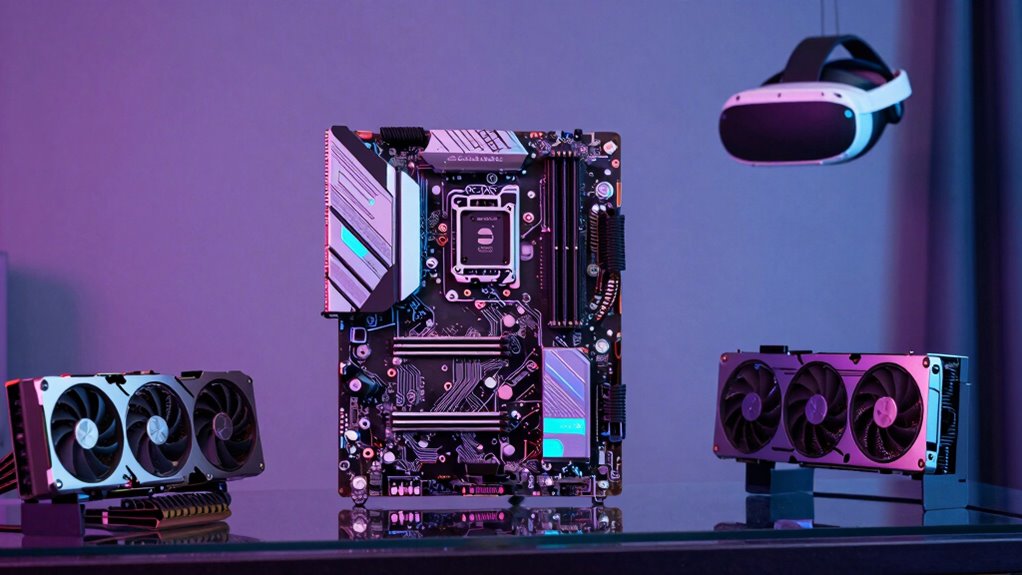
Building a VR gaming PC demands a motherboard that supports high-performance components and offers robust connectivity. The MSI MPG X870E Carbon WiFi stands out as the overall best choice thanks to its latest PCIe 5.0 support and Wi-Fi 7, ensuring future-proof compatibility. For a more budget-friendly option, the MSI A520M-A PRO provides solid performance with DDR4 and PCIe 3.0, suitable for entry-level setups. Meanwhile, the GIGABYTE B850 AORUS Elite WIFI7 appeals to enthusiasts wanting premium features and cutting-edge tech. Readers will face tradeoffs between cutting-edge features, price, and ease of use, so continue reading for a detailed breakdown of each option.

Get the latest gadgets delivered free with Prime
- Fast, free delivery on millions of items
- Prime Video, Amazon Music and more included
- Member-only deals all year
Complete the kit



Key Takeaways
- Future-proofing features like PCIe 5.0 and Wi-Fi 7 are key for long-term VR gaming setups.
- Motherboards with higher VRM quality and better cooling tend to support overclocking and sustained performance.
- Choosing between DDR4 and DDR5 depends on budget and upgrade plans, impacting compatibility and longevity.
- Connectivity options such as multiple USB-C, Thunderbolt, and high-speed Ethernet can enhance VR peripherals and streaming.
- Entry-level motherboards may save money but often lack advanced features needed for demanding VR experiences.
| MSI MPG X870E Carbon WiFi Gaming Motherboard (AMD Ryzen 9000/8000/7000 Series, AM5, DDR5, PCIe 5.0, M.2 Gen5, SATA 6Gb/s, USB 40Gbps, HDMI, Wi-Fi 7, Bluetooth 5.4, 5Gbps LAN, ATX) |  | Best Overall for Cutting-Edge VR Gaming | Processor Socket: Socket AM5 | Compatible Devices: Personal Computer | RAM Memory Technology: DDR5 | VIEW ON AMAZON | See Our Full Breakdown |
| GIGABYTE B550 Gaming X V2 AMD AM4 Motherboard |  | Best Value for Mid-Range VR Gaming | Socket: AM4 | Supported Processors: Ryzen 5000/4000/3000 Series | Memory Support: DDR4, 4 DIMMs, XMP support | VIEW ON AMAZON | See Our Full Breakdown |
| ASUS ROG Strix B550-F Gaming WiFi II AMD AM4 Motherboard |  | Best for High-Performance VR with Networking | Socket: AM4 | Supported Processors: AMD Ryzen 3000 and 5000 series | Networking: WiFi 6E, 2.5 Gb Ethernet | VIEW ON AMAZON | See Our Full Breakdown |
| MSI A520M-A PRO Gaming Motherboard (AMD Ryzen 5000, AM4, DDR4, PCIe 3.0, SATA 6Gb/s, M.2, USB 3.2 Gen 1, DVI/HDMI, Micro-ATX) |  | Best Budget Micro-ATX for Entry-Level VR Gaming | Processor Support: 3rd Gen AMD Ryzen Desktop Processors | Memory: DDR4 up to 4600 MHz (OC) | Storage: M.2 PCIe Gen3 x4, SATA 6Gb/s | VIEW ON AMAZON | See Our Full Breakdown |
| MSI MPG B550 Gaming Plus V1 Gaming Motherboard (AMD Ryzen 5000, AM4, DDR4, PCIe 4.0, SATA 6Gb/s, M.2, USB 3.2 Gen 2, HDMI/DP, ATX) |  | Best for High-Performance VR with Future Compatibility | Processor Support: AMD Ryzen 5000 series with BIOS update | Memory: Dual channel DDR4 up to 128 GB (4400 MHz) | PCIe: 4.0 | VIEW ON AMAZON | See Our Full Breakdown |
| GIGABYTE B850 AORUS Elite WIFI7 AMD AM5 Motherboard |  | Best for Cutting-Edge AMD VR Gaming Builds | Socket: AMD AM5 | Supported CPU: AMD Ryzen 9000/8000/7000 Series | Memory: DDR5, 4 DIMMs | VIEW ON AMAZON | See Our Full Breakdown |
| MSI B760 Gaming Plus WiFi Motherboard for 12th/13th/14th Gen Intel Processors |  | Best for Versatile Intel VR Gaming and Professional Use | Processor Socket: LGA 1700 | Supported Processors: 12th/13th/14th Gen Intel Core | Memory Technology: DDR5 | VIEW ON AMAZON | See Our Full Breakdown |
| motherboard for vr gaming pc | Supported Processors |
|---|---|
| MSI MPG X870E Carbon WiFi Gami | AMD Ryzen 9000/8000/7000 Series Processors |
| GIGABYTE B550 Gaming X V2 AMD | Ryzen 5000/4000/3000 Series |
| ASUS ROG Strix B550-F Gaming W | AMD Ryzen 3000 and 5000 series |
| MSI A520M-A PRO Gaming Motherb | — |
| MSI MPG B550 Gaming Plus V1 Ga | — |
| GIGABYTE B850 AORUS Elite WIFI | — |
| MSI B760 Gaming Plus WiFi Moth | 12th/13th/14th Gen Intel Core |
More Details on Our Top Picks
MSI MPG X870E Carbon WiFi Gaming Motherboard (AMD Ryzen 9000/8000/7000 Series, AM5, DDR5, PCIe 5.0, M.2 Gen5, SATA 6Gb/s, USB 40Gbps, HDMI, Wi-Fi 7, Bluetooth 5.4, 5Gbps LAN, ATX)
This motherboard stands out for supporting the latest AMD Ryzen 9000 and 8000 series processors, paired with DDR5 RAM and PCIe 5.0, making it ideal for gamers who want the fastest data transfer and future-proofing. Its advanced thermal design and extensive connectivity—including Wi-Fi 7 and Bluetooth 5.4—ensure high performance and minimal lag during VR sessions. Compared to the ASUS ROG Strix B550-F Gaming WiFi II, it offers newer PCIe standards and superior connectivity options, but this comes with a higher price and a need for compatible DDR5 memory, which can be costly. Its ATX form factor suits larger cases, but isn’t ideal for compact builds.
Pros:- Supports latest AMD Ryzen 9000/8000/7000 processors for ultimate performance
- Features PCIe 5.0 for the fastest data transfer speeds
- Includes Wi-Fi 7 and Bluetooth 5.4 for seamless connectivity
- Advanced thermal design improves heat dissipation during intensive gaming
Cons:- High cost, especially with compatible DDR5 RAM and processors
- Limited to ATX form factor, restricting smaller builds
Best for: VR gamers seeking maximum performance and future-proofing with top-tier connectivity
Not ideal for: Budget-conscious users or those with small PC cases due to its cost and size
- Processor Socket:Socket AM5
- Compatible Devices:Personal Computer
- RAM Memory Technology:DDR5
- Supported Processors:AMD Ryzen 9000/8000/7000 Series Processors
- Chipset Type:AMD X870
- Memory Clock Speed:7800 MHz
- Platform:Windows 11
- Maximum RAM Size:256 GB
- Supported PCIe Standard:PCIe 5.0
Our verdict“This motherboard is best suited for serious VR gamers who prioritize cutting-edge specs and future-ready features.”
GIGABYTE B550 Gaming X V2 AMD AM4 Motherboard
Compared with the MSI A520M-A PRO, the GIGABYTE B550 Gaming X V2 offers better power delivery and more advanced features like PCIe 4.0 support, making it a solid choice for mid-tier VR gaming setups. Its dual M.2 slots support fast NVMe SSDs, enhancing load times and game streaming. While it lacks Wi-Fi, the user-friendly Q-Flash Plus feature simplifies BIOS updates, and its robust connectivity options include USB-C and Bluetooth 5.3. However, it’s limited to AMD’s AM4 socket, excluding the newer Ryzen 7000 series, and its RGB lighting is fairly basic. This balance of features makes it appealing for gamers balancing performance and budget.
Pros:- Supports latest Ryzen 5000/4000/3000 processors with strong power delivery
- Dual M.2 slots for fast SSD storage
- User-friendly BIOS with Q-Flash Plus for easy updates
- Good connectivity including USB-C and Bluetooth 5.3
Cons:- No built-in Wi-Fi, requiring external adapters for wireless connectivity
- Limited to AMD AM4 socket processors, excluding newer CPUs
Best for: DIY enthusiasts building a capable VR gaming PC with AMD Ryzen processors on a budget
Not ideal for: Users seeking Wi-Fi 6E or PCIe 5.0 support, or planning to upgrade to the latest Ryzen 7000 CPUs
- Socket:AM4
- Supported Processors:Ryzen 5000/4000/3000 Series
- Memory Support:DDR4, 4 DIMMs, XMP support
- M.2 Slots:2 (PCIe 4.0 and PCIe 3.0)
- Connectivity:USB 3.2 Gen 2, USB-C, Bluetooth 5.3
- Additional Features:Q-Flash Plus, RGB Fusion
Our verdict“Ideal for budget-conscious gamers who want reliable performance without the latest features.”
ASUS ROG Strix B550-F Gaming WiFi II AMD AM4 Motherboard
The ASUS ROG Strix B550-F Gaming WiFi II makes this list for supporting AMD Ryzen 3000 and 5000 series processors with PCIe 4.0 and WiFi 6E, offering excellent high-speed network performance critical for smooth VR experiences. Its dual M.2 slots and bundled software enhance customization and storage options, outperforming the MSI A520M-A PRO in build quality and networking. However, it can be complex for beginners to configure and lacks Bluetooth without a separate adapter. Its AM4 socket limits future CPU upgrade options, but its high-quality power stages and robust connectivity make it well-suited for gamers looking for a premium experience within a familiar platform.
Pros:- Supports latest Ryzen processors with PCIe 4.0
- Fast WiFi 6E and 2.5 Gb Ethernet for lag-free online gaming
- High-quality power delivery for overclocking
- Dual M.2 slots with heatsinks for fast storage
Cons:- Complex setup for beginners
- No built-in Bluetooth (requires separate adapter)
Best for: VR gamers wanting high-speed networking and overclocking capabilities on AMD systems
Not ideal for: First-time builders or those seeking the latest CPU support beyond Ryzen 5000 series
- Socket:AM4
- Supported Processors:AMD Ryzen 3000 and 5000 series
- Networking:WiFi 6E, 2.5 Gb Ethernet
- Expansion Slots:PCIe 4.0, dual M.2
- USB:USB 3.2 Gen 2 Type-C
- Additional Features:BIOS Flashback, Aura Sync
Our verdict“This motherboard is suited for gamers aiming for high-speed networking and overclocked AMD Ryzen performance.”
MSI A520M-A PRO Gaming Motherboard (AMD Ryzen 5000, AM4, DDR4, PCIe 3.0, SATA 6Gb/s, M.2, USB 3.2 Gen 1, DVI/HDMI, Micro-ATX)
The MSI A520M-A PRO offers a practical platform for entry-level VR gaming, supporting AMD Ryzen 5000 and G-series processors with DDR4 memory up to 4600 MHz (OC). Compared to higher-end boards like the MSI MPG B550 Gaming Plus, it sacrifices PCIe 4.0 support, sticking with PCIe 3.0, which may limit future storage and GPU bandwidth. Its micro-ATX form factor makes it suitable for smaller cases but also limits expansion options. While it provides basic features such as DVI and HDMI outputs, its lack of advanced networking or RGB lighting makes it less appealing for enthusiasts. Still, it’s a dependable choice for those building a VR-ready system on a strict budget.
Pros:- Supports AMD Ryzen 5000 processors for good performance
- High-speed DDR4 memory support up to 4600 MHz (OC)
- Compact micro-ATX size fits smaller cases
- Affordable price point
Cons:- Limited to PCIe 3.0, restricting future expansion
- Basic features without Wi-Fi or advanced connectivity
Best for: Beginners or budget-conscious users assembling a compact VR gaming PC
Not ideal for: Users who want PCIe 4.0 or high-end networking features for demanding VR setups
- Processor Support:3rd Gen AMD Ryzen Desktop Processors
- Memory:DDR4 up to 4600 MHz (OC)
- Storage:M.2 PCIe Gen3 x4, SATA 6Gb/s
- Graphics Outputs:DVI, HDMI
- Form Factor:Micro-ATX
- Additional Features:Audio Boost
Our verdict“This motherboard is best for entry-level VR setups where space and budget are primary concerns.”
MSI MPG B550 Gaming Plus V1 Gaming Motherboard (AMD Ryzen 5000, AM4, DDR4, PCIe 4.0, SATA 6Gb/s, M.2, USB 3.2 Gen 2, HDMI/DP, ATX)
Compared to the MSI MPG X870E Carbon WiFi, the MSI B550 Gaming Plus V1 offers many of the same features like PCIe 4.0 support, but at a more accessible price point for mid-range VR gaming setups. Its BIOS, with an update, supports AMD Ryzen 5000 series, and the inclusion of M.2 Shield Frozr enhances storage longevity and speed. The extended heatsink and thermal solution improve cooling during extended VR sessions. While it lacks Wi-Fi, its robust power delivery and RGB customization make it a compelling choice for gamers who want solid performance without the premium cost. It’s less future-proof than the X870E but offers a good balance of features for most gamers.
Pros:- Supports AMD Ryzen 5000 series with BIOS update
- PCIe 4.0 for fast graphics and storage
- Extended heatsink with thermal pads for reliable cooling
- RGB lighting and customization options
Cons:- Requires BIOS update for Ryzen 5000 support
- No built-in Wi-Fi, requiring external adapters
Best for: VR enthusiasts seeking a balance of future-proofing and affordability within AMD platforms
Not ideal for: Gamers who need Wi-Fi 6E or PCIe 5.0 support, or those with very small cases
- Processor Support:AMD Ryzen 5000 series with BIOS update
- Memory:Dual channel DDR4 up to 128 GB (4400 MHz)
- PCIe:4.0
- M.2:Yes, with Shield Frozr
- USB:3.2 Gen 2
- Form Factor:ATX
Our verdict“This motherboard is suitable for VR gamers who want high performance and future capabilities without the high-end price.”
GIGABYTE B850 AORUS Elite WIFI7 AMD AM5 Motherboard
The GIGABYTE B850 AORUS Elite WIFI7 motherboard stands out for supporting the latest AMD Ryzen 9000, 8000, and 7000 series processors, making it ideal for users who want to leverage the newest CPU technologies. Its DDR5 memory support and PCIe 5.0 connectivity deliver high bandwidth essential for VR gaming, especially when paired with high-speed GPUs and fast storage solutions. Compared to the MSI B760 Gaming Plus WiFi, which supports Intel’s latest chips, this board is tailored for AMD fans who prioritize future-proofing and raw performance. The 14+2+2 power phases offer stable power delivery for overclocking, but the absence of RGB lighting and the AMD-only socket could deter those seeking aesthetic customization or a more flexible platform. This motherboard is best suited for enthusiasts targeting AMD’s latest CPUs and high-end VR setups, but beginners may find its complexity intimidating.
Pros:- Supports the latest AMD Ryzen 9000/8000/7000 series processors
- DDR5 memory compatibility ensures high-speed performance
- PCIe 5.0 and WiFi 7 provide top-tier connectivity for VR streaming and data transfer
- Multiple M.2 slots for expansive fast storage
Cons:- Limited to AMD’s AM5 socket, reducing upgrade flexibility
- Lacks RGB lighting, which may be a drawback for aesthetic-focused builds
- Potentially complex for less experienced builders
Best for: High-end AMD enthusiasts building a future-proof VR gaming PC with the latest Ryzen processors.
Not ideal for: Users who prefer Intel platforms or are looking for a simpler, more plug-and-play motherboard.
- Socket:AMD AM5
- Supported CPU:AMD Ryzen 9000/8000/7000 Series
- Memory:DDR5, 4 DIMMs
- Power Design:14+2+2 phases
- Storage:3x M.2 slots
- Expansion Slots:PCIe 5.0
- Connectivity:USB-C, WiFi 7, 2.5GbE LAN
Our verdict“This motherboard is perfect for AMD enthusiasts seeking maximum future-proofing and high-speed VR gaming capability but may be overkill for casual users.”
MSI B760 Gaming Plus WiFi Motherboard for 12th/13th/14th Gen Intel Processors
The MSI B760 Gaming Plus WiFi motherboard makes a compelling case for gamers who want a flexible Intel-based platform capable of handling VR gaming and productivity tasks. Supporting 12th, 13th, and 14th Gen Intel Core processors, it offers a significant advantage over AMD-based boards like the GIGABYTE B850 AORUS Elite WIFI7 for those committed to Intel. Its DDR5 support up to 6800+MHz (OC) and PCIe 4.0 ensure fast data transfer, but it doesn’t include PCIe 5.0, which might limit future GPU upgrades compared to the MSI MPG X870E Carbon. Wi-Fi 6E and Bluetooth 5.3 deliver cutting-edge wireless connectivity, making it ideal for wireless VR headsets and streaming. However, the motherboard’s reliance on DDR5 RAM and the absence of integrated graphics require careful component selection, which could increase overall build complexity and cost. This board appeals to users wanting a balanced mix of performance, expandability, and connectivity for VR gaming and beyond.
Pros:- Supports latest Intel 12th/13th/14th Gen processors
- High-speed DDR5 memory up to 6800+MHz (OC)
- Wi-Fi 6E and Bluetooth 5.3 for advanced wireless connectivity
- Multiple PCIe and M.2 slots for expansion
Cons:- Limited to DDR5 RAM, which can be more expensive and harder to find
- No PCIe 5.0 support, restricting future GPU upgrades
- Requires compatible high-speed RAM and dedicated GPU, increasing overall build complexity
Best for: Gamers and professionals who prefer Intel CPUs and want a robust, expandable motherboard for high-performance VR gaming.
Not ideal for: Budget builders or those who prefer AMD platforms, due to higher costs and socket limitations.
- Processor Socket:LGA 1700
- Supported Processors:12th/13th/14th Gen Intel Core
- Memory Technology:DDR5
- Memory Max Size:128 GB
- Memory Speed:6800 MHz (OC)
- Storage Capacity:128 GB RAM
- Graphics Interface:PCIe 4.0
- Connectivity:Wi-Fi 6E, Bluetooth 5.3
Our verdict“This motherboard suits users seeking a flexible, high-performance Intel VR gaming platform with excellent connectivity options but at a premium price point.”

How We Picked
The evaluation focused on compatibility with high-performance CPUs, especially AMD Ryzen and Intel 13th/14th Gen processors, as VR gaming benefits from powerful CPU support. We prioritized features like PCIe 5.0 and DDR5 for future-proofing, along with robust power delivery and cooling solutions for stability during extended VR sessions. Connectivity options, including Wi-Fi 7, multiple USB ports, and fast Ethernet, were also key. Lastly, the overall build quality, BIOS stability, and value for the price influenced the rankings, ensuring each motherboard offers a balanced mix of performance and usability for VR gaming in 2026.Factors to Consider When Choosing Motherboard For Vr Gaming Pc
Selecting the right motherboard for a VR gaming PC involves balancing several factors. Beyond raw features, understanding how each element impacts your setup can prevent costly mistakes and ensure smooth VR experiences. Here are key considerations that go beyond product specs to help you make a smarter choice.Compatibility with CPUs and Future Upgrades
Ensuring your motherboard supports the latest CPUs and upcoming generations can extend the lifespan of your VR gaming rig. AMD and Intel boards differ significantly in socket types and chipset features, so matching your CPU choice with the right motherboard is vital. Investing in a motherboard with support for PCIe 5.0 and DDR5 can be more expensive upfront but pays off with better future compatibility and performance gains, especially as VR games become more demanding.
Connectivity and Expansion Options
VR headsets and peripherals demand multiple USB ports, ideally USB-C or Thunderbolt for high-speed data transfer. Ethernet connectivity, especially Wi-Fi 6E or Wi-Fi 7, improves streaming and online multiplayer experiences. Consider how many M.2 slots and PCIe slots are available for expansion cards like capture cards or additional SSDs. Overlooking these details can limit your setup or force costly upgrades later.
VRM Quality and Cooling
VRM (Voltage Regulator Module) quality impacts stability during intensive VR sessions, especially if overclocking. Higher-quality VRMs tend to run cooler and deliver cleaner power, reducing crashes or performance dips. This is particularly important for high-end CPUs paired with demanding GPUs. Cheaper motherboards might cut corners here, risking thermal throttling or instability, so evaluate cooling solutions and VRM ratings carefully.
Price vs. Features Balance
While premium motherboards with the latest tech are appealing, they often come with a hefty price tag. Entry-level boards may lack features like PCIe 4.0 or Wi-Fi 6E, which could hinder VR performance or upgrade paths. Prioritize what features are essential for your VR setup and consider whether spending more now will future-proof your system. Remember, sometimes mid-range options offer the best value by balancing cost with necessary features.
Build Quality and Ease of Use
Motherboards with solid build quality and user-friendly BIOS interfaces simplify the assembly process and troubleshooting. Good quality components ensure longevity, while a straightforward BIOS makes tweaking settings easier. If you’re new to PC building, prioritize boards known for stable firmware and clear documentation to avoid frustration during setup.
Frequently Asked Questions
Can I use a motherboard with DDR4 RAM for VR gaming?
Yes, many motherboards support DDR4 RAM and are capable of delivering excellent VR performance, especially if paired with a high-end CPU and GPU. DDR4 modules are generally more affordable and widely available, making them a practical choice for budget-conscious builds. However, they lack some of the speed and bandwidth benefits of DDR5, which future upgrades might leverage more effectively. Consider your long-term upgrade plans when choosing between DDR4 and DDR5.
Is Wi-Fi 7 necessary for VR gaming performance?
While Wi-Fi 7 offers higher speeds and lower latency, it isn’t strictly necessary for VR gaming, especially if you use a wired Ethernet connection or are primarily gaming offline. For VR streaming or multiplayer experiences where network stability is critical, Wi-Fi 7 can provide a smoother experience. If your setup is wired or Wi-Fi 6E is sufficient, investing in Wi-Fi 7 may not be essential immediately but can future-proof your network connectivity.
How important is PCIe 5.0 support in a motherboard for VR?
PCIe 5.0 support ensures compatibility with the latest SSDs and graphics cards, offering faster data transfer speeds. For VR gaming, this means quicker load times and smoother streaming of large assets. However, most current VR games don’t demand PCIe 5.0, so its importance depends on your upgrade plans. If you want to future-proof your system, opting for PCIe 5.0 support makes sense, but for immediate needs, PCIe 4.0 or 3.0 may suffice.
Should I prioritize overclocking features for VR?
Overclocking can boost CPU and GPU performance, which benefits demanding VR titles. A motherboard with robust VRMs and cooling makes overclocking safer and more effective. However, if you’re new to overclocking or prefer a plug-and-play experience, a standard motherboard with good stability might be better. Overclocking is beneficial for pushing the limits but adds complexity and potential risks, so weigh this against your comfort level and cooling setup.
Is it better to choose an ATX or Micro-ATX motherboard for VR?
ATX motherboards generally provide more expansion slots, ports, and better cooling options, making them suitable for high-performance VR setups. Micro-ATX boards are more compact and can save space, but they often have fewer features and slots, which may limit future upgrades. If you plan to add multiple peripherals or components, an ATX board offers more flexibility. Smaller builds can work well, but they often require compromises on expansion and cooling.
Conclusion
For most users, the MSI MPG X870E Carbon WiFi offers the best balance of future-proofing, connectivity, and performance, making it the ideal choice for serious VR gamers. Budget builders or those new to PC gaming should consider the MSI A520M-A PRO for its affordability and solid core features. Enthusiasts aiming for premium setups will find the GIGABYTE B850 AORUS Elite WIFI7 appealing thanks to its cutting-edge features and expandability. In essence, your choice depends on your budget, upgrade plans, and specific VR needs — select accordingly to optimize your immersive experience.Columbus Day / Indigenous Peoples' Day Picks
long weekend sales
As an affiliate, we earn on qualifying purchases.