If you’re setting up a Thunderbolt dock in 2026, I recommend choosing monitors that support high resolutions like 4K, 5K, or even 8K to match your dock’s capabilities. Look for displays with Thunderbolt, DisplayPort, or HDMI 2.1 inputs, as well as good refresh rates and color accuracy for professional work. Many of these monitors are compatible with Windows, macOS, and Linux, ensuring versatility. Keep exploring to find the best options for your workspace.
Key Takeaways
- Prioritize monitors with Thunderbolt, USB-C, or DisplayPort inputs to ensure seamless compatibility with high-performance docks.
- Consider resolution needs—8K, 5K, or multiple 4K displays—for optimal clarity and multitasking efficiency.
- Check refresh rates and adaptive sync support for smooth visuals in gaming, video editing, or professional workflows.
- Match monitor size and form factor to your workspace—large for productivity or portable for mobility.
- Ensure compatibility with your dock’s maximum output capabilities, such as dual or triple display support and high refresh rates.
Anker Prime TB5 14-in-1 Thunderbolt Dock with Charging

If you’re setting up a Thunderbolt dock in 2026 and need a versatile, high-performance hub, the Anker Prime TB5 14-in-1 Thunderbolt Dock is an excellent choice. It offers blazing-fast transfer speeds up to 120Gbps and supports 8K display output, including dual 8K setups for compatible laptops. With multiple ports—Thunderbolt 5, USB-C, USB-A, SD, TF, Ethernet, and audio—it handles all your peripherals effortlessly. Plus, its robust cooling system keeps performance steady under heavy loads. The dock also delivers 140W power, ensuring rapid charging for your devices. It’s an extensive, reliable hub for professional and creative workflows.
StarTech Dual-Monitor Thunderbolt Mini Dock with Ethernet

The StarTech Dual-Monitor Thunderbolt Mini Dock with Ethernet stands out as an ideal choice for professionals who need a compact, high-performance docking solution that supports dual 4K displays with ease. It offers driverless, plug-and-play setup with Thunderbolt 3 certification, ensuring seamless compatibility with Windows, macOS, and Ubuntu, including Thunderbolt or USB4 laptops. Supporting 40 Gbps throughput, it provides two DisplayPort outputs at 60Hz, perfect for demanding tasks like video editing. Its bus-powered design, extended cable, and gigabit Ethernet make it versatile and reliable for demanding workstation setups, all while maintaining a lightweight, portable form factor.
Dell WD19TBS Thunderbolt Dock with Dual Monitor Support

Designed for demanding professionals who need reliable dual monitor support, the Dell WD19TBS Thunderbolt Dock delivers impressive connectivity and power. It includes a complete bundle with a docking station, 180W power adapter, HDMI, and DisplayPort cables, making setup straightforward. This dock supports dual DisplayPort 1.4 and HDMI 2.0, enabling triple 4K@60Hz or a single 5K display. It features 40Gbps data transfer, 130W Power Delivery, and multiple USB ports, ensuring fast data and device charging. Compatible with various laptops, including Dell, HP, Lenovo, and Microsoft Surface, it’s a durable, high-performance solution for multi-screen workflows.
TobenONE 4K Docking Station with 20 Ports for Multiple Devices
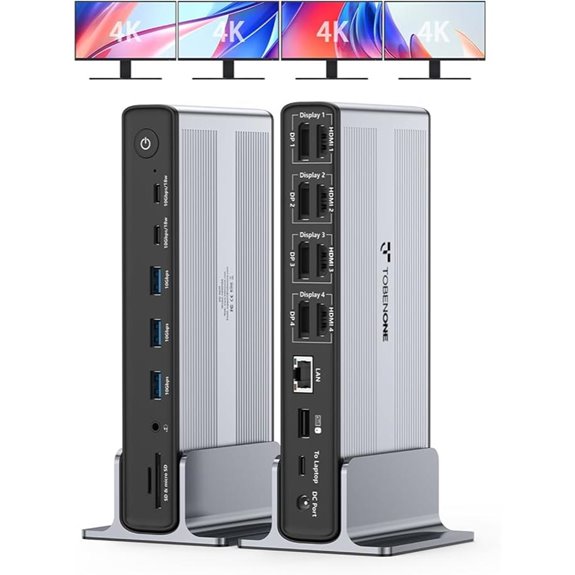
For professionals who need to connect multiple high-resolution monitors and peripherals seamlessly, the TobenONE 4K Docking Station stands out with its 20 ports and robust compatibility. It supports Windows 10+, MacBooks, Mac Minis, Android devices, and Thunderbolt 3, 4, 5, USB4, and USB-C, though Linux/Unix isn’t supported. With four HDMI and four DisplayPort outputs, you can connect up to four 4K displays at 60Hz (three on M1 Macs). Its extensive ports include USB, SD card slots, Ethernet, and audio, all powered by a 150W adapter that delivers 100W charging. Long-term support and a two-year warranty make it a reliable hub for demanding workflows.
Plugable 16-in-1 Thunderbolt 4 Dock with Dual 4K Monitors
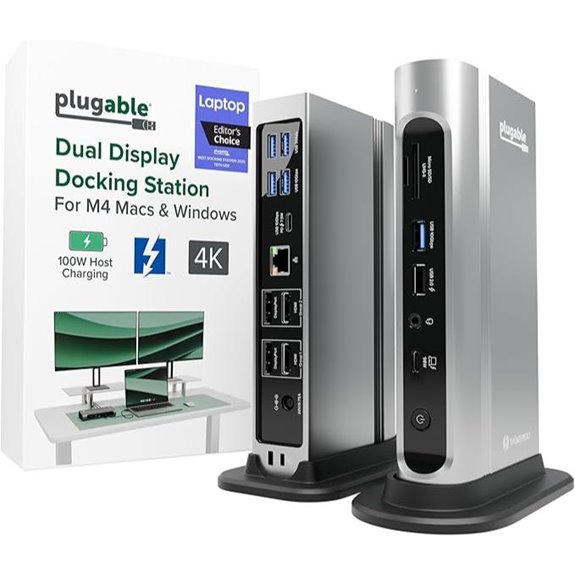
If you need a reliable docking station that seamlessly supports dual 4K monitors, the Plugable 16-in-1 Thunderbolt 4 Dock is an excellent choice. It offers plug-and-play simplicity, supporting dual 4K 60Hz displays via HDMI and DisplayPort. Compatible with macOS 11+, Windows 10+, Thunderbolt 4/5, USB4, and USB-C laptops, it includes a 40Gbps Thunderbolt 4 cable for easy setup. With 100W Power Delivery, it charges your laptop while you work. The dock also features multiple USB ports, 2.5G Ethernet, SD/microSD card readers, and audio, making it perfect for multitasking and professional workflows.
Dell WD22TB4 Thunderbolt 4 Docking Station Bundle
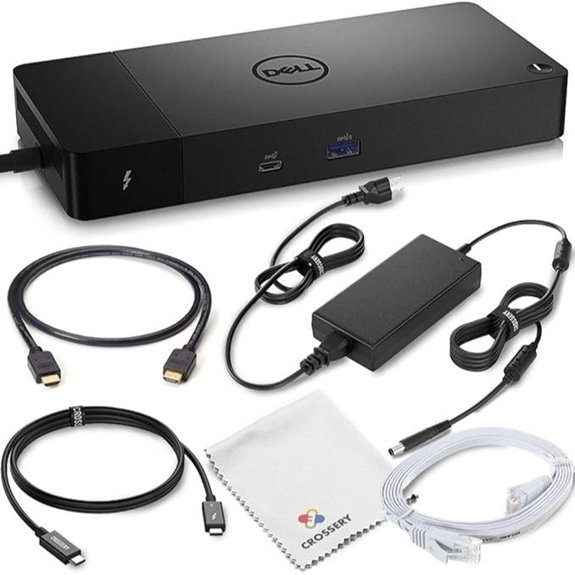
The Dell WD22TB4 Thunderbolt 4 Docking Station Bundle stands out as an ideal choice for professionals who need reliable, high-speed connectivity and versatile display support. It supports Thunderbolt 4, USB-C, and dual monitor setups, compatible with Windows and MacOS laptops. The extensive port selection includes USB-C, USB-A, DisplayPort, HDMI, Ethernet, and Thunderbolt 4, allowing for up to three 4K displays or one 5K monitor. With high-speed data transfer, fast charging via ExpressCharge, and a complete bundle of accessories, this dock enhances productivity and simplifies setup, making it perfect for demanding work environments.
Plugable Thunderbolt 4 Dock for MacBook Air & Pro
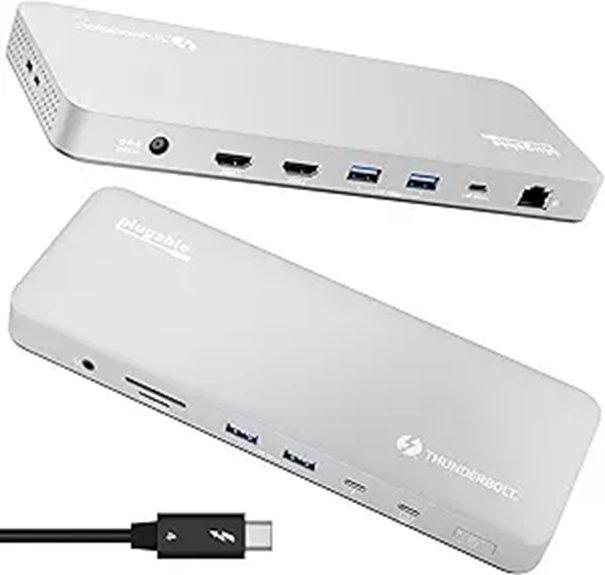
The Plugable Thunderbolt 4 Dock stands out as the ideal choice for MacBook users who need a seamless, high-performance connection hub. It’s compatible with M1, M2, M3 MacBooks, as well as Windows systems with Thunderbolt 4 or USB4. The dock supports dual 4K displays or a single 6K monitor, perfect for video editing and multitasking. With 13 ports—including Thunderbolt 4, USB-A, SD card reader, Ethernet, and audio—and 100W charging, it reduces clutter and enhances productivity. Its sleek space gray aluminum design makes it both durable and stylish, suitable for home, studio, or enterprise setups.
Plugable Thunderbolt 4 Dock with 100W Charging

For professionals seeking a reliable, high-performance dock that simplifies multiple connections, the Plugable Thunderbolt 4 Dock with 100W Charging stands out as an ideal choice. Certified as Thunderbolt and awarded Best Thunderbolt Dock 2025 by Wirecutter, it offers ultra-fast 40Gbps speeds and 13 versatile ports, including dual 4K HDMI displays or an 8K monitor. With 100W Power Delivery (96W certified), it guarantees your laptop stays charged during demanding tasks. Compatible with Thunderbolt 4, Thunderbolt 5, USB4, Windows, and top Macs, it’s perfect for modern setups requiring high-speed data, reliable charging, and extensive connectivity.
Dell Thunderbolt 4 Smart Dock SD25TB4 (130W, 4K, 4 Displays)

If you’re setting up a multi-monitor workspace with a Thunderbolt dock, the Dell Thunderbolt 4 Smart Dock SD25TB4 stands out thanks to its support for up to four 4K displays, making it ideal for professionals who need extensive screen real estate. It offers versatile connectivity with HDMI 2.1, DisplayPort 1.4, USB-C, and Thunderbolt 4, enabling seamless multi-monitor setups. Dual Thunderbolt 4 ports allow chaining up to six devices, while high-speed data ports ensure quick transfers. With up to 130W power delivery, it charges Dell devices rapidly and supports 96W for others. Its robust security features and eco-friendly design make it a reliable, efficient choice for demanding workflows.
Belkin Thunderbolt 3 Dock Mini with Ethernet

With its ability to support dual 4K monitors at 60Hz through just one Thunderbolt 3 connection, the Belkin Thunderbolt 3 Dock Mini with Ethernet is an excellent choice for professionals seeking a streamlined, high-performance workstation. It offers multiple ports for monitors, Ethernet, and peripherals, making setup straightforward. Compatible with both MacOS and Windows, it delivers transfer speeds up to 40Gbps, ensuring fast data transfer and efficient workflows. The dock’s compact design and included cable simplify workspace organization, while supporting device charging keeps productivity uninterrupted. Overall, it’s a versatile, reliable solution for creating a powerful, clutter-free multi-monitor setup.
Plugable 13-in-1 USB-C Dock with Triple 4K Monitors
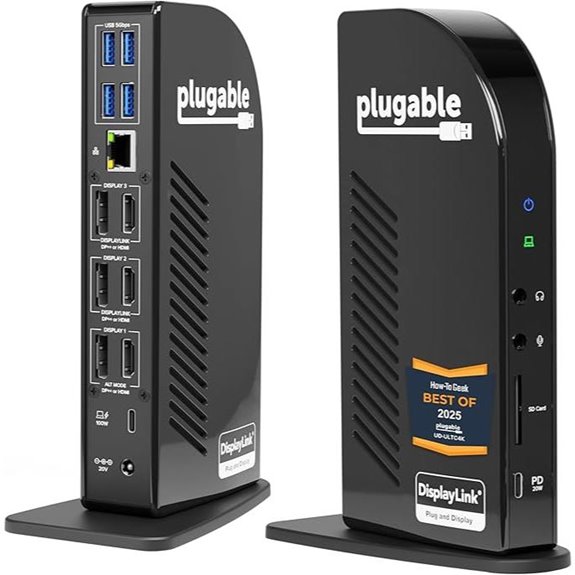
The Plugable 13-in-1 USB-C Dock stands out as an ideal choice for professionals who need an extensive docking solution that supports triple 4K monitors. It offers three 4K displays at 60Hz via HDMI and DisplayPort, providing sharp, smooth visuals. The dock connects through a single 10Gbps USB-C cable, simplifying setup and reducing clutter. With 100W power delivery, it can charge your laptop while in use, eliminating the need for extra adapters. Its versatile ports include USB-A, Ethernet, SD card reader, and audio, making it perfect for a busy workspace. Compatibility with Thunderbolt and USB4 laptops guarantees broad usability across devices.
Thunderbolt 4 Dock with DisplayLink, 21-in-1 USB-C/A

For users seeking versatile connectivity and high-resolution display support, the Thunderbolt 4 Dock with DisplayLink, 21-in-1 USB-C/A stands out as an excellent choice. It supports up to 150W charging, 40Gbps data transfer, and handles 8K or multiple 4K displays, making it ideal for demanding setups. Compatible with most laptops using 8th Gen Intel processors or newer, it offers broad device support. With dual or triple monitor configurations and fast charging capabilities, this dock simplifies workspace organization. Backed by a 12-month warranty and positive customer feedback, it provides reliable performance for both work and entertainment, making it a valuable addition to any high-performance setup.
StarTech Dual-Monitor Thunderbolt Mini Dock
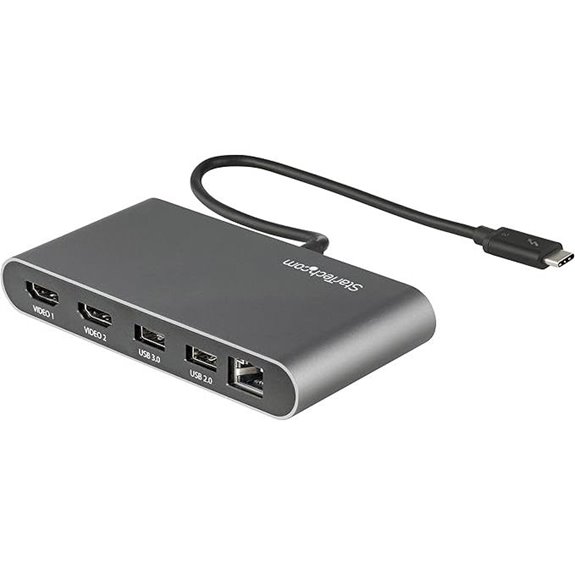
If you need a reliable, plug-and-play solution for dual 4K displays, the StarTech Dual-Monitor Thunderbolt Mini Dock stands out as an excellent choice. It offers Thunderbolt 3 certification, ensuring seamless compatibility with Windows, macOS, Ubuntu, and Thunderbolt or USB4 laptops, including recent MacBooks and iPad Pro M1+. With support for two 4K 60Hz HDMI outputs, it delivers GPU-level performance without compression. The dock also includes essential ports like USB 5Gbps, USB 2.0, and Gigabit Ethernet, plus an extended 11-inch cable for better reach. Built for enterprise use, it’s perfect for professionals needing a durable, high-performance docking solution.
Minthouz Thunderbolt 4 Dock with 8K/4K Displays

When aiming for high-resolution multitasking, the Minthouz Thunderbolt 4 Dock stands out with its ability to support a single 8K@60Hz display or three 4K@60Hz monitors through Thunderbolt 4. It offers an all-encompassing 12-in-1 port setup, including Thunderbolt 4, HDMI, USB-C, USB-A, Ethernet, SD/TF card slots, and a phone jack. This makes it perfect for creative professionals needing multiple high-res screens and fast data transfer. With 96W Power Delivery and broad system compatibility, it simplifies workspace setup without sacrificing performance or connectivity, making it an excellent hub for demanding workflows.
Factors to Consider When Choosing a Monitor for Thunderbolt Dock Setup

When choosing a monitor for your Thunderbolt dock, I focus on compatibility with display resolutions and the connectivity options I need. I also consider the screen size that suits my workspace and the performance specs like refresh rate. Finally, I look at power delivery and port support to make sure everything works seamlessly together.
Display Resolution Compatibility
Choosing the right monitor for a Thunderbolt dock setup starts with ensuring that its maximum resolution aligns with your dock’s supported display outputs. You need to verify if your dock can handle resolutions like 4K, 5K, or even 8K to get the best image quality. It’s also important to check whether the dock supports multiple displays at specific resolutions, such as dual 4K@60Hz or a single 8K@60Hz, to match your multi-monitor needs. Make sure the monitor’s native resolution matches what your dock can output to avoid performance issues. Finally, confirm the monitor supports compatible input standards like HDMI 2.1 or DisplayPort 1.4 for seamless connectivity. High-resolution monitors may also require specific hardware or system configurations to perform at their best.
Connectivity Options Needed
Selecting a monitor for your Thunderbolt dock setup requires careful attention to connectivity options to guarantee seamless performance. First, verify the monitor has compatible video input ports like HDMI, DisplayPort, or Thunderbolt that match your dock’s output. This prevents connection issues and maximizes compatibility. Next, consider if the monitor supports high-resolution displays such as 4K or 8K to fully leverage Thunderbolt’s high-speed data transfer. If you need additional connectivity, confirm the presence of USB ports and Ethernet ports built into the monitor, which can simplify your workspace. Also, check if the monitor supports power delivery to charge devices or daisy-chaining multiple displays via Thunderbolt, reducing clutter and increasing efficiency. Prioritizing these connectivity options helps create a reliable, versatile, and streamlined setup.
Screen Size Preferences
The size of your monitor considerably impacts your overall workspace and comfort during extended use. Larger monitors, like 27 inches or more, offer ample screen space for multitasking and detailed work, boosting productivity. Smaller monitors, such as 24 inches or less, are more compact and ideal if you have limited desk space or need portability. Your viewing distance should influence your choice; bigger screens work well when viewed from closer, while smaller ones suit setups where you sit farther away. If you use multiple monitors, matching their sizes helps create a seamless visual experience. Ultimately, consider your workspace layout and comfort—select a size that fits well on your desk and minimizes eye strain during long sessions.
Performance and Refresh Rate
When setting up a monitor with a Thunderbolt dock, paying attention to performance and refresh rate is essential for a smooth visual experience. A higher refresh rate, like 60Hz or above, ensures motion looks smoother and reduces blur, especially during fast scenes. For gaming or professional video editing, 120Hz or higher offers more responsiveness and fluidity. It’s important to verify that the monitor supports your desired refresh rate through DisplayPort or HDMI, as compatibility impacts performance. Keep in mind that GPU capabilities and bandwidth limitations can restrict achievable refresh rates at higher resolutions such as 4K or 8K. Additionally, adaptive sync technologies like FreeSync or G-Sync help minimize screen tearing, providing a better experience during intense visual tasks.
Power and Port Support
Ensuring your monitor’s power input matches the dock’s power delivery is crucial for reliable operation and charging. I always check that the monitor supports the dock’s power output—whether it’s 60W, 96W, or 130W—to avoid power issues. It’s essential that the monitor supports the necessary video output standards like Thunderbolt 3, Thunderbolt 4, USB-C, HDMI, or DisplayPort, guaranteeing compatibility with your dock. I also verify the monitor’s maximum resolution and refresh rate, making sure they align with what the dock can deliver, such as 4K@60Hz or 8K@60Hz. Additionally, I confirm the monitor has enough ports or supports daisy-chaining for multi-monitor setups. Proper power and port support ensure a seamless, efficient work environment.
Frequently Asked Questions
Which Monitor Size Is Optimal for Productivity and Space?
I believe a 27-inch monitor is ideal for productivity and space. It offers enough screen real estate to multitask efficiently without overwhelming your desk. Plus, it’s compact enough to fit comfortably in most workspaces. I find that this size balances clarity and workspace, making it easier to focus and switch between tasks. If you need more room, a 32-inch monitor could work, but 27 inches hits the sweet spot for most setups.
How Does Refresh Rate Impact Multi-Monitor Setups?
A higher refresh rate makes my multi-monitor setup smoother, especially when I’m scrolling or moving windows across screens. It reduces motion blur and lag, which helps me stay focused and productive. For fast-paced tasks like gaming or video editing, I prefer 120Hz or higher. But for general work, 60Hz often suffices. Overall, a better refresh rate enhances my experience and minimizes eye strain during extended use.
Are Certain Monitor Brands More Compatible With Thunderbolt Docks?
Yes, some monitor brands tend to be more compatible with Thunderbolt docks. I’ve found that brands like Apple, LG, and Dell often provide better compatibility because they prioritize Thunderbolt integration and quality. To guarantee smooth performance, I recommend checking for Thunderbolt 3 or 4 support and reading user reviews. This way, you’ll avoid potential connection issues and get a reliable setup that maximizes your dock’s capabilities.
What Is the Ideal Resolution for Dual or Multiple Monitor Setups?
The ideal resolution for dual or multiple monitor setups is at least 1080p, but I recommend 1440p or 4K for sharper images and more workspace. Higher resolutions like 4K make multitasking easier and improve visual clarity, especially for creative or professional tasks. I find that using monitors with similar resolutions helps maintain a seamless experience, preventing frustration caused by mismatched display quality.
How Do Color Accuracy and Panel Type Affect Creative Work?
Honestly, if your creative work relies on color perfection, you can’t ignore color accuracy and panel type. I’ve learned that accurate colors and IPS panels make a world of difference—your images come alive with true-to-life hues, and details stay sharp across angles. Skipping these? Well, you might as well be painting in the dark. For serious projects, invest in monitors that prioritize precise color reproduction and rich panel technology.
Conclusion
After exploring these top monitors for a thunderbolt dock setup, I believe the key isn’t just specs but how well they fit your workflow. notably, some experts argue that higher resolution alone doesn’t guarantee better productivity—it’s about synergy between the dock, monitor, and your tasks. So, whether you choose a 4K or an 8K display, focus on compatibility and your specific needs. Ultimately, a well-chosen monitor can transform your setup into a powerhouse of efficiency.