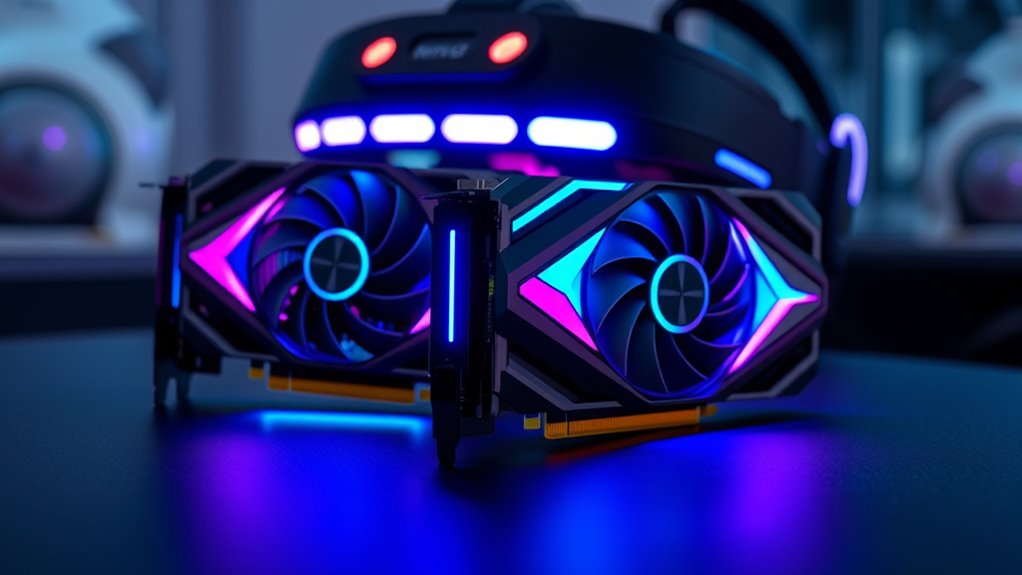
Choosing a GPU for VR that excels with supersampling means balancing raw power, cooling efficiency, and compatibility. Top contenders like the ASUS Prime Radeon RX 9070 XT and GIGABYTE RTX 5080 offer ample VRAM and advanced features but come with tradeoffs in size or cost. Meanwhile, the NVIDIA RTX 3090 remains the king for demanding workloads, but its high power needs and size can be prohibitive. In this roundup, I focus on these options to help you identify which GPU best aligns with your VR ambitions and build constraints.

Get the latest gadgets delivered free with Prime
- Fast, free delivery on millions of items
- Prime Video, Amazon Music and more included
- Member-only deals all year
Complete the kit



Key Takeaways
- The ASUS Prime Radeon RX 9070 XT offers robust cooling and OC headroom for high-fidelity VR with supersampling.
- The ASUS Dual GeForce RTX 4070 Super EVO balances performance and efficiency, making it ideal for mid-range VR setups.
- The GIGABYTE Radeon RX 9070 XT stands out with 16GB VRAM and PCIe 5.0, perfect for high-resolution VR but larger in size.
- The GIGABYTE RTX 5080 provides cutting-edge DLSS 4 support, suited for the most demanding VR experiences.
- The NVIDIA RTX 3090 remains relevant for ultra-high-end VR, though its size and power draw limit compatibility.
| ASUS Prime Radeon RX 9070 XT 16GB GDDR6 OC Edition Gaming Graphics Card |  | Best Overall for High-Performance VR with Supersampling | Memory: 16GB GDDR6 | Boost Clock (OC Mode): up to 3030 MHz | Form Factor: 2.5-slot | VIEW ON AMAZON | See Our Full Breakdown |
| ASUS Dual GeForce RTX 4070 Super EVO OC Edition 12GB GDDR6X |  | Best Mid-Range VR GPU with Advanced Features | GPU: NVIDIA GeForce RTX 4070 Super | Memory: 12GB GDDR6X | Boost Clock: 2550 MHz | VIEW ON AMAZON | See Our Full Breakdown |
| GIGABYTE Radeon RX 9070 XT Gaming OC 16G |  | Best for High-Res VR and 8K Support | Memory: 16GB GDDR6 | GPU Clock Speed: 3060 MHz | Interface: PCIe 5.0 | VIEW ON AMAZON | See Our Full Breakdown |
| GIGABYTE GeForce RTX 5080 Gaming OC 16G |  | Best for Cutting-Edge Performance and DLSS 4 | GPU: NVIDIA GeForce RTX 5080 | Memory: 16GB GDDR7 | Interface: PCIe 5.0 | VIEW ON AMAZON | See Our Full Breakdown |
| NVIDIA GeForce RTX 3090 Founders Edition |  | Best for Ultra-High-End VR and Demanding Workloads | Video Memory: 24GB GDDR6X | Memory Interface: 384-bit | Outputs: DisplayPort x3, HDMI 2.1 | VIEW ON AMAZON | See Our Full Breakdown |
| gpu for vr with supersampling | Memory | Cooling |
|---|---|---|
| ASUS Prime Radeon RX 9070 XT 1 | 16GB GDDR6 | Axial-tech fans, phase-change thermal pad |
| ASUS Dual GeForce RTX 4070 Sup | 12GB GDDR6X | Axial-tech fans |
| GIGABYTE Radeon RX 9070 XT Gam | 16GB GDDR6 | WINDFORCE with Hawk Fan |
| GIGABYTE GeForce RTX 5080 Gami | 16GB GDDR7 | WINDFORCE |
| NVIDIA GeForce RTX 3090 Founde | — | — |
More Details on Our Top Picks
ASUS Prime Radeon RX 9070 XT 16GB GDDR6 OC Edition Gaming Graphics Card
The ASUS Prime Radeon RX 9070 XT stands out for its strong cooling capabilities and high boost clocks, making it a solid choice for VR with supersampling. Its 16GB of GDDR6 memory ensures ample headroom for high-res textures and supersampling workloads, which are critical in VR to maintain clarity. The dual BIOS and phase-change thermal pad contribute to stable performance and quieter operation, especially during extended sessions. Compared with other options, it offers a good balance of cooling, power, and performance, though its 2.5-slot design can be tight in smaller cases. Overall, it’s an excellent choice for enthusiasts who want high frame fidelity without sacrificing thermals or noise.
Pros:- Effective cooling with Axial-tech fans and phase-change thermal pad
- Dual BIOS for performance or quiet operation
- High boost clocks up to 3030 MHz in OC mode
- 16GB VRAM ideal for high-res VR and supersampling
Cons:- 2.5-slot design may limit compatibility in compact cases
- Potentially high power draw, requiring a robust PSU
Best for: High-end VR users seeking maximum performance with reliable cooling
Not ideal for: Small form factor builds or those on a tight budget
- Memory:16GB GDDR6
- Boost Clock (OC Mode):up to 3030 MHz
- Form Factor:2.5-slot
- Cooling:Axial-tech fans, phase-change thermal pad
- BIOS:Dual BIOS
- Software:GPU Tweak III
Our verdict“This card offers excellent cooling and clock speeds, making it a top pick for demanding VR with supersampling.”
ASUS Dual GeForce RTX 4070 Super EVO OC Edition 12GB GDDR6X
The ASUS Dual GeForce RTX 4070 Super EVO brings NVIDIA’s latest architecture with DLSS 3 support and efficient cooling, making it suitable for VR users who want high performance without the premium price of flagship cards. Its 12GB of GDDR6X memory pairs well with DLSS 3 to boost frame rates significantly, especially useful in supersampling scenarios that demand extra GPU headroom. Its Axial-tech fans and 0dB tech keep noise levels low during light workloads, but the 2.5-slot design might limit compatibility with some compact cases. It’s an excellent fit for gamers who want a future-proof VR experience at a more accessible price point.
Pros:- DLSS 3 support for up to 4x performance gains in VR
- Efficient cooling with Axial-tech fans and quiet operation
- Factory overclocked to 2550 MHz boost clock
- 3-year warranty included
Cons:- Limited VRAM for extreme 4K workloads
- 2.5-slot design may restrict case compatibility
Best for: Enthusiast VR users seeking a balance of performance and value
Not ideal for: Users needing maximum VRAM or working in very compact cases
- GPU:NVIDIA GeForce RTX 4070 Super
- Memory:12GB GDDR6X
- Boost Clock:2550 MHz
- Architecture:Ada Lovelace
- Features:DLSS 3, Ray Tracing
- Cooling:Axial-tech fans
Our verdict“A well-rounded choice offering NVIDIA’s latest tech for smoother VR with supersampling at a reasonable price.”
GIGABYTE Radeon RX 9070 XT Gaming OC 16G
The GIGABYTE Radeon RX 9070 XT Gaming OC offers 16GB of GDDR6 memory and PCIe 5.0 interface, making it perfect for high-resolution VR and supersampling. Its WINDFORCE cooling system with Hawk fans ensures effective heat dissipation during intensive VR sessions. The large VRAM and high GPU clock (3060 MHz) make it suitable for demanding VR titles and high-quality textures. The card’s sizable dimensions, however, could pose challenges in smaller cases. If your setup supports its size, it provides superb performance for immersive VR experiences with maximum detail.
Pros:- Large 16GB GDDR6 VRAM for high-res textures and supersampling
- Advanced cooling with server-grade thermal gel
- Supports up to 8K resolution for future-proof VR
- Customizable RGB lighting
Cons:- Large dimensions may limit compatibility
- Requires a spacious case and high-wattage PSU
Best for: High-end VR setups requiring maximum resolution and VRAM
Not ideal for: Compact or budget-conscious builds
- Memory:16GB GDDR6
- GPU Clock Speed:3060 MHz
- Interface:PCIe 5.0
- Max Resolution:7680 x 4320
- Cooling:WINDFORCE with Hawk Fan
- Outputs:DisplayPort
Our verdict“A top-tier choice for high-resolution VR with extensive VRAM and cooling, ideal for high-end rigs.”
GIGABYTE GeForce RTX 5080 Gaming OC 16G
The GIGABYTE RTX 5080 Gaming OC represents NVIDIA’s latest Blackwell architecture, equipped with 16GB of GDDR7 memory and PCIe 5.0, making it suitable for the most demanding VR applications with supersampling. Its DLSS 4 support and 4th Gen Tensor Cores translate into impressive frame rate boosts, especially in graphically intensive VR titles. The WINDFORCE cooling system manages thermal output effectively, but as a flagship, it commands a premium price and high power requirements. This GPU is built for enthusiasts who want the best possible VR experience with maximum detail and performance.
Pros:- Latest NVIDIA Blackwell architecture with DLSS 4
- High bandwidth 16GB GDDR7 memory
- PCIe 5.0 for future-proofing
- Effective WINDFORCE cooling
Cons:- Expensive compared to mid-range options
- High power consumption
Best for: High-end VR users wanting the latest tech and highest performance
Not ideal for: Budget-conscious buyers or small form factor builds
- GPU:NVIDIA GeForce RTX 5080
- Memory:16GB GDDR7
- Interface:PCIe 5.0
- Architecture:Blackwell
- DLSS:DLSS 4
- Cooling:WINDFORCE
Our verdict“This GPU offers top-tier performance with cutting-edge features, ideal for serious VR enthusiasts willing to invest.”
NVIDIA GeForce RTX 3090 Founders Edition
The NVIDIA GeForce RTX 3090 Founders Edition remains a reference for VR professionals and enthusiasts needing maximum VRAM for supersampling and high-detail textures. Its 24GB of GDDR6X memory and 384-bit memory interface deliver unmatched bandwidth, making it suitable for the most demanding VR titles and workflows. Its large size, high power draw, and premium price point are tradeoffs, but for those with a spacious case and power supply, it offers unmatched performance for immersive, high-resolution VR experiences. It’s the choice for users who won’t compromise on detail or future-proofing.
Pros:- 24GB GDDR6X for demanding VR and creative workloads
- High bandwidth with 384-bit interface
- Supports multiple high-resolution outputs
- Very reliable and long-lasting warranty
Cons:- Huge size and high power requirements
- Very expensive for most users
Best for: High-end VR professionals and enthusiasts seeking maximum VRAM and performance
Not ideal for: Small cases, budget-conscious buyers, or standard gaming rigs
- Video Memory:24GB GDDR6X
- Memory Interface:384-bit
- Outputs:DisplayPort x3, HDMI 2.1
- Size:Very large
- Warranty:3 years
Our verdict“A powerhouse for demanding VR workloads, best suited for users with the space and budget to handle its size and power.”
How We Picked
My selection process focused on GPUs that deliver strong supersampling performance in VR, considering factors like VRAM, processing power, cooling solutions, and compatibility. I prioritized models with recent architectures supporting advanced features such as DLSS and ray tracing, essential for high-quality VR. I also examined cooling efficiency, form factor, and power requirements to ensure these cards are suitable for a range of VR setups—from compact builds to high-end rigs. The goal was to identify options that balance performance, reliability, and value, highlighting the tradeoffs each presents.
| gpu for vr with supersampling | Cooling |
|---|---|
| ASUS Prime Radeon RX 9070 XT 1 | Axial-tech fans, phase-change thermal pad |
| ASUS Dual GeForce RTX 4070 Sup | Axial-tech fans |
| GIGABYTE Radeon RX 9070 XT Gam | WINDFORCE with Hawk Fan |
| GIGABYTE GeForce RTX 5080 Gami | WINDFORCE |
| NVIDIA GeForce RTX 3090 Founde | — |
Factors to Consider When Choosing Gpu For Vr With Supersampling
Choosing the right GPU for VR with supersampling involves balancing performance, compatibility, and future-proofing. The key is to consider your VR headset’s resolution, your case size, and whether you prioritize raw power or efficiency. High VRAM is essential for supersampling, but recent architectures also offer AI-driven features like DLSS for smoother performance. Cooling solutions and power requirements are equally important, especially for high-end models. With these factors in mind, I’ve broken down the most relevant considerations for different user needs.
Performance and VRAM
For VR with supersampling, high frame rates and ample VRAM are non-negotiable. Aim for at least 12GB of VRAM if you plan on running at high resolutions or with aggressive supersampling settings. Top-tier options like the GIGABYTE RX 9070 XT or RTX 5080 provide the horsepower needed for the most demanding VR titles, but they come with size and cost considerations. Mid-range cards, such as the ASUS RTX 4070 Super EVO, can handle most VR workloads comfortably while offering better value for casual or mid-tier setups.
Cooling and Size
Effective cooling is vital to prevent thermal throttling during extended VR sessions. Most high-performance cards use axial-tech fans or advanced cooling systems like GIGABYTE’s WINDFORCE. However, size matters—large cards like the RTX 5080 or RX 9070 XT can be problematic in small cases. If space is limited, look for models with a slim profile or those that support a dual-fan cooling system compatible with your case dimensions.
Features and Future-Proofing
Features like DLSS 3, ray tracing, and PCIe 5.0 support enhance VR realism and performance. The RTX 5080 offers the latest DLSS 4 and architecture, making it ideal for users who want maximum longevity. Meanwhile, the RX 9070 XT supports high resolutions and supersampling with robust software and cooling features. Consider your VR headset’s resolution and your plans for future VR titles when evaluating these options.
Frequently Asked Questions
Why is VRAM important for VR with supersampling?
VRAM determines how much high-resolution textures and supersampling data your GPU can handle simultaneously. For VR, especially with supersampling enabled, larger VRAM allows for higher quality textures and smoother performance without stuttering or artifacts. Typically, 12GB or more is recommended for demanding VR workloads, with 16GB+ providing extra headroom for future titles.
How does cooling affect VR performance?
Cooling directly impacts the GPU’s ability to sustain high clock speeds during long VR sessions. Overheating causes thermal throttling, which reduces performance and can lead to less stable visuals. Effective cooling solutions like axial-tech fans or custom heatsinks keep temperatures in check, ensuring consistent frame rates and a more comfortable VR experience.
Is size a concern when choosing a GPU for VR?
Yes, especially with high-end models like the RX 9070 XT or RTX 5080. Larger cards may not fit in smaller cases or compact builds, limiting options for some users. Always check your case’s dimensions and compatibility before selecting a GPU, and consider models with a smaller profile if space is tight.
Should I prioritize DLSS or raw power for VR?
DLSS enhances performance by upscaling lower-resolution images using AI, which is very effective in VR for maintaining high frame rates with supersampling. If your VR setup supports DLSS, it’s often more practical than relying solely on raw GPU power. However, for maximum fidelity and future-proofing, a powerful GPU with high raw performance remains advantageous.
Are flagship GPUs worth it for VR?
Flagship GPUs like the RTX 3090 or RTX 5080 provide unmatched VRAM and processing power, ideal for ultra-high-resolution VR and demanding applications. But they come with high costs and size considerations. For most users, high-end but more affordable options like the RTX 4070 Super EVO or RX 9070 XT offer excellent performance without overextending their budget or case size.
Conclusion
For casual or mid-range VR users, the ASUS Dual GeForce RTX 4070 Super EVO offers a compelling mix of features and affordability. Enthusiasts aiming for maximum detail and future-proofing should consider the GIGABYTE RTX 5080 or RX 9070 XT, depending on preference for NVIDIA or AMD architectures. Power users with large cases and demanding workloads will find the NVIDIA RTX 3090 or GIGABYTE RX 9070 XT to be the best fit. Ultimately, your choice hinges on balancing budget, case size, and performance goals in your VR setup.
Columbus Day / Indigenous Peoples' Day Picks
long weekend sales
As an affiliate, we earn on qualifying purchases.