
The best emergency radios keep weather alerts and essential power within reach when ordinary services are unavailable. My best overall pick is the Midland ER310, which offers a focused emergency-radio design, while the Midland ER310PRO adds Bluetooth for buyers who want extra everyday utility. For a larger built-in power reserve, the 12,000mAh solar and hand-crank models stand out, though capacity claims do not tell you how long a radio will run or how quickly it will recharge. The main tradeoffs are battery capacity versus portability, extra functions versus simple operation, and multiple charging methods versus dependable performance in real conditions. Read on for the full breakdown and a guide to choosing the right radio for your household.

Get the latest gadgets delivered free with Prime
- Fast, free delivery on millions of items
- Prime Video, Amazon Music and more included
- Member-only deals all year
Complete the kit



Key Takeaways
- The Midland ER310 leads this lineup because it is a purpose-built emergency radio, while the ER310PRO’s Bluetooth adds convenience rather than replacing emergency-focused features.
- Several models advertise 10,000–12,000mAh batteries, but those figures alone do not establish radio runtime, phone-charging output, or how much power solar and hand-crank charging can restore.
- Charging variety is a recurring strength: many options combine a rechargeable battery, solar panel, and hand crank, but each method has different practical limits and should be treated as backup rather than guaranteed power.
- Alert and tuning capabilities vary more than the shared emergency-radio label suggests; the Raynic model listing shortwave alongside AM/FM and NOAA offers a broader band mix than simpler radios.
- Built-in features create clear tradeoffs: SOS alarms, flashlights, Bluetooth, and built-in cables can add usefulness, but buyers should weigh those extras against size, operating simplicity, and the radio’s core alerting role.
| Emergency Weather Radio with Solar Panel and 12,000 mAh Battery | 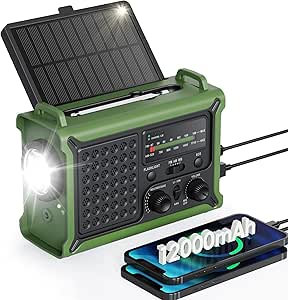 | Best Overall | Battery capacity: 12,000 mAh | Radio bands: AM/FM and 7 NOAA bands | Charging options: USB-C, solar panel, hand crank, built-in battery, AAA batteries | VIEW ON AMAZON | See Our Full Breakdown |
| Leaton Hand Crank Emergency Weather Radio with 10,000mAh Battery |  | Best Compact Pick | Battery capacity: 10,000 mAh | Radio bands: AM 520–1710 kHz, FM 87–108 MHz, NOAA 162.400–162.550 MHz | Charging methods: USB-C, solar, hand crank | VIEW ON AMAZON | See Our Full Breakdown |
| Emergency Weather Radio, 12000mAh Solar Hand Crank NOAA Radio, Army Green |  | Best Rugged Outdoor Pick | Battery capacity: 12,000 mAh | Radio bands: NOAA, AM, FM | Power sources: Solar, hand crank, USB-C, AAA batteries | VIEW ON AMAZON | See Our Full Breakdown |
| Raynic Emergency Weather Radio with Solar Charging, Hand Crank, and SOS Siren |  | Best for Automatic NOAA Alerts | Battery capacity: 5,000 mAh / 18,500 mWh | Radio bands: AM, FM, shortwave, NOAA weather | Charging options: Rechargeable battery, solar, hand crank, AAA batteries, USB | VIEW ON AMAZON | See Our Full Breakdown |
| 12000mAh Emergency Weather Radio with Hand Crank, Solar Charging, Flashlight, and SOS Alarm |  | Best for Bright Emergency Lighting | Battery capacity: 12,000 mAh | Radio bands: 7 NOAA weather channels, AM 520–1710 kHz, FM 87.5–108 MHz | Power options: USB-C, solar panel, hand crank, 3 AAA batteries | VIEW ON AMAZON | See Our Full Breakdown |
| Midland ER310 Emergency Crank Weather Radio, AM/FM, Red/Black |  | Best for Familiar, Straightforward Emergency Use | Radio bands: AM/FM | Power sources: Solar, hand crank, and six included AA batteries | Weather features: NOAA weather scan and alert | VIEW ON AMAZON | See Our Full Breakdown |
| 12000mAh Solar Emergency Hand Crank Radio with NOAA, AM/FM, Flashlight, and Phone Charger |  | Best for Lighting and Phone Backup | Battery capacity: 12,000mAh lithium battery | Radio bands: NOAA, FM, AM | Power sources: Solar panel, hand crank, USB-C input, or three AAA batteries | VIEW ON AMAZON | See Our Full Breakdown |
| Raynic Emergency Weather Radio with Solar Hand Crank, AM/FM/SW/NOAA Alert, 5000mAh Battery, Flashlight, and SOS Siren |  | Best for Band Variety and Portability | Battery capacity: 5,000mAh / 18,500mWh | Radio bands: AM, FM, shortwave, NOAA | Charging options: Solar, hand crank, AC adapter, USB-C, AAA batteries, and internal rechargeable battery | VIEW ON AMAZON | See Our Full Breakdown |
| Emergency Radio with Hand Crank, Solar Charging, NOAA, AM/FM, and 12,000mAh Battery |  | Best for Wet-Weather Readiness | Battery capacity: 12,000mAh | Radio bands: NOAA weather, AM/FM | Charging options: Solar, hand crank, USB-C | VIEW ON AMAZON | See Our Full Breakdown |
| FosPower A1 NOAA Emergency Weather Radio with Solar and Hand Crank, Orange |  | Best Compact, Simple Backup | Model: FOSPWB-2376 | Radio bands: AM/FM/weather band | Power sources: Solar, hand crank, AAA batteries, USB | VIEW ON AMAZON | See Our Full Breakdown |
| Emergency Radio Hand Crank Solar 10000mAh/37000mWh |  | Best for Emergency-Kit Extras | Battery capacity: 37,000mWh | Charging methods: Hand crank, solar, internal lithium-ion battery | Weather channels: 7 | VIEW ON AMAZON | See Our Full Breakdown |
| Midland ER310PRO Portable Emergency Weather Radio with Bluetooth |  | Best for Long Radio Listening | Model: ER310PRO | Radio bands: AM, FM, NOAA weather | Power bank capacity: 10,000mAh | VIEW ON AMAZON | See Our Full Breakdown |
| Hand Crank Emergency Radio with Solar Charging and Built-In Cables |  | Best for Charging Mixed Devices | Battery capacity: 7,400mWh (2,000mAh) | Power sources: USB-C, hand crank, solar, AAA batteries | Radio bands: AM, FM, weather band; 7-band | VIEW ON AMAZON | See Our Full Breakdown |
| Weather Radio Portable AM/FM NOAA Alert with Battery Backup and 12000mAh Power |  | Best for Flexible Backup Power | Radio bands: NOAA, AM, FM | Weather frequency: 162 MHz | Battery capacity: 12,000mAh lithium battery | VIEW ON AMAZON | See Our Full Breakdown |
| Dreamsky NOAA Emergency Radio Weather Alert with Hand Crank Solar |  | Best for Home Emergency Lighting | Battery capacity: 18,500mWh | Charging methods: AC wall power, solar, hand crank | Radio bands: AM, FM, weather band | VIEW ON AMAZON | See Our Full Breakdown |
| emergency radio | Radio bands | Battery capacity | Dimensions |
|---|---|---|---|
| Emergency Weather Radio with S | AM/FM and 7 NOAA bands | 12,000 mAh | — |
| Leaton Hand Crank Emergency We | AM 520–1710 kHz, FM 87–108 MHz, NOAA 162.400–162.550 MHz | 10,000 mAh | 6.3 × 3.5 × 3.1 inches |
| Emergency Weather Radio | NOAA, AM, FM | 12,000 mAh | Not specified |
| Raynic Emergency Weather Radio | AM, FM, shortwave, NOAA weather | 5,000 mAh / 18,500 mWh | — |
| 12000mAh Emergency Weather Rad | 7 NOAA weather channels, AM 520–1710 kHz, FM 87.5–108 MHz | 12,000 mAh | 4.7 × 2.9 × 6.8 inches |
| Midland ER310 Emergency Crank | AM/FM | — | 9.61 x 2.95 x 6.85 inches |
| 12000mAh Solar Emergency Hand | NOAA, FM, AM | 12,000mAh lithium battery | 6.8 x 4.7 x 2.9 inches |
| Raynic Emergency Weather Radio | AM, FM, shortwave, NOAA | 5,000mAh / 18,500mWh | 6.8 x 3.7 x 2.9 inches |
| Emergency Radio with Hand Cran | NOAA weather, AM/FM | 12,000mAh | 6.81 x 2.91 x 4.76 inches |
| FosPower A1 NOAA Emergency Wea | AM/FM/weather band | — | 6.2 x 2.1 x 2.9 inches |
| Emergency Radio Hand Crank Sol | — | 37,000mWh | — |
| Midland ER310PRO Portable Emer | AM, FM, NOAA weather | — | 8.1 × 2.8 × 3.4 in |
| Hand Crank Emergency Radio wit | AM, FM, weather band; 7-band | 7,400mWh (2,000mAh) | 6.49 × 1.9 × 2.9 in |
| Weather Radio Portable AM/FM N | NOAA, AM, FM | 12,000mAh lithium battery | 6.8 × 2.9 × 4.7 in |
| Dreamsky NOAA Emergency Radio | AM, FM, weather band | 18,500mWh | — |
More Details on Our Top Picks
Emergency Weather Radio with Solar Panel and 12,000 mAh Battery
This is my strongest all-around pick for a home emergency kit because it combines a 12,000 mAh battery with several ways to keep the radio and lights running: USB-C, solar, hand crank, and AAA batteries. Its AM/FM and seven NOAA bands cover everyday listening and weather information, while the flashlight, reading lamp, and SOS alarm add useful backup functions during an outage. Compared with the Leaton, this model offers a larger stated battery and NOAA alerts, though the Leaton is lighter and lists its dimensions. IPX6 water resistance also gives it a better fit for wet conditions than the Raynic’s IPX3 rating. The tradeoff is that solar and crank charging take favorable conditions or effort, and AAA batteries may need to be supplied separately.
Pros:- Four listed power routes, including USB-C, solar, hand crank, and AAA batteries
- 12,000 mAh battery can support the radio, lights, and emergency device charging
- Receives AM/FM broadcasts and seven NOAA bands
- Combines a flashlight, reading lamp, SOS alarm, and IPX6 water resistance
Cons:- AAA batteries may not be included
- Solar and hand-crank charging depend on sunlight or sustained manual effort
- No dimensions or weight are provided in the supplied product details
Best for: Households building a versatile storm kit that need several backup power options, lighting, and NOAA weather information in one device.
Not ideal for: Buyers who want verified size and weight details or rely on a radio that can run indefinitely from solar or hand-crank power.
- Battery capacity:12,000 mAh
- Radio bands:AM/FM and 7 NOAA bands
- Charging options:USB-C, solar panel, hand crank, built-in battery, AAA batteries
- Solar panel:8,500 mm² monocrystalline
- Flashlight:5 W adjustable beam
- Reading lamp:12 LEDs
- Water resistance:IPX6
- Enclosure material:ABS
Our verdict“Choose this as a flexible household emergency radio if you value its large stated battery, multiple backup power options, and IPX6 protection.”
Leaton Hand Crank Emergency Weather Radio with 10,000mAh Battery
The Leaton is the lineup’s more clearly specified compact choice: at 1.1 pounds and 6.3 × 3.5 × 3.1 inches, it is easier to place in a go-bag than the larger-battery options whose size is not listed. Its 10,000 mAh battery, USB-C, solar, and hand-crank charging provide useful backup flexibility, and a USB output can give a phone a limited emergency charge. A built-in compass adds a small outdoor-oriented extra. The key compromise is radio alerting: unlike the Raynic, which lists automatic NOAA alert scanning, the Leaton requires manual tuning and does not offer automatic or location-based alerts. Its IPX6 rating is also described as splash protection, not permission for immersion or heavy rain.
Pros:- Compact, specified size and 1.1-pound weight suit a packed emergency bag
- USB-C, solar, and hand-crank charging offer alternatives during outages
- Includes an LED flashlight, reading lamp, and built-in compass
- USB output supports emergency phone charging
Cons:- NOAA broadcasts require manual tuning; automatic and location-based alerts are not supported
- 5V/1A phone output and conversion losses limit its usefulness as a power bank
- No headphone jack, and the stated water protection is for splashes
Best for: Hikers and campers who want a compact emergency radio with stated dimensions, a compass, and several ways to recharge it.
Not ideal for: People who need automatic NOAA warnings, headphone listening, or dependable phone charging beyond a brief emergency top-up.
- Battery capacity:10,000 mAh
- Radio bands:AM 520–1710 kHz, FM 87–108 MHz, NOAA 162.400–162.550 MHz
- Charging methods:USB-C, solar, hand crank
- USB output:5 V/1 A
- Dimensions:6.3 × 3.5 × 3.1 inches
- Weight:1.1 lb (500 g)
- Lighting:Three-mode LED flashlight and 1.3 W reading lamp
- NOAA alerts:Manual tuning; no automatic or location-based alerts
- Water resistance:IPX6
Our verdict“Pick the Leaton for a compact, specified-size kit radio, but choose the Raynic instead if automatic NOAA alerts matter more than weight and portability.”
Emergency Weather Radio, 12000mAh Solar Hand Crank NOAA Radio, Army Green
This model is aimed at outdoor users who prioritize a tough-feeling emergency kit over detailed product documentation. Its listed 12,000 mAh battery, USB-C charging, solar panel, hand crank, and AAA option make it adaptable when one power source is unavailable. A flashlight, reading lamp, and SOS alarm cover practical needs around camp or during a blackout, while the description specifically identifies the housing as water-resistant and shock-resistant. Compared with the Leaton, this radio has a larger stated battery and a more rugged-use emphasis, but the Leaton provides dimensions, weight, and a defined IPX6 rating. The missing size and weight figures here make packing decisions less certain, and the supplied details do not specify alert behavior or speaker output.
Pros:- 12,000 mAh battery provides a substantial stated capacity for radio and lighting use
- Solar, hand-crank, USB-C, and AAA power options offer flexibility
- Water-resistant and shock-resistant design is suited to outdoor use
- Includes a flashlight, reading lamp, and SOS alarm
Cons:- Dimensions and weight are not specified, making pack fit difficult to judge
- Water resistance is not tied to a stated IP rating
- The supplied details do not specify automatic NOAA alerts or speaker output
Best for: Campers and outdoor preparedness buyers who want a large stated battery, multiple power sources, and a radio described as shock-resistant.
Not ideal for: Buyers who need published dimensions, a precise water-resistance rating, or confirmed details about automatic alerts and audio performance.
- Battery capacity:12,000 mAh
- Radio bands:NOAA, AM, FM
- Power sources:Solar, hand crank, USB-C, AAA batteries
- Solar panel:8,500 mm²
- Water resistance:Water-resistant; rating not specified
- Shock resistance:Shock-resistant
- Dimensions:Not specified
- Lighting and alert features:Flashlight, reading lamp, SOS alarm
Our verdict“Choose this for outdoor preparedness when rugged-use claims and multiple power options matter more than precise size, alert, and audio specifications.”
Raynic Emergency Weather Radio with Solar Charging, Hand Crank, and SOS Siren
The Raynic earns its place by addressing a key emergency-radio difference: it lists automatic NOAA alert scanning, so users do not have to rely solely on remembering to tune to a weather channel. It also receives AM, FM, and shortwave, giving it broader listening options than the Leaton, which lacks shortwave and requires manual NOAA tuning. An LCD display and headphone jack are useful additions for checking settings or listening privately. The tradeoff is a smaller stated 5,000 mAh battery than the 10,000 and 12,000 mAh options in this group, plus IPX3 protection that is less suited to wet outdoor use than the IPX6 radios. Product dimensions and weight are listed, but the source notes that these figures differ across product information.
Pros:- Automatic NOAA alert scanning reduces dependence on manual tuning
- AM, FM, shortwave, and NOAA reception provide a broad range of listening
- LCD display and 3.5 mm headphone jack add useful controls and private listening
- Includes solar, hand-crank, USB, rechargeable-battery, and AAA power options
Cons:- 5,000 mAh capacity is below the 10,000–12,000 mAh options in this batch
- IPX3 water resistance offers limited protection compared with IPX6 models
- Listed dimensions and weight differ between the description and product information
Best for: Preparedness buyers who want automatic NOAA alert scanning, shortwave reception, and a display for checking radio settings.
Not ideal for: People who expect heavy rain protection, a high-capacity phone-charging reserve, or fully consistent published size and weight details.
- Battery capacity:5,000 mAh / 18,500 mWh
- Radio bands:AM, FM, shortwave, NOAA weather
- Charging options:Rechargeable battery, solar, hand crank, AAA batteries, USB
- Display:LCD
- Connectivity:USB Type-C and 3.5 mm headphone jack
- Flashlight output:3 W
- Water resistance:IPX3
- Dimensions and weight:6.8 × 3.7 × 2.9 inches and 1.2 lb, as listed; source figures differ
Our verdict“Choose the Raynic if automatic NOAA alert scanning and shortwave matter more to you than larger battery capacity or stronger water protection.”
12000mAh Emergency Weather Radio with Hand Crank, Solar Charging, Flashlight, and SOS Alarm
This radio stands apart from the other 12,000 mAh models through its stated lighting output: a 300-lumen flashlight and 250-lumen reading light make it the clearest choice here for illuminating a room or campsite during a blackout. Its 115 dB SOS siren adds a loud signaling option, and USB-C, solar, hand-crank, and AAA power give owners several ways to keep the unit available. Compared with the first radio in this batch, it provides specific lumen figures and a listed listening-time estimate, but its NOAA alerts require the radio to be on and tuned to the weather band. The Raynic is a better fit for automatic alerts. The product is described as waterproof, though no IP rating is supplied, and a wall adapter is not included.
Pros:- 300-lumen flashlight and 250-lumen reading light provide clearly stated brightness
- 115 dB SOS siren offers a strong audible signaling feature
- 12,000 mAh battery and four listed power options support emergency use
- Lists FM listening time of up to 60 hours at 50% volume
Cons:- NOAA alerts require the radio to be on and tuned to a weather band
- Waterproof claim is not accompanied by an IP rating
- Wall adapter is not included
Best for: Households and campers who value bright backup lighting and a loud SOS signal alongside NOAA, AM, and FM reception.
Not ideal for: Buyers who need automatic NOAA alerts, a stated IP water-resistance rating, or an included wall adapter.
- Battery capacity:12,000 mAh
- Radio bands:7 NOAA weather channels, AM 520–1710 kHz, FM 87.5–108 MHz
- Power options:USB-C, solar panel, hand crank, 3 AAA batteries
- Solar panel area:8,500 mm²
- Flashlight brightness:300 lumens
- Reading light brightness:250 lumens
- SOS siren:115 dB
- FM listening time:Up to 60 hours at 50% volume
- Dimensions:4.7 × 2.9 × 6.8 inches
Our verdict“Pick this model if bright lighting and a loud SOS siren are your priorities, but favor the Raynic if automatic weather alerts are the deciding feature.”
Midland ER310 Emergency Crank Weather Radio, AM/FM, Red/Black
The Midland ER310 suits buyers who want established emergency features without the extra battery capacity found in the 12,000mAh options from this roundup. NOAA weather scan and alerts help it serve as a warning device as well as an AM/FM radio, while its solar, hand-crank, and included AA-battery power provide alternatives when wall power is unavailable. The SOS flashlight and ultrasonic dog whistle add signaling options that the FosPower A1 does not list, making this a more safety-feature-focused pick. At 16 ounces, it is still portable, though its 9.61-inch length takes more room than the smaller FosPower. The tradeoff is a lack of water resistance, and relying on disposable backup power means keeping six AA batteries ready.
Pros:- Scans for NOAA weather broadcasts and provides alerts
- Can run on solar, hand-crank power, or six included AA batteries
- SOS flashlight and ultrasonic dog whistle offer additional signaling options
- 16-ounce weight is manageable for a portable emergency kit
Cons:- Not water resistant, limiting use in wet outdoor conditions
- Six AA batteries are required for that backup power option
- No internal battery capacity is specified for phone charging
Best for: Households seeking NOAA alerts, several backup power choices, and added signaling features for an indoor emergency kit.
Not ideal for: Campers or storm-preparedness buyers who expect rain exposure, and anyone who wants a large built-in phone-charging battery.
- Radio bands:AM/FM
- Power sources:Solar, hand crank, and six included AA batteries
- Weather features:NOAA weather scan and alert
- Additional features:SOS flashlight and ultrasonic dog whistle
- Display:LED
- Connectivity:USB
- Dimensions:9.61 x 2.95 x 6.85 inches
- Weight:16 ounces
- Water resistance:Not water resistant
Our verdict“Choose the Midland ER310 for a portable, alert-focused kit with multiple power choices, but skip it if water protection or substantial phone charging is a priority.”
12000mAh Solar Emergency Hand Crank Radio with NOAA, AM/FM, Flashlight, and Phone Charger
This model is the strongest fit here for buyers who want an emergency radio to support a phone and illuminate a room, not just deliver weather updates. Its 12,000mAh battery and dual USB outputs give it a larger stated reserve than the Raynic radio’s 5,000mAh battery, while a separate reading lamp adds useful area lighting alongside the flashlight. NOAA, AM, and FM reception cover the core listening needs; the SOS alarm supplies another way to signal for help. Power options include solar, hand crank, USB-C, and three AAA batteries, although the product data does not provide runtime or charging-time figures. Compared with the more compact FosPower A1, this is heavier at 1.6 pounds, and its water resistance is not given an IP rating.
Pros:- 12,000mAh battery and dual USB outputs support phone charging
- Solar, hand-crank, USB-C, and AAA power choices provide flexibility
- Separate flashlight and reading lamp serve different lighting needs
- Receives NOAA, AM, and FM broadcasts
Cons:- No runtime or charging-time measurements are provided
- At 1.6 pounds, it is heavier than the 1.2-pound Raynic option
- Water resistance is stated without a specific rating
Best for: Campers and households who want a high-capacity phone-charging reserve, room lighting, and radio reception in one emergency device.
Not ideal for: Buyers who need a clearly rated level of water protection, verified runtime figures, or a lightweight radio for a small go-bag.
- Battery capacity:12,000mAh lithium battery
- Radio bands:NOAA, FM, AM
- Power sources:Solar panel, hand crank, USB-C input, or three AAA batteries
- USB-C input:5V/2A
- Lighting:LED flashlight and reading lamp, each with two brightness levels
- Additional features:SOS alarm and dual USB outputs for phone charging
- Dimensions:6.8 x 4.7 x 2.9 inches
- Weight:1.6 pounds
- Speaker output:5 watts
Our verdict“Pick this radio if phone backup and two kinds of lighting matter more than a lighter carry or clearly documented performance figures.”
Raynic Emergency Weather Radio with Solar Hand Crank, AM/FM/SW/NOAA Alert, 5000mAh Battery, Flashlight, and SOS Siren
The Raynic makes more sense for listeners who value AM, FM, shortwave, and NOAA reception in a relatively light emergency radio. Shortwave adds a listening option the Midland ER310 and FosPower A1 do not list, while the large LCD and automatic NOAA alerts make station information and weather warnings easier to check. Its six charging methods include solar, hand crank, USB-C, an AC adapter, AAA batteries, and the internal rechargeable battery, giving it more variety than models with fewer listed inputs. The compromise is capacity: at 5,000mAh, it has less stored power than the 12,000mAh radios in this batch. Its IPX3 rating offers limited splash protection rather than the stronger water protection claimed for the IPX6 option.
Pros:- AM, FM, shortwave, and NOAA bands provide the widest listed reception range in this batch
- Six charging options include USB-C, AC adapter, and AAA batteries
- Automatic NOAA alerts provide weather warnings without manual station checks
- At 1.2 pounds, it weighs less than the 1.6-pound 12,000mAh models
Cons:- 5,000mAh capacity is below the 12,000mAh options in this batch
- IPX3 protection is limited to light splashing
- AAA batteries are not included
Best for: Listeners who want shortwave alongside NOAA and local stations, plus a lighter radio for a home kit or outdoor bag.
Not ideal for: Buyers prioritizing a larger phone-charging reserve or protection against heavy water exposure.
- Battery capacity:5,000mAh / 18,500mWh
- Radio bands:AM, FM, shortwave, NOAA
- Charging options:Solar, hand crank, AC adapter, USB-C, AAA batteries, and internal rechargeable battery
- Display:Large HD LCD
- Lighting:3W flashlight and 2.5W reading lamp
- Connectivity:USB Type-C and 3.5mm headphone jack
- Dimensions:6.8 x 3.7 x 2.9 inches
- Weight:1.2 pounds
- Water resistance:IPX3
Our verdict“Choose the Raynic for shortwave reception and a lighter carry, but favor a 12,000mAh model if phone-charging capacity is the priority.”
Emergency Radio with Hand Crank, Solar Charging, NOAA, AM/FM, and 12,000mAh Battery
When exposure to rain or splashing is a concern, this radio’s IPX6 water resistance gives it a clearer advantage over the Raynic’s IPX3 rating and the non-water-resistant Midland ER310. Its 12,000mAh battery also supplies a substantial stated capacity for phone charging, with solar, hand-crank, and USB-C inputs available as alternatives to a wall outlet. NOAA and AM/FM cover familiar emergency broadcasts, while the 5W flashlight, 12-LED reading lamp, and 120dB SOS alarm extend its role beyond listening. One limitation is that NOAA reception is not described as an automatic alert feature: the radio needs to be on and tuned to a station. Solar charging also depends on available sunlight, so it is not a guaranteed power source.
Pros:- IPX6 water resistance offers stronger stated protection than the IPX3 Raynic
- 12,000mAh battery supports phone charging
- Solar, hand-crank, and USB-C charging offer several ways to replenish power
- 5W flashlight, 12-LED reading lamp, and 120dB SOS alarm add emergency functions
Cons:- NOAA broadcasts require the radio to be powered on and tuned to a station
- Solar charging depends on available sunlight
- AM/FM and NOAA reception omit the shortwave band available on the Raynic
Best for: Outdoor users and storm-kit owners who want a high-capacity radio with stronger stated water protection and built-in lighting.
Not ideal for: People who need shortwave reception, a documented automatic NOAA alert function, or charging independent of sunlight and manual cranking.
- Battery capacity:12,000mAh
- Radio bands:NOAA weather, AM/FM
- Charging options:Solar, hand crank, USB-C
- Flashlight output:5W
- Reading lamp:12 LEDs
- SOS alarm:120dB
- Water resistance:IPX6
- Dimensions:6.81 x 2.91 x 4.76 inches
- Weight:1.6 pounds
Our verdict“This is the more fitting choice for damp outdoor conditions and a large power reserve, provided manual NOAA tuning suits your needs.”
FosPower A1 NOAA Emergency Weather Radio with Solar and Hand Crank, Orange
The FosPower A1 is the compact, lower-capacity alternative for buyers who want essential radio and lighting functions without carrying a 1.6-pound unit like the 12,000mAh models in this group. It receives AM/FM and NOAA weather broadcasts and can draw power from solar, a hand crank, USB, or four AAA batteries. The 2000mAh power bank can provide a modest phone-charging reserve, but it is not in the same league as the larger batteries in the Raynic 12,000mAh option or the 12,000mAh wet-weather model. A 1W flashlight, four-LED reading light, and SOS alarm cover basic outage needs. Its water resistance is useful for some outdoor use, though no rating is given, and AAA operation depends on keeping four batteries available.
Pros:- Compact 310g design is lighter than the 1.2-pound Raynic and 1.6-pound models
- Solar, hand crank, AAA batteries, and USB provide several power options
- NOAA, AM, and FM reception covers weather and general radio listening
- Includes a power bank, SOS alarm, flashlight, and reading light
Cons:- 2,000mAh power bank has less capacity than the 5,000mAh and 12,000mAh options
- Requires four AAA batteries when using that power source
- Water resistance is not specified with an IP rating
Best for: Minimalist emergency-kit owners who want a small radio with weather reception, basic lighting, and backup power choices.
Not ideal for: Buyers who need extended phone charging, a large built-in battery, or a specified water-resistance rating for harsh outdoor conditions.
- Model:FOSPWB-2376
- Radio bands:AM/FM/weather band
- Power sources:Solar, hand crank, AAA batteries, USB
- Power bank capacity:7,400mWh / 2,000mAh
- Battery requirement:Four AAA batteries
- Lighting:1W flashlight and four-LED reading light
- Speaker output:2W
- Dimensions:6.2 x 2.1 x 2.9 inches
- Weight:310g
Our verdict“Choose the FosPower A1 for a lightweight, basic emergency radio, but pick a larger-capacity model for more substantial phone backup.”
Emergency Radio Hand Crank Solar 10000mAh/37000mWh
This pick pairs a 37,000mWh battery with hand-crank and solar charging, then adds a thermal blanket and a paracord bracelet with survival tools. Those extras give it a different role from the Midland ER310PRO, which puts more emphasis on a defined 10,000mAh power bank, Bluetooth, and a brighter specified flashlight. Here, the appeal is having several small preparedness items together rather than a clearly documented charging output for phones.
The radio offers a seven-channel NOAA scan, SOS alarm, flashlight, USB port, and headphone jack. I’d shortlist it for a compact emergency kit, but the supplied 55g weight is unusually low for a device with this feature set and should be checked against the actual unit. There is also no stated water-resistance rating, and the battery may not support extended phone charging.
Pros:- Hand-crank, solar, and internal lithium-ion power options
- Automatic NOAA weather scan across seven channels
- Includes a thermal blanket and paracord bracelet with compass, blade, whistle, and fire rod
- SOS alarm, flashlight, USB port, and headphone jack
Cons:- No water-resistance rating is provided
- Battery capacity may be limited for extended external-device charging
- The listed 55g weight is not supported by further device-weight details
Best for: Emergency-kit builders who want a weather radio bundled with basic signaling and survival accessories.
Not ideal for: People expecting a rugged, weather-sealed radio or dependable extended phone charging, since neither water protection nor charging endurance is specified.
- Battery capacity:37,000mWh
- Charging methods:Hand crank, solar, internal lithium-ion battery
- Weather channels:7
- Lighting:Built-in flashlight
- Alerts:SOS alarm
- Connections:USB port, headphone jack
- Included accessories:Thermal blanket; 10ft paracord bracelet with compass, blade, whistle, and magnesium fire rod
- Listed weight:55g
Our verdict“Choose this if bundled survival accessories matter as much as radio basics, but look elsewhere for documented ruggedness or sustained phone charging.”
Midland ER310PRO Portable Emergency Weather Radio with Bluetooth
The ER310PRO is the strongest fit here for people who expect to keep a radio running through a lengthy outage: its stated radio-use battery life reaches up to 200 hours, and the 10,000mAh power bank can top up another device. That endurance claim applies to radio use, not every feature at once, so I would not treat it as a promise of 200 hours of light or phone charging. Compared with the Emergency Radio Hand Crank Solar 10000mAh/37000mWh, it offers a clearer power-bank capacity and adds Bluetooth, while that model bundles survival accessories instead.
AM/FM and NOAA reception cover routine broadcasts and weather updates; a 130-lumen flashlight, SOS beacon, and rescue siren support basic signaling. Solar and hand-crank charging provide alternatives when outlets are unavailable. Its 8.1-inch length makes it less pocketable than the smaller Hand Crank Emergency Radio with Solar Charging and Built-In Cables, and Bluetooth is a convenience rather than an emergency-radio advantage. I’d pick it for a home kit where listening endurance outweighs compact size.
Pros:- Up to 200 hours of stated radio-use battery life
- 10,000mAh power bank for external devices
- Solar and hand-crank recharge options
- 130-lumen flashlight, SOS beacon, rescue siren, and Bluetooth
Cons:- The 200-hour figure is for radio use and may not apply when other features are active
- At 8.1 inches long, it is less compact than the built-in-cable alternative
- No water-resistance rating is listed
Best for: Households preparing for extended outages who want long radio listening, a phone-charging bank, and a clear SOS signal.
Not ideal for: Pack-focused hikers who want a smaller radio or buyers who need water resistance, which is not specified in the supplied details.
- Model:ER310PRO
- Radio bands:AM, FM, NOAA weather
- Power bank capacity:10,000mAh
- Stated radio battery life:Up to 200 hours
- Recharge methods:Solar panel, hand crank
- Flashlight output:130 lumens
- Connectivity:Bluetooth
- Dimensions:8.1 × 2.8 × 3.4 in
Our verdict“Pick the ER310PRO for extended radio listening and useful signaling in a home outage kit, not for the lightest or most weather-sealed setup.”
Hand Crank Emergency Radio with Solar Charging and Built-In Cables
The standout here is practical cable access: built-in Lightning, USB-C, and Micro USB cables mean fewer loose accessories to find when charging a compatible device. Its four power sources—USB-C, hand crank, solar, and AAA batteries—also give it more fallback choices than the Midland ER310PRO, which specifies solar and crank charging. The tradeoff is a smaller 7,400mWh battery than the ER310PRO’s 10,000mAh bank, so I’d treat phone charging as a backup rather than a central role.
For radio use, it receives AM, FM, and weather broadcasts, with an extended antenna and an SOS alarm. A three-mode flashlight and six reading LEDs serve different tasks, from finding a path to lighting a small area. It is also listed as waterproof, though no rating is given, so the claim offers less detail than a stated protection standard. At 6.49 inches long, it is more pack-friendly than the larger Midland, but AAA batteries are not included.
Pros:- Four power sources: USB-C, hand crank, solar, and AAA batteries
- Built-in Lightning, USB-C, and Micro USB cables
- AM/FM and weather-band reception with an extended antenna
- Flashlight, six reading LEDs, and SOS alarm
Cons:- 7,400mWh battery is smaller than the ER310PRO’s stated 10,000mAh power bank
- AAA batteries are not included
- Waterproof claim has no rating specified
Best for: Campers and households with a mix of older and newer phones who want built-in charging cables and several backup power sources.
Not ideal for: Buyers prioritizing a large battery bank or fully documented water protection; capacity is modest and no waterproof rating is supplied.
- Battery capacity:7,400mWh (2,000mAh)
- Power sources:USB-C, hand crank, solar, AAA batteries
- Radio bands:AM, FM, weather band; 7-band
- Built-in cables:Lightning, USB-C, Micro USB
- Lighting:Three-mode flashlight and six LED reading lights
- Water protection:Listed as waterproof; rating not specified
- Dimensions:6.49 × 1.9 × 2.9 in
- Display:Analog
Our verdict“Choose this for cable convenience and flexible backup power in a compact package, but not if battery-bank capacity is your main priority.”
Weather Radio Portable AM/FM NOAA Alert with Battery Backup and 12000mAh Power
This radio suits buyers who want several ways to keep a 12,000mAh battery ready: solar, hand crank, USB-C input, or three AAA batteries. That mix is broader than the Dreamsky NOAA Emergency Radio, whose listed charging options are AC wall power, solar, and hand crank. The AAA option gives this model an additional fallback when the rechargeable battery is depleted, while included batteries make that route available without a separate purchase.
NOAA, AM, and FM reception, an analog display, a flashlight, and a reading lamp cover the core outage tasks. Its stated water resistance adds some reassurance outdoors, but it is not described as waterproof. The 6.8 × 2.9 × 4.7-inch body and 5-watt maximum output favor a handled, household-ready radio over a minimal pack item. A full initial charge is recommended for optimal performance, so it is better prepared in advance than bought as a last-minute solution.
Pros:- 12,000mAh lithium battery with solar, hand-crank, and USB-C charging
- Three included AAA batteries provide another backup power route
- NOAA, AM, and FM reception
- Flashlight, reading lamp, and water-resistant construction
Cons:- Water resistance is not the same as a waterproof rating
- Requires an initial full charge for optimal performance
- Its 6.8 × 2.9 × 4.7-inch dimensions may be less convenient for small packs
Best for: Households that want a weather radio with several recharge routes, replaceable AAA backup, and separate task lighting.
Not ideal for: People who need a compact hiking radio or a device they can expose to heavy rain or immersion; it is only described as water resistant.
- Radio bands:NOAA, AM, FM
- Weather frequency:162 MHz
- Battery capacity:12,000mAh lithium battery
- Power sources:Solar, hand crank, USB-C input, 3 AAA batteries
- Maximum output power:5 watts
- Display:Analog
- Water protection:Water resistant
- Dimensions:6.8 × 2.9 × 4.7 in
Our verdict“Choose this for a household emergency kit that benefits from multiple power backups, but not for compact carry or waterproof protection.”
Dreamsky NOAA Emergency Radio Weather Alert with Hand Crank Solar
Dreamsky’s clearest advantage is combining a radio with 17 LED bulbs, a flashlight, and a lamp, giving it more lighting emphasis than the Weather Radio Portable AM/FM NOAA Alert with Battery Backup and 12000mAh Power, which lists a flashlight and reading lamp without a bulb count. For a household outage kit, that can make the radio useful beyond listening to weather updates. It also supports AM, FM, and weather-band broadcasts, with an SOS siren for signaling.
Its 18,500mWh battery can be replenished from AC wall power, solar, or a hand crank, so it offers an outlet-based charging route as well as manual and sunlight options. The listed features also include phone charging. Compared with the Midland ER310PRO, Dreamsky specifies neither a 10,000mAh power bank nor a radio-use runtime, so buyers have less detail for planning device charging or listening endurance. The included lighting and charging breadth come with a bulkier design and the ongoing effort of crank charging.
Pros:- 18,500mWh battery with AC wall, solar, and hand-crank charging
- AM, FM, and weather-band reception
- 17 LED bulbs plus a flashlight and lamp
- SOS siren and phone-charging feature
Cons:- Battery capacity may not support extended use without recharging
- Bulkier design is less suited to compact carry
- Phone-charging capacity and radio runtime are not specified
Best for: Households that want one outage-kit radio to provide weather updates, area lighting, and basic phone-charging capability.
Not ideal for: Backpackers seeking a compact radio or buyers who need clearly stated phone-bank capacity and runtime before relying on charging.
- Battery capacity:18,500mWh
- Charging methods:AC wall power, solar, hand crank
- Radio bands:AM, FM, weather band
- Lighting:17 LED bulbs, flashlight, lamp
- Emergency signal:SOS siren
- Phone charging:Supported; capacity not specified
Our verdict“Pick Dreamsky for a home kit where multiple lights and flexible charging matter more than compact size or fully specified runtime.”
How We Picked
I ranked these radios around the job buyers are hiring them to do: receive weather information and remain usable when routine power or communication is disrupted. My criteria included the stated radio bands and alert features, available power sources, advertised battery capacity, practical controls, and added tools such as a flashlight, SOS alarm, or phone-charging function. I treated product names and advertised capacities as feature claims, not proof of real-world runtime or charging speed.
The order favors models with a clear emergency-radio purpose and useful information access over products whose distinguishing details are limited to a large battery figure or a long feature list. The Midland ER310 ranks first as the focused pick; the ER310PRO follows as a more feature-oriented alternative. Radios with solar and hand-crank charging or larger stated batteries remain relevant for buyers who prioritize backup power, while models with less clearly differentiated features rank lower. Since the supplied product details do not provide comparable runtime, alert-reception, durability, or charging test results, I avoid claiming one model performs best on those measures.
Factors to Consider When Choosing Emergency Radios
Before choosing among these emergency radios, decide which failures you are preparing for: a short power outage, severe weather, a longer evacuation, or a need to charge a phone. A feature list can obscure the difference between receiving useful information and simply having extra functions built into one device. These factors help connect the radio’s design to the situation you actually want it to handle.
Prioritize the information you need to receive
Start with the broadcasts you expect to rely on, rather than assuming every radio covers the same stations. NOAA weather capability is relevant for weather alerts, while AM and FM can provide other local news and updates. A shortwave band, listed on one Raynic option, broadens tuning choices but may matter less than straightforward access to local alerts for many households. Check whether the product description specifies alert functionality or only lists a band; those are not interchangeable promises. If several people will use the radio, simple tuning and readable controls may be more useful than a longer list of frequencies. Choose broader reception only when you have a clear reason to use it.
Treat battery capacity as one clue, not a runtime guarantee
A stated capacity such as 5,000, 10,000, or 12,000mAh can help compare advertised onboard reserves, but it does not directly reveal how many hours the radio will operate. Runtime varies with volume, lighting, reception conditions, and how the device manages power. Phone charging draws from the same reserve, so using the radio as a power bank may leave less energy for listening. Look for separate runtime and output details when a listing provides them; do not infer either from capacity alone. For a radio that will mostly sit in a kit, a larger reserve may be appealing, while a compact setup may matter more for evacuation. Keep a separate power bank if phone charging is a major part of your plan.
Understand the limits of solar and hand-crank charging
Solar panels and hand cranks offer ways to replenish power without a wall outlet, but they serve different conditions. Solar charging depends on available light and exposure, which can be limited indoors, during storms, or in shaded locations. A hand crank can provide a manual fallback, but it requires effort and should not be assumed to restore a large battery quickly. Treat both as resilience features, not substitutes for keeping the radio charged before severe weather arrives. If you rely on either method, check the maker’s charging guidance and practice using it before an emergency. A radio with several input methods is most useful when you also have a realistic plan for using them.
Match extras to your actual emergency plan
Flashlights, SOS alarms, Bluetooth, and built-in charging cables can reduce the number of separate devices you pack. That convenience comes with a tradeoff: extra controls can make a radio less straightforward to operate, and power used by lights or phone charging may compete with listening time. An SOS siren is useful only if its sound and controls suit the setting where you expect to use it. Bluetooth may add everyday entertainment value, but it is not a substitute for weather reception or backup power. Before paying for added functions, decide which ones you would use under stress and which can be covered by gear you already own. Simpler operation can be the better choice for a shared household kit.
Check portability, controls, and household readiness
A radio stored at home can be larger than one intended for a go-bag, so compare the intended location and carrying plan before prioritizing battery size. Make sure the controls are understandable to everyone who may need the device, including someone using it in low light or under pressure. Keep the radio where it can be found, and learn how to tune stations, activate alerts, and use backup charging before an outage. A device that remains packed away with a depleted battery offers little practical value. Also check what the product listing says about charging cables, batteries, and other included items instead of assuming accessories come in the box. Routine checks are part of owning any emergency radio, not a reason to favor a longer feature list.
Frequently Asked Questions
Is a 12,000mAh emergency radio automatically a better choice than a 5,000mAh model?
No. The larger advertised capacity suggests a greater stated battery reserve, but it does not by itself establish radio runtime, charging speed, or usable power for a phone. The lower-capacity Raynic model also lists AM/FM, shortwave, NOAA alerts, a flashlight, and an SOS siren, while many 12,000mAh listings emphasize charging capacity and common emergency functions. Decide whether you need a larger reserve or a particular reception and alert feature, then look for comparable runtime and output details. If those details are missing, treat the capacity as a specification rather than a performance guarantee.
Can I rely on a hand crank or solar panel as my only way to power an emergency radio?
I would treat both as backup methods, not the sole power plan. Solar charging depends on suitable light, which may be scarce during bad weather or indoors, and hand cranking requires ongoing effort. Product listings that include these features do not establish how quickly either method can recharge a battery. Charge the radio ahead of time and learn the maker’s recommended charging procedure. If an outage could last several days, plan for more than one power source rather than counting on a single built-in backup.
Should I choose the Midland ER310 or the ER310PRO?
The ER310 is the stronger fit if you want a focused emergency-radio option and do not need Bluetooth. The ER310PRO adds Bluetooth, which may make it more useful outside emergencies or for listening to audio from a compatible device. That extra feature does not, on its own, show that it receives alerts better or lasts longer. Compare the complete specifications and controls for the exact model you are considering, then decide whether Bluetooth is worth adding to your preparedness setup. If you value a simpler role, the ER310 is the more direct choice.
Does NOAA capability mean an emergency radio will automatically wake me for every alert?
Not necessarily. A listing may mention NOAA reception without making the alert behavior, supported alert settings, or activation requirements clear. Check the product details and manual for whether the radio has an alert mode, how it is configured, and whether it needs to remain powered or tuned in a particular way. Test the setup before relying on it, and keep local official alert channels available when possible. Do not assume that a NOAA label alone guarantees automatic notifications in every situation.
Should I buy an emergency radio with phone charging built in?
It can be useful if keeping a phone powered is part of your emergency plan, especially when a radio already has a battery reserve and multiple charging methods. But phone charging draws from that reserve, which may reduce the energy available for listening or lighting. Product names that mention a phone charger or built-in cables do not establish charging output, compatibility, or how many charges to expect. Check those details before treating the radio as a power bank. If phone power is a high priority, a separate power bank can preserve the radio’s listening role.
Conclusion
For most buyers seeking a focused emergency-radio choice, I recommend the Midland ER310 as best overall; choose the ER310PRO as best premium-style option if Bluetooth adds useful everyday function for you. The 12,000mAh solar and hand-crank models are the best-value direction for shoppers prioritizing a larger advertised battery reserve and multiple power inputs, though I would verify runtime and charging details before relying on those figures. For beginners, I favor the ER310’s clear emergency-radio role over models whose longer feature lists may complicate the choice. If you want a broader range of tuning bands and listed SOS features, consider the Raynic 5,000mAh model; if portability and simple backup are your priorities, compare the smaller-capacity options against your go-bag needs. Whichever you choose, keep it charged, learn its controls, and treat solar, hand-crank, and phone-charging functions as parts of a plan rather than guarantees.
Columbus Day / Indigenous Peoples' Day Picks
long weekend sales
As an affiliate, we earn on qualifying purchases.