As VR continues to push the limits of immersive experiences, selecting the right GPU with AV1 encoding support becomes essential. The market features a range of options, but for 2026, a few models stand out for their performance and features. The ASUS Dual NVIDIA GeForce RTX 5060 offers high-end power for demanding VR tasks, while the ASUS GeForce RTX 5070 balances performance with compact design. Meanwhile, the ASUS ROG Astral RTX 5080 caters to those seeking top-tier gaming and VR performance. Each has tradeoffs—whether in size, power, or price—and understanding these differences helps in making the best choice.

Get the latest gadgets delivered free — and shop member deals
- Fast, free delivery on millions of items
- Access to Prime Big Deal Days deals on October 6–7
- Prime Video, Amazon Music and more included
Complete the kit



Key Takeaways
- The ASUS Dual RTX 5060 provides robust performance but may have higher power needs.
- The ASUS RTX 5070 offers a compact design suited for small builds, with slightly less raw power.
- The ASUS Dual RTX 5060 Ti delivers high memory capacity for demanding VR applications.
- The ZOTAC RTX 5070 balances high-end features with VR readiness, but at a premium price.
- The ASUS ROG Astral RTX 5080 is ideal for gamers seeking maximum performance, with size and cost considerations.
| ASUS Dual NVIDIA GeForce RTX 5060 8GB GDDR7 OC Edition |  | High-performance GPU for demanding VR and content creation | Memory: 8GB GDDR7 | Architecture: NVIDIA Blackwell | OC Mode Clock: 2565 MHz | VIEW ON AMAZON | See Our Full Breakdown |
| ASUS GeForce RTX 5070 Graphics Card (12GB GDDR7, PCIe 5.0, HDMI/DP 2.1, 2.5-Slot, Axial-tech Fans, Dual BIOS) |  | Compact yet powerful VR-ready GPU for small builds | Architecture: NVIDIA Blackwell | Memory: 12GB GDDR7 | Interface: PCIe 5.0 | VIEW ON AMAZON | See Our Full Breakdown |
| ASUS Dual NVIDIA GeForce RTX 5060 Ti 16GB GDDR7 OC Edition |  | High-memory GPU for demanding VR workloads | Memory: 16GB GDDR7 | Architecture: NVIDIA Blackwell | OC Mode Speed: 2632 MHz | VIEW ON AMAZON | See Our Full Breakdown |
| ZOTAC Gaming GeForce RTX 5070 Solid OC DLSS 4 12GB GDDR7 |  | VR and 8K-ready GPU with advanced cooling | Memory: 12GB GDDR7 | Memory Interface: 192-bit | Memory Speed: 28 Gbps | VIEW ON AMAZON | See Our Full Breakdown |
| ASUS ROG Astral NVIDIA GeForce RTX 5080 16GB GDDR7 OC Edition |  | Ultimate high-performance GPU for VR and gaming | GPU Architecture: NVIDIA Blackwell | Memory: 16GB GDDR7 | Cooling System: Triple-fan vapor chamber | VIEW ON AMAZON | See Our Full Breakdown |
| gpu for vr with av1 encoding | Memory | Architecture | Interface | Cooling |
|---|---|---|---|---|
| ASUS Dual NVIDIA GeForce RTX 5 | 8GB GDDR7 | NVIDIA Blackwell | PCIe 5.0 | Axial-tech fan design |
| ASUS GeForce RTX 5070 Graphics | 12GB GDDR7 | NVIDIA Blackwell | PCIe 5.0 | Axial-tech fans |
| ASUS Dual NVIDIA GeForce RTX 5 | 16GB GDDR7 | NVIDIA Blackwell | — | — |
| ZOTAC Gaming GeForce RTX 5070 | 12GB GDDR7 | NVIDIA Blackwell | — | IceStorm 2.0 with BladeLink fans |
| ASUS ROG Astral NVIDIA GeForce | 16GB GDDR7 | — | PCIe 5.0 | — |
More Details on Our Top Picks
ASUS Dual NVIDIA GeForce RTX 5060 8GB GDDR7 OC Edition
The ASUS Dual RTX 5060 OC Edition stands out for its advanced NVIDIA Blackwell architecture and 8GB GDDR7 memory, making it capable of handling VR with AV1 encoding. Its Axial-tech fans contribute efficient cooling, supporting sustained performance during extended VR sessions. Compared to more compact options, this GPU offers more raw power, but the higher power consumption and size may limit compatibility in smaller cases. It lacks detailed benchmarks, which makes estimating real-world VR performance somewhat challenging, but overall, it’s a solid choice for those prioritizing performance over size.
Pros:- Powerful NVIDIA Blackwell architecture
- Supports PCIe 5.0 and latest connectivity standards
- Effective Axial-tech cooling design
- Ideal for intensive VR applications
Cons:- High power consumption
- Limited detailed performance benchmarks
- Potentially high cost
Best for: High-end VR users seeking maximum performance and future-proof connectivity
Not ideal for: Small-form-factor builds or budget-conscious buyers
- Memory:8GB GDDR7
- Architecture:NVIDIA Blackwell
- OC Mode Clock:2565 MHz
- Default Mode Clock:2535 MHz
- Interface:PCIe 5.0
- Cooling:Axial-tech fan design
Our verdict“Best suited for users who need raw performance and are less constrained by size or power considerations.”
ASUS GeForce RTX 5070 Graphics Card (12GB GDDR7, PCIe 5.0, HDMI/DP 2.1, 2.5-Slot, Axial-tech Fans, Dual BIOS)
The ASUS RTX 5070 offers a compelling mix of performance and size, especially with 12GB GDDR7 memory and a dual BIOS setup. Its small 2.5-slot design makes it suitable for cramped cases, yet it doesn’t compromise on PCIe 5.0 support or advanced cooling with axial-tech fans. Compared with larger models, it might deliver slightly less overall power, but its ease of installation and compatibility make it a smart choice for those with limited space. Benchmark data is sparse, but its feature set aligns well with VR and AV1 encoding needs.
Pros:- Compact 2.5-slot design
- Supports PCIe 5.0 and latest VR standards
- Efficient axial-tech cooling
- Dual BIOS for customization
Cons:- Limited benchmark data
- Potential case compatibility issues with very small cases
- Slightly lower performance compared to full-sized cards
Best for: Small-build enthusiasts and VR users needing high performance in tight spaces
Not ideal for: Large cases or users requiring maximum raw power
- Architecture:NVIDIA Blackwell
- Memory:12GB GDDR7
- Interface:PCIe 5.0
- Video Outputs:HDMI 2.1, DisplayPort 2.1
- Cooling:Axial-tech fans
- Warranty:3 years
Our verdict“Ideal for compact VR setups where space is at a premium but performance still matters.”
ASUS Dual NVIDIA GeForce RTX 5060 Ti 16GB GDDR7 OC Edition
The ASUS Dual RTX 5060 Ti with 16GB GDDR7 memory is tailored for VR applications that demand significant bandwidth and memory capacity. Its NVIDIA Blackwell architecture and axial-tech fan design deliver strong performance, particularly in VR scenarios requiring high data throughput. While the 16GB memory is a clear advantage, especially for future VR content, the OC mode boosts clock speeds to improve performance further. However, this comes with increased power draw and potential noise, and it may require a larger case for optimal airflow. Compared to the 8GB version, this model is best for power users with demanding VR setups.
Pros:- Large 16GB GDDR7 memory
- Supports DLSS 4 and latest VR standards
- Robust axial-tech cooling
- 3-year warranty
Cons:- High power consumption
- Potential size and fit issues
- OC mode may increase noise
Best for: VR professionals and gamers needing extensive memory and performance
Not ideal for: Budget builds or users with small cases
- Memory:16GB GDDR7
- Architecture:NVIDIA Blackwell
- OC Mode Speed:2632 MHz
- Default Speed:2602 MHz
- Fan Design:Axial-tech
- Slots:2.5-slot
Our verdict“A strong choice for VR users who need maximum memory and performance, with tradeoffs in size and power.”
ZOTAC Gaming GeForce RTX 5070 Solid OC DLSS 4 12GB GDDR7
The ZOTAC RTX 5070 combines high performance with advanced cooling, supporting 12GB GDDR7 and 8K VR gaming among other high-res capabilities. Its IceStorm 2.0 cooling system with BladeLink fans keeps temperatures in check during intense VR sessions, and the 192-bit memory interface ensures fast data transfer. It’s especially designed for VR and 8K gaming, making it a versatile choice for demanding setups. Still, the premium price and bulkier design may be a concern for smaller cases or budget shoppers, but its VR and AV1 encoding support are well-suited for serious enthusiasts.
Pros:- Supports 8K and VR gaming
- Advanced IceStorm 2.0 cooling
- Supports DLSS 4 and multiple high-res outputs
- Bundled GPU support stand
Cons:- Pricey compared to other options
- Bulky size, may not fit small cases
- High power draw
Best for: High-end VR and 8K gaming enthusiasts who need maximum graphics power
Not ideal for: Small form-factor systems or budget buyers
- Memory:12GB GDDR7
- Memory Interface:192-bit
- Memory Speed:28 Gbps
- Architecture:NVIDIA Blackwell
- Cooling:IceStorm 2.0 with BladeLink fans
- Display Outputs:3x DisplayPort 2.1b, 1x HDMI 2.1b
Our verdict“Best for users prioritizing VR and ultra-high-resolution gaming with cooling and performance to match.”
ASUS ROG Astral NVIDIA GeForce RTX 5080 16GB GDDR7 OC Edition
The ASUS ROG Astral RTX 5080 is built for those demanding the pinnacle of VR and gaming performance. Its 16GB GDDR7 memory, combined with a triple-fan vapor chamber cooling system, provides stable, sustained performance even under heavy VR loads. Its large size—3.8 slots—may restrict compatibility in smaller cases, but it compensates with PCIe 5.0 support and a suite of thermal management features. While its high price and size may deter casual users, it offers the raw power needed for the most demanding VR and AV1 encoding workflows at the highest resolutions.
Pros:- Powerful NVIDIA Blackwell architecture
- Large 16GB GDDR7 memory
- Efficient vapor chamber cooling
- Supports PCIe 5.0
Cons:- Large 3.8-slot size
- High power consumption
- Premium price
Best for: Enthusiasts and professionals seeking maximum performance and future-proofing
Not ideal for: Small or budget-conscious builds
- GPU Architecture:NVIDIA Blackwell
- Memory:16GB GDDR7
- Cooling System:Triple-fan vapor chamber
- Interface:PCIe 5.0
- Outputs:HDMI, DisplayPort 2.1
Our verdict“Designed for those who need absolute maximum GPU performance, size and cost are significant considerations.”
How We Picked
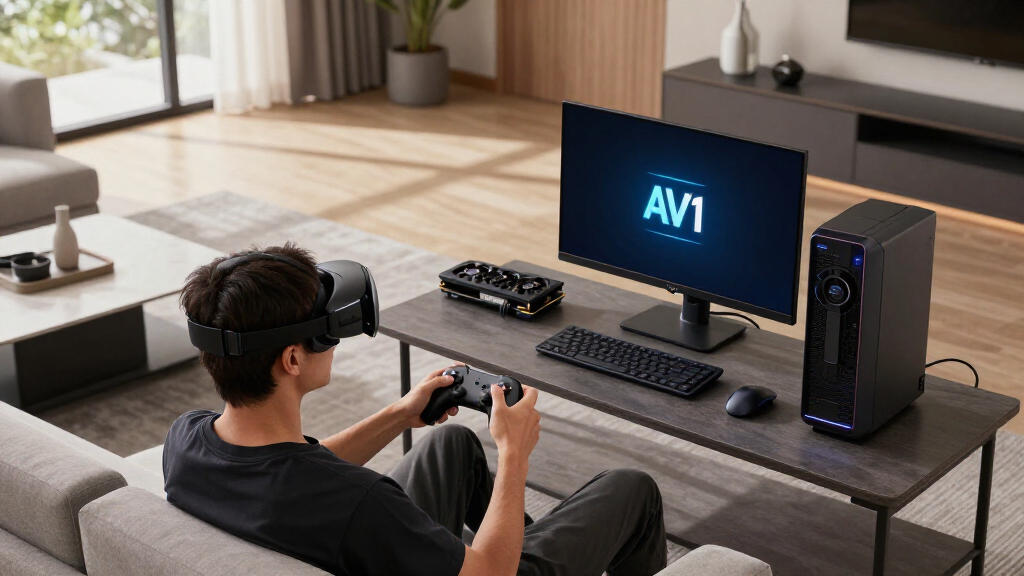
Our selection process focused on GPUs that support AV1 encoding and are well-suited for VR applications in 2026. I examined the latest architecture, VR and AV1 capabilities, cooling solutions, size, and price. Each product was evaluated for its technical performance, compatibility with VR setups, and overall value. The goal was to recommend options that serve different user needs, from compact builds to high-end gaming rigs, with an emphasis on both performance and practical tradeoffs.
| gpu for vr with av1 encoding | Cooling |
|---|---|
| ASUS Dual NVIDIA GeForce RTX 5 | Axial-tech fan design |
| ASUS GeForce RTX 5070 Graphics | Axial-tech fans |
| ASUS Dual NVIDIA GeForce RTX 5 | — |
| ZOTAC Gaming GeForce RTX 5070 | IceStorm 2.0 with BladeLink fans |
| ASUS ROG Astral NVIDIA GeForce | — |
Factors to Consider When Choosing Gpu For Vr With Av1 Encoding
Choosing a GPU for VR with AV1 encoding in 2026 involves balancing performance, size, cooling, and budget. VR applications benefit from high memory capacity, fast data transfer, and efficient cooling solutions to ensure smooth experiences. The importance of supporting AV1 encoding means prioritizing architectures that integrate hardware AV1 encoders, especially for streaming and content creation. I’ll guide you through the key considerations to help you identify which GPU aligns with your specific needs.Performance and VR Workload Demands
For VR, raw power matters. Look for GPUs with high CUDA or equivalent core counts, fast memory, and support for AV1 encoding hardware. High-end models like the ASUS ROG Astral RTX 5080 excel here, but for most users, the RTX 5060 Ti or 5070 offer a good balance. Consider your VR applications—if you do complex simulations or content creation, leaning toward higher memory and compute power makes sense.
Size and Compatibility
Size can be a limiting factor, especially in small cases. Compact models like the ASUS RTX 5070 provide a good compromise, supporting PCIe 5.0 while fitting into tighter spaces. Larger cards like the ASUS ROG Astral RTX 5080 require bigger cases and robust power supplies. Always check your case dimensions and power capacity before choosing a high-end GPU.
Cooling and Noise
Efficient cooling ensures sustained VR performance without thermal throttling. Models with axial-tech fans or vapor chamber cooling, like the ASUS ROG Astral or ZOTAC RTX 5070, excel here. However, high-performance cooling systems may generate more noise, which can be distracting during VR sessions. Balance cooling efficiency with noise levels based on your environment and preferences.
Price and Future-Proofing
High-end GPUs come with a premium price, but they also offer improved future-proofing, especially with PCIe 5.0 support and larger VRAM buffers. For most users, the RTX 5070 or RTX 5060 Ti strike a good balance, while enthusiasts might lean toward the RTX 5080. Budget-conscious buyers should consider whether the incremental gains justify the additional spend.
Frequently Asked Questions
Why is AV1 encoding important for VR in 2026?
AV1 encoding provides more efficient compression, reducing streaming bandwidth and improving quality, which is especially beneficial for VR streaming and content creation. Hardware AV1 support in GPUs accelerates encoding tasks, leading to smoother workflows and less CPU load, enabling more immersive and higher-quality VR experiences.
How does GPU size impact VR setup compatibility?
The physical dimensions of a GPU can limit your choice of case, especially for high-end models like the ASUS ROG Astral RTX 5080 with a 3.8-slot design. Ensuring your case can accommodate the card’s size is crucial to avoiding installation issues. Smaller cases may require more compact GPUs like the ASUS RTX 5070, which still deliver solid VR performance.
Is higher VRAM always better for VR and AV1 encoding?
Not necessarily, but higher VRAM generally benefits VR workloads by allowing larger textures and more complex scenes. For AV1 encoding, hardware support and encoder efficiency matter more than VRAM size. The 16GB in the ASUS RTX 5060 Ti provides a buffer for demanding VR content, but most VR applications will run well with 12GB or 16GB, depending on the complexity.
What should I prioritize: performance or size?
This depends on your setup. If you have a spacious case and a high power supply, prioritizing performance with models like the ASUS RTX 5080 makes sense. For smaller builds or limited budgets, compact cards like the ASUS RTX 5070 deliver a good balance, though with slightly less raw power.
Are these GPUs suitable for VR streaming and content creation?
Yes, all these GPUs support AV1 encoding hardware and high-quality VR performance, making them suitable for streaming, recording, and content creation alongside gaming. The choice depends on your specific needs—higher memory and better cooling for intensive workflows, or more compact solutions for space-constrained setups.
Conclusion
For buyers prioritizing raw power and future-proofing, the ASUS ROG Astral RTX 5080 fits best, despite its size and cost. Enthusiasts and professionals needing extensive VR workflows should consider the 16GB ASUS RTX 5060 Ti. For those with limited space or budget, the ASUS RTX 5070 offers a compelling balance of performance and size. Casual VR users or those with smaller cases might opt for more mid-range options, but all these cards support AV1 encoding, making them suited for both gaming and content creation in 2026.
Fall Picks
fall essentials
As an affiliate, we earn on qualifying purchases.