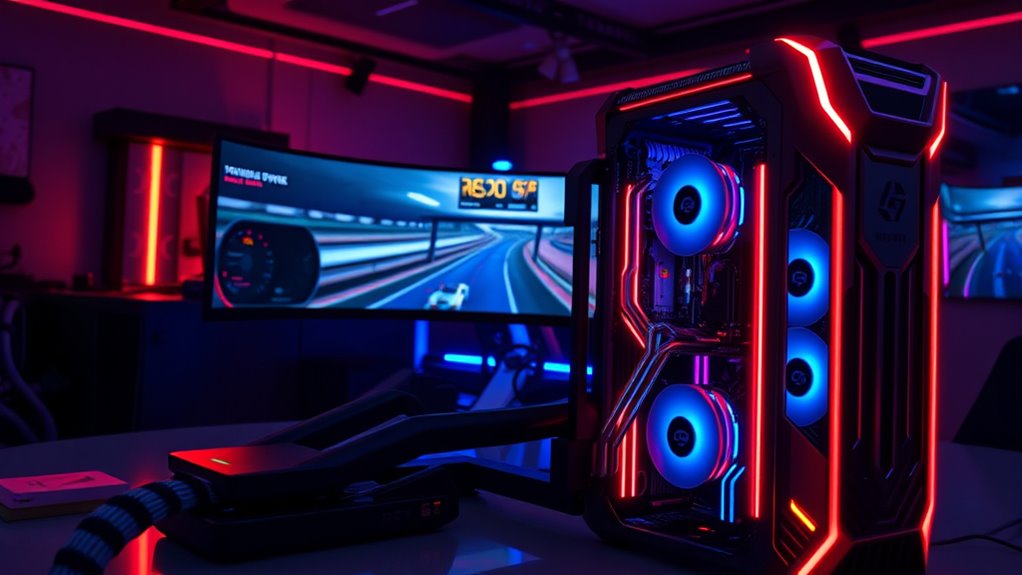

If you want to feel the speed in VR sim racing in 2026, I recommend checking out the top GPUs like the ASUS TUF Gaming RTX 5070 12GB, ASUS RTX 5070 OC 12GB, and GIGABYTE RTX 3060 OC 12G. The GTX 1060 6GB remains a budget-friendly option, but for smoother and more immersive gameplay, the latest architectures support higher VRAM and advanced features. Keep exploring to find the perfect GPU that matches your racing dreams.
Key Takeaways
- High VRAM (12GB+), like the ASUS TUF RTX 5070 or GIGABYTE RTX 3060, ensures smooth performance at ultra-high resolutions.
- Support for HDMI 2.1 and DisplayPort 2.1 guarantees compatibility with the latest VR headsets and multi-monitor setups.
- Advanced architectures such as NVIDIA Blackwell and AMD RDNA 3 provide future-proofing for upcoming VR applications.
- Efficient thermal management with dual axial-tech fans or phase-change pads maintains stability during extended VR sessions.
- Features like DLSS 4 and FidelityFX Super Resolution enhance visual quality and frame rates for immersive VR sim racing.
| GTX 1060 6GB Gaming Graphics Card with Dual Fans | 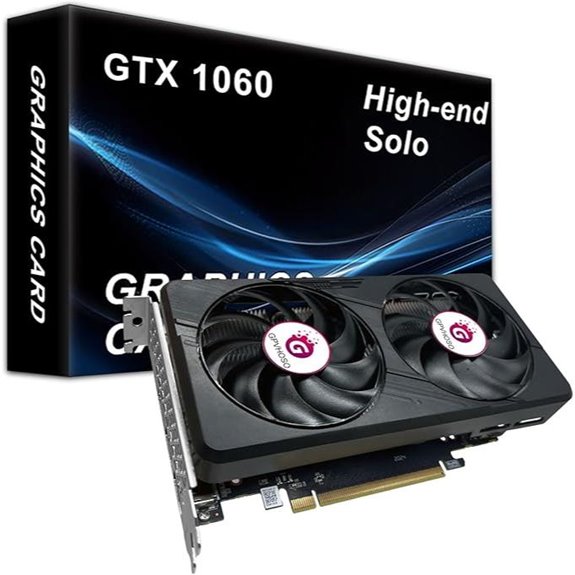 | Budget Gaming Power | Memory Size: 6GB GDDR5 | Connectivity Options: HDMI, DisplayPort x2 | Cooling System: Dual Fans | VIEW LATEST PRICE | See Our Full Breakdown |
| ASUS TUF Gaming RTX 5070 12GB Graphics Card | 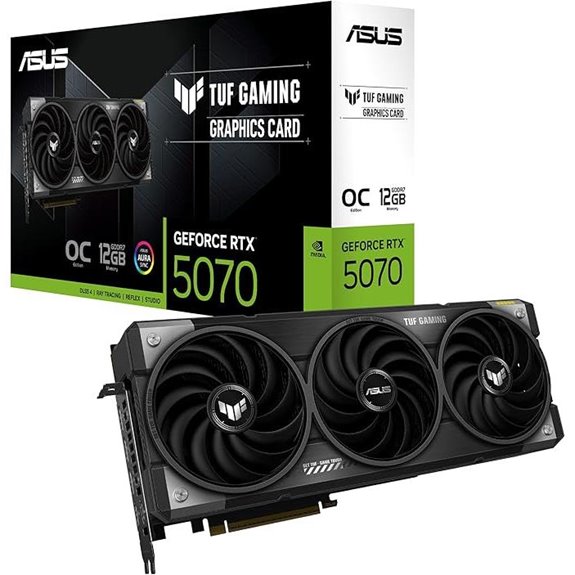 | High-Performance Durability | Memory Size: 12GB GDDR7 | Connectivity Options: HDMI, DisplayPort | Cooling System: Axial-tech Fans | VIEW LATEST PRICE | See Our Full Breakdown |
| ASUS RTX 5070 OC 12GB GDDR7 Graphics Card | 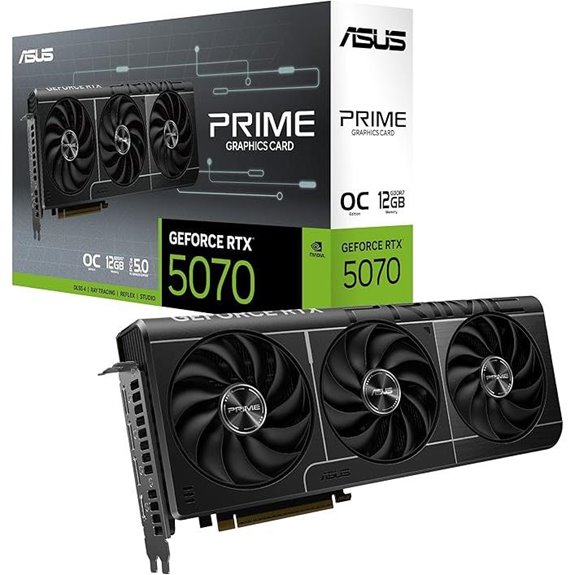 | Compact Powerhouse | Memory Size: 12GB GDDR7 | Connectivity Options: HDMI, DisplayPort | Cooling System: Axial-tech Fans | VIEW LATEST PRICE | See Our Full Breakdown |
| AISURIX RX 580 8GB Gaming Graphics Card | 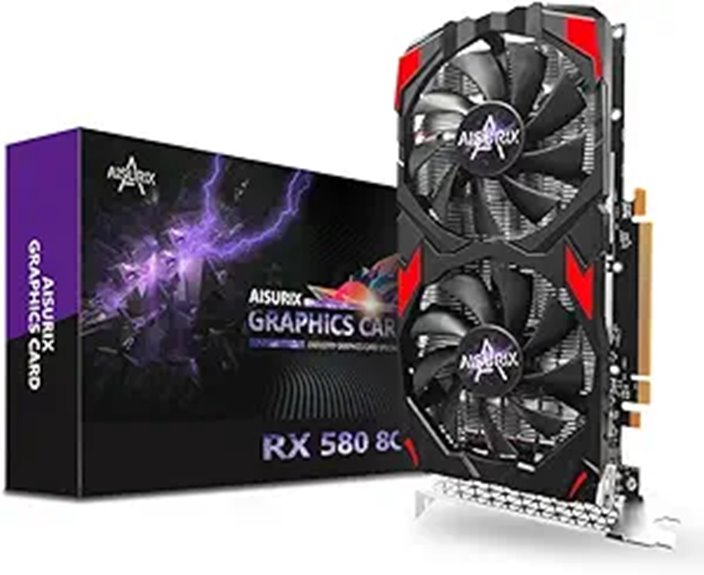 | Value for Enthusiasts | Memory Size: 8GB GDDR5 | Connectivity Options: 2x DisplayPort, HDMI | Cooling System: Semi-automatic Fan System | VIEW LATEST PRICE | See Our Full Breakdown |
| GTX 1060 6GB Gaming Graphics Card with Dual Fans | 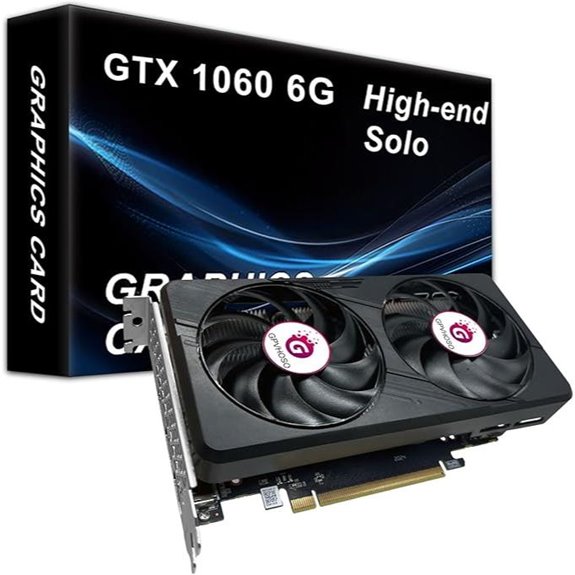 | Reliable 1440p Gaming | Memory Size: 6GB GDDR5 | Connectivity Options: HDMI, DisplayPort | Cooling System: Dual Fans | VIEW LATEST PRICE | See Our Full Breakdown |
| GIGABYTE GeForce RTX 3060 Gaming OC 12G | 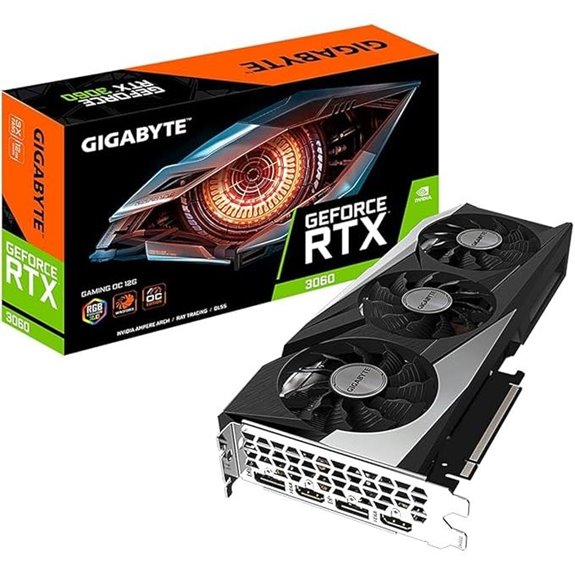 | Classic High-End | Memory Size: 12GB GDDR6 | Connectivity Options: HDMI, DisplayPort | Cooling System: WINDFORCE 3X Cooling | VIEW LATEST PRICE | See Our Full Breakdown |
| GTX 1080 8GB GDDR5X Gaming Graphics Card | 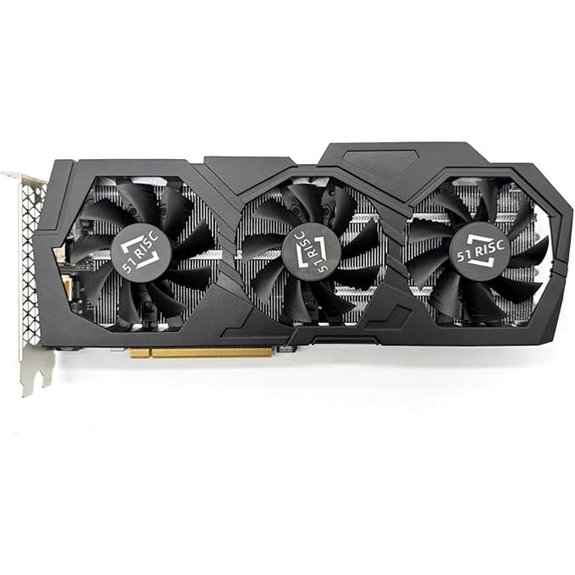 | Best Future-Proof | Memory Size: 8GB GDDR5X | Connectivity Options: HDMI, DisplayPort | Cooling System: Triple Fans | VIEW LATEST PRICE | See Our Full Breakdown |
More Details on Our Top Picks
GTX 1060 6GB Gaming Graphics Card with Dual Fans
If you’re looking for a budget-friendly yet powerful GPU for VR sim racing in 2026, the GTX 1060 6GB with dual fans is an excellent choice. It delivers solid gaming performance thanks to high clock speeds, CUDA cores, and 6GB GDDR5 memory, supporting DirectX 12, HDR, and 8K resolution. Its dual fans and thermal design keep temperatures low during intense sessions, ensuring smooth gameplay and longevity. With multiple outputs like HDMI and DisplayPort, it’s easy to connect multiple monitors or VR headsets. Plus, it’s compatible with systems requiring over 400W power, making it a reliable, cost-effective option for immersive racing experiences.
- Memory Size:6GB GDDR5
- Connectivity Options:HDMI, DisplayPort x2
- Cooling System:Dual Fans
- Power Requirements:Over 400W PSU, 6-pin cable
- Supported Technologies:DirectX 12, VRWorks
- Form Factor / Size:Standard ATX size
- Additional Feature:Dual fan cooling system
- Additional Feature:Supports HDR and 8K
- Additional Feature:VRWorks technology included
ASUS TUF Gaming RTX 5070 12GB Graphics Card
The ASUS TUF Gaming RTX 5070 12GB Graphics Card stands out as one of the top choices for VR sim racing enthusiasts seeking reliable and high-performance hardware in 2026. Built on NVIDIA’s Blackwell architecture, it supports DLSS 4, PCIe 5.0, and HDMI 2.1, ensuring fast, smooth visuals. Its military-grade components and protective PCB coating enhance durability, while phase-change thermal pads and three axial-tech fans keep temperatures in check during intense sessions. The GPU’s robust construction, combined with ASUS’s manufacturing quality, offers long-lasting stability. Plus, GPU Tweak III software makes tuning and monitoring straightforward, letting me optimize performance for the most immersive VR racing experience possible.
- Memory Size:12GB GDDR7
- Connectivity Options:HDMI, DisplayPort
- Cooling System:Axial-tech Fans
- Power Requirements:Not specified, PCIe 5.0 support
- Supported Technologies:DLSS 4, PCIe 5.0
- Form Factor / Size:Dual-slot, 3.125-slot design
- Additional Feature:Military-grade components
- Additional Feature:Phase-change thermal pads
- Additional Feature:Auto-Extreme manufacturing
ASUS RTX 5070 OC 12GB GDDR7 Graphics Card
Looking for a compact yet powerful GPU that can handle demanding VR sim racing experiences in 2026? The ASUS RTX 5070 OC 12GB GDDR7 is an excellent choice. Built on NVIDIA’s Blackwell architecture with DLSS 4, it delivers impressive performance in a small-form-factor design, perfect for tight builds. Its dual axial-tech fans ensure efficient cooling, while the phase-change thermal pad keeps temperatures in check. With PCIe® 5.0, HDMI®, and DisplayPort 2.1 support, it’s ready for high-resolution VR. The OC edition boosts clock speeds, and the dual BIOS offers customizable performance or quiet operation, making it a versatile and reliable option for serious racers.
- Memory Size:12GB GDDR7
- Connectivity Options:HDMI, DisplayPort
- Cooling System:Axial-tech Fans
- Power Requirements:Not specified, designed for SFF builds
- Supported Technologies:DLSS 4, PCIe 5.0
- Form Factor / Size:Compact, SFF-ready, 2.5-slot
- Additional Feature:Silent 0dB operation
- Additional Feature:Dual BIOS switch
- Additional Feature:Compact 2.5-slot design
AISURIX RX 580 8GB Gaming Graphics Card
For gamers seeking reliable performance without breaking the bank, the AISURIX RX 580 8GB Gaming Graphics Card offers a solid balance of power and efficiency. Built on Arctic Islands architecture with a Polaris 20 XTX processor, it supports DirectX 12 for modern game compatibility. With 2048 Stream Processors and 8GB GDDR5 memory running at 1750 MHz, it delivers smooth, high-quality visuals. It supports up to two monitors, including 4K displays, and connects via PCIe 3.0 x16. Its semi-automatic fan system reduces noise during low loads, extending durability. Overall, it’s a dependable choice for immersive VR sim racing at an accessible price point.
- Memory Size:8GB GDDR5
- Connectivity Options:2x DisplayPort, HDMI
- Cooling System:Semi-automatic Fan System
- Power Requirements:8-pin connector, 185W max
- Supported Technologies:DirectX 12, Display Support
- Form Factor / Size:Dual-slot
- Additional Feature:Intelligent fan system
- Additional Feature:Supports 4K resolution
- Additional Feature:Low noise operation
GTX 1060 6GB Gaming Graphics Card with Dual Fans
If you’re seeking a dependable GPU that balances performance and affordability for VR sim racing, the GTX 1060 6GB Gaming Graphics Card with Dual Fans is a solid choice. It offers high clock speeds, 6GB GDDR5 memory, and wide bandwidth, supporting DirectX 12 and PCIe 3.0 x16 for smooth gameplay and immersive visuals. Its VR-Ready VRWorks technology ensures low latency and excellent compatibility with VR devices. The dual fans and thermal design keep temperatures low during intense sessions, boosting stability and longevity. Just remember, it needs over 400W power and a 6-pin cable. Overall, it’s a reliable option for immersive VR racing experiences.
- Memory Size:6GB GDDR5
- Connectivity Options:HDMI, DisplayPort
- Cooling System:Dual Fans
- Power Requirements:Over 400W PSU, 6-pin cable
- Supported Technologies:DirectX 12, VR-Ready
- Form Factor / Size:Standard size with dual fans
- Additional Feature:VR-Ready with VRWorks
- Additional Feature:Multiple output ports
- Additional Feature:Uninstall outdated drivers
GIGABYTE GeForce RTX 3060 Gaming OC 12G
The GIGABYTE GeForce RTX 3060 Gaming OC 12G stands out as a solid choice for VR sim racing enthusiasts who want high performance without breaking the bank. Powered by NVIDIA’s Ampere architecture, it features advanced RT and Tensor Cores for realistic visuals and AI acceleration. With 12GB of GDDR6 memory and a core clock of 1837 MHz, it handles demanding games and creative tasks smoothly. Its WINDFORCE 3X cooling system keeps temperatures in check during intense VR sessions, ensuring stable performance. Connectivity options like HDMI 2.1 and DisplayPort 1.4 make it versatile for multiple displays, making this GPU a reliable option for immersive VR racing experiences.
- Memory Size:12GB GDDR6
- Connectivity Options:HDMI, DisplayPort
- Cooling System:WINDFORCE 3X Cooling
- Power Requirements:Not specified
- Supported Technologies:DirectX 12, Ray Tracing
- Form Factor / Size:Dual-slot, mid-tower
- Additional Feature:RGB Fusion lighting
- Additional Feature:WINDFORCE 3X cooling
- Additional Feature:High customer rating
GTX 1080 8GB GDDR5X Gaming Graphics Card
The GTX 1080 8GB GDDR5X Gaming Graphics Card stands out as an excellent choice for VR sim racing enthusiasts who demand high performance and visual realism. Its Pascal architecture delivers impressive efficiency and power, supporting high-resolution gaming and demanding applications. With ray tracing technology, it creates lifelike lighting, shadows, and reflections, elevating immersion. Features like DLSS upscaling and G-SYNC synchronization ensure sharp visuals and smooth gameplay, while VR-Ready certification guarantees seamless virtual reality experiences. The triple-fan cooling system maintains ideal temps during intense sessions, ensuring consistent performance and durability for long-term racing adventures.
- Memory Size:8GB GDDR5X
- Connectivity Options:HDMI, DisplayPort
- Cooling System:Triple Fans
- Power Requirements:Not specified, typical high-end requirements
- Supported Technologies:Ray Tracing, DLSS, G-SYNC
- Form Factor / Size:Standard size, 2-slot
- Additional Feature:Ray tracing technology
- Additional Feature:G-SYNC compatible
- Additional Feature:Triple-fan cooling system
Factors to Consider When Choosing a GPU for VR Sim Racing
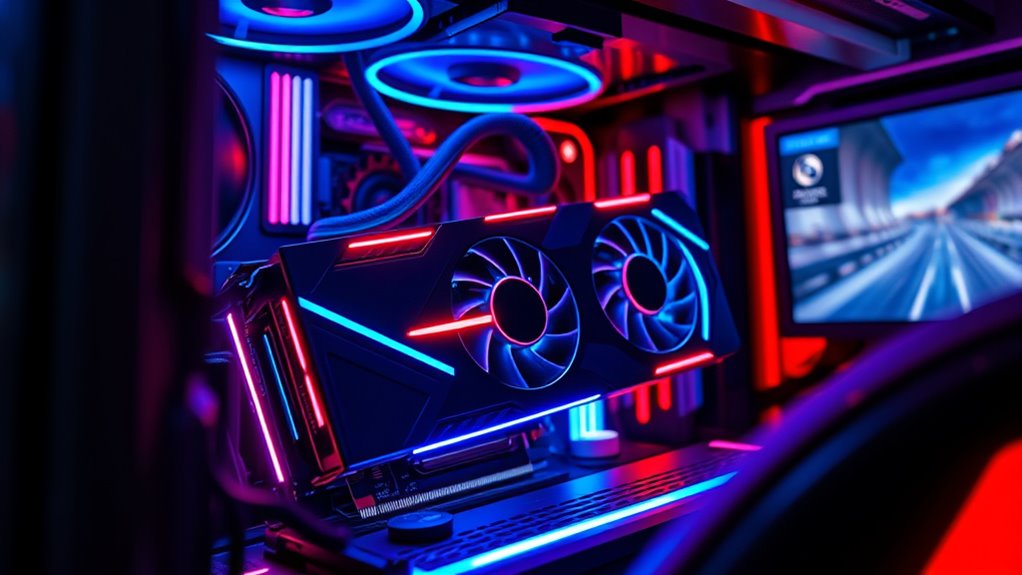
When choosing a GPU for VR sim racing, I focus on several key factors to guarantee the best experience. These include VR compatibility, GPU performance, and frame rate stability, which directly impact immersion and smooth gameplay. Additionally, I consider resolution, visuals, and cooling to keep everything running efficiently.
VR Compatibility Requirements
Choosing the right GPU for VR sim racing hinges on several key compatibility requirements that guarantee an immersive and smooth experience. First, it must support HDMI 2.0 or DisplayPort 1.4 to handle high-resolution VR displays without lag or dropout. At least 8GB of GDDR6 or GDDR7 VRAM is essential for rendering detailed virtual environments seamlessly. Support for VR-specific technologies like VRWorks or DLSS helps reduce latency and enhances visual fidelity, paramount for realism. A high core clock speed, along with strong CUDA or RT cores, ensures the GPU maintains the high frame rates needed for comfort and immersion. Lastly, compatibility with the latest DirectX 12 or Vulkan APIs allows the GPU to deliver advanced graphics features critical for realistic VR racing.
GPU Power and Speed
GPU power and speed profoundly impact your VR sim racing experience. A higher GPU clock speed reduces rendering times and boosts frame rates, ensuring smooth visuals that are essential in VR. More CUDA cores or stream processors allow the GPU to handle complex graphics and detailed environments efficiently, preventing lag and stuttering. Memory bandwidth and size, like 6GB versus 12GB, determine how well the GPU manages high-resolution textures and rich environments, directly affecting visual clarity. Support for advanced APIs such as DirectX 12 and Vulkan optimizes performance and stability in VR racing games. Additionally, features like DLSS or AI upscaling technologies improve rendering speed and visual fidelity, giving you a more immersive, responsive experience. Prioritizing these factors helps you choose a GPU that truly feels like the engine under your virtual hood.
Frame Rate Stability
Maintaining a stable frame rate is essential for an immersive VR sim racing experience, as fluctuations can cause discomfort and break immersion. A steady 90 FPS or higher minimizes motion sickness and keeps visuals smooth. Consistent frame pacing prevents stutters and judders that disrupt the virtual environment, making gameplay feel seamless. GPUs with higher and more stable clock speeds help reduce frame rate fluctuations during demanding scenes, ensuring smooth performance. VR-specific optimizations like increased VRAM and effective thermal management support steady frame rates over long sessions. Additionally, selecting GPUs with robust drivers and support for advanced VR rendering techniques can further improve stability. Prioritizing these factors helps create a more comfortable, realistic, and enjoyable VR racing experience.
Resolution and Visuals
When it comes to VR sim racing, higher resolution displays considerably enhance visual clarity and immersion, but they also demand more from your GPU. To handle detailed textures and visuals effectively, a GPU with ample video memory and high bandwidth is essential. Supporting 4K or higher resolutions guarantees sharper images and a more immersive experience, making every detail pop. Advanced rendering technologies like ray tracing further boost realism by providing accurate lighting, reflections, and shadows, enriching the VR environment. A GPU that performs well in VR benchmarks helps achieve smoother frame rates, reducing motion sickness and increasing immersion. Most importantly, maintaining high frame rates at these resolutions prevents lag, ensuring a seamless, realistic racing experience that feels natural and engaging.
Cooling and Thermal Management
Choosing the right cooling system is crucial for ensuring your VR sim racing experience stays smooth and safe. Effective cooling, like dual or axial-tech fans, helps keep temperatures in check during intense sessions. Thermal pads and heat sinks improve heat transfer from the GPU, reducing overheating risks when pushing demanding visuals. Proper airflow within your case, with well-placed intake and exhaust fans, enhances overall thermal management and prevents hot spots. Monitoring GPU temperatures with software tools ensures the card operates within safe limits, avoiding throttling that can impair performance. Advanced thermal designs, such as phase-change thermal pads and larger fin arrays, substantially boost heat dissipation and extend your GPU’s lifespan. Prioritizing these cooling features guarantees reliable, consistent VR performance without thermal hiccups.
Connectivity Options Needed
Selecting the right connectivity options is essential for a smooth VR sim racing experience, as it directly affects how well your GPU can support your headset and multiple displays. I look for GPUs with multiple HDMI and DisplayPort outputs to connect my VR headset and extra monitors simultaneously without hassle. High refresh rates and resolutions are crucial for immersive gameplay, so I ensure the GPU supports these specs for seamless visuals. VR-Ready certification and optimized performance features guarantee compatibility and smooth virtual reality experiences. I also verify that the GPU matches my VR headset’s connection standards and video output requirements. Additionally, handling high data transfer rates is vital to maintain low latency, which reduces motion sickness and enhances immersion during intense racing sessions.
Future-Proofing Capabilities
To guarantee your VR sim racing setup remains relevant in the coming years, prioritizing future-proofing features in a GPU is essential. Look for models with high VRAM, like 12GB or more, to handle upcoming VR software and game demands. Choosing the latest architecture, such as NVIDIA’s Blackwell or AMD’s RDNA 3, ensures compatibility with future VR tech and boosts performance. Support for PCIe 5.0 and HDMI 2.1 is vital for higher data transfer rates and resolutions, matching upcoming VR system standards. Features like DLSS or FidelityFX Super Resolution can extend your GPU’s lifespan by improving upscaling and performance. Finally, opt for GPUs with strong driver support and regular firmware updates to stay compatible with evolving VR applications and avoid obsolescence.
Frequently Asked Questions
How Does VR Headset Compatibility Influence GPU Choice?
VR headset compatibility is vital in choosing a GPU because it guarantees smooth, immersive gameplay without lag or visual glitches. I look for GPUs that support the latest VR standards and have enough power to handle high-resolution displays and demanding graphics. If my GPU isn’t compatible or lacks enough performance, my VR experience suffers, so I prioritize compatibility to get the best, most seamless racing experience possible.
What Is the Ideal GPU VRAM for Ultra-Realistic Racing?
For ultra-realistic racing, I’d say 12 to 16 GB of VRAM is ideal because it balances high-resolution textures with smooth performance. While more VRAM might seem tempting, beyond 16 GB, the gains are minimal for most racing sims. I prefer this range, as it handles demanding graphics without bottlenecking, ensuring I feel fully immersed in the virtual cockpit without sacrificing frame rates or detail.
Do Specific GPU Brands Outperform Others in VR Sim Racing?
Yes, I’ve found that specific GPU brands can outperform others in VR sim racing. I prefer NVIDIA for its reliable drivers and excellent performance, especially with their latest RTX series. AMD also offers solid options, often at a better price point, but I’ve noticed NVIDIA tends to have smoother VR experiences with less latency. Ultimately, I recommend choosing a reputable brand with good customer support and proven VR performance.
How Important Is Ray Tracing for VR Racing Immersion?
Ray tracing in VR racing? Honestly, it’s the cherry on top of immersion. While it adds stunning realism, I find that smooth frame rates matter far more for feeling like you’re actually behind the wheel. Sure, ray tracing looks incredible, but if your GPU can’t keep up, you’ll sacrifice fluidity. So, I say prioritize power and performance first—ray tracing’s just the fancy frosting on an already tasty cake.
Can Older GPUS Handle Future VR Sim Racing Updates?
Older GPUs might struggle with future VR sim racing updates, especially as games become more demanding. I’ve found that they often lack the power and features needed for smooth, immersive experiences. If you want to stay ahead, I recommend upgrading to a more recent GPU that supports the latest VR tech. This way, you’ll enjoy all the new features and maintain a high level of performance.
Conclusion
Choosing the right GPU for VR sim racing means balancing power, performance, and future-proofing. It’s about matching your needs with your budget, pushing limits without sacrificing stability, and embracing advancements while respecting current tech. Ultimately, it’s about more than just specs—it’s about revealing immersion, enhancing experience, and fueling passion. Because when you pick the right GPU, you’re not just racing in VR; you’re living the speed, feeling the thrill, and chasing every moment.