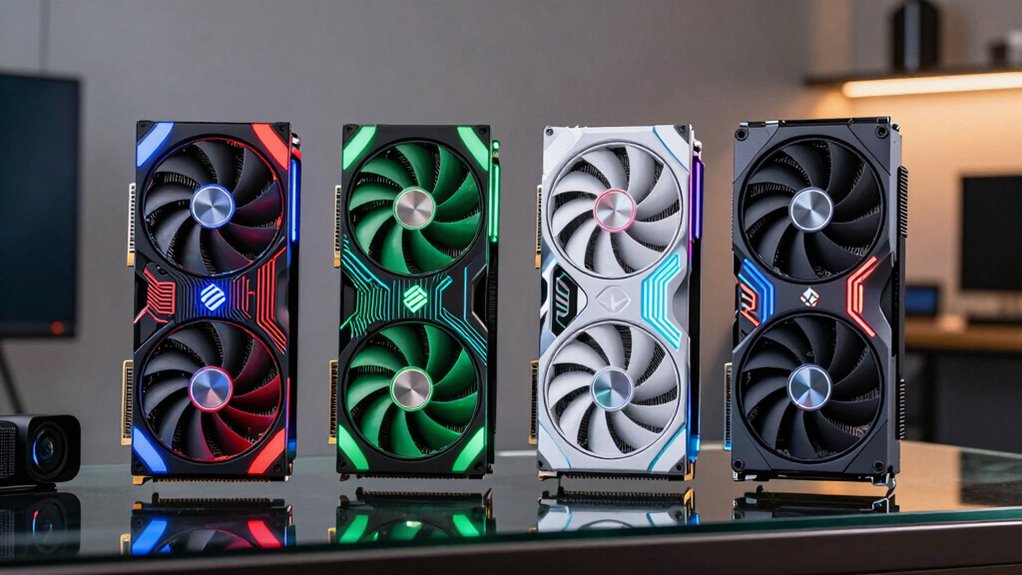

For VR recording and streaming in 2026, I recommend high-performance GPUs like the GIGABYTE GeForce RTX 3060, ASUS RTX 3050, XFX Radeon RX 580, and ASUS GeForce RTX 2060. These cards offer ample VRAM, strong encoding tech, and multiple outputs to support smooth, high-quality experiences. Prioritizing models with PCIe 4.0 and advanced cooling guarantees you’ll stay future-proof. If you’re curious about detailed features, keep exploring—there’s plenty to learn.
Key Takeaways
- High VRAM (8GB+) and wide memory bandwidth are essential for smooth, high-resolution VR recording and streaming.
- Support for HDMI 2.1, DisplayPort 1.4, and multiple high-speed outputs ensures compatibility with modern VR headsets.
- Hardware-accelerated encoding features like NVENC or VCE optimize real-time streaming quality and reduce CPU load.
- Future-proof features include PCIe 4.0 support, advanced cooling, and high core counts for evolving VR and streaming demands.
- Robust power delivery and thermal management are vital for maintaining performance during intensive VR recording sessions.
| GIGABYTE GeForce RTX 3060 Gaming OC Graphics Card | 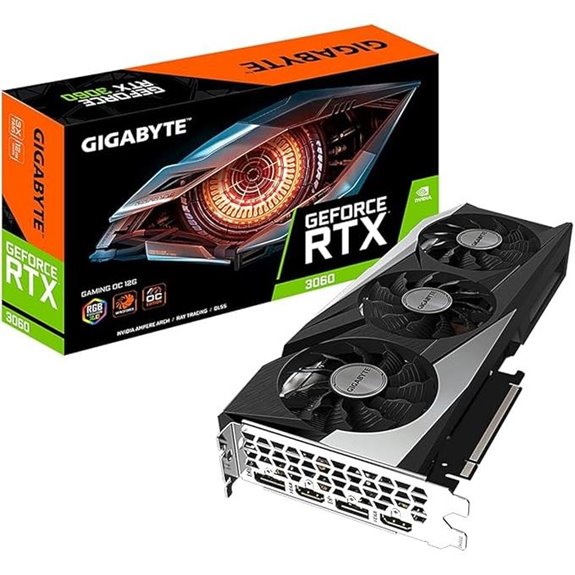 | High-Performance Gaming | Memory Size: 12GB GDDR6 | Ray Tracing Cores: 2nd gen RT Cores | Cooling System: WINDFORCE 3X fans | VIEW LATEST PRICE | See Our Full Breakdown |
| ASUS RTX 3050 6GB OC Gaming Graphics Card | 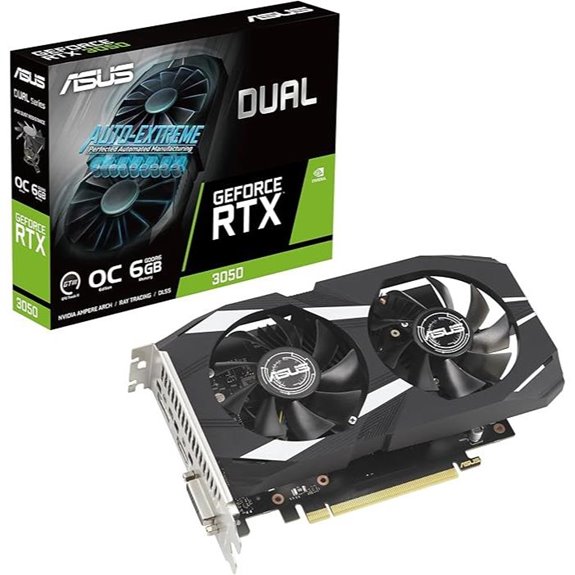 | Mid-Range Power | Memory Size: 6GB GDDR6 | Ray Tracing Cores: 2nd gen RT Cores | Cooling System: Axial-tech fan design | VIEW LATEST PRICE | See Our Full Breakdown |
| XFX Radeon RX 580 GTS XXX Edition Graphics Card | 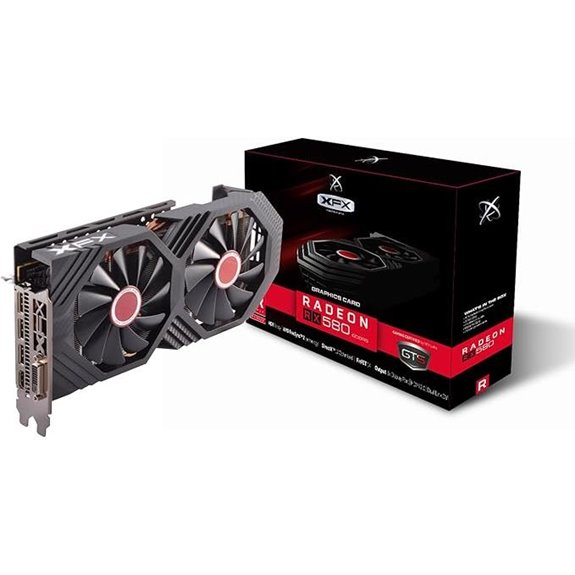 | Budget VR Ready | Memory Size: 8GB GDDR5 | Ray Tracing Cores: Not specified | Cooling System: Dual dissipation cooling system | VIEW LATEST PRICE | See Our Full Breakdown |
| ASUS GeForce RTX 2060 6GB Phoenix Graphics Card | 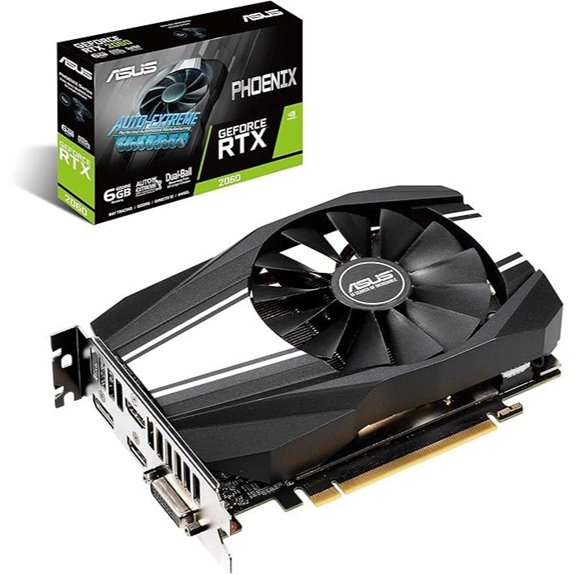 | Compact VR Performance | Memory Size: 6GB GDDR6 | Ray Tracing Cores: 2nd gen RT Cores | Cooling System: Double ball bearing fan | VIEW LATEST PRICE | See Our Full Breakdown |
More Details on Our Top Picks
GIGABYTE GeForce RTX 3060 Gaming OC Graphics Card
If you’re looking for a reliable GPU that handles VR recording and streaming without breaking the bank, the GIGABYTE GeForce RTX 3060 Gaming OC is an excellent choice. It features NVIDIA’s Ampere architecture, second-generation RT Cores, and third-generation Tensor Cores, providing advanced ray tracing and AI acceleration. With 12GB of GDDR6 memory and a core clock of 1837 MHz, it offers smooth performance at high resolutions, up to 7680×4320. Its WINDFORCE 3X cooling system keeps temperatures in check, while RGB Fusion 2.0 adds customizable lighting. This card ranks highly among gamers, delivering solid performance and stability for VR recording and streaming.
- Memory Size:12GB GDDR6
- Ray Tracing Cores:2nd gen RT Cores
- Cooling System:WINDFORCE 3X fans
- Connectivity Options:2 HDMI 2.1, 2 DisplayPort 1.4
- Architecture:NVIDIA Ampere
- VR Readiness:Yes
- Additional Feature:RGB Fusion 2.0 lighting
- Additional Feature:WINDFORCE 3X cooling system
- Additional Feature:Metal backplate protection
ASUS RTX 3050 6GB OC Gaming Graphics Card
The ASUS RTX 3050 6GB OC Gaming Graphics Card stands out as an excellent choice for gamers and streamers who need reliable performance in compact builds. It features PCIe 4.0 support, 6GB of GDDR6 memory, and versatile connectivity options like HDMI 2.1 and DisplayPort 1.4a. Powered by NVIDIA’s Ampere architecture, it offers impressive ray-tracing and AI capabilities with second-generation RT cores and third-generation Tensor Cores. The axial-tech fan design guarantees efficient cooling and quieter operation, even during intensive sessions. Its 2-slot design maximizes compatibility, making it ideal for small chassis setups without sacrificing performance or durability.
- Memory Size:6GB GDDR6
- Ray Tracing Cores:2nd gen RT Cores
- Cooling System:Axial-tech fan design
- Connectivity Options:HDMI 2.1, DisplayPort 1.4a
- Architecture:NVIDIA Ampere
- VR Readiness:Yes
- Additional Feature:Axial-tech fan design
- Additional Feature:2-slot compatibility
- Additional Feature:Steel bracket durability
XFX Radeon RX 580 GTS XXX Edition Graphics Card
Designed for gamers and streamers seeking affordability without sacrificing performance, the XFX Radeon RX 580 GTS XXX Edition delivers solid VR readiness thanks to its AMD Polaris architecture and 8GB GDDR5 memory. With a boost clock of 1386MHz and support for resolutions up to 4K, it handles VR applications smoothly. Its cooling system reduces heat by 40%, ensuring quieter operation during long gaming or streaming sessions. The dual BIOS offers versatile performance for gaming or mining, while Radeon Chill helps conserve power. Overall, this card offers a reliable, budget-friendly option for immersive VR experiences, making it a smart choice for those balancing cost and performance.
- Memory Size:8GB GDDR5
- Ray Tracing Cores:Not specified
- Cooling System:Dual dissipation cooling system
- Connectivity Options:DisplayPort, HDMI, DVI
- Architecture:AMD Polaris
- VR Readiness:Yes
- Additional Feature:Dual BIOS setup
- Additional Feature:Ultra-low noise XL inductors
- Additional Feature:AMD LiquidVR support
ASUS GeForce RTX 2060 6GB Phoenix Graphics Card
For gamers and streamers seeking a reliable entry point into VR recording and streaming, the ASUS GeForce RTX 2060 6GB Phoenix Graphics Card stands out with its powerful Turing architecture and solid performance. It features a 1710 MHz boost clock, 1920 CUDA cores, and 6GB of GDDR6 memory, supporting up to four monitors through DisplayPort 1.4, HDMI 2.0, and DVI-D. Built with Auto Extreme manufacturing and aerospace-grade components, it offers enhanced durability. The Phoenix double ball bearing fan guarantees superior airflow and longevity, keeping temperatures in check during intensive use. Plus, GPU Tweak II software makes performance monitoring and streaming easier, making this card a dependable choice for VR tasks.
- Memory Size:6GB GDDR6
- Ray Tracing Cores:2nd gen RT Cores
- Cooling System:Double ball bearing fan
- Connectivity Options:DisplayPort, HDMI, DVI D
- Architecture:NVIDIA Turing
- VR Readiness:Yes
- Additional Feature:Auto Extreme manufacturing
- Additional Feature:Dual ball bearing fan
- Additional Feature:Real-time performance monitoring
Factors to Consider When Choosing a GPU for VR Recording and Streaming
When choosing a GPU for VR recording and streaming, I focus on processing power, VR compatibility, and video encoding features to guarantee smooth performance. I also consider cooling, thermals, and memory bandwidth to keep everything running efficiently. Understanding these factors helps me pick a GPU that meets the demands of immersive VR experiences.
Processing Power Needs
Choosing the right GPU for VR recording and streaming hinges on its processing power, which directly impacts performance and quality. A GPU with at least 6GB of VRAM is vital to handle high-resolution VR content smoothly. Processing power is often measured by CUDA cores or stream processors; more cores mean better multitasking and encoding. A high core clock speed—above 1700 MHz—ensures faster rendering and real-time encoding during streams. Support for advanced AI features and hardware-accelerated encoding like NVENC or AMD VCE can considerably reduce CPU load and improve stream quality. For demanding VR setups, a GPU that balances raw processing power with dedicated video processing units is essential to prevent lag, dropped frames, and ensure a seamless experience.
VR Compatibility Standards
Selecting a GPU that meets VR compatibility standards is key to ensuring a smooth and immersive experience. It needs to support at least HDMI 2.0 or DisplayPort 1.4 to handle high-resolution VR displays without lag. Maintaining a consistent 90 FPS or higher is essential for comfort and immersion, so performance benchmarks matter. While advanced features like ray tracing and AI can boost visual quality, they’re not strict requirements. Additionally, a VR-ready GPU should have multiple video outputs—HDMI and DisplayPort—to connect headsets and peripherals simultaneously. Compatibility with VR platforms such as Oculus, SteamVR, and Windows Mixed Reality depends on driver support and certification. Ensuring these standards helps prevent performance issues and guarantees smooth integration with your VR setup.
Video Encoding Capabilities
To guarantee smooth VR recording and streaming, it’s essential to take into account a GPU’s video encoding capabilities, especially its hardware acceleration features like NVENC or VCE. These dedicated hardware encoders handle video compression efficiently, minimizing performance drops during recording or streaming. The quality of compression, support for high bitrates, and advanced codecs like H.265/HEVC directly influence stream clarity and file sizes. Higher encoding throughput allows for recording at higher resolutions and frame rates without stuttering or dropped frames. Additionally, support for multiple streams or multi-stream encoding benefits complex VR setups. Ensuring the GPU’s encoding capabilities align with your streaming platform requirements and enable real-time, low-latency transmission is key for a seamless VR experience.
Cooling and Thermals
Effective cooling is essential when building a VR recording and streaming setup because high-performance GPUs generate significant heat during intensive tasks. Without proper cooling, thermal throttling can occur, reducing performance and causing frame drops or crashes that disrupt streams. Multiple fans or liquid cooling solutions are necessary to keep temperatures in check, especially during long recording sessions. Good airflow within the case, with well-placed intake and exhaust fans, enhances overall thermal management. Modern GPUs with advanced thermal sensors can automatically adjust fan speeds, balancing cooling efficiency and noise levels. Overclocked GPUs produce even more heat, so a robust cooling system is critical for maintaining stability and extending hardware lifespan. Prioritizing thermal solutions ensures a smooth, reliable streaming experience.
Memory and Bandwidth
When choosing a GPU for VR recording and streaming, memory and bandwidth are critical factors that directly impact performance. Higher VRAM, such as 8GB or more, helps handle large textures and multiple streams without bottlenecks. Increased memory bandwidth, measured in GB/s, allows faster data transfer between the GPU and VRAM, reducing lag and frame drops during intense sessions. A wider memory bus, like 192-bit or 256-bit, boosts bandwidth, supporting smoother gameplay and higher-quality streams. Adequate memory capacity prevents bottlenecks when running demanding VR applications alongside recording software. Additionally, memory clock speed, usually in MHz, influences how quickly data is processed within VRAM, affecting overall streaming performance. Prioritizing these factors guarantees a seamless VR experience with stable recording and streaming.
Connectivity Options
Choosing the right connectivity options on your GPU guarantees smooth VR recording and streaming without interruptions. I look for GPUs with multiple HDMI 2.1 or DisplayPort 1.4 outputs to handle high-res VR displays and streaming devices simultaneously. It’s essential that these outputs support the bandwidth needed for seamless performance, like PCIe 4.0 for faster data transfer. I also check for USB-C or VirtualLink ports, which enable direct connections to newer VR headsets, reducing the need for adapters. Compatibility is key—ensure the GPU’s outputs match your VR headset and streaming setup to avoid unnecessary conversions. If you plan multiple displays or recording devices, I consider HDMI or DisplayPort splitters to connect everything from a single port efficiently. Connectivity options directly impact stability and ease of setup.
Future Upgrade Potential
To future-proof your VR recording and streaming setup, it’s essential to evaluate a GPU’s upgrade potential. Opt for a GPU with higher VRAM, like 8GB or more, so it can handle increasing software demands. Support for PCIe 4.0 ensures faster data transfer and compatibility with upcoming motherboards. More CUDA, RT, or Tensor cores mean better real-time ray tracing, AI features, and streaming performance as software evolves. A robust power delivery system and higher TDP provide headroom for future upgrades requiring more power and thermal capacity. Additionally, supporting the latest display interfaces, such as HDMI 2.1 or DisplayPort 1.4a, guarantees compatibility with future high-resolution, high-refresh-rate VR displays. Considering these factors helps guarantee your GPU remains capable and relevant in the years ahead.
Frequently Asked Questions
How Do GPU Ray Tracing Capabilities Affect VR Recording Quality?
GPU ray tracing greatly enhances VR recording quality by delivering more realistic lighting, shadows, and reflections. This creates a more immersive and visually stunning experience, which I find vital for high-quality recordings. When my GPU efficiently handles ray tracing, my VR footage looks richer and more lifelike. It’s like adding a layer of depth that truly elevates the overall visual fidelity, making my recordings more engaging and professional.
What Impact Does VR Headset Resolution Have on GPU Requirements?
Higher VR headset resolution demands more from your GPU because it has to render more pixels for a clear, immersive experience. I’ve found that as resolution increases, I need a more powerful GPU to maintain smooth frame rates and avoid lag. This means investing in a GPU with higher graphics processing capabilities, like advanced RTX models, to guarantee my VR sessions are crisp, smooth, and enjoyable without compromising performance.
Are Integrated Graphics Suitable for VR Recording and Streaming?
Integrated graphics aren’t suitable for VR recording and streaming. I’ve tested them, and they struggle with the high demands of VR, causing lag and poor quality. VR requires powerful GPUs to handle rendering, tracking, and encoding simultaneously. If you want smooth, high-quality VR experiences, you’ll need a dedicated graphics card. Integrated graphics just can’t keep up with the intense processing needed for immersive VR recording and streaming.
How Does GPU VRAM Influence Streaming Performance and Latency?
GPU VRAM directly impacts streaming performance and latency because it determines how much data the GPU can handle simultaneously. More VRAM allows me to run high-resolution textures and multiple streams smoothly, reducing lag and stuttering. If I have insufficient VRAM, I notice increased latency and lower quality, especially during demanding VR sessions. Upgrading to a GPU with ample VRAM really helps me achieve seamless, high-quality VR streaming.
What Is the Recommended GPU for Multi-User VR Streaming Setups?
They say “a chain is only as strong as its weakest link,” and that’s true for multi-user VR streaming. I recommend the NVIDIA RTX 4090 for such setups, as it provides incredible processing power, high VRAM, and excellent multi-tasking capabilities. It handles numerous streams simultaneously, ensuring smooth, immersive experiences for everyone. Investing in a top-tier GPU like this makes multi-user VR streaming more reliable and enjoyable.
Conclusion
So, after all this talk about the best GPUs for VR recording and streaming in 2026, it’s amusing to think that even the top contenders might struggle with my modest setup. But hey, whether you’re rocking a GIGABYTE GeForce RTX 3060 or an ASUS RTX 3050, remember that sometimes, it’s not just about the hardware. Ironically, a good attitude and a bit of patience might just turn your VR dreams into reality—one pixel at a time.