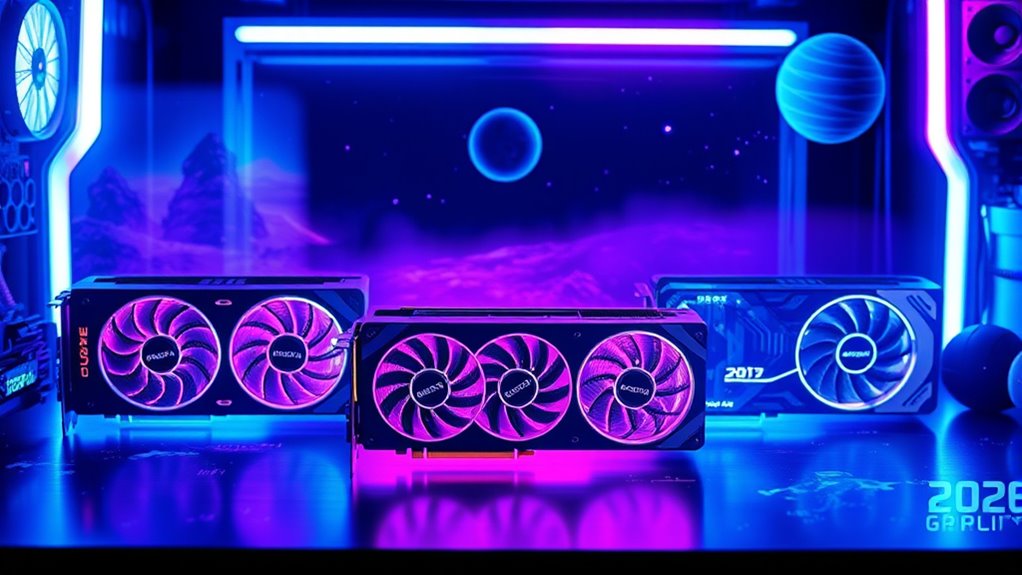

Choosing the right GPU for ultra settings VR in 2026 means balancing raw power, compatibility, and value. The ASUS TUF RTX 3080 stands out for demanding users needing 8K support, while the GIGABYTE RTX 3060 offers a solid high-performance choice at a more accessible price. Meanwhile, the EVGA RTX 3070 hits a sweet spot for gamers seeking robust performance without the premium cost of top-tier models. Each option has its tradeoffs, from size and power requirements to feature set, so understanding your specific needs is key.

Get the latest gadgets delivered free with Prime
- Fast, free delivery on millions of items
- Prime Video, Amazon Music and more included
- Member-only deals all year
Complete the kit



Key Takeaways
- High-end GPUs like the RTX 3080 excel at ultra settings VR but demand larger cases and higher power supplies.
- Mid-range options like the RTX 3060 and RTX 3070 provide excellent performance at a more affordable price point.
- Cooling systems and size are important; powerful GPUs tend to be larger and require better airflow.
- Ray tracing and DLSS support significantly enhance VR visuals, but they come with additional hardware demands.
- Budget-conscious buyers should prioritize balanced options like the RTX 3060 to avoid overspending while still enjoying high-quality VR experiences.
| GIGABYTE GeForce RTX 3060 Gaming OC 12G (REV2.0) Graphics Card |  | Best Value for High-Performance VR | Graphics Coprocessor: NVIDIA GeForce RTX 3060 | RAM: 12 GB | GPU Clock Speed: 1837 MHz | VIEW ON AMAZON | See Our Full Breakdown |
| ZOTAC Gaming GeForce RTX 3060 Twin Edge OC 12GB GDDR6 Graphics Card |  | Best for Ray Tracing and High-Fidelity VR | GPU: NVIDIA GeForce RTX 3060 | CUDA cores: 3584 | Memory: 12GB GDDR6 | VIEW ON AMAZON | See Our Full Breakdown |
| ASUS Dual GeForce RTX 3050 6GB GDDR6 OC Edition Gaming Graphics Card |  | Best Compact Card for Entry-Level Ultra VR | Graphics Coprocessor: NVIDIA GeForce RTX 3050 | RAM: 6 GB | GPU Clock Speed: 1500 MHz | VIEW ON AMAZON | See Our Full Breakdown |
| ASUS TUF Gaming NVIDIA GeForce RTX 3080 V2 OC Edition |  | Best for Ultra-High-End VR and 8K Gaming | Graphics Coprocessor: NVIDIA GeForce RTX 3080 | RAM: 10 GB GDDR6X | Memory Clock Speed: 1815 MHz | VIEW ON AMAZON | See Our Full Breakdown |
| EVGA GeForce RTX 3070 FTW3 Ultra Gaming Graphics Card |  | Best for High-Performance VR at 4K and Beyond | Graphics Coprocessor: NVIDIA GeForce RTX 3070 | Memory: 8 GB GDDR6X | Memory Clock Speed: 14000 MHz | VIEW ON AMAZON | See Our Full Breakdown |
| gpu for ultra settings vr | Graphics Coprocessor | Maximum Resolution | RAM |
|---|---|---|---|
| GIGABYTE GeForce RTX 3060 Gami | NVIDIA GeForce RTX 3060 | 7680 x 4320 | 12 GB |
| ZOTAC Gaming GeForce RTX 3060 | — | — | — |
| ASUS Dual GeForce RTX 3050 6GB | NVIDIA GeForce RTX 3050 | 3840 x 2160 | 6 GB |
| ASUS TUF Gaming NVIDIA GeForce | NVIDIA GeForce RTX 3080 | 8192 x 4320 | 10 GB GDDR6X |
| EVGA GeForce RTX 3070 FTW3 Ult | NVIDIA GeForce RTX 3070 | 4K (3840×2160) | — |
More Details on Our Top Picks
GIGABYTE GeForce RTX 3060 Gaming OC 12G (REV2.0) Graphics Card
The GIGABYTE RTX 3060 Gaming OC 12G offers a capable solution for VR at ultra settings, with 12GB of GDDR6 memory ensuring smooth performance at high resolutions. Its triple WINDFORCE fans and effective cooling system make it suitable for long gaming sessions without thermal throttling. Compared to higher-tier cards like the RTX 3080, it’s more affordable and fits well in mid-sized cases, but it might struggle with the most demanding VR titles at the highest quality settings. This card is ideal for users who want excellent VR experiences without pushing into the very high-end price range.
Pros:- 12GB GDDR6 memory provides plenty of headroom for high-res textures
- Effective triple-fan cooling system maintains thermal stability
- Supports high resolutions up to 7680×4320 for future-proofing
- RGB Fusion 2.0 adds aesthetic customization
Cons:- Limited to desktop use, not portable
- Requires PCI-Express x16 slot and sufficient case space
- Warranty details are less transparent
Best for: Budget-conscious gamers and VR enthusiasts seeking high performance without overspending
Not ideal for: Users needing 4K high-refresh-rate performance or ultra-high-end VR experiences with maximum detail
- Graphics Coprocessor:NVIDIA GeForce RTX 3060
- RAM:12 GB
- GPU Clock Speed:1837 MHz
- Video Output Interface:DisplayPort, HDMI
- Graphics RAM Type:GDDR6
- Maximum Resolution:7680 x 4320
Our verdict“A balanced, high-performance VR GPU that offers strong value for mid-range builds.”
ZOTAC Gaming GeForce RTX 3060 Twin Edge OC 12GB GDDR6 Graphics Card
The ZOTAC RTX 3060 Twin Edge OC combines NVIDIA’s Ampere architecture with a strong cooling system, making it suitable for immersive VR at ultra settings. Its 12GB GDDR6 memory and support for real-time ray tracing and DLSS produce visually rich experiences, especially at high resolutions. While it’s comparable in performance to the GIGABYTE model, its slightly higher power requirement (600W PSU recommended) and size might limit compatibility in smaller cases. This card is best for users prioritizing visual fidelity and ray tracing capabilities, but it’s more expensive and power-hungry.
Pros:- Supports real-time ray tracing and DLSS for improved VR visuals
- IceStorm 2.0 cooling maintains thermal stability
- Multiple high-res display outputs including HDMI 2.1
- VR ready with advanced features
Cons:- Requires a 600W power supply, which may be high for some setups
- Size may be restrictive for small cases
- Price not specified, potentially expensive
Best for: VR gamers who want advanced graphics effects and ray tracing
Not ideal for: Compact case builds or budget systems with limited power supply capacity
- GPU:NVIDIA GeForce RTX 3060
- CUDA cores:3584
- Memory:12GB GDDR6
- Memory bus:192-bit
- Boost clock:1807 MHz
- Display outputs:3 x DisplayPort 1.4a, 1 x HDMI 2.1
Our verdict“Excellent for VR users seeking high-fidelity visuals with ray tracing, at the cost of higher power needs.”
ASUS Dual GeForce RTX 3050 6GB GDDR6 OC Edition Gaming Graphics Card
The ASUS Dual RTX 3050 OC provides a solid foundation for VR at ultra settings, especially in smaller builds thanks to its 2-slot design. With 6GB of GDDR6, it supports ray tracing and AI features, but the limited VRAM may restrict performance at the highest settings or with future titles. Its dual axial-tech fans and durable build make it reliable, but it’s best suited for less demanding VR experiences or users with tight space constraints. This card is ideal for those who need compactness without sacrificing too much performance.
Pros:- Compact 2-slot design fits in small cases
- Effective cooling with dual axial-tech fans
- Supports ray tracing and AI features
- Dust resistance and durable build
Cons:- Limited to 6GB VRAM, which may bottleneck demanding VR titles
- No high-resolution multi-monitor support
- Potentially higher price for a lower VRAM card
Best for: Compact PC builds and entry-level VR users
Not ideal for: High-end VR gaming at 8K or with very demanding titles
- Graphics Coprocessor:NVIDIA GeForce RTX 3050
- RAM:6 GB
- GPU Clock Speed:1500 MHz
- Video Output Interface:HDMI
- Graphics RAM Type:GDDR6
- Maximum Resolution:3840 x 2160
Our verdict“A good choice for small form factor builds that want VR performance without the bulk of larger cards.”
ASUS TUF Gaming NVIDIA GeForce RTX 3080 V2 OC Edition
The ASUS TUF RTX 3080 V2 OC delivers exceptional performance for ultra settings VR, supporting resolutions up to 8K with ease thanks to its 10GB GDDR6X memory. Its advanced cooling, with triple axial-tech fans and durable components, ensures sustained high performance in demanding VR scenarios. The boost clock reaching 1815 MHz makes it suitable for the most intensive VR titles with realistic graphics and ray tracing effects. However, its size and power consumption require a spacious case and a strong PSU. This card targets serious enthusiasts and professionals who demand top-tier VR experiences without compromise.
Pros:- Exceptional 8K support with 10GB GDDR6X memory
- Advanced cooling with triple fans for thermal stability
- Boost clock up to 1815 MHz for peak performance
- Supports high resolutions up to 8K
Cons:- Expensive and power-hungry, requiring high wattage PSU
- Large physical size may limit compatibility
- Premium price point
Best for: High-end VR gamers and professionals needing maximum resolution and detail
Not ideal for: Budget builds or users with limited case space and power capacity
- Graphics Coprocessor:NVIDIA GeForce RTX 3080
- RAM:10 GB GDDR6X
- Memory Clock Speed:1815 MHz
- Maximum Resolution:8192 x 4320
- Display Resolution Maximum:7680×4320
- Number of Fans:3
Our verdict“The go-to GPU for maximum VR fidelity and resolution, ideal for enthusiasts and professionals.”
EVGA GeForce RTX 3070 FTW3 Ultra Gaming Graphics Card
The EVGA RTX 3070 FTW3 Ultra offers an impressive combination of power and features with 8GB GDDR6X memory, making it suitable for demanding VR at 4K and high settings. Its iCX3 cooling technology ensures stable operation during extended VR sessions, while ARGB lighting adds aesthetic flair. Though it’s slightly less powerful than the RTX 3080, it strikes a good balance for users who want high-quality VR without the steepest price tag. It’s especially appealing for those who want durability and customization in their gaming rig.
Pros:- 8GB GDDR6X memory supports demanding VR titles
- Advanced iCX3 cooling maintains thermal stability
- Customizable ARGB lighting enhances aesthetics
- Metal backplate adds durability
Cons:- Price may be high for budget buyers
- Size could restrict small cases
- Requires sufficient power supply and space
Best for: High-performance VR gamers seeking 4K quality at a more manageable price
Not ideal for: Ultra-high-end VR at 8K resolution or with extremely demanding visual features
- Graphics Coprocessor:NVIDIA GeForce RTX 3070
- Memory:8 GB GDDR6X
- Memory Clock Speed:14000 MHz
- Maximum Resolution:4K (3840×2160)
- Display Output Interface:HDMI, DisplayPort
- Warranty:2 years
Our verdict“A robust, high-performance VR GPU suitable for serious gamers balancing cost and power.”

How We Picked
Our selection process focused on GPUs that can reliably run VR at ultra settings in 2026, emphasizing performance benchmarks, VR-specific features, cooling solutions, and compatibility. We prioritized models with at least 10GB of VRAM for high-resolution textures, robust cooling for sustained performance, and support for the latest connectivity standards like HDMI 2.1 and DisplayPort 1.4a. Cost considerations were balanced against performance to ensure these picks serve different user needs—from enthusiasts to budget gamers.
| gpu for ultra settings vr | Graphics Coprocessor |
|---|---|
| GIGABYTE GeForce RTX 3060 Gami | NVIDIA GeForce RTX 3060 |
| ZOTAC Gaming GeForce RTX 3060 | — |
| ASUS Dual GeForce RTX 3050 6GB | NVIDIA GeForce RTX 3050 |
| ASUS TUF Gaming NVIDIA GeForce | NVIDIA GeForce RTX 3080 |
| EVGA GeForce RTX 3070 FTW3 Ult | NVIDIA GeForce RTX 3070 |
Factors to Consider When Choosing Gpu For Ultra Settings Vr
When selecting a GPU for ultra settings VR in 2026, the primary considerations include performance capacity, VRAM, cooling solutions, and compatibility. The ideal VR GPU should handle high frame rates, support the latest VR standards, and maintain thermal stability during extended use. It’s also critical to match the GPU with your system’s power supply and case size to prevent bottlenecks or fitment issues. This guide breaks down key factors to help you choose the best fit for your VR ambitions.
Performance and VRAM
For ultra settings VR, high frame rates and sufficient VRAM are essential. Look for GPUs with at least 10GB of VRAM, such as the RTX 3080 or RTX 3060 Ti, to ensure smooth visuals at high resolutions. Lower VRAM cards like the RTX 3050 may struggle with demanding VR titles or high-quality textures. The GPU’s core count and clock speeds also influence performance; higher numbers typically mean better frame rates and responsiveness.
Cooling and Size
Powerful GPUs generate significant heat, making efficient cooling systems vital. Cards with triple axial-tech fans or advanced cooling tech like EVGA’s iCX3 tend to maintain stability during long VR sessions. Size matters too—larger cards like the RTX 3080 require spacious cases and strong airflow, while compact models like the RTX 3050 fit smaller builds but may sacrifice thermal performance. Balance your case size and cooling needs accordingly.
Connectivity and Compatibility
Ensure your system supports the required outputs—HDMI 2.1 and DisplayPort 1.4a are standard for VR headsets. Power requirements are another key factor; high-end GPUs often need a 600W+ power supply and multiple 8-pin connectors. Compatibility with your motherboard’s PCIe slots and sufficient physical space in your case are also important considerations to avoid bottlenecks or fitment issues in your VR setup.
Price and Future-Proofing
While high-end GPUs like the RTX 3080 deliver maximum performance, they come at a premium. Mid-range options such as the RTX 3060 and RTX 3070 offer excellent value, especially if you’re mindful of budget constraints. Prioritize features like DLSS and ray tracing support, which significantly enhance VR visuals without requiring the highest-end hardware. Investing in a more capable GPU now can extend the lifespan of your VR system as VR titles evolve.
Frequently Asked Questions
What GPU is best for ultra settings VR in 2026?
The best GPU depends on your performance needs and budget. For maximum VR quality at ultra settings, the RTX 3080 or higher-tier models like the RTX 3090 are ideal, supporting resolutions up to 8K and advanced features like ray tracing. If you want a balance of power and affordability, the RTX 3070 or RTX 3060 Ti provide strong performance for most VR titles at a lower cost. Consider your system’s compatibility and your VR goals when choosing.
How much VRAM do I need for ultra settings VR?
For VR at ultra settings, a GPU with at least 10GB of VRAM is recommended. This amount ensures smooth performance with high-resolution textures and future VR titles. Cards like the RTX 3080 with 10GB or more are well-suited, whereas models with 6GB VRAM, such as the RTX 3050, may struggle with demanding content or future-proofing. VRAM is critical for maintaining visual fidelity and avoiding bottlenecks in high-end VR experiences.
Do I need a powerful PSU for high-end GPUs?
Yes, high-performance GPUs like the RTX 3080 or RTX 3070 typically require a power supply of 600W or more, with some demanding models needing even higher wattage. Ensuring your PSU can deliver stable power is essential for system stability and GPU longevity. Additionally, check for the necessary power connectors, usually 8-pin or 6-pin, to support the GPU’s power demands. Investing in a quality PSU is a smart move for high-end VR builds.
Are cooling systems important for VR GPUs?
Absolutely, cooling is vital for maintaining performance during extended VR sessions. High-end GPUs generate more heat, so models equipped with triple axial-tech fans or advanced cooling technologies like EVGA’s iCX3 are better at managing thermal loads. Proper cooling prevents thermal throttling, which can reduce frame rates and impact VR experience quality. Always consider your case airflow and the GPU’s cooling solution when building your VR system.
Is ray tracing necessary for VR?
Ray tracing enhances visual realism by simulating real-world lighting and reflections, significantly improving VR immersion. While not strictly necessary, enabling ray tracing can elevate the experience, making environments more believable. However, it also increases hardware demands. If your GPU supports ray tracing, activating it can be worthwhile, but for the highest VR performance, ensure your hardware can handle the extra load without sacrificing frame rates.
Conclusion
For users targeting ultra settings VR with maximum resolution and visual fidelity, the ASUS TUF RTX 3080 remains the best choice despite its size and price. The GIGABYTE RTX 3060 offers excellent value for high-quality VR experiences on a budget or in smaller builds, while the EVGA RTX 3070 strikes a balance for gamers who want high performance without reaching the top-tier premium. If your system supports it and you seek the ultimate VR clarity, the RTX 3080 is the way to go. Those with limited space or lower budgets should consider the RTX 3050 or RTX 3060 models, which still deliver impressive VR experiences.
Halloween Picks
halloween
As an affiliate, we earn on qualifying purchases.