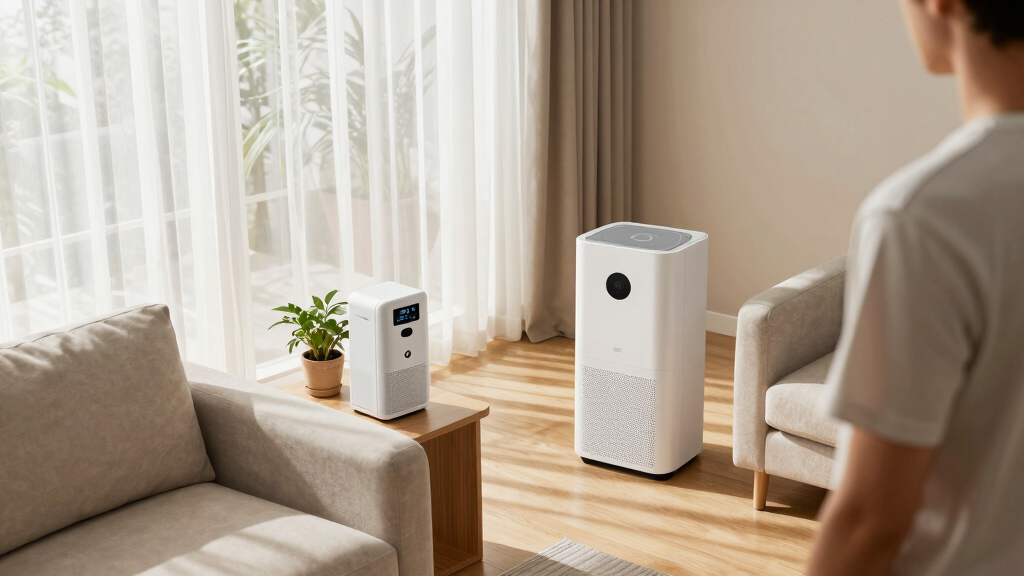
Choosing the best whole home air quality monitor involves balancing accuracy, ease of use, and cost. The SAF Aranet4 Home stands out as the overall top pick for its portability and comprehensive data features. For those prioritizing smart integrations, the Amazon Smart Air Quality Monitor offers seamless Alexa compatibility. Meanwhile, the Airthings Wave Plus excels at radon detection and detailed air metrics. Most options trade off between advanced features and user-friendliness, so understanding your specific needs is key. Keep reading for a detailed comparison to find the best fit for your home environment.
Key Takeaways
- The top monitors balance multi-parameter detection with user-friendly interfaces and data accessibility.
- Smart integrations are common, but some models offer more reliable connectivity and app features than others.
- Radon detection remains a standout feature for health-conscious users, especially with models like Airthings Wave Plus.
- Portability varies; some monitors are ideal for fixed locations, while others are more versatile for multiple spaces.
- Price differences often reflect the sophistication of sensors and alerting systems, impacting overall value.


More Details on Our Top Picks
SAF Aranet4 Home: Wireless Indoor Air Quality Monitor for Office or School (CO2, Temperature, Humidity and More) Portable, Battery Powered, E-Ink Screen, App for Configuration & Data History
This device excels in delivering reliable, long-lasting CO2, temperature, and humidity readings with a minimal setup. Its e-ink display offers exceptional battery life—up to four years—and clear visibility in bright lighting, making it perfect for those who prefer a set-and-forget approach. Unlike the GoveeLife monitor, which provides more detailed multi-parameter data, the Aranet4 prioritizes core measurements, sacrificing some advanced gas detection features. Its Bluetooth connection limits integration with broader home systems, but for standalone monitoring, this is a major advantage. The app provides simple data logs for up to 90 days, aiding long-term ventilation planning. Comparing with the BREATHE Airmonitor Plus, it lacks VOC detection but offers superior battery longevity and simplicity. This pick makes the most sense for users who want highly accurate CO2 data without complex setup or frequent charging, especially in educational or office environments.
Pros:- Extended battery life up to 4 years thanks to e-ink display
- Highly accurate nondispersive infrared (NDIR) CO2 sensor
- Wireless and portable, ideal for various indoor spaces
- Simple, intuitive app with 90-day data history
Cons:- Limited to Bluetooth connectivity, restricting integration into broader smart home systems
- Does not measure VOCs, PM levels, or formaldehyde
Best for: Homeowners, office managers, or educators seeking a dependable, low-maintenance CO2 monitor with long battery life.
Not ideal for: Users who need comprehensive gas sensing like VOCs or formaldehyde, or integration into smart home ecosystems via Wi-Fi.
- Battery Life:Up to 4 years
- Connectivity:Bluetooth
- Display:E-ink
- Parameters Monitored:CO2, Temperature, Humidity, Pressure
- Sensor Technology:NDIR
- App Features:Historical data, alerts
- Size:2.76 x 2.76 x 0.94 inches
Bottom line: Ideal for those needing a reliable, low-maintenance CO2 monitor with long-term data tracking in educational or office settings.
BREATHE Airmonitor Plus Indoor Air Quality Monitor – Smart CO2, PM1 PM2.5 PM10, VOC & Formaldehyde Sensor | Professional-Grade Air Monitor with App
This monitor stands out for its comprehensive detection capabilities, tracking CO₂, PM levels, VOCs, and formaldehyde in real time, making it suitable for users wanting detailed indoor air insights. Its advanced sensors outperform basic models like the Amazon Smart Air Quality Monitor, which focuses mainly on PM and VOCs. The BREATHE Airmonitor Plus’s app provides instant alerts and 30-day trend data, ideal for diagnosing pollution sources like cooking or cleaning. However, its size and complexity may overwhelm casual users, and calibration requires some effort. Unlike the GoveeLife, which emphasizes CO₂, this device offers a broader spectrum of indoor pollutants, but it does so at a higher cost and with a more involved setup process. This monitor makes the most sense for households or workplaces concerned about multiple indoor pollutants, including formaldehyde and fine particulate matter.
Pros:- Detects 9 key parameters including CO₂, PM, VOCs, and formaldehyde
- Real-time alerts with customizable thresholds
- 30-day data trend analysis and export options
- Professional-grade sensors for high accuracy
Cons:- Relatively complex setup and calibration process
- Higher price point compared to simpler monitors
- Larger physical size may not suit small spaces
Best for: Families with allergy sufferers or those requiring detailed pollutant breakdowns for health reasons.
Not ideal for: Users seeking a simple, plug-and-play device focused solely on CO₂ or humidity without complex app interactions.
- Parameters:CO₂, PM1, PM2.5, PM10, VOC, Formaldehyde, Temp, Humidity
- Accuracy:High precision sensors
- Connectivity:Wi-Fi
- Data Storage:30 days
- Display:Mobile app
- Power:AC powered
Bottom line: Best suited for users needing in-depth pollutant data and trend analysis for health-conscious indoor environments.
Professional 16 in 1 Air Quality Monitor Indoor 10h Battery & 5.5″ Display 9 AQI+7 AQI Alerts, Portable CO2 Monitor Air Quality Tester for CO2, TVOC, PM2.5 PM1.0 PM10, HCHO Temp/ Humidity AQI & Time
This device combines high-precision sensors with a large, clear display and multiple AQI alerts, making it a versatile choice for users who want detailed, real-time air quality data. Its 16-in-1 detection includes CO₂, PM, VOCs, and formaldehyde, surpassing simpler models like the Amazon Smart or GoveeLife monitors, which typically focus on fewer parameters. The 10-hour battery allows for portable use across different rooms or even outdoor settings. The multiple AQI buzzers provide immediate alerts for various pollutants, but the device’s complexity may be intimidating for casual users. Its external sensors offer high accuracy but require careful handling to maintain calibration. Compared with the Aranet4, which emphasizes long-term CO₂ tracking, this monitor provides a broader pollutant profile suitable for detailed environmental assessments.
Pros:- 16-in-1 detection including CO₂, PM, VOC, HCHO, Temp, and Humidity
- 7 AQI alert buzzers for specific pollutant notifications
- Portable with up to 10 hours battery life
- Large, high-contrast 5.5″ display for easy reading
Cons:- Setup and calibration can be complex for average users
- Battery life may be insufficient for all-day monitoring without charging
- Size and weight less ideal for discreet placement
Best for: Environmental professionals, health-conscious families, or users needing multi-parameter alerts with portability.
Not ideal for: Those seeking a simple, Wi-Fi-connected system or long-term data logging without alarms.
- Parameters:CO₂, PM1, PM2.5, PM10, HCHO, TVOC, Temp, Humidity, AQI
- Battery Life:Up to 10 hours
- Display:5.5-inch color screen
- Alerts:7 distinct AQI alerts
- Sensor Type:High-precision external sensors
- Connectivity:Portable, no Wi-Fi
Bottom line: Ideal for professionals or dedicated users who need portable, multi-parameter air quality alerts with visual and audible notifications.
GoveeLife Smart Air Quality Monitor for Home, CO2 Detector for Health, Sleep Quality & Energy Efficiency, Thermometer Hygrometer with Real-Time Display & Alarm, for Office, Bedroom, Kitchen
This monitor offers a well-rounded package, combining real-time CO₂, temperature, and humidity readings with customizable alarms and app notifications, similar to the GoveeLife device. Its accuracy with the SCD4x sensor ensures reliable CO₂ measurements, while the integrated thermometer and hygrometer provide a comprehensive view of indoor climate. Unlike the Aranet4, which focuses solely on CO₂, the GoveeLife offers a multi-functional display and smart alert system that can trigger devices, making it suitable for users who want to automate their environment. While the Amazon Smart monitor integrates with Alexa, it doesn’t provide detailed trend data or alarms for specific pollutants other than general air quality scores. This makes the GoveeLife a good choice for families or small offices wanting an all-in-one, connected solution that combines ease of use with detailed alerts.
Pros:- Fast 5-second refresh rate with ±40ppm accuracy for CO₂
- Multi-parameter display including CO₂, Temp, Humidity
- Triple alert system: buzzer, app notifications, email
- Customizable LED brightness and automatic light adjustment
Cons:- Requires connection to mains power, limiting placement flexibility
- App features may be limited compared to more advanced monitors
- No formaldehyde or VOC detection
Best for: Homeowners or families seeking an affordable, multi-metric air quality monitor with smart alarms and integration.
Not ideal for: Users requiring professional-grade pollutants detection or long-term data export capabilities.
- Parameters:CO₂, Temp, Humidity
- Accuracy:±40ppm
- Refresh Rate:5 seconds
- Display:Color LED
- Alerts:Buzzer, app, email
- Power:AC powered
Bottom line: Best suited for family homes wanting a smart, multi-metric monitor with real-time alerts and automation features.
Amazon Smart Air Quality Monitor – Know your air, Works with Alexa
This device provides a straightforward way to monitor PM 2.5, VOCs, CO, humidity, and temperature with minimal setup, primarily designed for Alexa ecosystem integration. Its LED indicator and simple app display give a quick snapshot of indoor air quality, making it suitable for users already invested in Alexa devices. Compared to the more detailed BREATHE Airmonitor Plus, it offers less pollutant granularity and no alerts for specific parameters, but excels in convenience. Its reliance on Alexa routines allows for basic automation, such as turning on air purifiers when air quality drops. The device’s simplicity makes it less suitable for users needing detailed pollutant trends or comprehensive data logging. It’s best for homeowners who want an easy, voice-compatible device to keep an eye on general air quality without fuss.
Pros:- Easy setup with Alexa integration
- Color-coded LED for quick air quality indication
- Monitors PM 2.5, VOCs, CO, humidity, and temperature
- Compact, unobtrusive design
Cons:- Limited to basic air quality metrics without detailed data logs
- Lacks alarms for specific pollutant thresholds
- Does not measure formaldehyde or PM1 levels
Best for: Alexa users seeking a simple, voice-controlled air quality monitor for basic indoor environment awareness.
Not ideal for: Users who need detailed pollutant breakdowns, alarms, or extensive data history beyond basic scores.
- Parameters:PM2.5, VOC, CO, Temp, Humidity
- Indication:LED color codes
- Connectivity:Wi-Fi, Alexa
- Data Storage:Basic app scores
- Power:Mains powered
Bottom line: Best for Alexa-compatible households wanting quick, simple insights into overall indoor air quality without complex features.
Airthings 2930 Wave Plus – Radon & Air Quality Monitor, Battery Powered (CO2, VOC, Humidity, Temp, Pressure)
This device stands out for its comprehensive approach to indoor air quality, especially with its accurate radon detection, which is often overlooked in other monitors like the Professional Indoor Air Quality Monitor. Unlike basic models, the Wave Plus offers continuous long-term radon measurement, making it invaluable for homes in high-risk zones. Its sensors for CO2, VOCs, humidity, temperature, and pressure provide a full picture, but it’s important to note that it’s consumer-grade, so readings should be viewed as trends rather than absolute professional measurements. The Bluetooth app and online dashboard make tracking easy, and the device’s 16-month battery life reduces hassle. The main tradeoff is that calibration takes 7 days, which might delay initial insights. Overall, this pick is ideal for homeowners prioritizing radon awareness and long-term indoor air health monitoring.
Pros:- Accurate long-term radon detection with continuous tracking
- Full spectrum sensors for CO2, VOCs, humidity, temperature, and pressure
- Bluetooth app with detailed analytics and historical data
Cons:- Requires 7-day calibration period before accurate readings
- Consumer-grade sensors mean data is trend-based, not 100% precise
Best for: Homeowners in radon-prone areas seeking reliable, long-term radon and air quality data.
Not ideal for: People needing immediate, professional-grade radon measurements or those looking for a plug-and-play device without calibration wait times.
- Power Source:2 AA batteries, 16 months battery life
- Sensor Type:Radon, CO2, VOC, humidity, temperature, air pressure
- Operating Humidity:<85%
- Upper Temperature Rating:104°F
- Style:Battery powered, Bluetooth connectivity
- Color:White
- Item Dimensions:1.4 x 4.75 x 4.75 inches
- Item Weight:7.68 ounces
- Warranty & Support:5-year extended warranty
Bottom line: This monitor is perfect for homeowners wanting ongoing radon tracking with comprehensive air quality insights, accepting some calibration delay.
Professional Indoor Air Quality Monitor with AQI Alerts, Portable Real-Time Detector for Home, Car, Plants & Pet
This device makes the most sense for users new to air quality monitoring who want a straightforward, portable solution. Its one-button start and quick controls make setup simple, unlike the more complex 16 in 1 Air Quality Monitor Indoor which offers more parameters but with a steeper learning curve. The large, HD color display provides real-time updates on PM, CO2, TVOC, HCHO, humidity, and temperature, with alerts that are easy to understand. Its 4-hour battery life is sufficient for short-term monitoring but less ideal for all-day, continuous tracking. The compact design and versatile mounting options make it perfect for use in cars, offices, or bedrooms. The main drawback is the limited runtime, which requires frequent recharging. This monitor is best for beginners wanting quick, reliable air quality checks on the go.
Pros:- Simple one-button operation and quick setup
- Large HD color display for clear real-time data
- Portable design suitable for multiple environments
Cons:- Limited battery life of around 4 hours
- Primarily designed for short-term monitoring, not continuous use
Best for: Individuals seeking a portable, easy-to-use monitor for daily indoor and on-the-move air quality checks.
Not ideal for: Users requiring long-term, continuous indoor air monitoring or professional-grade data collection.
- Power Source:Built-in rechargeable battery, 4-hour runtime
- Sensor Type:PM1.0, PM2.5, PM10, CO2, TVOC, HCHO, humidity, temperature
- Display:7-inch large color LCD
- Operating Humidity:<85%
- Upper Temperature Rating:104°F
- Style:Portable, with mounting options
- Color:White
- Item Dimensions:7 x 4 x 2 inches
- Item Weight:10.56 ounces
Bottom line: This monitor is ideal for beginners who want a portable, easy-to-read device for quick air quality snapshots and alerts.
16 in 1 Air Quality Monitor Indoor 7″ Large Display 9 AQI+7 Alerts, CO2 Monitor Air Quality Tester for CO2, TVOC, PM2.5 PM1.0 PM10, HCHO Temperature Humidity AQI & Time
This model makes a compelling choice for those who want detailed, real-time data with visual alerts, especially with its 7-inch LCD display and multiple AQI alerts. Compared to the View Plus, it offers a larger screen and more customizable alert options, making it suitable for users who prefer visual cues and immediate feedback. Its external high-precision sensors deliver very accurate readings with a 0.001 unit resolution, ideal for tracking subtle changes. The device’s multi-sensor array and airflow design provide rapid response times, but users should avoid touching the sensors or exposing them to strong odors to maintain accuracy. Its long battery life (up to 8 hours) and USB-C charging make it convenient for home use. The main tradeoff is that it’s less portable for on-the-go use. This pick is perfect for users wanting in-depth, real-time air quality insights with easy-to-understand visual alerts.
Pros:- Large 7-inch high-resolution display for clear readings
- 9 AQI alerts with 7 different notification options
- Highly accurate external sensors with 0.001 precision
Cons:- Less portable due to size and power constraints
- Requires careful handling to keep sensors accurate
Best for: Homeowners or health-conscious users needing detailed, real-time air quality data with visual and audible alerts.
Not ideal for: Those seeking a portable, battery-only device for on-the-move monitoring or minimalistic users preferring simple displays.
- Power Source:Rechargeable battery, up to 8 hours
- Sensor Type:CO2, PM1.0, PM2.5, PM10, HCHO, TVOC, Temp, Humidity, AQI
- Display:7-inch LED screen
- Operating Humidity:<85%
- Upper Temperature Rating:104°F
- Style:Wall-mountable, portable
- Color:Black
- Item Dimensions:7 x 5.59 x 7.91 inches
- Item Weight:1.48 pounds
Bottom line: This monitor offers detailed, real-time air quality data with visual alerts, ideal for users who want in-depth monitoring at home.
Airthings 2960 View Plus – Battery Powered Radon & Air Quality Monitor (PM, CO2, VOC, Humidity, Temp, Pressure)
This device excels in providing continuous, WiFi-connected radon and air quality monitoring with its electrochemical radon sensor, surpassing the Best Overall model in real-time cloud access and multi-room integration. Its passive diffusion chamber sampling assures reliable radon detection, crucial for those in high-risk zones. Unlike the Best Overall model, the View Plus supports remote monitoring via the app and integrates seamlessly with other Airthings devices, offering a truly interconnected air quality system. The device’s sleek, battery-powered design with a long two-year battery life makes placement flexible. Its comprehensive sensors for PM, CO2, VOCs, humidity, temperature, and pressure provide a broad health picture. The main limitation is the need for WiFi and app use, which might not suit all users. This monitor is ideal for tech-savvy homeowners wanting a connected, multi-parameter radon solution with cloud access.
Pros:- Always-on WiFi-connected sensors for real-time data
- Excellent radon detection with alpha spectrometry
- Supports multi-room monitoring and app integration
Cons:- Requires internet and app setup, not ideal for offline use
- Higher complexity compared to basic models
Best for: Tech-oriented homeowners seeking a WiFi-enabled, multi-room radon and air quality system with remote access.
Not ideal for: Users preferring standalone, non-connected devices or with limited internet access.
- Power Source:Battery powered, 2-year battery life
- Sensor Type:Electrochemical radon, PM, CO2, VOCs, humidity, temperature, pressure
- Operating Temperature:39°F to 104°F
- Sensor Accuracy:Radon alpha spectrometry, high-precision PM, CO2, VOC sensors
- Style:WiFi-enabled, compact
- Color:White
- Item Dimensions:4 x 4 x 2 inches
- Item Weight:5.76 ounces
- Warranty & Support:5-year extended warranty
Bottom line: This monitor is perfect for users who want continuous, connected radon and air quality monitoring across multiple rooms with cloud access.
How We Picked
These products were evaluated based on their ability to provide accurate, comprehensive air quality data across multiple pollutants, including CO2, VOCs, particulate matter, and radon. Usability factors such as display clarity, app integration, and setup ease played a significant role. Build quality and battery life influenced the durability and convenience of portable models. Value was assessed by comparing features relative to price, ensuring budget-conscious buyers aren’t sacrificing essential functionality. Lastly, versatility and suitability for different home environments determined their overall ranking, with a focus on models that meet both casual and health-focused needs.Factors to Consider When Choosing Best Whole Home Air Quality Monitors
When selecting a whole home air quality monitor, it’s vital to consider several key factors beyond just sensor accuracy. Understanding your specific environment and health priorities can help you avoid common pitfalls like overpaying for features you don’t need or choosing a model that isn’t compatible with your smart home setup. The following sections highlight the main considerations that will guide your decision, ensuring you find a device that truly fits your needs.Sensor Accuracy and Range
Reliable sensors are the foundation of a good air quality monitor. Look for devices that specify their sensor types and measurement ranges, especially for pollutants relevant to your environment, like radon or VOCs. Cheaper models may have lower sensitivity, leading to false positives or missed issues. Prioritize monitors with proven sensor technology if you need precise data for health reasons, but be mindful that higher accuracy often comes at a higher price.
Ease of Use and Data Accessibility
An intuitive interface and clear display are essential for quickly understanding your air quality status without hassle. Consider whether the monitor offers real-time data, historical trends, and easy-to-read visuals. Mobile app integration should be seamless, allowing you to monitor remotely and set alerts. Devices with complicated setups or poor app support can frustrate users and reduce the likelihood of regular monitoring, which defeats the purpose of a whole home system.
Smart Home Compatibility
If you already use smart home devices, selecting a monitor with compatibility can enhance automation and alerts. Devices like the Amazon Smart Air Quality Monitor integrate easily with Alexa, while others may support Google Assistant or Apple HomeKit. Compatibility features add convenience but sometimes limit sensor options or data granularity. Weigh these tradeoffs based on your existing ecosystem and how much you want your monitor to be part of an integrated smart home system.
Portability and Installation
Decide whether you prefer a fixed monitor or a portable one that can be moved around different rooms. Portable models offer flexibility but may lack the continuous monitoring of fixed systems. Consider the size, power source, and mounting options—battery-powered units are easier to set up but may require periodic charging or battery replacement. Fixed monitors with multiple sensors can cover larger areas but often come with installation costs.
Price and Long-Term Value
While budget models can provide basic readings, investing in higher-end monitors often means better sensor quality and more detailed data. Think about long-term costs, including replacement filters, batteries, or subscription services for advanced analytics. Avoid models that seem cheap but lack critical features like alerts or reliable connectivity. Balancing initial price with ongoing expenses will ensure your monitor remains effective and cost-efficient over time.
Frequently Asked Questions
How often should I calibrate my air quality monitor?
Calibration frequency depends on the model and usage environment. Many monitors are factory-calibrated but may need periodic adjustments—typically every 6 to 12 months—to maintain accuracy. Some advanced devices include automatic calibration features, reducing the need for manual intervention. Regular calibration ensures that the data remains trustworthy, especially if you’re monitoring for health concerns or allergens.
Can these monitors detect all indoor pollutants?
Most whole home air quality monitors cover common pollutants like CO2, VOCs, and particulate matter, but no single device can detect every potential indoor contaminant. For example, radon detection is limited to specific models like Airthings Wave Plus. If you suspect specific issues such as mold or bacteria, additional specialized sensors or professional testing may be necessary. Choosing a monitor with a broad sensor array provides a more comprehensive picture of your indoor air quality.
Are smart home integrations worth the extra cost?
Smart integrations can significantly enhance your monitoring experience by providing remote alerts and automation options, making it easier to respond quickly to air quality issues. If your home already uses smart devices, compatibility can streamline your setup. However, not all integrations are equally reliable, and some add cost without substantial benefit. Evaluate whether these features align with your lifestyle and whether they justify the price premium for your specific needs.
What is the typical lifespan of an air quality monitor’s sensors?
Sensors in air quality monitors generally last between 2 to 5 years, depending on usage and environmental factors. VOC sensors may degrade faster, requiring calibration or replacement sooner. Particulate sensors tend to be more durable but still benefit from periodic checking. Understanding sensor lifespan helps plan for maintenance and ensures your monitor continues providing accurate data over time.
Should I prioritize radon detection in my air quality monitor?
Radon is a significant indoor health risk, especially in certain geographic areas, making radon detection a valuable feature for many households. Monitors like the Airthings Wave Plus and View Plus include radon sensors, providing comprehensive air quality insights. If radon is a concern, choosing a monitor with this capability can give you peace of mind and prompt you to take mitigation steps if necessary. For homes without radon risk, other pollutants might be a higher priority.