
The best wireless earbuds for commuters balance noise control, a secure fit, dependable battery life, and simple controls. My best overall pick is the TOZO NC9 for its hybrid active noise cancelling, while the Soundcore P30i stands out for commuters who want ANC and a case that doubles as a phone stand. If you need to hear station announcements or nearby traffic, the Soundcore V20i open-ear design is a more suitable alternative. The main tradeoff is between blocking surrounding noise and staying aware of it; fit, call quality, and battery needs matter too. Read on for the full breakdown of all 15 options and how I’d match them to different commutes.

Get the latest gadgets delivered free with Prime
- Fast, free delivery on millions of items
- Prime Video, Amazon Music and more included
- Member-only deals all year
Complete the kit


Key Takeaways
- Noise control separates the leading picks: The TOZO NC9 and Soundcore P30i offer ANC-focused options, while open-ear models such as the Soundcore V20i let ambient sound reach your ears.
- Awareness and isolation serve different routes: Open-ear designs suit commuters who need to hear announcements or street noise; they are less suited to loud trains when you want stronger sound isolation.
- Secure-fit designs are not just for workouts: Earhook models such as the JBL Endurance Peak 4, PocBuds T60, Aptkdoe HD65, and WHYKJTEK BX30 may suit crowded, active trips, but their bulk can be less comfortable for some ears.
- Long battery claims do not settle the choice: Case displays and extended playback figures appear across several models, but fit, charging habits, and whether the earbuds meet your daily listening needs matter more than a headline number.
- Feature-rich does not always mean commute-ready: The Soundcore P31i adds translation features, while the Soundcore P30i adds a phone-stand case; commuters who only need reliable audio may prefer a simpler model such as the JLab Go Pop+ or JBL Vibe Beam.
| Soundcore V20i Open-Ear True Wireless Earbuds |  | Best for Staying Aware | Design: Open-ear true wireless | Fit: Adjustable ear hooks with four positions | Drivers: 16 mm titanium-coated domes | VIEW LATEST PRICE | See Our Full Breakdown |
| JLab Go Pop+ True Wireless Earbuds, Black |  | Best Compact Pick | Fit: In-ear with three tip sizes | Connectivity: Bluetooth 5.3 | Battery life: 9+ hours per earbud | VIEW LATEST PRICE | See Our Full Breakdown |
| JBL Endurance Peak 4 Wireless Sport Earbuds with Adaptive Noise Cancelling, Black/Grey |  | Best for Active Commuters | Fit: TwistLock design with liquid-silicone ear hooks and memory wire | Driver: 10 mm dynamic | Noise control: Adaptive Noise Cancelling and Smart Ambient | VIEW LATEST PRICE | See Our Full Breakdown |
| JBL Vibe Beam True Wireless Earbuds, Black |  | Best Everyday In-Ear Pick | Type: True wireless Bluetooth earbuds | Driver size: 8 mm | Battery life: Up to 8 hours in earbuds; up to 32 hours total with case | VIEW LATEST PRICE | See Our Full Breakdown |
| Aptkdoe HD65 Wireless Earbuds with Earhooks |  | Best for Long Shifts Between Charges | Model: HD65 | Connectivity: Bluetooth 5.4 | Fit: Ergonomic TPU ear hooks | VIEW LATEST PRICE | See Our Full Breakdown |
| TOZO A1 Mini Wireless Earbuds with Bluetooth 5.3 |  | Best for Small Ears | Connectivity: Bluetooth 5.3 | Fit: In-ear, designed for small ears | Earbud weight: 3.7 g each | VIEW LATEST PRICE | See Our Full Breakdown |
| TOZO NC9 Hybrid Active Noise Cancelling Wireless Earbuds with LED Display |  | Best for Noisy Transit | Connectivity: Bluetooth 5.3 | Noise cancellation: Hybrid ANC, up to 45 dB noise reduction; transparency mode | Playback per charge: Up to 14 hours with ANC off; up to 10 hours with ANC on | VIEW LATEST PRICE | See Our Full Breakdown |
| Soundcore by Anker P20i True Wireless Earbuds |  | Best for Quick Top-Ups | Connectivity: Bluetooth 5.3 | Driver size: 10 mm | Battery life: Up to 10 hours per charge; up to 30 hours with case | VIEW LATEST PRICE | See Our Full Breakdown |
| TOZO OpenEarRing Open-Ear Wireless Earbuds, Bluetooth 5.4, 40-Hour Playback |  | Best for Staying Aware | Design: Open-ear clip-on | Connectivity: Bluetooth 5.4 | Weight: 5.1 g per earbud | VIEW LATEST PRICE | See Our Full Breakdown |
| AOVOCE S48 Wireless Earbuds with Bluetooth 5.4, ENC Microphones, 48-Hour Battery, IPX7 Waterproofing and LED Display |  | Best for Long Days and Wet Weather | Connectivity: Bluetooth 5.4 | Driver size: 13.4 mm | Playback per charge: Up to 8 hours | VIEW LATEST PRICE | See Our Full Breakdown |
| PocBuds T60 Wireless Bluetooth Earbuds with Ear Hooks, Charging Case, and Digital Display |  | Best for Long Gaps Between Charges | Bluetooth: 5.3 | Battery life: Up to 8 hours per charge; up to 80 hours with charging case | Charging: USB-C and Qi wireless charging | VIEW LATEST PRICE | See Our Full Breakdown |
| Raycon The Everyday Earbuds Classic, Black |  | Best for Simple ANC Without Extra Features | Model: RBE725-21E-BLA | Type: Wireless in-ear earbuds | Connectivity: Bluetooth | VIEW LATEST PRICE | See Our Full Breakdown |
| WHYKJTEK BX30 Wireless Noise-Cancelling Earbuds with Ear Hooks |  | Best for Secure Fit and Noise Control | Bluetooth: 6.0 | Bluetooth range: Up to 50 ft | Playback time: Up to 8 hours per charge; over 90 hours with case | VIEW LATEST PRICE | See Our Full Breakdown |
| Soundcore P31i by Anker Translation Earbuds with Adaptive ANC |  | Best for Feature-Rich Commutes | Fit: In-ear | Noise cancellation: Adaptive ANC; reduces noise by up to 52 dB | Audio: Hi-Res Audio with LDAC | VIEW LATEST PRICE | See Our Full Breakdown |
| Soundcore P30i Noise-Cancelling Wireless Earbuds with Phone-Stand Charging Case |  | Best for Everyday Versatility | Bluetooth: 5.4 | Driver size: 10 mm | Noise cancelling: Adaptive ANC, reduces noise by up to 42 dB | VIEW LATEST PRICE | See Our Full Breakdown |
| wireless earbuds for commuter | Water resistance | Connectivity | Battery life | Fit |
|---|---|---|---|---|
| Soundcore V20i Open-Ear True W | IP55 | Bluetooth 5.4 with multipoint | Up to 8 hours per charge; up to 36 hours total | Adjustable ear hooks with four positions |
| JLab Go Pop+ True Wireless Ear | — | Bluetooth 5.3 | 9+ hours per earbud | In-ear with three tip sizes |
| JBL Endurance Peak 4 Wireless | — | Bluetooth with multipoint | Up to 12 hours in earbuds; up to 48 hours total with ANC off | TwistLock design with liquid-silicone ear hooks and memory wire |
| JBL Vibe Beam True Wireless Ea | — | — | Up to 8 hours in earbuds; up to 32 hours total with case | — |
| Aptkdoe HD65 Wireless Earbuds | IPX7 | Bluetooth 5.4 | 15 hours per charge; up to 75 hours total with case | Ergonomic TPU ear hooks |
| TOZO A1 Mini Wireless Earbuds | IPX5 | Bluetooth 5.3 | Up to 7 hours per charge; up to 32 hours with case | In-ear, designed for small ears |
| TOZO NC9 Hybrid Active Noise C | IPX8 | Bluetooth 5.3 | — | — |
| Soundcore by Anker P20i True W | Water-resistant; specific IP rating not stated | Bluetooth 5.3 | Up to 10 hours per charge; up to 30 hours with case | — |
| TOZO OpenEarRing Open-Ear Wire | IPX5 | Bluetooth 5.4 | Up to 10 hours per charge; up to 40 hours with case | — |
| AOVOCE S48 Wireless Earbuds wi | IPX7 | Bluetooth 5.4 | — | — |
| PocBuds T60 Wireless Bluetooth | IPX7 | — | Up to 8 hours per charge; up to 80 hours with charging case | Over-ear hooks; three ear-tip sizes |
| Raycon The Everyday Earbuds Cl | IPX4 | Bluetooth | — | — |
| WHYKJTEK BX30 Wireless Noise-C | IPX7 | — | — | Flexible ear hooks with S/M/L gel tips |
| Soundcore P31i by Anker Transl | IP55 | — | Up to 10 hours per charge and 50 hours with case; with ANC, up to 8 hours per charge and 40 hours with case | In-ear |
| Soundcore P30i Noise-Cancellin | IP54 | — | — | — |
More Details on Our Top Picks
Soundcore V20i Open-Ear True Wireless Earbuds
For a commute where hearing platform announcements, traffic, or nearby conversation matters, the open-ear design gives the V20i a clear advantage over the sealed JBL Vibe Beam. Four-position adjustable hooks help tailor the fit, while the four microphones with AI call enhancement are useful for calls taken on the move. Bluetooth 5.4 multipoint can connect to two devices, making it easier to switch between a phone and laptop. The app adds EQ, HearID, and Spatial Audio rather than limiting you to fixed sound settings.
The tradeoff is acoustic: open ears offer less isolation from train and street noise than an in-ear option such as the JLab Go Pop+. The hooks may also feel bulky to commuters who prefer small earbuds that disappear under a hat. I’d choose these when awareness and adjustable fit matter more than blocking a noisy ride.
Pros:- Open-ear design keeps surrounding sounds accessible
- Four-position adjustable hooks allow fit adjustment
- Four microphones with AI enhancement support calls
- Multipoint Bluetooth and app-based sound settings add flexibility
Cons:- Offers less isolation from transit and street noise than in-ear designs
- Ear-hook shape may not suit every wearer
- Up to 8 hours of earbud playback is less than the Aptkdoe HD65’s stated 15 hours per charge
Best for: Commuters who walk or cycle near traffic, need to hear announcements, and want adjustable ear hooks for a more secure fit.
Not ideal for: Riders on loud trains who want passive noise isolation, or anyone who finds ear hooks uncomfortable or cumbersome.
- Design:Open-ear true wireless
- Fit:Adjustable ear hooks with four positions
- Drivers:16 mm titanium-coated domes
- Microphones:4 with AI call enhancement
- Connectivity:Bluetooth 5.4 with multipoint
- Battery life:Up to 8 hours per charge; up to 36 hours total
- Water resistance:IP55
- Controls:Touch control
Our verdict“Choose the V20i if hearing your surroundings matters more on the commute than blocking ambient noise.”
JLab Go Pop+ True Wireless Earbuds, Black
The Go Pop+ suits commuters who want a small case that slips into a pocket without the bulk of the JBL Endurance Peak 4’s ear-hook design. Its in-ear fit with three tip sizes can create a more sheltered listening experience than the open-ear Soundcore V20i, though the seal depends on finding a comfortable tip. The JLab app offers three sound presets, and Be Aware Mode lets ambient sounds through when a fully sealed listening experience is not appropriate.
Battery capacity is a strong point for this compact set: the earbuds claim 9+ hours per charge, with 26+ more from the case. That makes it a practical choice for regular trips without constant charging. The compromise is a plastic enclosure and a fit that may take some trial and adjustment. I’d pick these for pocket-friendly everyday travel, not for riders who need a highly secure hook fit or a tougher weather-focused build.
Pros:- Compact case is suited to pocket carry
- Three sound presets are available through the app
- Be Aware Mode allows ambient sound through
- Claims 9+ hours per earbud and 35+ hours total
Cons:- In-ear seal may require trying multiple tip sizes
- Plastic enclosure feels less rugged than sport-focused options such as the JBL Endurance Peak 4
- Does not offer the adjustable open-ear awareness of the Soundcore V20i
Best for: Daily transit riders who prioritize a pocketable charging case, long stated playback, and simple app-based sound presets.
Not ideal for: Commuters who need ear hooks for a secure fit during active travel, or those who dislike in-ear tips and want open awareness.
- Fit:In-ear with three tip sizes
- Connectivity:Bluetooth 5.3
- Battery life:9+ hours per earbud
- Total playtime:35+ hours with case
- Sound presets:JLab Signature, Balanced, Bass Boost
- Noise control:Be Aware Mode
- Controls:Touch
- Warranty:2 years
Our verdict“Pick the Go Pop+ for compact pocket carry and long stated battery life, provided an in-ear fit works for you.”
JBL Endurance Peak 4 Wireless Sport Earbuds with Adaptive Noise Cancelling, Black/Grey
The Endurance Peak 4 is the most workout-oriented pick here, and that matters for commuters who walk briskly, cycle, or keep earbuds on through a gym session. Its TwistLock fit with liquid-silicone hooks and memory wire is built to stay put more securely than the JBL Vibe Beam’s conventional stick design. IP68 water and dust resistance also gives it a stronger protection claim than the Soundcore V20i’s IP55 rating. For the ride itself, adaptive noise cancelling and Smart Ambient let you switch between reducing noise and hearing more of your surroundings.
That security comes with extra bulk around the ears, so this is less discreet than the JLab Go Pop+. Battery claims reach 48 hours total with ANC off, but fall to 32 hours with ANC on; the earbuds are rated for up to 8 hours with ANC active. I’d favor it for a commute that continues into demanding workouts, rather than for a minimalist office-to-train setup.
Pros:- TwistLock ear hooks are designed for a secure active-use fit
- IP68 rating covers water and dust protection
- Adaptive noise cancelling and Smart Ambient provide listening options
- Multipoint connectivity and six microphones support calls and device switching
Cons:- Hook design is bulkier than compact options such as the JLab Go Pop+
- Battery life drops to up to 8 hours in the earbuds with ANC on
- Charging cable is not included
Best for: Commuters who combine transit with running, cycling, or gym workouts and want secure hooks, strong water-and-dust protection, and adjustable noise modes.
Not ideal for: Riders seeking small, low-profile earbuds, or people who want the longest stated battery life with noise cancelling enabled.
- Fit:TwistLock design with liquid-silicone ear hooks and memory wire
- Driver:10 mm dynamic
- Noise control:Adaptive Noise Cancelling and Smart Ambient
- Microphones:6 total
- Water and dust resistance:IP68
- Connectivity:Bluetooth with multipoint
- Battery life:Up to 12 hours in earbuds; up to 48 hours total with ANC off
- Fast charging:10 minutes provides up to 4 hours of playback
Our verdict“Choose the Endurance Peak 4 if your commute includes workouts and you value a secure, weather-resistant fit over a discreet shape.”
JBL Vibe Beam True Wireless Earbuds, Black
The Vibe Beam is a straightforward choice for commuters who prefer a closed in-ear design and bass-forward sound over the open fit of the Soundcore V20i. Its 8 mm drivers and JBL Deep Bass Sound suit music and podcasts, while Smart Ambient, TalkThru, and Ambient Aware offer ways to hear more around you without removing the earbuds. VoiceAware helps manage how much of your own voice you hear during calls, a useful touch when speaking in a busy station.
It is less specialized than the JBL Endurance Peak 4: there are no ear hooks, adaptive noise cancelling, or comparable IP68 protection. The Vibe Beam is splash and dust resistant, but the supplied information gives no specific IP rating. Up to 32 hours total playback and a 10-minute speed charge cover routine travel, though the earbuds themselves are rated for up to 8 hours. I’d choose it for familiar, simple in-ear commuting rather than rugged all-day use.
Pros:- Deep Bass Sound and 8 mm drivers suit bass-forward listening
- Smart Ambient modes help bring surrounding sound into the listening experience
- 10-minute speed charge provides up to 2 hours of playback
- Claims up to 32 hours of total battery life
Cons:- Closed in-ear design can limit outside sound when ambient modes are off
- Up to 8 hours per earbud charge is shorter than the JLab Go Pop+’s stated 9+ hours
- Splash and dust resistance is listed without a specific IP rating
Best for: Commuters who want a conventional in-ear fit, bass-forward listening, ambient modes, and a charging case for daily travel.
Not ideal for: People who need a secure ear-hook fit for exercise, stronger stated water-and-dust protection, or an open-ear design.
- Type:True wireless Bluetooth earbuds
- Driver size:8 mm
- Battery life:Up to 8 hours in earbuds; up to 32 hours total with case
- Speed charging:10 minutes provides up to 2 hours of playback
- Features:JBL Deep Bass Sound, Smart Ambient, TalkThru, Ambient Aware, VoiceAware
- Controls:Touch control
- Water and dust resistance:Splash and dust resistant
- Included accessories:Charging case, three sizes of eartips, USB Type-C to Type-A charging cable
Our verdict“Pick the Vibe Beam for everyday bass-forward commuting if you want a conventional in-ear fit and do not need sport-style hooks.”
Aptkdoe HD65 Wireless Earbuds with Earhooks
If recharging is the part of commuting you most want to forget, the HD65 makes the strongest battery claim in this group: 15 hours per charge and up to 75 hours with the case. That exceeds the stated total playback of the JBL Endurance Peak 4 and the JLab Go Pop+. TPU ear hooks and an IPX7 rating also suit sweaty walks or rainy trips better than the JBL Vibe Beam’s unspecified splash-and-dust resistance. A dual LED case display makes remaining battery easier to check at a glance.
The feature set is more basic than the JBL Endurance Peak 4’s adaptive noise cancelling and Smart Ambient, and no ambient-listening mode is listed. Physical buttons may be easier to operate without accidental taps, but they can feel less convenient than touch controls. The prominent hooks also make these less discreet than the JLab Go Pop+. I’d choose them for long stretches between charges, not for adjustable noise management or a minimalist commuter look.
Pros:- Claims 15 hours per charge and up to 75 hours total with the case
- Ergonomic TPU ear hooks are designed for a secure fit
- IPX7 rating suits exposure to sweat and rain
- Dual LED display shows case battery status
Cons:- No noise cancelling or ambient mode is listed, unlike the JBL Endurance Peak 4
- Physical buttons may be less convenient than touch controls
- Ear hooks are bulkier than the JLab Go Pop+’s compact in-ear format
Best for: Frequent travelers and long-shift commuters who want a secure ear-hook fit, water protection, and fewer charging interruptions.
Not ideal for: Commuters who want adaptive noise cancelling, ambient modes, a compact low-profile design, or touch controls.
- Model:HD65
- Connectivity:Bluetooth 5.4
- Fit:Ergonomic TPU ear hooks
- Speaker driver:14.2 mm
- Battery life:15 hours per charge; up to 75 hours total with case
- Water resistance:IPX7
- Charging interface:USB-C
- Controls:Physical buttons
Our verdict“Choose the HD65 if extended battery life and a secure, water-resistant fit matter more than noise-control features or a discreet design.”
TOZO A1 Mini Wireless Earbuds with Bluetooth 5.3
The TOZO A1 Mini suits commuters who find standard earbuds bulky: each bud weighs just 3.7 g, and its compact in-ear shape is designed for smaller ears. That can make a crowded ride more comfortable, though the fit still depends on your ears. Its up to 32 hours with the case can cover several days of typical trips, but the seven-hour maximum per charge trails the TOZO NC9’s longer single-charge claim. Unlike the NC9, the A1 has no active noise cancellation, so it offers less help against train or bus rumble. ENC microphones, app-based EQ, and IPX5 protection add practical flexibility for calls and light splashes, but this is a comfort-first pick, not the strongest option for blocking commute noise.
Pros:- Lightweight, compact earbuds designed with small ears in mind
- Up to 32 hours of playback with the charging case
- 32 EQ presets available through the TOZO app
- ENC microphones and IPX5 protection for calls and sweat or light splashes
Cons:- No active noise cancellation for reducing steady transit noise
- Up to seven hours per charge is less than the TOZO NC9’s stated single-charge runtime
- IPX5 protection is described for sweat and light splashes, not immersion
Best for: Commuters with smaller ears who prioritize a lightweight fit and want app-based sound adjustment for daily trips.
Not ideal for: Riders seeking active noise cancellation or long uninterrupted listening between case charges; the A1 has no ANC and is rated for up to seven hours per charge.
- Connectivity:Bluetooth 5.3
- Fit:In-ear, designed for small ears
- Earbud weight:3.7 g each
- Battery life:Up to 7 hours per charge; up to 32 hours with case
- Microphones:2 with ENC
- Water resistance:IPX5
- Sound customization:32 EQ presets via TOZO app
- Color:Rose Gold
Our verdict“Choose the TOZO A1 Mini if small-ear comfort matters more than ANC or extended listening on a single charge.”
TOZO NC9 Hybrid Active Noise Cancelling Wireless Earbuds with LED Display
For a commute dominated by engine hum and carriage noise, the TOZO NC9’s hybrid ANC gives it a clearer purpose than the TOZO A1 Mini, which lacks active noise cancellation. The NC9 also offers transparent mode, letting riders hear more of their surroundings when they need situational awareness. Its stated noise reduction reaches up to 45 dB, while six microphones with ENC support calls in busy settings. Battery life is unusually flexible on paper: up to 14 hours per charge with ANC off, or 10 with it on, with case totals of 60 and 40 hours respectively. That runtime advantage comes with a tradeoff: using ANC reduces playback, and a full case charge takes about two hours. Choose it for noise control, not the smallest or simplest setup.
Pros:- Hybrid ANC and transparency mode suit changing transit conditions
- Up to 45 dB noise reduction is specified
- Six ENC microphones support calls
- Up to 40 hours with ANC on or 60 hours with ANC off, including the case
Cons:- Playback drops from up to 14 to 10 hours per charge when ANC is on
- A full case charge takes about two hours
- In-ear noise isolation may be unsuitable for commuters who want to hear more of their surroundings
Best for: Train and bus commuters who want adjustable noise reduction, a transparency mode, and long case-supported battery life.
Not ideal for: Buyers who prefer open-ear awareness or a compact, uncomplicated option; this in-ear model prioritizes isolation and its case takes about two hours to charge fully.
- Connectivity:Bluetooth 5.3
- Noise cancellation:Hybrid ANC, up to 45 dB noise reduction; transparency mode
- Playback per charge:Up to 14 hours with ANC off; up to 10 hours with ANC on
- Playback with case:Up to 60 hours with ANC off; up to 40 hours with ANC on
- Microphones:6 with ENC
- Driver size:10 mm
- Water resistance:IPX8
- Sound customization:32 EQ options via TOZO app
Our verdict“Pick the TOZO NC9 if reducing transit noise matters more than open-ear awareness or the simplest charging routine.”
Soundcore by Anker P20i True Wireless Earbuds
The Soundcore P20i is a practical commute pick for anyone who often leaves home with a low battery. A 10-minute charge adds up to two hours of playback, which is more useful for a missed charging routine than the TOZO A1 Mini’s smaller seven-hour single-charge allowance. The P20i also runs up to 10 hours per charge and 30 hours with its case, though the TOZO NC9 offers much more case-supported playback and adds active noise cancellation. Here, noise control is passive, so the snug in-ear fit—not ANC—does the work of reducing outside sound. App controls, 22 EQ presets, and Find My Earbuds make day-to-day management easier, while the attached lanyard helps keep the compact case close at hand.
Pros:- A 10-minute charge provides up to two hours of playback
- Up to 10 hours per charge and 30 hours with the case
- App offers 22 EQ presets and customizable controls
- Find My Earbuds can make a misplaced bud emit a sound
Cons:- Noise control is passive rather than active
- Total case-supported playback is lower than the TOZO NC9’s stated maximum
- Water resistance is listed without a specific IP rating
Best for: Commuters who need a quick battery top-up, customizable controls, and a way to locate a misplaced earbud.
Not ideal for: Riders who need active noise cancellation for loud trains or want a case with more total playback than the P20i’s 30-hour rating.
- Connectivity:Bluetooth 5.3
- Driver size:10 mm
- Battery life:Up to 10 hours per charge; up to 30 hours with case
- Quick charge:10 minutes provides up to 2 hours of playback
- Microphones:2 with AI-enhanced call pickup
- Sound customization:22 EQ presets
- Noise control:Passive noise cancellation
- Water resistance:Water-resistant; specific IP rating not stated
Our verdict“Choose the P20i if quick charging and earbud-finding tools matter more than active noise cancellation or maximum case runtime.”
TOZO OpenEarRing Open-Ear Wireless Earbuds, Bluetooth 5.4, 40-Hour Playback
Unlike the sealed fit of the TOZO NC9, the TOZO OpenEarRing uses a clip-on open-ear design that leaves the ear canal uncovered. That makes it a better match for commuters who want to hear announcements and nearby activity, but it also means less isolation from traffic and other riders. At 5.1 g per earbud, the lightweight clips are designed to sit alongside glasses, a useful distinction from conventional in-ear choices such as the Soundcore P20i. Battery life reaches up to 10 hours per charge and 40 hours with the case, giving it more case-supported playback than the P20i’s stated 30 hours. The tradeoff is straightforward: open-ear awareness comes at the expense of a quieter listening bubble, and the single-charge maximum still calls for case breaks on longer days.
Pros:- Open-ear clip-on design leaves the ear canal uncovered
- Designed to sit comfortably alongside glasses
- Up to 10 hours per charge and 40 hours with the case
- Bluetooth 5.4, 32 EQ modes, touch controls, and IPX5 resistance
Cons:- Provides less isolation from surrounding noise than in-ear options such as the TOZO NC9
- Up to 10 hours per charge may require a case break on long days
- Open-ear listening may be less private in crowded settings
Best for: Urban commuters who need to hear station announcements or surrounding activity and prefer a clip-on fit that accommodates glasses.
Not ideal for: Riders who want a strong seal against train noise or private listening in loud environments; open-ear construction provides less isolation.
- Design:Open-ear clip-on
- Connectivity:Bluetooth 5.4
- Weight:5.1 g per earbud
- Battery life:Up to 10 hours per charge; up to 40 hours with case
- Water resistance:IPX5
- Wireless range:Up to 15 m
- Sound customization:32 EQ modes
- Charging:USB-C
Our verdict“Choose the OpenEarRing if hearing your surroundings and accommodating glasses matter more than blocking transit noise.”
AOVOCE S48 Wireless Earbuds with Bluetooth 5.4, ENC Microphones, 48-Hour Battery, IPX7 Waterproofing and LED Display
The AOVOCE S48 makes sense for commuters who want a substantial case reserve and stronger stated water protection than the IPX5 TOZO A1 Mini or OpenEarRing. Its IPX7 rating and four ENC microphones give it a practical slant for rainy walks, sweaty connections, and calls, while the case’s dual LED display makes battery status easy to check at a glance. Total playback reaches up to 48 hours, more than the Soundcore P20i’s 30-hour case total, but each charge is rated for only up to eight hours. That makes the S48 better for topping up between trips than wearing continuously through a long day. It also lacks the NC9’s ANC, so its in-ear fit cannot offer the same active help against steady transit noise.
Pros:- IPX7 water resistance is suited to sweat, rain, and splashes
- Up to 48 hours of total playback with the charging case
- Four ENC microphones are designed for clearer calls
- Dual LED case display and three included ear-tip sizes
Cons:- Up to eight hours per charge is shorter than the Soundcore P20i’s stated 10 hours
- No active noise cancellation for reducing steady transit noise
- In-ear fit may not suit every wearer
Best for: Commuters who travel in wet weather, take calls on the move, and value a visible case battery display and large total charge reserve.
Not ideal for: People who need active noise cancellation or long uninterrupted listening without returning the earbuds to the case; playback is rated for up to eight hours per charge.
- Connectivity:Bluetooth 5.4
- Driver size:13.4 mm
- Playback per charge:Up to 8 hours
- Playback with case:Up to 48 hours
- Microphones:4 with ENC noise reduction
- Water resistance:IPX7
- Fit and ear tips:In-ear; S, M, and L ear tips included
- Battery display:Dual LED display on charging case
Our verdict“Pick the AOVOCE S48 for wet-weather resilience and a clear case battery readout, provided you can recharge during longer listening days.”
PocBuds T60 Wireless Bluetooth Earbuds with Ear Hooks, Charging Case, and Digital Display
The T60’s commuter case is its main advantage: up to 80 hours of combined listening means fewer charging stops for people who travel often or forget to plug in overnight. Its ear hooks and three tip sizes also suit crowded walks and active transfers better than a conventional in-ear fit that can shift around. Compared with the WHYKJTEK BX30, the T60 offers Qi charging and a stated five-year warranty, while the BX30 adds adaptive ANC and transparency mode—useful advantages when train noise is the bigger problem. The T60’s IPX7 rating helps with rain and sweat, but there is no stated noise cancellation, so it won’t quiet a noisy carriage as effectively. Each charge lasts up to eight hours, and Qi charging requires a separate pad.
Pros:- Up to 80 hours of combined listening with the charging case
- Supports both USB-C and Qi wireless charging
- Ear hooks and three ear-tip sizes help secure the fit
- IPX7 water resistance suits rain and sweaty walks
Cons:- No noise cancellation is listed for reducing carriage or traffic noise
- Each earbud is rated for up to eight hours per charge
- Qi charging pad is not included
Best for: Commuters who want secure ear hooks and long case-backed battery life, especially if they already own a Qi charging pad.
Not ideal for: Riders who need active noise cancellation for loud trains or want the longest possible listening time from one earbud charge.
- Bluetooth:5.3
- Battery life:Up to 8 hours per charge; up to 80 hours with charging case
- Charging:USB-C and Qi wireless charging
- Driver size:13 mm
- Water resistance:IPX7
- Wireless range:Up to 30 ft
- Fit:Over-ear hooks; three ear-tip sizes
- Warranty:5 years
Our verdict“Choose the T60 if a secure hooked fit and a long-running charging case matter more than active noise cancellation.”
Raycon The Everyday Earbuds Classic, Black
The Raycon Everyday Earbuds Classic keeps the commuter setup straightforward: active noise cancellation can help soften everyday travel distractions, and multiple ear-tip sizes let buyers tune the in-ear fit. Its IPX4 rating is suited to sweat and light splashes, making it more practical for a walk to the station than earbuds with no listed water resistance. Compared with the Soundcore P30i, though, the Raycon listing gives much less to plan around: it specifies neither battery life nor charging details, while the P30i provides playback figures, quick charging, transparency mode, and app controls. That makes the Raycon a reasonable match for listeners who want basic ANC and device compatibility, but a harder choice for a daily commute where charging schedules matter. Push-button controls are simple, though the available information does not establish more advanced commuter features.
Pros:- Active noise cancellation helps reduce listening distractions
- Multiple ear-tip sizes support a more secure fit
- IPX4 resistance suits sweat and light splashes
- Compatible with iOS and Android devices
Cons:- Battery life and charging details are not provided
- No transparency mode or app features are specified
- Warranty excludes wear and tear, misuse, and unauthorized repairs
Best for: Commuters who want in-ear earbuds with ANC, broad iOS and Android compatibility, and a simple feature set.
Not ideal for: Daily riders who need known battery runtimes, charging details, or clearly specified controls for managing noisy and quiet environments.
- Model:RBE725-21E-BLA
- Type:Wireless in-ear earbuds
- Connectivity:Bluetooth
- Noise cancellation:Active
- Water resistance:IPX4
- Controls:Push-button
- Compatibility:iOS and Android
- Color:Black
Our verdict“Pick the Raycon for a simple ANC-focused set, but choose the Soundcore P30i if documented battery and charging features are a priority.”
WHYKJTEK BX30 Wireless Noise-Cancelling Earbuds with Ear Hooks
The BX30 combines two commuter-friendly priorities that often pull in different directions: ear hooks for a stable fit and adaptive ANC for reducing outside sound. Transparency mode adds a way to hear more of your surroundings without removing an earbud, while the IPX7 rating suits wet walks and sweaty station runs. Compared with the PocBuds T60, the BX30 is the stronger pick for noisy rides because it lists ANC and transparency; the T60 instead supports Qi charging and has a stated five-year warranty. The BX30 also claims over 90 hours with its case, but that total depends on carrying and recharging from the case, not on a single charge. Its eight-hour per-charge limit is similar to the T60, and the hooked design may feel less discreet than the in-ear Soundcore P30i.
Pros:- Adaptive ANC and transparency mode support changing commute environments
- Flexible ear hooks and three gel-tip sizes help keep the fit secure
- IPX7 water resistance suits sweat and splashes
- Over 90 hours of stated total battery life with the case
Cons:- Up to eight hours of playback per charge is shorter than the total case figure suggests
- USB-C is the listed charging method; Qi charging is not specified
- Ear hooks are bulkier than a conventional in-ear design
Best for: Commuters who want earbuds that stay put during brisk walks and offer ANC for transit, with transparency mode for outdoor awareness.
Not ideal for: Riders who prefer a small, discreet in-ear shape or want Qi wireless charging rather than USB-C.
- Bluetooth:6.0
- Bluetooth range:Up to 50 ft
- Playback time:Up to 8 hours per charge; over 90 hours with case
- Noise cancellation:Adaptive ANC, up to 45 dB
- Water resistance:IPX7
- Charging:USB-C
- Fit:Flexible ear hooks with S/M/L gel tips
- Weight:6 g per earbud
Our verdict“Choose the BX30 over the PocBuds T60 if ANC and transparency matter more than Qi charging and a stated long warranty.”
Soundcore P31i by Anker Translation Earbuds with Adaptive ANC
The P31i is the most feature-heavy commuter option here, pairing adaptive ANC with six microphones, app controls, and real-time translation in over 100 languages. Its up-to-10-hour playback per charge gives it more single-charge headroom than the eight-hour PocBuds T60 and WHYKJTEK BX30, though ANC lowers that figure to up to eight hours. That reduction matters for long days away from an outlet; the T60’s much larger stated case total may suit travelers who value fewer recharges instead. For audio-focused riders, LDAC and Hi-Res Audio offer a different emphasis from the Soundcore P30i, which instead pairs ANC with a phone-stand case and simpler listening extras. The P31i’s IP55 rating adds dust and water resistance, but its three-hour charging time is worth planning around.
Pros:- Adaptive ANC and six microphones support noisy rides and calls
- LDAC audio and app controls offer more sound customization than the Soundcore P30i
- Translation supports over 100 languages
- Ten-minute quick charge provides up to 3.5 hours of listening
Cons:- Playback falls to up to eight hours per charge with ANC enabled
- Full charging takes three hours
- Translation and app features may be unnecessary for commuters seeking a basic listening set
Best for: Commuters who want adaptive ANC, app-based sound options, clearer-call features, or translation support in one set of earbuds.
Not ideal for: Riders who mainly want a simple, fast-to-charge set or who rely on the longest possible battery life with ANC enabled.
- Fit:In-ear
- Noise cancellation:Adaptive ANC; reduces noise by up to 52 dB
- Audio:Hi-Res Audio with LDAC
- Translation:Real-time AI translation in over 100 languages
- Microphones:6 AI-enhanced microphones
- Battery life:Up to 10 hours per charge and 50 hours with case; with ANC, up to 8 hours per charge and 40 hours with case
- Quick charge:10 minutes provides up to 3.5 hours of listening
- Water resistance:IP55
Our verdict“Choose the P31i if you value ANC, call features, and translation more than a simpler setup or the P30i’s phone-stand case.”
Soundcore P30i Noise-Cancelling Wireless Earbuds with Phone-Stand Charging Case
The P30i makes the most sense for commuters who want useful daily features without the P31i’s translation and LDAC emphasis. Its adaptive ANC and transparency mode let riders tune out some travel noise or hear more of their surroundings, while the case’s built-in phone stand has a practical role during layovers and desk breaks. Battery life is listed at up to 10 hours per charge, but drops to six hours with ANC on; the case raises those totals to 45 and 25 hours respectively. Compared with the PocBuds T60, the P30i prioritizes noise control and app-based adjustment over ear hooks, Qi charging, and a higher stated case total. Its IP54 rating is less protective than the T60’s IPX7, so it is a better match for ordinary commuting than heavy exposure to rain.
Pros:- Adaptive ANC and transparency mode suit changing travel environments
- Phone-stand case adds hands-free viewing during waits and breaks
- App-based EQ and ANC settings allow sound adjustments
- Quick charge provides up to two hours of use from a 10-minute charge
Cons:- Playback is limited to up to six hours per charge with ANC enabled
- IP54 offers less water protection than the PocBuds T60’s IPX7 rating
- No ear hooks are listed for extra hold during active walks
Best for: Commuters who want ANC, transparency mode, adjustable app settings, and a case that can prop up a phone during breaks.
Not ideal for: People who need a secure hooked fit, stronger water resistance, or long playback with ANC enabled between charges.
- Bluetooth:5.4
- Driver size:10 mm
- Noise cancelling:Adaptive ANC, reduces noise by up to 42 dB
- Playtime:Up to 10 hours per charge; up to 45 hours with case; with ANC, up to 6 hours per charge and 25 hours with case
- Quick charge:10 minutes provides up to 2 hours of use
- Microphones:4 with AI-enhanced call processing
- Water resistance:IP54
- Case feature:Built-in phone stand
Our verdict“Pick the P30i for flexible everyday commuting features and a useful case, but favor the P31i for longer ANC playback and more advanced audio extras.”
How We Picked
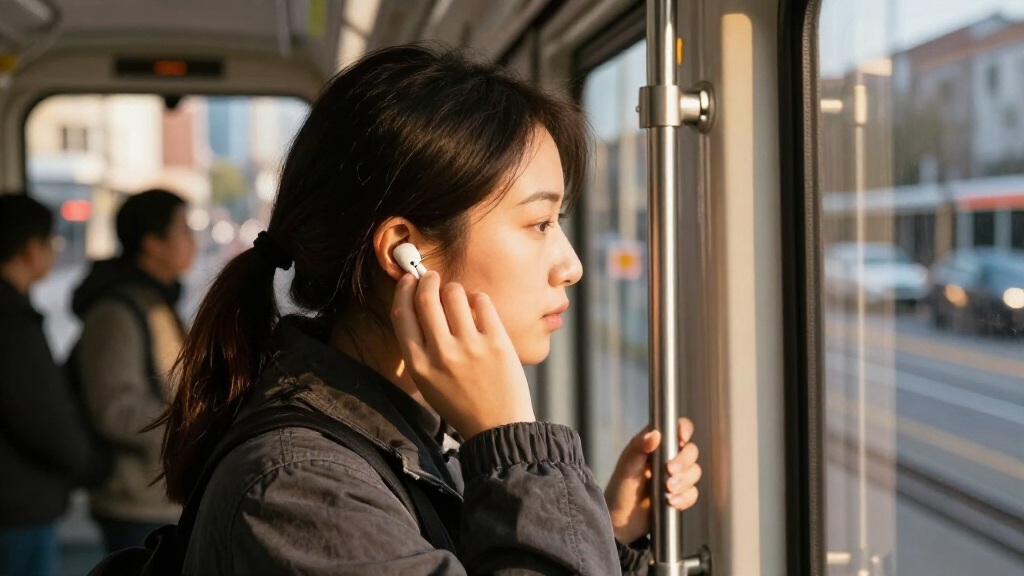
I ranked these earbuds around the demands of a daily commute: controlling traffic, engine, and crowd noise; keeping a stable fit on foot or in transit; lasting through the day; and making calls and playback controls practical. I also looked at design tradeoffs that affect everyday use, including open-ear awareness, earhooks, case size, water resistance claims, and features such as ANC or display-equipped cases. A long playback figure or a long feature list could not outweigh a design mismatch for common commuting situations.
The order reflects how broadly useful each model appears for commuting, not a claim that one design suits everyone. ANC-focused models rank well for noisy enclosed routes, while open-ear and earhook options have distinct strengths for awareness or a more secure fit. More specialized or feature-heavy models rank lower when their main advantage is useful to a narrower group. Since fit and hearing preferences vary, I call out who each type may suit and the tradeoff a buyer should weigh.
| wireless earbuds for commuter | Connectivity |
|---|---|
| Soundcore V20i Open-Ear True W | Bluetooth 5.4 with multipoint |
| JLab Go Pop+ True Wireless Ear | Bluetooth 5.3 |
| JBL Endurance Peak 4 Wireless | Bluetooth with multipoint |
| JBL Vibe Beam True Wireless Ea | — |
| Aptkdoe HD65 Wireless Earbuds | Bluetooth 5.4 |
| TOZO A1 Mini Wireless Earbuds | Bluetooth 5.3 |
| TOZO NC9 Hybrid Active Noise C | Bluetooth 5.3 |
| Soundcore by Anker P20i True W | Bluetooth 5.3 |
| TOZO OpenEarRing Open-Ear Wire | Bluetooth 5.4 |
| AOVOCE S48 Wireless Earbuds wi | Bluetooth 5.4 |
| PocBuds T60 Wireless Bluetooth | — |
| Raycon The Everyday Earbuds Cl | Bluetooth |
| WHYKJTEK BX30 Wireless Noise-C | — |
| Soundcore P31i by Anker Transl | — |
| Soundcore P30i Noise-Cancellin | — |
Factors to Consider When Choosing Wireless Earbuds For Commuters
Choosing commuter earbuds starts with your route, not the longest specification list. A quiet walk, a packed train, and a bus ride with frequent announcements call for different levels of isolation and awareness. These factors can help narrow the field before you compare individual models.
Match noise control to your route
ANC can make engine rumble and steady transit noise less intrusive, which may let you listen at a more comfortable level. It does not make every sound disappear, and voices or sudden noises may still come through. Open-ear earbuds take the opposite approach: they leave your ears uncovered, which can help you hear announcements and nearby activity. A common mistake is choosing maximum isolation for every commute, even when the route includes busy crossings or frequent platform changes. If your journey mixes quiet walking with loud trains, prioritize a model that lets you pause audio easily and use ANC only when it makes sense.
Treat fit as a daily-use feature
Earbuds that loosen during a short walk can become an annoyance over a longer commute, so comfort and stability deserve attention alongside sound features. Earhooks can help keep earbuds in place, but they add structure around the ear and may feel bulky under hats or against some glasses. Small in-ear designs can be less noticeable, though their fit depends on having a tip size that seals comfortably. A weak seal can also reduce passive noise blocking and make bass sound less full, even if the earbuds have ANC. Check the available tip sizes and return terms, and avoid assuming that a workout-oriented shape will suit every ear.
Plan for real battery habits
Compare battery life with the way you actually travel: a round trip with transfers has different demands from a brief ride to work. Manufacturer playback claims may depend on settings and listening conditions, and using ANC can change how long earbuds run between charges. A case can offer extra recharges, but it also needs to fit your pocket and be easy to top up. Display-equipped cases show charge information at a glance, yet they do not replace a reliable charging routine. If you often forget to charge, prioritize a case you will carry and a battery margin that covers your longest day rather than focusing on the largest advertised total.
Check call and control needs before buying
Commuters who take calls in stations or on busy streets need to think about microphone performance as well as music playback. Noise-reduction labels alone do not tell you how clearly your voice will come through in wind, crowd noise, or traffic. Physical buttons and touch controls can both work well, but controls should be easy to use without repeatedly adjusting the fit. If you use one earbud at a time, check whether that listening style is supported and whether the controls remain practical. For frequent work calls, look for credible call examples or clear return options rather than treating an ENC label as a guarantee.
Pay for features you will use
ANC, translation tools, open-ear designs, and unusual case features each solve different problems; none is automatically worth choosing over comfortable, dependable basics. Translation functions may appeal to travelers, but they add little to a familiar daily route if you rarely use them. A phone-stand case can be handy during a layover, though it may not improve listening or fit. Water resistance can be useful when you walk in rain or exercise after work, but check the specific rating and care instructions rather than assuming every water-resistant product can be submerged. Spend more attention on the feature that addresses a recurring commute annoyance, and skip extras that would mostly sit unused.
Decide how much awareness you need
Commuting safety depends on the setting: a pedestrian crossing, a quiet train carriage, and a busy platform are not interchangeable. Open-ear designs allow more environmental sound in, but they do not guarantee that you will notice every warning or announcement. ANC can make a noisy cabin calmer, yet it may also reduce awareness of surrounding activity when used at high levels. Keep volume moderate and pause or remove an earbud when you need to hear instructions or traffic clearly. Rather than expecting one setting to work everywhere, choose earbuds that make it easy to adjust your listening habits as your route changes.
Frequently Asked Questions
Should I choose ANC earbuds or open-ear earbuds for a train commute?
For a loud train, ANC earbuds such as the TOZO NC9 or Soundcore P30i are the more direct fit if reducing steady cabin noise is your priority. Open-ear options like the Soundcore V20i let more outside sound reach you, which can help with announcements and changing surroundings but offers less isolation. Think about whether you spend more time in a loud carriage or walking through areas where awareness matters. You can also pause audio or remove an earbud for announcements rather than expecting either design to handle every situation. Keep playback at a level that lets you respond to important cues.
Are earhook earbuds a good choice if I do not exercise on my commute?
They can be, especially if standard earbuds tend to loosen while you walk, climb stairs, or move through a crowded station. Models such as the JBL Endurance Peak 4, PocBuds T60, Aptkdoe HD65, and WHYKJTEK BX30 use earhooks as a stability feature, not only as a workout feature. The tradeoff is a more noticeable shape that may press against glasses, hats, or helmet straps. If your trip is mostly seated, a compact in-ear pair may feel easier to carry and wear. Fit varies, so check how the hook rests around your ear before committing.
Can I rely on earbuds with ENC or noise-cancelling microphones for calls on a busy platform?
Those labels suggest voice-noise processing, but they do not guarantee that callers will hear you clearly over wind, announcements, and nearby conversations. Microphone placement and how well the earbuds fit can affect call quality too. The AOVOCE S48 lists ENC microphones, while the other models should be judged by their own call features and available demonstrations. If platform calls are a regular need, look for real-world voice samples or a return policy that lets you assess them in your setting. For important calls, moving to a quieter spot is still the safer plan.
Is a long advertised battery life enough reason to pick one of these earbuds?
No; the figure may refer to total playback with the charging case rather than one charge of the earbuds. ANC use, volume, calls, and charging habits can affect how much listening time you get in daily use. Models such as the TOZO OpenEarRing and AOVOCE S48 advertise extended total playback, but you should still check how often you will need to recharge the case. A case display can make charge levels easier to monitor, although it does not add capacity by itself. Choose battery headroom that covers your longest usual day, not just an impressive headline figure.
Which type should I choose if I switch between walking, transit, and work calls?
A mixed commute rewards flexibility more than a single standout feature. ANC can help on a noisy bus or train, while easy-to-use controls let you pause audio when you reach a crossing or need to hear an announcement. If you take frequent calls, give microphone evidence and a comfortable fit more weight than extras such as translation or a stand built into the case. The Soundcore P30i and TOZO NC9 are the ANC-focused choices in this lineup, while open-ear models suit people who place greater value on hearing their surroundings. Pick according to the part of your route that causes the most frustration.
Conclusion
For the broadest mix of commuter needs, I’d start with the TOZO NC9 as best overall, particularly if reducing transit noise matters most. The Soundcore P30i is my best premium-style feature pick for commuters who value ANC plus a phone-stand case, while the JLab Go Pop+ is a sensible best-value choice for buyers who want a simpler true-wireless option without prioritizing advanced noise control. For beginners, the straightforward JBL Vibe Beam is an easy place to start if you do not need open-ear awareness or earhooks. Choose the Soundcore V20i for a specific need—keeping your ears more open to surroundings—or consider an earhook model such as the JBL Endurance Peak 4 if a stable fit matters most. The best match comes down to your route: isolation for loud rides, awareness for street-heavy trips, and a comfortable fit for every day.