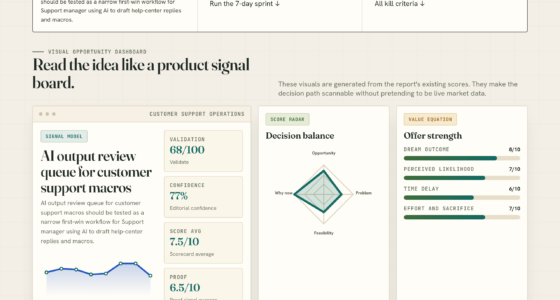
📊 Full opportunity report: The Delegation Ladder: The Four Agentic Loops, And What Each One Lets You Stop Doing on ThorstenMeyerAI.com — validation score, market gap, and execution plan.

Get the latest gadgets delivered free with Prime
- Fast, free delivery on millions of items
- Prime Video, Amazon Music and more included
- Member-only deals all year
TL;DR
The Delegation Ladder outlines four levels of AI loops, from turn-based checks to fully autonomous workflows. Each level reduces human involvement, but requires discipline and proper system design. This framework helps organizations manage AI automation effectively.
Anthropic’s Claude Code team has introduced the ‘Delegation Ladder,’ a framework describing four levels of AI loops that progressively delegate control away from humans. This development clarifies how organizations can design AI workflows that automate tasks while managing risks and costs. The ladder illustrates a spectrum from simple turn-based checks to fully autonomous, event-driven processes, helping developers and businesses optimize AI deployment.
The four agentic loops are defined by the level of control handed off from humans to AI systems. Rung 1 — Turn-based involves the AI performing a cycle of work, including self-verification, with humans inspecting results afterward. It’s suitable for short, one-off tasks where quality assurance is embedded into the process.
Rung 2 — Goal-based allows the AI to determine when a task is complete based on predefined success criteria, with a separate evaluator model verifying the goal. This reduces the need for human oversight during iterative tasks but requires clear, deterministic success metrics.
Rung 3 — Time-based introduces scheduled or event-triggered loops, where the AI system re-runs tasks at set intervals or upon external triggers, such as monitoring pull requests or updating reports automatically. This level enables work to continue autonomously over time, often without human intervention.
Rung 4 — Proactive represents full autonomy, where the AI initiates tasks based on events or schedules, orchestrating workflows across multiple agents. This highest rung demands rigorous system discipline but offers maximum leverage, such as automatic bug triage or complex decision-making pipelines.
Anthropic emphasizes that not every task requires a high-level loop; starting simple and climbing only as needed ensures efficiency and control. The framework aims to guide businesses in designing AI systems that balance automation benefits with safety and cost management.
The delegation ladder: four agentic loops, and what each lets you stop doing
Strip the hype and a “loop” is simple — an agent repeating work until a stop condition is met. The useful lens isn’t the mechanics, it’s what you hand off. Four loop types = four rungs of delegation, from a tool you operate to a process that runs.
The whole framework reduces to one question about your own work: where am I the bottleneck, and which single piece can I hand off? Can you write the check? Is the goal concrete? Does the work arrive on a schedule? That answer picks your rung — and you climb one step at a time. The real skill isn’t operating a loop; it’s the judgment of what to delegate and how far — enough hands off to gain leverage, enough on the wheel that “runs without you” doesn’t become “runs away from you.”
Implications for AI Automation and Business Control
This framework provides a clear roadmap for organizations to progressively automate tasks, reducing manual effort and increasing efficiency. By understanding the levels of control, businesses can better manage risks associated with autonomous AI, such as errors or unintended behaviors. The ladder also highlights the importance of system discipline, verification, and appropriate task selection to maximize benefits without compromising safety.
Adopting this structured approach can lead to more reliable AI workflows, lower operational costs, and the ability to scale automation responsibly. It also encourages a shift from viewing AI as a tool to seeing it as a process that can run independently, provided the right safeguards are in place.
As an affiliate, we earn on qualifying purchases.
Evolution of AI Automation Frameworks
The concept of looping in AI has gained prominence as organizations seek to automate complex workflows safely. Prior to this, AI deployment often relied on manual prompts and limited automation. Anthropic’s introduction of the Delegation Ladder formalizes the progression from simple prompting to autonomous, event-driven systems.
Earlier frameworks lacked a clear categorization of control levels, leading to inconsistent practices. The ladder addresses this gap by defining four distinct stages, each with specific control and verification mechanisms, aligning technical design with organizational risk management.
This development follows broader industry trends toward autonomous systems, including scheduled tasks, goal-oriented automation, and event-based orchestration, reflecting a maturing understanding of AI’s role in operational workflows.
“The Delegation Ladder offers a practical map for scaling AI automation responsibly, emphasizing system discipline at each level.”
— Thorsten Meyer, AI researcher
Unanswered Questions About Implementation and Limits
It is not yet clear how organizations will measure and enforce discipline across complex, multi-agent systems at the highest rung. The specific challenges of integrating dynamic workflows and auto mode in real-world scenarios remain under discussion. Additionally, the framework does not specify how to handle failures or unexpected behaviors at each level, which are critical for safe deployment.
Further research and case studies are needed to validate best practices for scaling these loops in diverse operational environments.
Next Steps for Adoption and Standardization
Organizations are expected to experiment with the four loops in controlled settings to evaluate their benefits and limitations. Industry groups may develop standards for verification and safety protocols aligned with each rung. Additionally, tools and frameworks that facilitate implementing these loops are likely to emerge, helping businesses adopt the ladder more systematically.
Further research will also focus on managing failures and ensuring robustness as systems scale toward full autonomy.
Key Questions
What are the main benefits of using the Delegation Ladder?
The ladder helps organizations systematically increase automation, reduce manual oversight, and improve efficiency while managing risks through clear control levels.
How does each rung differ in terms of control?
Rung 1 involves human-driven checks, Rung 2 allows AI to decide when tasks are complete, Rung 3 automates recurring or triggered tasks, and Rung 4 enables fully autonomous, event-driven workflows.
Is the framework applicable to all AI tasks?
No, the framework is most useful for tasks where automation can be safely scaled, and not all tasks require or benefit from high-level autonomy.
What are the risks of moving to higher rungs?
The main risks include loss of oversight, unintended behaviors, and difficulty in failure management, which require rigorous system discipline and verification.
When will tools be available to implement these loops?
Tools and frameworks are expected to evolve over the coming months as organizations experiment with the concepts and industry standards develop.
Source: ThorstenMeyerAI.com
Halloween Picks
halloween
As an affiliate, we earn on qualifying purchases.