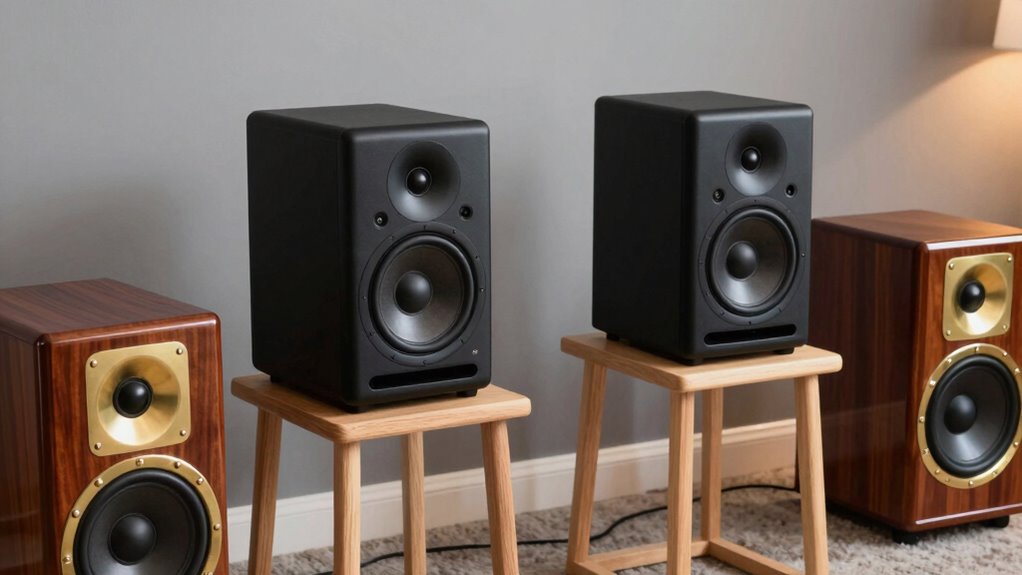

If you place studio monitors and hi-fi speakers in the same room, you’ll notice they have different jobs. Studio monitors deliver a flat, uncolored sound, perfect for accurate mixing and detailed audio work. Hi-fi speakers, on the other hand, focus on creating a warm, engaging experience for casual listening. Their design minimizes vibrations naturally, making them ideal for relaxed environments. Understanding these differences helps you choose the right setup; exploring further reveals how environment and purpose shape each option.
Key Takeaways
- Studio monitors deliver flat, uncolored sound for accurate mixing, while hi-fi speakers produce a warm, engaging sound for casual listening.
- Sound isolation and acoustic treatment are essential for studio monitors to ensure precise audio, less critical for hi-fi speakers.
- Room acoustics significantly impact both, but studio environments require tailored treatments for critical audio work.
- Design focuses differ: studio monitors prioritize flat response; hi-fi speakers aim for a pleasing, immersive experience.
- Use case determines choice: studio monitors for production accuracy; hi-fi speakers for enjoyment and entertainment.
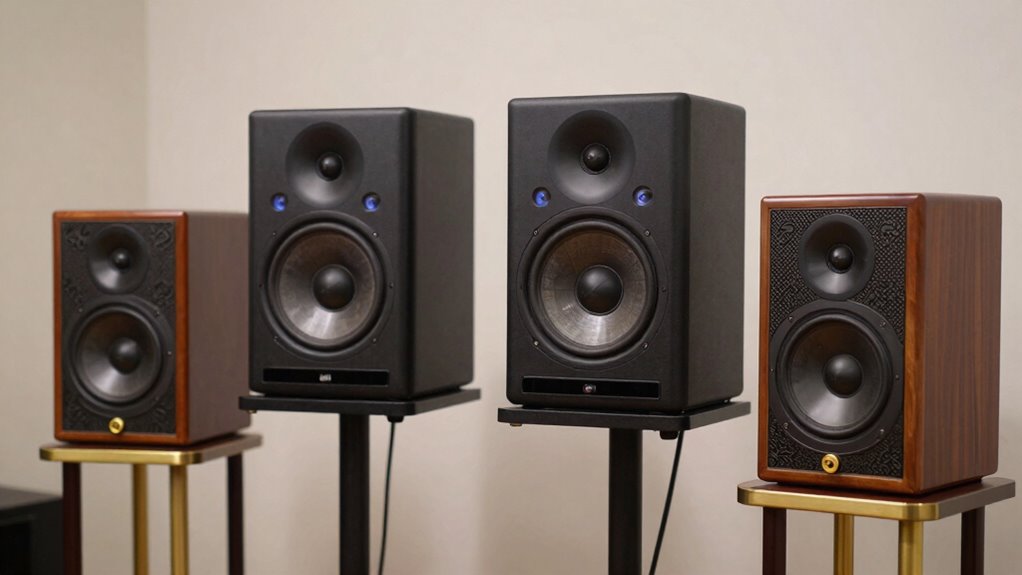
When choosing between studio monitors and hi-fi speakers, understanding their primary differences can help you make an informed decision. Although both are designed to produce sound, they serve distinct purposes and are built with different priorities in mind. As you evaluate your options, consider how sound isolation and acoustic treatment come into play. Studio monitors are engineered to deliver a flat, uncolored sound, so you get an accurate representation of your audio. This accuracy is essential when mixing music or producing content because you need to hear every detail clearly. However, to get the most out of studio monitors, you’ll want to ensure proper sound isolation. Without effective sound isolation, vibrations or external noise can bleed into your listening environment, skewing your perception of the audio. This might mean investing in isolation pads or mounts that reduce vibrations and prevent sound leakage. Additionally, acoustic treatment in your room becomes crucial. Proper acoustic panels, bass traps, and diffusers help control reflections and standing waves, creating a neutral listening environment that allows your studio monitors to perform optimally. A listening environment tailored for critical audio work enhances the accuracy and clarity of your sound.
Moreover, room acoustics play a significant role in how you perceive sound quality, reinforcing the importance of acoustic treatment. In contrast, hi-fi speakers are built to deliver a pleasing, warm sound tailored for general listening. They often emphasize certain frequencies to create a more engaging or immersive experience, which might not be ideal for critical audio work but is perfect for enjoying music or movies at home. Because hi-fi speakers are designed for a more forgiving listening environment, they typically don’t demand the same degree of sound isolation or acoustic treatment as studio monitors. Their enclosure design often minimizes vibrations and sound leakage naturally, and the focus is on filling a room with rich, full sound rather than providing an uncolored, flat response. Still, if you’re setting up a dedicated listening space, adding some acoustic treatment can improve sound clarity and reduce echoes, ensuring you get a more consistent and enjoyable listening experience. Understanding the design principles behind each type of speaker can help you select the right model for your needs and environment. Furthermore, the intended use of each speaker type influences their design and performance characteristics, guiding your choice based on your primary listening goals. Being aware of sound quality expectations can also help you choose equipment that aligns with your preferences and environment. Ultimately, your choice depends on what you want to achieve. If you need precise, uncolored audio for production work, prioritize studio monitors with proper sound isolation and acoustic treatment. If you’re looking for a pleasant, immersive sound for casual listening, hi-fi speakers are more suited to your needs. Understanding these differences helps you tailor your setup to your environment and your goals, ensuring you get the best sound quality for what matters most to you.

Sound Addicted – Studio Monitor Isolation Pads for 5 Inch Monitors, Pair of Two High Density Acoustic Foam which Fits Most Speaker Stands | SMPad 5
- Material: High-density acoustical foam (50kg/m^3)
- Dimensions: 7.5'' x 11'' x 1.6''
- Weight Capacity: Supports up to 24 lb each
As an affiliate, we earn on qualifying purchases.
As an affiliate, we earn on qualifying purchases.
Frequently Asked Questions
Can Studio Monitors Be Used for Casual Music Listening?
Yes, you can use studio monitors for casual music listening, but they might not provide the best sound quality for that purpose. Studio monitors are designed for accuracy, so they reveal every detail, which can sometimes make music sound less warm or engaging. If you prefer a richer, more immersive experience, hi-fi speakers are generally better suited. However, if you value precise sound, studio monitors can work for casual listening.
Do Hi-Fi Speakers Require Special Room Treatments?
Did you know that proper room acoustics can improve sound quality by up to 50%? Hi-fi speakers don’t require special room treatments, but good speaker placement and room acoustics make a significant difference. You should position your speakers away from walls and corners, and consider acoustic panels for ideal sound. This guarantees your hi-fi system delivers the best listening experience, free from unwanted echoes or bass muddiness.
How Do Power Requirements Differ Between Monitors and Hi-Fi Speakers?
You’ll find that studio monitors generally have higher power requirements than hi-fi speakers, affecting power efficiency and electrical compatibility. Monitors often need more wattage to deliver precise, flat sound for accurate mixing, so guarantee your amplifier can handle their power demands. Hi-fi speakers typically operate efficiently at lower power levels, making them easier on your electrical system. Always check the specifications to match your gear’s power needs for peak performance and safety.
Are Studio Monitors More Durable Than Hi-Fi Speakers?
Studio monitors are generally more durable than hi-fi speakers due to their build quality and design. They’re built to withstand the rigors of professional use, including frequent adjustments and long hours. In a durability comparison, monitors often feature rugged cabinets and reinforced components, making them more resilient. So, if you’re concerned about longevity and reliability, studio monitors usually hold up better over time than typical hi-fi speakers.
What Is the Typical Lifespan of Each Type of Speaker?
Studio monitors typically have a longer lifespan, often lasting 10-15 years or more, thanks to their robust equipment durability. Hi-fi speakers usually last around 8-12 years, but their longevity depends on usage and maintenance. Your speaker longevity depends on factors like build quality and care. Regular maintenance can extend your equipment durability, ensuring your speakers remain functional and high-performing over the years.
Conclusion
So, next time you’re choosing between studio monitors and hi-fi speakers, remember—they’re designed for different jobs. But which one truly suits your needs? Could the perfect sound be hiding in plain sight? The answer might surprise you. Stay tuned, because the choice you make could transform your listening experience in ways you never expected. Ready to discover what’s best for you? The journey to the perfect sound is just beginning.