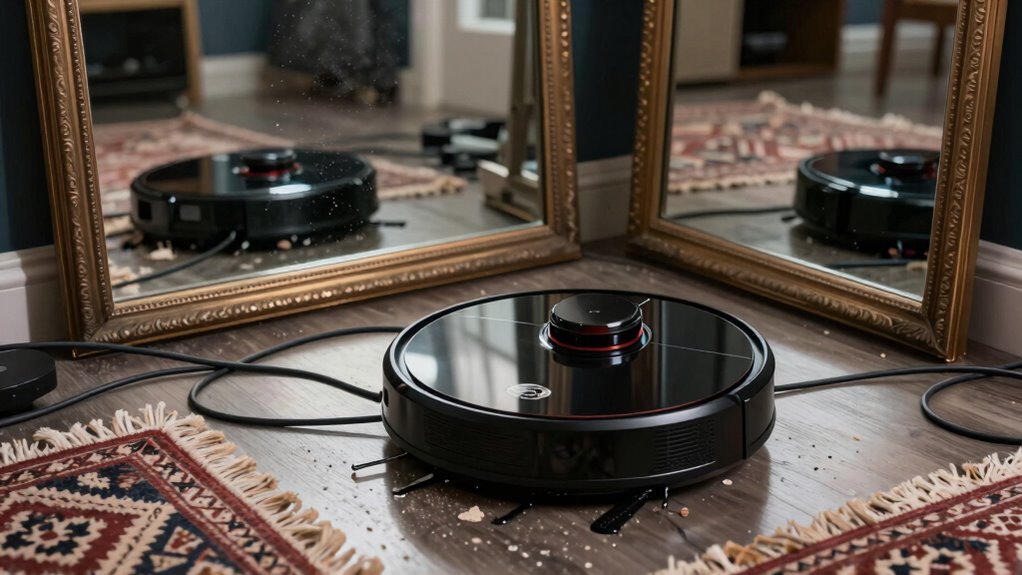

Your robot vacuum struggles with cables, fringes, and mirrors because its sensors get confused by visual distractions. Cables and clutter can mislead it or trap the vacuum, while fringes on carpets can tangle or cause hesitation. Reflective surfaces like mirrors can trick sensors into thinking there’s an obstacle or boundary, leading to inefficient cleaning. Keep exploring to discover how to create an environment that helps your vacuum work better and cleaner.
Key Takeaways
- Cables and fringes can confuse sensors, causing misjudged distances and navigation errors.
- Reflective surfaces and mirrors create false obstacles, leading to unexpected changes in direction.
- Clutter near charging stations hampers quick recognition and proper docking.
- Frayed carpet fringes may tangle in brushes or sensors, disrupting movement.
- Dust and debris on sensors reduce detection accuracy, affecting overall cleaning efficiency.

Robot vacuums have become a popular solution for keeping floors clean, but they often face challenges when encountering various obstacles. You might notice your device hesitating or getting stuck around certain areas, especially near charging stations or along carpet edges. These common trouble spots can disrupt the cleaning process and frustrate you, but understanding why your robot struggles can help you troubleshoot and improve its performance.
Charging stations are designed to help your robot recharge automatically, but they can also cause issues. When a robot approaches its charging dock, it needs to identify the station’s exact location. Sometimes, cables or cords around the station can confuse the sensors, leading the vacuum to misjudge distances or become trapped in a tangle. To prevent this, keep cables neatly organized and away from the charging area. Clear the space around the station so the vacuum can easily find its dock without unnecessary hesitation or misnavigation. Proper placement and minimal clutter around the charging station help your robot recognize it quickly and return efficiently for recharging. Sensor accuracy can also be improved through regular cleaning of the sensors to ensure optimal performance.
Keep cables organized and clear around the charging station for smooth robot vacuum navigation and efficient recharging.
Carpet edges are another obstacle that trips up many robot vacuums. These edges often have a slightly higher or different texture than hard floors, which can throw off the sensors. When your vacuum encounters a carpet edge, it may hesitate, back away, or attempt to climb the edge repeatedly, wasting time and battery life. To minimize this, you can use boundary strips or physical barriers to prevent your robot from approaching edges it struggles with. Some models have trouble shifting between hard floors and carpets, especially if the carpet edges are frayed or have fringes. Fringes can get tangled in the brushes or sensors, causing the robot to stop or change direction abruptly. Keeping fringes tidy or trimming them can help your vacuum move smoothly across different surfaces. Additionally, sensor calibration can improve its ability to distinguish between different textures and surfaces.
Floor mirrors or reflective surfaces also pose problems because they can confuse the sensors that rely on visual cues. When your robot approaches a mirror, it might perceive the reflection as an obstacle or a wall, causing it to change direction unexpectedly. This often results in repetitive or inefficient cleaning patterns. If possible, reposition your mirror or place a small barrier in front of it to prevent the vacuum from getting distracted. By reducing reflective surfaces in the cleaning path, you help your robot navigate more confidently and cover the entire area without unnecessary detours. Recognizing and addressing these floor obstacles can significantly enhance your vacuum’s cleaning efficiency.
Additionally, some models are equipped with advanced sensors, but they still benefit from a well-organized environment to function at peak performance.
robot vacuum cable management tools
As an affiliate, we earn on qualifying purchases.
As an affiliate, we earn on qualifying purchases.
Frequently Asked Questions
How Do Robot Vacuums Detect Cables Before They Get Tangled?
Robot vacuums detect cables before they get tangled through cable detection technology. They use sensors and cameras to identify obstacles, including cables, during cleaning. When the vacuum approaches a cable, obstacle avoidance systems activate, allowing it to navigate around or gently pull back to prevent entanglement. This proactive detection helps maintain efficient cleaning sessions and avoids potential damage to both the vacuum and your cables.
Can Robot Vacuums Distinguish Between Mirrors and Actual Obstacles?
Sure, your robot vacuum might mistake mirror reflections for real obstacles—those pesky illusion tricks that confuse it. It can’t quite tell if that shiny surface is a wall or just an obstacle illusion, so it often bumps and backtracks. While some models try to differentiate, many still see reflections as barriers, leading to unnecessary detours. So, don’t expect it to master the art of mirror recognition just yet—robots still have a way to go.
Do Robot Vacuums Have Sensors to Identify Fringes or Tassels?
Robot vacuums typically lack specialized sensors for fringe detection or tassel avoidance. Instead, they rely on basic obstacle sensors and cameras that may struggle with delicate fringes or tassels, risking tangling or damage. You can help by trimming fringes and tassels or placing physical barriers. While some advanced models might have better obstacle recognition, most still require manual care to prevent issues like tassel entanglement.
How Do Robot Vacuums Handle Unexpected Floor Obstacles Like Toys?
Imagine your robot vacuum as a vigilant explorer facing unexpected obstacles like toys. It detects these objects with sensors, reroutes to avoid disruption, and keeps cleaning efficiently. When it encounters toys, it temporarily pauses, recalibrates, and continues without missing spots. This process preserves its cleaning efficiency and conserves battery life, ensuring your floor stays spotless without frequent interruptions. You can trust your robot to handle surprises gracefully and efficiently.
Are There Specific Robot Vacuum Models Better at Avoiding Floor Hazards?
Some robot vacuum models excel at avoiding floor hazards, especially those with advanced sensors and mapping technology. You’ll find that models with longer battery life can handle larger areas without interruption, while quieter options minimize noise levels during navigation. These features help the vacuum detect and avoid obstacles like cables, fringes, or mirrors more effectively, ensuring thorough cleaning without bumping into hazards or disturbing your household.
Conclusion
So, imagine a world where your robot vacuum bravely battles the treacherous terrain of cables, fringes, and floor mirrors—like a tiny hero facing an army of chaos! These obstacles aren’t just minor annoyances; they’re the villains that threaten your spotless sanctuary. Without your watchful eye, your robot might just be doomed to a never-ending struggle, forever tangled in the web of your home’s tiniest hazards. Protect your vacuum, and save your floors from this epic showdown!