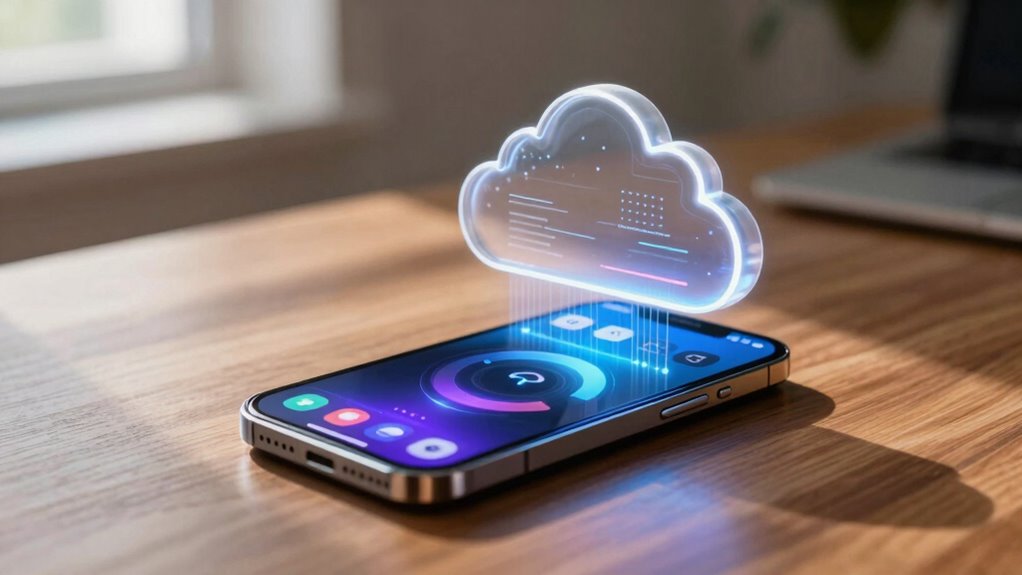

Choosing between on-device AI and cloud AI depends on what matters most to you. If privacy and instant responses are top priorities, on-device AI is smarter, as it processes data locally and reduces security risks. For complex tasks needing large datasets, cloud AI offers powerful capabilities despite some latency. Hybrid options blend both strengths for a balanced approach. To uncover how each fits your needs and what’s on the horizon, keep exploring further.
Key Takeaways
- On-device AI excels in privacy, security, and instant response, ideal for real-time, sensitive applications.
- Cloud AI offers greater processing power and access to extensive data, suitable for complex tasks and large-scale analysis.
- Hybrid solutions combine both, balancing privacy, performance, and scalability for diverse needs.
- Advances in edge computing and on-device processing are narrowing performance gaps.
- The best choice depends on specific use cases, prioritizing privacy, speed, or computational demands.
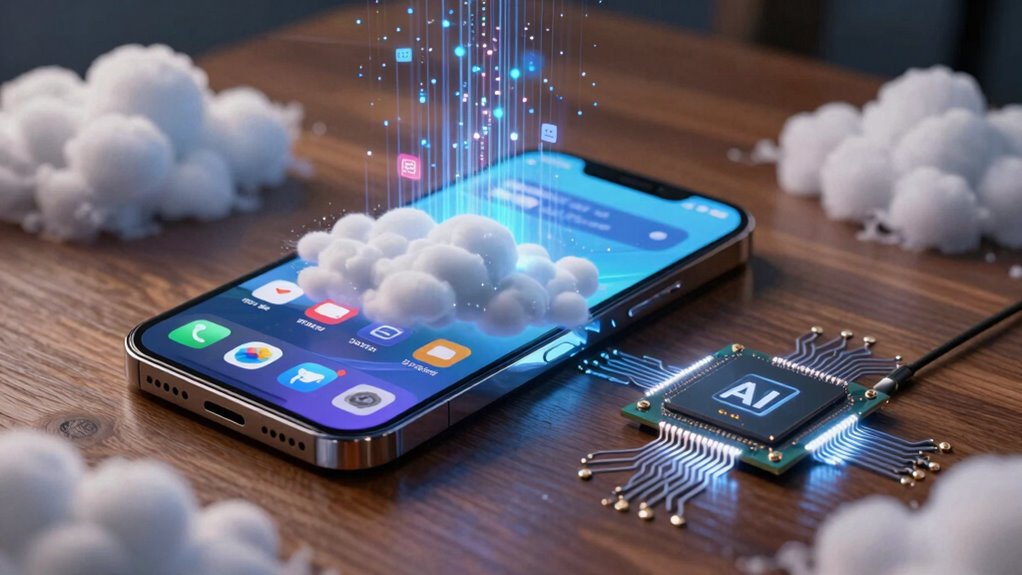
As artificial intelligence continues to advance, choosing between on-device AI and cloud-based AI has become a crucial decision for users and developers alike. Your choice impacts how quickly you get results, how secure your data remains, and how efficiently your devices operate. On-device AI processes data locally on your device, like your smartphone or IoT gadgets, offering significant benefits in data privacy. Since data doesn’t need to leave your device to be processed elsewhere, you maintain more control over sensitive information, reducing the risk of breaches or leaks. This local processing also means lower latency, so responses happen almost instantly—perfect for real-time tasks like voice commands, facial recognition, or augmented reality. You get immediate feedback without waiting for cloud servers to respond, making on-device AI ideal when speed is critical.
In contrast, cloud AI relies on powerful servers situated remotely, often offering access to larger datasets and more complex models. While this setup can provide more advanced processing capabilities, it comes with certain drawbacks. Data privacy becomes a concern because your information travels over the internet and is stored on external servers, increasing vulnerability to cyber threats. Additionally, cloud AI introduces latency because data must be transmitted back and forth between your device and the servers, which can cause delays in processing and response times. For tasks that aren’t time-sensitive or require extensive computational power—like big data analysis or training new AI models—the cloud can be advantageous. It allows you to leverage scalable infrastructure without taxing your device’s resources, enabling more sophisticated or resource-heavy applications. processing capabilities continue to improve on both fronts, making the decision-making process even more nuanced. As both approaches evolve, the potential for hybrid solutions that combine the best of both worlds is becoming increasingly feasible. These innovations are driving a shift toward more integrated AI systems that adapt seamlessly to user needs. Moreover, advancements in edge computing are helping bridge the gap by bringing cloud-like processing closer to the user, further enhancing the potential of hybrid models.
Your decision depends on what matters most for your use case. If you prioritize data privacy and need immediate responses, on-device AI is likely the smarter choice. It keeps your data secure and minimizes delays, making it suitable for interactive apps, gaming, or privacy-sensitive functions. However, if you rely on complex computations or need access to vast datasets that your device can’t handle alone, cloud AI offers more power and flexibility, despite the trade-offs in latency and privacy. Ultimately, the most suitable choice aligns with your specific needs—balancing performance, privacy, and computational demands. Recognize that advancements in both areas continue to evolve, and hybrid solutions are emerging to combine the strengths of on-device and cloud-based AI, giving you even more options for smarter, faster, and more secure AI experiences.

Pocket AI Voice Recorder & Smart Assistant – Auto Transcription, Summaries & Action Items – AI Note Taker for Meetings, Calls & Productivity – Space Grey
- AI Personal Assistant: Transcribes and summarizes meetings and calls
- One-Tap Recording: Easily capture audio with a single tap
- Smart AI Insights: Generates summaries and action items automatically
As an affiliate, we earn on qualifying purchases.
As an affiliate, we earn on qualifying purchases.
Frequently Asked Questions
How Does Latency Differ Between On-Device and Cloud AI?
Latency is generally lower with on-device AI because edge processing handles data locally, reducing delays caused by data travel to and from the cloud. This setup improves real-time responses and enhances data sovereignty, ensuring sensitive information stays on the device. In contrast, cloud AI relies on internet connections, which can introduce variability and higher latency, especially in areas with poor connectivity. So, for rapid, privacy-focused tasks, on-device AI is often the smarter choice.
What Are the Privacy Implications of On-Device Versus Cloud AI?
Think of on-device AI as a secure vault where your data stays close, safeguarding your privacy with data encryption and maintaining user anonymity. In contrast, cloud AI acts like a public square, where data travels across networks, increasing exposure risks. With on-device AI, you control your data, reducing privacy concerns. Cloud AI might offer convenience, but it often requires sharing more info, raising potential privacy implications.
Which AI Approach Is More Cost-Effective Long-Term?
You find that on-device AI often proves more cost-effective long-term because it reduces ongoing maintenance costs and relies less on expensive cloud services. While initial setup may be higher, you’ll save money over time by avoiding recurring cloud fees and minimizing data transfer costs. Plus, with on-device AI, you benefit from faster, localized processing, which boosts efficiency and lowers operational expenses in the long run.
How Scalable Is On-Device AI Compared to Cloud Solutions?
On-device AI is less scalable than cloud solutions because device limitations restrict processing power and storage capacity. You might face challenges with data synchronization, especially when updating models across multiple devices. Cloud AI scales easily since resources expand with demand, allowing you to handle a larger user base and more complex tasks effortlessly. If scalability is your priority, cloud solutions offer more flexibility and growth potential over on-device AI.
Can On-Device AI Replace Cloud AI Entirely?
Think of on-device AI as a trusty pocket knife—great for quick tasks, but not replacing a full toolkit. It can handle many AI deployment needs locally, but it can’t fully replace cloud AI, especially for complex, large-scale tasks. Edge computing enhances on-device AI’s capabilities, yet for heavy processing and data analysis, cloud systems still offer unmatched power. So, on-device AI complements rather than replaces cloud AI.
Conclusion
Choosing between on-device AI and cloud AI isn’t about finding a clear winner, but about discovering what suits your needs best. Both options have their subtle virtues, quietly shaping your experience in ways you might not immediately see. By understanding their gentle strengths and quiet limitations, you can make a smarter choice—one that feels right and seamlessly fits into your world. After all, the best decision often whispers softly, waiting for you to listen.