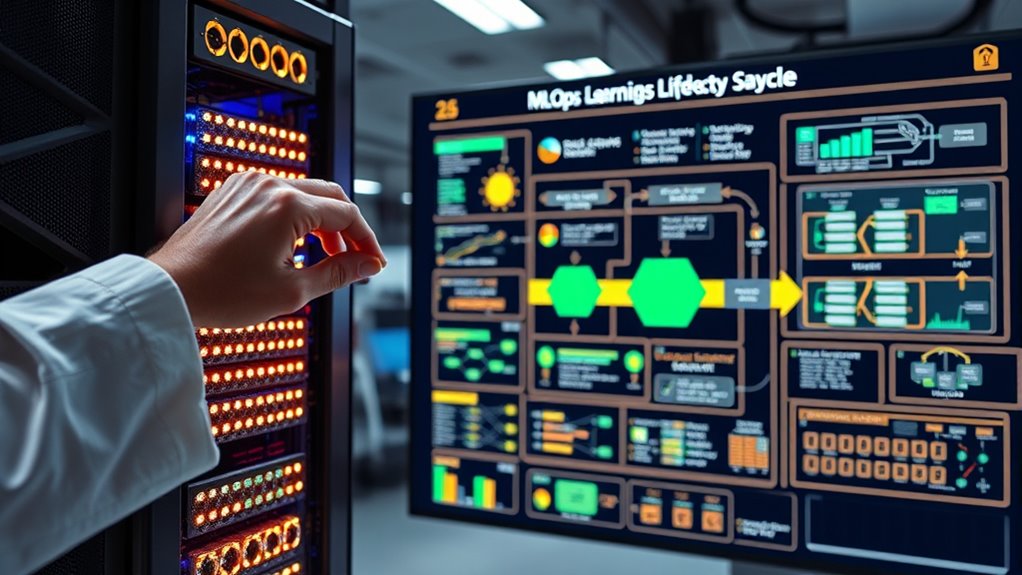

The MLOps lifecycle guides you in turning machine learning experiments into reliable, scalable production systems by emphasizing data versioning, automation, and monitoring. You need to use tools like Docker for environment consistency and implement CI/CD pipelines for seamless deployment. Managing model versions, data snapshots, and deployment strategies helps maintain performance and manage updates efficiently. Keep exploring to discover how to optimize each step and build resilient, high-performing machine learning solutions.
Key Takeaways
- Transition from experiment to production involves deploying models with automation, monitoring, and scalability considerations.
- Containerization and CI/CD pipelines streamline testing, validation, and deployment processes.
- Data versioning ensures consistency, reproducibility, and better diagnostics across model development and deployment.
- Managing the model lifecycle includes version control, rollback strategies, and maintaining deployment environments.
- Efficient deployment and data control enhance reliability, performance, and compliance of machine learning solutions.

Have you ever wondered how organizations efficiently develop, deploy, and maintain machine learning models at scale? It all begins with turning your experimental ideas into robust, production-ready solutions. The journey from prototype to deployment involves several vital steps, but two fundamental aspects are model deployment and data versioning. When you’re ready to move a model into production, you need a dependable way to deploy it so that it can handle real-world data and user requests smoothly. This process isn’t just about copying files; it requires automation, monitoring, and scalability. You want your model to be accessible via APIs or integrated into existing systems seamlessly. Containerization tools like Docker often come into play here, ensuring your model runs consistently across different environments. Once deployed, continuous monitoring helps you catch issues early, such as performance drift or errors. This is where data versioning becomes essential—by tracking different versions of your data sets, you can understand how changes impact your model’s accuracy and stability over time. Data versioning allows you to reproduce results, troubleshoot problems, and guarantee consistency across training and inference phases. Without proper data management, you risk deploying models based on outdated or inconsistent datasets, which can undermine trust and performance. To streamline model deployment, many teams adopt CI/CD pipelines tailored for machine learning. These pipelines automate the testing, validation, and deployment processes, reducing manual errors and speeding up iteration cycles. They also help enforce standards for model quality and data integrity. As you progress, you’ll realize that managing model lifecycle components—like version control, rollback strategies, and deployment environments—is vital for maintaining a healthy MLOps pipeline. This way, you can update or replace models without disrupting end users. Additionally, integrating data versioning into your workflow ensures that every model version is associated with a specific data snapshot, making it easier to diagnose issues or improve models based on historical data. Proper model management and data tracking are crucial for maintaining a resilient and compliant MLOps system. It also supports compliance requirements by maintaining a clear audit trail. In brief, efficient model deployment, combined with disciplined data versioning, forms the backbone of a successful MLOps lifecycle. They empower you to confidently push models into production, manage updates seamlessly, and sustain high performance over time. By automating these processes and maintaining rigorous data control, you guarantee your machine learning solutions are scalable, reliable, and ready to deliver value at every stage.
Frequently Asked Questions
How Do I Choose the Right MLOPS Tools for My Project?
You should start by evaluating your project’s needs, focusing on model versioning and tool integration capabilities. Look for tools that seamlessly integrate with your existing tech stack and support version control for models. Prioritize user-friendly options, scalability, and automation features. Test a few solutions to see which ones streamline your workflow, ensure collaboration, and protect model integrity. Choosing the right MLOps tools boosts efficiency and reduces deployment risks.
What Are Common Challenges During Deploying ML Models to Production?
When deploying ML models to production, you might face challenges like model drift, where your model’s accuracy declines over time, and infrastructure scaling, which can strain resources. You need to monitor your models continuously and adjust your infrastructure accordingly. Ensuring your deployment pipeline is robust helps mitigate these issues, allowing your model to adapt and perform reliably at scale. Regular updates and scalable architecture are key to overcoming these hurdles.
How Can I Ensure Data Privacy in MLOPS Pipelines?
Prioritize privacy by practicing proper data protection techniques. You can guarantee data privacy in MLOps pipelines through robust data anonymization, removing personally identifiable information before processing. Implement encryption strategies, like encrypting data at rest and in transit, to safeguard sensitive information. Consistently monitor for leaks, adopt access controls, and stay compliant with privacy regulations. These proactive practices prevent breaches and protect user data throughout your machine learning lifecycle.
What Strategies Improve Collaboration Between Data Scientists and Engineers?
You can improve collaboration by fostering cross-team communication, ensuring everyone stays aligned on goals and updates. Implementing clear version control practices helps track changes and avoid conflicts, making handoffs smoother. Encourage regular meetings and shared documentation to build transparency. By promoting open dialogue and robust version control, you create a collaborative environment where data scientists and engineers work efficiently, reducing errors and accelerating project delivery.
How Do I Measure Success in MLOPS Post-Deployment?
To gauge success in MLOps post-deployment, track model monitoring and performance metrics consistently. You’ll want to watch for accuracy, latency, and drift to make certain your model’s reliability. Success means your system sustains stability, stays scalable, and adapts to data changes. Regular reviews and real-time alerts help you identify issues early, ensuring your model continues to deliver dependable, data-driven decisions day after day.
Conclusion
Mastering the MLOps lifecycle transforms you into an unstoppable force, effortlessly turning raw experiments into unstoppable production engines. With this knowledge, you’ll navigate challenges with the precision of a surgeon and the speed of a cheetah, ensuring your models not only succeed but dominate the industry. Embrace this journey, and you’ll wield the power to shape the future of AI, leaving competitors in the dust and setting new standards for excellence in machine learning.