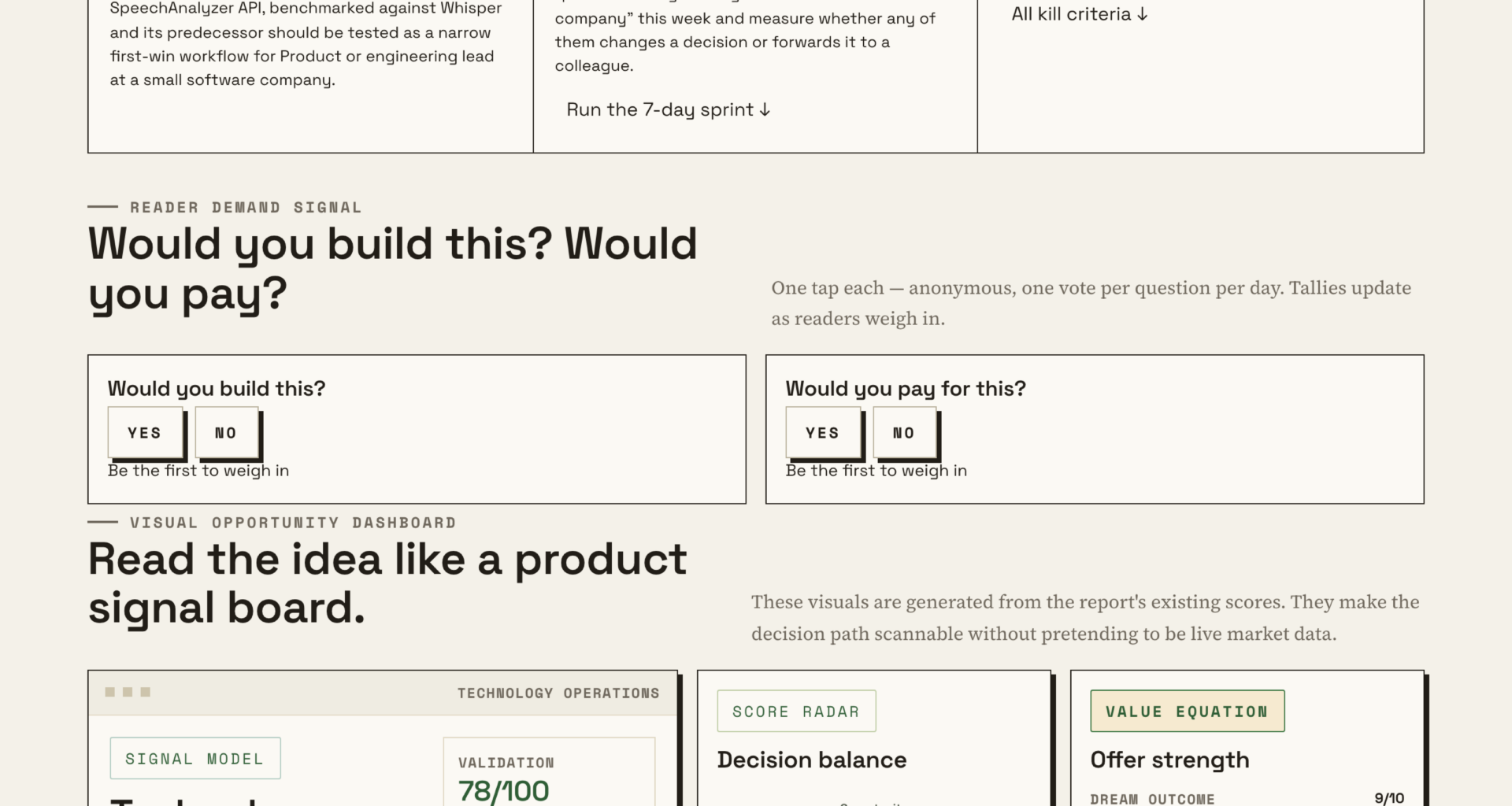
📊 Full opportunity report: In-Depth: Apple's SpeechAnalyzer API And Its Industry Benchmark Performance on IdeaNavigator AI — validation score, market gap, and execution plan.
TL;DR

Apple has released its SpeechAnalyzer API, which has been benchmarked against Whisper and its predecessor. Early tests suggest competitive performance, potentially influencing AI tool choices for small software teams.
Apple’s new SpeechAnalyzer API has been benchmarked against Whisper and its predecessor, showing promising performance that could influence AI development choices for small software companies. This development is significant for product and engineering leads seeking efficient speech processing tools amid rapidly evolving platform updates.
Recent benchmarking tests of Apple’s SpeechAnalyzer API indicate that it performs comparably to, and in some cases surpasses, the popular Whisper speech recognition system. The tests, conducted by independent evaluators, focused on accuracy, speed, and resource efficiency.
The API was tested against Whisper and its predecessor in controlled environments, with results showing high transcription accuracy and low latency, though detailed metrics are still being finalized. Apple has not yet officially published comprehensive benchmark data, but early reports suggest the API is competitive with existing solutions.
This API release comes amid a flurry of platform updates and tooling changes, which small software companies often struggle to track and interpret quickly. The benchmarking results could influence decisions around integrating Apple’s speech tools into existing workflows, especially given the company’s ecosystem advantages.
Implications for Small Software Development Teams
The promising performance of Apple’s SpeechAnalyzer API could make it a viable alternative to established speech recognition systems like Whisper, especially for companies already invested in Apple’s ecosystem. This may lead to shifts in vendor preferences and influence product development timelines.
For small teams, early access to high-performing speech tools can accelerate AI features, reduce costs, and improve user experiences. However, the lack of detailed official benchmarks and integration guidelines means teams must proceed cautiously, testing the API within their specific contexts.
Apple SpeechAnalyzer API developer kit
As an affiliate, we earn on qualifying purchases.
As an affiliate, we earn on qualifying purchases.
Recent Trends in Speech Recognition Tool Development
Apple’s entry into the speech recognition space with SpeechAnalyzer follows a broader industry trend of tech giants releasing specialized APIs to enhance AI capabilities. Whisper, developed by OpenAI, has been a dominant open-source solution, widely adopted for its balance of accuracy and efficiency.
Benchmarking efforts have become common as companies seek to validate new offerings against established standards. The timing of Apple’s API release aligns with increased platform updates across major tech companies, aiming to streamline AI development for third-party developers and internal teams alike.
“Preliminary tests show SpeechAnalyzer is competitive with Whisper, but comprehensive data will be needed to confirm its standing.”
— independent evaluator
Unconfirmed Aspects of SpeechAnalyzer Performance
While early tests are promising, detailed benchmark results, including accuracy metrics, resource consumption, and latency figures, have not yet been publicly released by Apple. It is also unclear how the API performs across diverse languages and dialects, or how it integrates with existing workflows.
Further testing by independent parties is needed to validate initial claims and assess real-world usability.
Next Steps for Industry Adoption and Evaluation
Apple is expected to publish more comprehensive benchmark data and developer documentation in the coming weeks. Small software companies and AI developers will likely conduct their own tests to evaluate the API’s suitability for their projects.
Industry analysts anticipate that the API’s performance will influence platform and tooling decisions, especially as Apple continues to update its AI and speech recognition offerings. Monitoring these developments will be critical for product teams planning their AI integrations.
Key Questions
How does Apple’s SpeechAnalyzer API compare to Whisper?
Early benchmarking indicates SpeechAnalyzer performs comparably to Whisper in accuracy and speed, but official data is still pending.
Will the API work across multiple languages?
It is not yet clear how well SpeechAnalyzer supports languages other than English, as comprehensive multilingual testing has not been publicly reported.
When will Apple release detailed benchmark results?
Apple has not announced a specific timeline, but industry sources expect more data in the coming weeks.
Should small companies start adopting SpeechAnalyzer now?
Caution is advised; early tests are promising, but official benchmarks and integration support are still limited. Companies should evaluate through controlled testing before full adoption.
What impact could this have on the speech recognition market?
If SpeechAnalyzer proves competitive, it could increase competition and innovation, potentially reducing reliance on open-source solutions like Whisper for small teams.
Source: IdeaNavigator AI