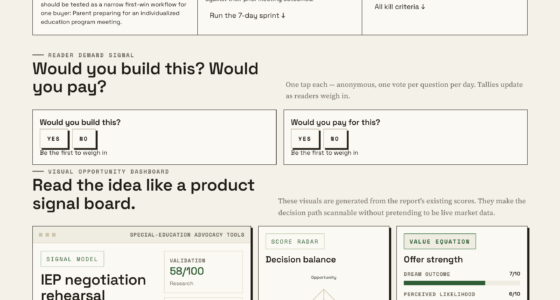
📊 Full opportunity report: IdeaClyst: The Validation Council on ThorstenMeyerAI.com — validation score, market gap, and execution plan.

Get the latest gadgets delivered free — and shop member deals
- Fast, free delivery on millions of items
- Access to Prime Big Deal Days deals on October 6–7
- Prime Video, Amazon Music and more included
TL;DR
IdeaClyst has launched a new validation council that uses opposing AI models to stress-test ideas before they proceed. This process aims to reduce costly, plausible but weak ideas in planning. The approach emphasizes structured disagreement for better decision-making.
IdeaClyst has launched a new ‘Validation Council’ that employs two opposing AI models—Claude and Codex—to rigorously evaluate and stress-test ideas before they are approved for development. This structured approach aims to improve decision quality by surfacing weaknesses early, preventing costly failures later. The council is developed privately and is not publicly available.
The IdeaClyst Validation Council operates by first conducting a research pre-step that gathers relevant context and evidence about an idea. This information is then examined through five deliberation steps: framing the idea, steelmanning it, red-teaming it, evidence-checking it, and finally issuing a verdict. The process involves two models—Claude and Codex—that are assigned opposing roles: one to support the idea, the other to challenge it. This disagreement is intentional, aiming to produce more robust, trustworthy assessments.
The process is designed to be low-cost and provider-agnostic, running locally on owned compute resources. It is the first decision node in IdeaClyst’s private workflow, intended to serve as a gatekeeper that kills weak ideas early, saving time and resources. The system emphasizes transparency, allowing users to review the reasoning behind each verdict, rather than relying solely on the final decision. However, experts caution that models can still share blind spots and confidently endorse weak ideas, so the process is not foolproof.
IdeaClyst — the validation council
Most ideas don’t die from being bad — they die from being plausible and untested. A research pre-step, then two models cross-examining the idea before it earns a roadmap slot.
Independent commentary, produced with AI assistance under human editorial oversight. The views are the author’s own and may change. IdeaClyst is developed privately and is not publicly available and is provided “as is” without warranty. The council’s research, deliberation and verdicts are produced by automated models and may contain errors or shared blind spots — a verdict is auditable reasoning, not validated demand; verify independently before committing. Product and company names are trademarks of their respective owners; mention does not imply endorsement.
Why Structured Disagreement Improves Idea Validation
The introduction of a multi-model council for idea validation represents a significant step toward more rigorous, transparent decision-making in product development and strategic planning. By forcing opposing models to argue for and against ideas, the process reduces the risk of accepting plausible but weak ideas that could lead to costly failures. This approach leverages the strengths of AI while acknowledging its limitations, providing a more reliable filter for high-stakes decisions.
For operators, this means better leverage—making more confident choices about what to pursue or abandon—without the need to hire additional skeptics or experts. It shifts decision-making from intuition or unstructured judgment to a repeatable, auditable process, which could influence how organizations prioritize innovation and resource allocation.
As an affiliate, we earn on qualifying purchases.
Background on IdeaClyst and AI-Driven Decision Tools
IdeaClyst was developed as part of a broader effort to improve idea vetting and decision-making processes through AI. Its predecessor, IdeaNavigator, provided a public, evidence-mined idea stream. The company emphasizes that many failed ideas are not inherently bad but are plausible enough to be accepted without proper stress-testing. The new Validation Council builds on this by creating a private, structured environment for rigorous evaluation, using multiple AI models and a formal deliberation process.
This development aligns with trends toward provider-agnostic AI tools that prioritize transparency and repeatability. The process is designed to operate locally, avoiding reliance on proprietary cloud services, thus making it more accessible and cost-effective for organizations. You can learn more about IdeaClyst’s approach to decision-making tools.
“Our Validation Council forces ideas to survive a rigorous fight, making the decision process more transparent and trustworthy.”
— Thorsten Meyer, IdeaClyst founder
Limitations and Risks of Multi-Model Idea Validation
It remains unclear how well the council performs across diverse domains or in real-world decision-making scenarios. The models can still share blind spots, potentially leading to confident but incorrect verdicts. The process’s effectiveness depends on the quality of the models and the rigor of the deliberation steps. Additionally, there is a risk that the structured process could lend unwarranted legitimacy to weak ideas if not carefully monitored.
Further empirical validation and user testing are needed to assess its reliability and impact over time.
Next Steps for IdeaClyst and Its Validation Framework
IdeaClyst plans to gather user feedback to refine the process. Future developments may include integrating additional models, expanding the scope of evaluation, and developing metrics to measure the decision quality improvements. The company also aims to demonstrate the system’s effectiveness through case studies and real-world applications, encouraging adoption across industries seeking better idea vetting tools.
Key Questions
How does the IdeaClyst Validation Council improve decision-making?
It introduces structured disagreement between two AI models to rigorously evaluate ideas, reducing the likelihood of advancing weak or untested concepts.
Can the council guarantee the correctness of the ideas it approves?
No, the council cannot guarantee correctness. It reduces risk by surfacing weaknesses, but models can share blind spots or confidently endorse flawed ideas.
Is the process open source and customizable?
The system is developed privately and is not publicly available, but it is designed to run locally on owned compute, allowing customization.
What are the limitations of using AI models for idea validation?
Models can have shared blind spots, may confidently endorse weak ideas, and the process relies on the quality of the models and evidence gathering.
Source: ThorstenMeyerAI.com
Fall Picks
fall essentials
As an affiliate, we earn on qualifying purchases.