Haptic feedback in sim racing isn’t just a fun gimmick; it’s a essential tool that makes your experience more realistic and immersive. It transmits critical cues like grip loss, collisions, and surface texture directly through tactile signals, helping you understand vehicle behavior better. This technology sharpens your awareness, improves control, and can even boost your real driving skills. If you keep exploring, you’ll discover how this technology truly elevates your racing experience beyond visuals alone.

Get the latest gadgets delivered free — and shop member deals
- Fast, free delivery on millions of items
- Access to Prime Big Deal Days deals on October 6–7
- Prime Video, Amazon Music and more included
Key Takeaways
- Haptic feedback provides realistic physical cues that improve driving awareness, making it more than just a visual simulation.
- Force and tactile sensations help users instinctively respond to vehicle dynamics, enhancing control and skill development.
- Serious sim racers rely on haptic signals to detect subtle changes like grip loss or tire wear, improving performance.
- Some perceive haptic feedback as a gimmick, but for enthusiasts, it significantly enhances immersion and responsiveness.
- Advances in technology make haptic feedback an essential component, bridging the gap between virtual and real-world driving sensations.
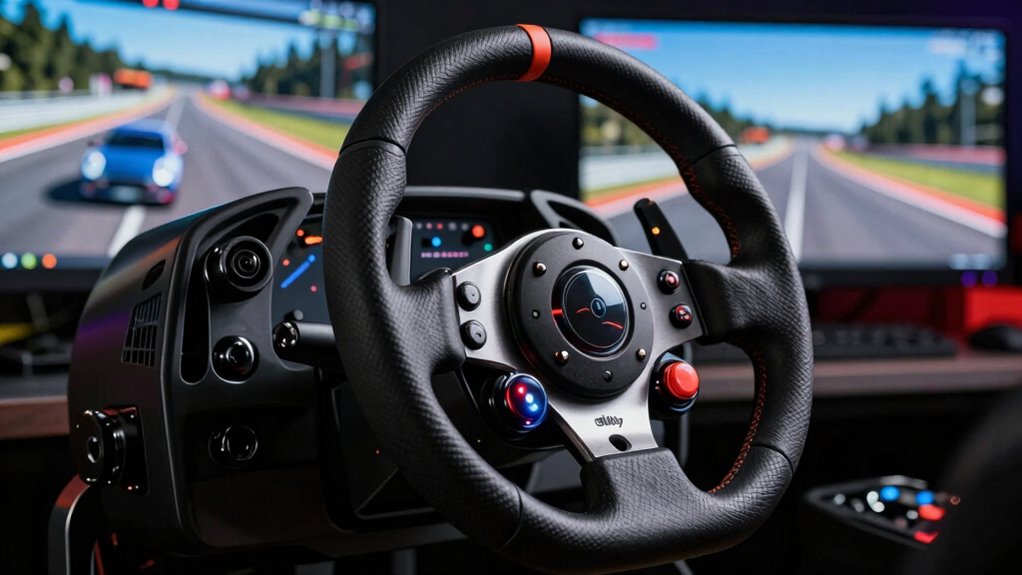
Haptic feedback has become an essential feature in sim racing, immersing you more deeply into the driving experience. When you grip the steering wheel, you don’t just feel like you’re steering—you sense every nuance of your virtual car’s behavior through force feedback and tactile sensations. This technology transmits vibrations, resistance, and subtle cues that mimic real-world driving, making your interactions feel authentic. It’s not just about adding realism; it’s about communicating critical information directly to your hands, so you know exactly what’s happening on the road without constantly glancing at your screen or dashboard.
Force feedback is the backbone of haptic feedback in sim racing. It applies variable resistance to your wheel based on the car’s dynamics, road surface, and collisions. When you go over a curb, hit a wall, or lose grip, you feel the steering wheel resist or vibrate accordingly. This immediate, physical response helps you understand the car’s limits and your control, giving you a tactile sense of traction, understeer, or oversteer. It bridges the gap between visual cues and physical sensation, enabling you to react more instinctively and precisely. The tactile sensations, often delivered through vibration motors or other actuators, enhance this realism by adding layers of feedback—like the roughness of gravel or the smoothness of asphalt—further immersing you in the virtual environment. Additionally, force feedback technology continues to evolve, offering more accurate and nuanced signals to improve realism and responsiveness. As haptic feedback systems become more sophisticated, they can now simulate even more complex driving conditions, further elevating the experience. A precise force feedback system can significantly elevate your driving skill by providing clearer and more consistent cues. Moreover, advancements in haptic technology are making these signals more lifelike and tailored to individual preferences, increasing their effectiveness.
Force feedback mimics real driving by providing resistance and vibrations, enhancing realism and responsiveness in sim racing.
Some might see haptic feedback as a gimmick, but for serious sim racers, it serves an essential purpose. It sharpens your awareness of your vehicle’s behavior, often providing cues that you might miss visually. For example, subtle vibrations can alert you to tire wear or slipping, while resistance cues can inform you about steering angles or changes in grip. This physical communication makes your control more nuanced, giving you an edge in competitive scenarios. Furthermore, the sense of tactile sensation makes the experience more engaging, turning a simple video game into a realistic simulation that can improve your actual driving skills. As technology advances, the accuracy of haptic cues continues to improve, making the experience even more realistic and beneficial for training.
In the end, whether you see haptic feedback as a fun gimmick or a useful signal depends on how much you value immersion and tactile communication. For many, it’s an essential part of a complete sim racing setup. The combination of force feedback and tactile sensations creates a more intuitive and responsive experience, helping you feel connected to your virtual car like never before. It’s not just about making racing more fun; it’s about making it more meaningful and effective as a training tool.
sim racing force feedback steering wheel
As an affiliate, we earn on qualifying purchases.
As an affiliate, we earn on qualifying purchases.
Frequently Asked Questions
How Does Haptic Feedback Differ From Visual or Audio Cues?
Haptic feedback differs from visual or audio cues by engaging your sense of touch to enhance user immersion. While visuals and sounds provide external information, haptic feedback delivers tactile sensations, like vibrations or resistance, directly through your controller or steering wheel. This sensory perception creates a more realistic experience, helping you feel the car’s grip, bumps, and other dynamics, making your sim racing more immersive and intuitive.
Can Haptic Feedback Improve Overall Driving Skills in Sim Racing?
Yes, haptic feedback can improve your overall driving skills by enhancing realism and immersion. Studies show that racers using haptic systems perform better in simulations, as it provides real-time signals about tire grip and road conditions. This realistic sensation helps you react faster and make better decisions, sharpening your skills. Ultimately, haptic feedback creates a more immersive experience, making your practice more effective and enjoyable.
What Are the Best Haptic Devices for Beginners?
For beginners, the Logitech G29 or G920 are excellent choices because they offer good haptic device compatibility and are budget-friendly. These wheels provide tactile feedback that enhances your experience without breaking the bank. Consider the cost versus benefit—these models deliver reliable performance and realistic feedback, making them ideal for newcomers wanting to improve skills and enjoy the game. Upgrading later is easier once you’re more familiar with haptic systems.
Is Haptic Feedback Effective Across All Types of Racing Games?
Haptic feedback is quite effective across various racing games, enhancing realism and immersion. It provides tactile cues like tire grip, road surface, and collisions, making your experience more authentic. Whether you’re racing on city streets or off-road tracks, haptic signals help you feel the environment better. This realism enhancement keeps you engaged, immersing you deeper into the game, regardless of the game type, and improves overall driving accuracy and enjoyment.
How Customizable Is the Haptic Feedback Experience?
You can customize your haptic feedback experience extensively, with many racing setups offering over 20 personalization options. This allows you to tailor sensory immersion precisely to your preferences, enhancing realism and engagement. Such customization makes you feel more connected to the game, turning every turn and bump into a visceral experience. With adjustable intensity and feedback types, you control how immersive your racing becomes, making your setup uniquely yours.
Conclusion
So, is haptic feedback just a fun gimmick or a truly useful signal in sim racing? It’s clear that it enhances immersion and provides essential sensory cues that can improve your driving skills. While it might feel like a bonus at first, its real value lies in how it sharpens your awareness and reaction times. Don’t you want to experience the thrill of feeling every bump and turn? Ultimately, it’s a game-changer waiting to be explored.
Fall Picks
fall essentials
As an affiliate, we earn on qualifying purchases.