📊 Full opportunity report: Future Trends: AI Studio Microphones Leading The 2026 Sound Scene on ThorstenMeyerAI.com — validation score, market gap, and execution plan.

Get the latest gadgets delivered free — and shop member deals
- Fast, free delivery on millions of items
- Access to Prime Big Deal Days deals on October 6–7
- Prime Video, Amazon Music and more included
TL;DR
AI-powered studio microphones are now leading the professional sound recording market in 2026. This shift is driven by advancements in AI technology that enhance sound quality, usability, and adaptability, marking a significant change in the industry.
AI-driven studio microphones are now the leading technology in the 2026 sound recording scene, according to industry sources. For a detailed overview, see the original analysis of top studio microphones. These microphones incorporate advanced artificial intelligence features that improve sound quality, noise reduction, and user experience, making them a preferred choice for professionals and enthusiasts alike.
Multiple manufacturers, including RØDE, Audio-Technica, and Shure, have introduced AI-enhanced microphones that outperform traditional models in various recording scenarios. These microphones utilize AI algorithms for real-time noise suppression, adaptive sound shaping, and automatic calibration, providing users with superior clarity and ease of use. Industry insiders suggest that the integration of AI in microphone technology is set to revolutionize the sound production landscape, with many studios and content creators adopting these innovations for their flexibility and quality. Learn more in the comprehensive guide to studio microphones.
Confirmed models such as the RØDE NT1 Signature Series and Audio-Technica AT2035 now feature AI-powered processing in studio microphones, which helps in reducing background noise and optimizing sound capture without extensive manual adjustments. While exact sales figures are not yet available, industry reports indicate a rapid adoption rate, with AI microphones increasingly replacing conventional analog models in professional settings.
The 8 picks
- 1
 Shure SM4 XLR Studio Condenser Microphone Kit for RecordingView on Amazon →
 - 2
 Audio-Technica AT2035 Cardioid Condenser Microphone with Shock Mount and Acce…View on Amazon →
 - 3
 RØDE NT1 Signature Series Large-Diaphragm Condenser Microphone with Shock Mou…View on Amazon →
 - 4
 Audio-Technica AT2020 Cardioid Condenser Studio XLR MicrophoneView on Amazon →
 - 5
 AKG Pro Audio P120 Condenser MicrophoneView on Amazon →
 - 6
 MAONO A04 Gen2 XLR/USB Condenser Microphone Kit for PC and Content CreationView on Amazon →
 - 7
 Mackie EM-Series Large-Diaphragm Condenser Microphone (EM-91C)View on Amazon →
 - 8
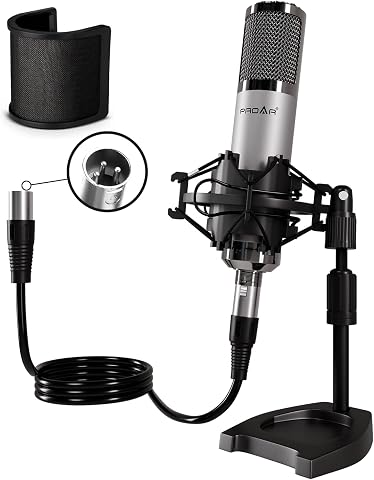 XLR Condenser Microphone with Desktop Stand for Vocals and PodcastingView on Amazon →
Impact of AI Microphones on the Sound Industry
The rise of AI studio microphones in 2026 signifies a major shift in sound recording technology, offering enhanced audio quality, greater ease of use, and increased versatility. For professionals, this means faster setup times, improved sound fidelity, and the ability to adapt quickly to different environments and sources. For consumers and content creators, AI microphones lower the barrier to high-quality recording, enabling higher production standards even with less technical expertise. This technological leap could reshape industry standards, influence equipment purchasing trends, and accelerate the adoption of intelligent audio solutions across various sectors.
Evolution of Microphone Technology Leading to AI Integration
Traditional studio microphones have long relied on manual calibration and passive noise reduction techniques. Over the past decade, incremental improvements in hardware quality and digital processing have enhanced sound clarity. In recent years, AI integration has emerged as a game-changer, with companies developing smart microphones that can analyze and adapt to their environment in real-time. Industry experts note that the 2026 market is witnessing a tipping point where AI-enhanced microphones are becoming the standard for both professional studios and serious hobbyists, driven by ongoing advancements in machine learning and digital signal processing.
Unconfirmed Aspects of AI Microphone Adoption
While industry reports suggest rapid adoption, precise market penetration rates and long-term durability of AI features remain unverified. It is also unclear how widespread the use of AI microphones will become in lower-tier markets or among casual users. Additionally, ongoing developments in AI algorithms could lead to further improvements or unforeseen issues, and regulatory or privacy concerns related to AI data processing have not yet been fully addressed.
Upcoming Developments and Industry Adoption Trends
Manufacturers are expected to release new AI-enhanced models throughout 2026, with increased integration of machine learning for even smarter sound processing. Industry analysts predict that AI microphones will become more affordable and accessible, leading to broader adoption across various segments, including broadcast, podcasting, and live performance. Further research and development are likely to focus on improving AI accuracy, reducing costs, and expanding compatibility with existing audio equipment.
Key Questions
Are AI studio microphones better than traditional models?
AI studio microphones offer advantages such as real-time noise suppression and adaptive sound shaping, which can improve sound quality and ease of use. However, whether they are better depends on the specific needs and environment of the user. For professional, high-fidelity recording, AI models are generally considered superior, but traditional microphones may still be suitable for basic applications.
Will AI microphones replace all traditional studio mics?
While AI microphones are gaining popularity and offer significant benefits, they are unlikely to completely replace traditional models in the near term. Many professionals still prefer conventional microphones for specific applications, and some may be hesitant to rely solely on AI-driven features. The industry is more likely to see a hybrid approach, with AI-enhanced models complementing existing technologies.
What features should I look for in an AI studio microphone?
Key features include real-time noise reduction, adaptive sound processing, compatibility with various recording environments, and ease of integration with existing equipment. Additional features like multiple polar patterns, high SPL handling, and included accessories can also enhance versatility and value.
Are AI microphones expensive compared to traditional models?
AI microphones tend to be priced higher due to advanced processing capabilities and integrated technology. However, prices are expected to decrease as the technology matures and becomes more widely adopted, making them more accessible to a broader range of users.
Source: ThorstenMeyerAI.com
Fall Picks
fall essentials
As an affiliate, we earn on qualifying purchases.