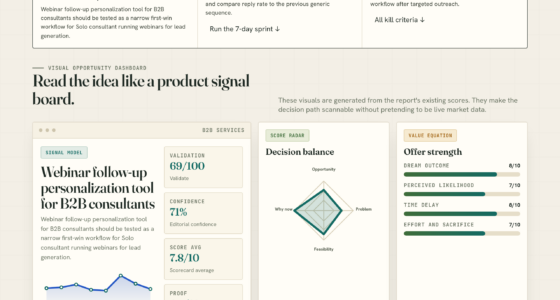

📊 Full opportunity report: From Concept To Creation: How Enterprises Leverage AI Effectively on ThorstenMeyerAI.com — validation score, market gap, and execution plan.

Get the latest gadgets delivered free — and shop member deals
- Fast, free delivery on millions of items
- Access to Prime Big Deal Days deals on October 6–7
- Prime Video, Amazon Music and more included
TL;DR
OpenAI has publicly described a shift in enterprise AI from providing assistance to actively executing tasks. This conceptual framing signals potential changes in how businesses deploy AI, though specific implementations and impacts remain unconfirmed.
OpenAI has publicly articulated a shift in enterprise AI from merely assisting workers to actively executing tasks, marking a potential evolution in how AI systems are integrated into business operations. The announcement emphasizes a move toward systems taking a more active role, though specific applications, deployment figures, or performance metrics are not yet available. For a detailed analysis, see the original analysis.
The announcement, published by OpenAI, describes a conceptual transition where AI moves beyond drafting, summarizing, or answering questions, toward carrying out defined parts of workflows. This framing suggests that AI could soon perform multi-step actions, such as updating records or initiating processes, with less human intervention. Learn more about how enterprises are implementing these shifts in this detailed report.
However, the available material does not specify which industries, tasks, or software environments are involved, nor does it provide concrete examples, deployment data, or independent assessments of impact. For more insights, see the original coverage. The distinction between assistance and execution involves different levels of system responsibility; assistance typically involves suggestions or drafts, while execution implies direct action affecting business operations.
OpenAI’s framing raises questions about safety, control, and accountability, as systems capable of executing tasks could introduce operational risks if not properly managed. The company has not disclosed safeguards, permissions, or oversight mechanisms associated with this shift.
Implications of AI Moving from Assistance to Active Execution
This development signals a potential transformation in enterprise AI deployment, where systems could take on more autonomous roles, reducing manual effort but increasing operational risks. For businesses, this could mean faster workflows and lower manual overhead, but also necessitates stronger safeguards, oversight, and regulatory compliance to prevent errors or misuse.
For stakeholders, understanding how AI systems are managed and monitored becomes critical, especially as the line between automation and decision-making blurs. The shift could influence AI safety standards, legal frameworks, and enterprise operational models.
As an affiliate, we earn on qualifying purchases.
Background on Enterprise AI Adoption and OpenAI’s Framing
Over recent years, enterprise AI has predominantly been used for support functions such as document drafting, internal search, and coding suggestions, with human oversight maintained at key decision points. OpenAI’s recent framing suggests a move toward more autonomous systems capable of executing tasks without continuous human input.
While AI automation has grown, there has been limited public information on the extent to which enterprises are deploying AI systems for autonomous task execution. The announcement appears to be a conceptual proposal rather than a description of specific, scaled implementations.
Previous developments have focused on AI assisting rather than replacing human decision-making, with safety, control, and transparency remaining central concerns. OpenAI’s framing indicates an evolving perspective on enterprise AI’s capabilities and responsibilities.
Unverified Aspects of AI Execution in Enterprises
It remains unclear which enterprises are actively deploying AI for task execution, what specific tasks are involved, and how these systems perform in real-world settings. No independent studies, metrics, or case studies have been published to verify the claimed shift.
Details about safety protocols, oversight, error rates, or compliance measures are also not disclosed, leaving questions about operational risks and governance unanswered.
Next Steps in Confirming Enterprise AI Deployment and Impact
Future developments will likely include case studies, deployment reports, or independent evaluations from companies adopting AI systems for task execution. OpenAI and participating enterprises may publish data on performance, safety, and ROI in the coming months.
Regulators and industry bodies may also begin scrutinizing safety standards and best practices for autonomous AI in business operations, shaping how these systems are governed and monitored.
Key Questions
What does OpenAI mean by ‘execution’ in enterprise AI?
OpenAI’s framing suggests that ‘execution’ involves AI systems performing defined tasks within workflows, such as updating records or initiating processes, potentially with less human oversight than traditional support functions.
Are companies currently using AI for autonomous task execution?
There is no publicly available evidence or confirmed deployment data indicating widespread use of AI for autonomous task execution. The announcement is conceptual and does not specify active implementations.
What safety concerns are associated with AI moving into execution roles?
Automated execution increases operational risks, including errors affecting customer data, financial transactions, or compliance. Proper safeguards, human review points, and audit trails are essential, but details have not been disclosed by OpenAI.
Will this shift reduce the need for human workers?
Potentially, yes. If AI systems can reliably perform tasks, manual effort may decrease. However, the extent of impact depends on deployment specifics, safety measures, and organizational policies.
When might we see real-world examples of AI executing tasks at scale?
Next few years will likely reveal pilot projects, case studies, or industry reports as companies experiment with and evaluate autonomous AI capabilities in operational settings.
Source: ThorstenMeyerAI.com
Fall Picks
fall essentials
As an affiliate, we earn on qualifying purchases.