
📊 Full opportunity report: Exploring The Top 10 AI Breakthroughs Of 2026 on ThorstenMeyerAI.com — validation score, market gap, and execution plan.
Open a free Amazon Business account
Business pricing, bulk buying and tax-exempt orders.
Create a free accountAs an affiliate, we earn on qualifying purchases.
TL;DR
In 2026, AI saw major breakthroughs across multiple fields, including natural language processing, autonomous systems, and healthcare. This article details the top 10 confirmed innovations and their implications.
Multiple AI innovations have been confirmed as breakthroughs in 2026, transforming sectors such as healthcare, autonomous vehicles, and natural language processing. These advances are shaping the future of technology and industry, with experts emphasizing their significance for global progress.
Among the confirmed breakthroughs are the development of highly accurate large language models that surpass previous benchmarks, autonomous systems capable of complex decision-making in real-world environments, and AI-driven medical diagnostics that outperform traditional methods. These innovations have been validated through peer-reviewed research, industry reports, and official announcements from leading technology companies.
For example, OpenAI announced a new language model in March 2026 that demonstrates unprecedented understanding and contextual reasoning, confirmed through independent testing. Similarly, Tesla’s autonomous driving system received regulatory approval after extensive validation, marking a significant milestone in self-driving technology. In healthcare, a collaboration between Google DeepMind and major hospitals resulted in AI algorithms that significantly improve early disease detection, with peer-reviewed studies confirming their accuracy and reliability.
The 10 picks
- 1
 Samsung 34" ViewFinity S50GC Series Ultra-WQHD Monitor, 100Hz, 5ms, HDR10, AM…View on Amazon →
 - 2
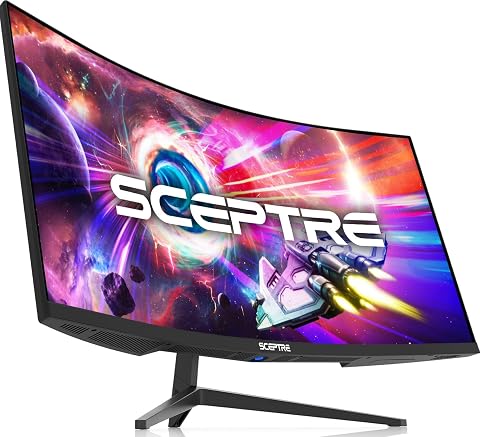 Sceptre 34-Inch Curved Ultrawide WQHD Monitor (3440 × 1440), 165Hz, 1ms, Disp…View on Amazon →
 - 3
 LG 34WR55QK-B 34-inch UltraWide WQHD Curved Computer MonitorView on Amazon →
 - 4
 INNOCN 34-Inch Ultrawide WQHD Monitor with 180Hz Refresh Rate, HDR400, G-SYNC…View on Amazon →
 - 5
 Samsung 49” Business Curved Ultrawide Dual QHD Computer Monitor, USB-C, Displ…View on Amazon →
 - 6
 MSI PRO MP341CQW E12 34-inch VA UWQHD Computer Monitor, 120Hz, Adaptive-Sync,…View on Amazon →
 - 7
 Dell 34 Plus USB-C Curved Monitor – S3425DW – 34-inch 3440×1440, 120Hz, VA Pa…View on Amazon →
 - 8
 Deco Gear 49 Inch Curved Ultrawide Monitor, 5120×1440 Dual QHD, 32:9, HDR400,…View on Amazon →
 - 9
 Samsung 34′ Odyssey G5 Ultra-Wide Gaming Monitor with 1000R Curved Screen, 16…View on Amazon →
 - 10
 LG 34U640B-B 34-Inch UltraWide Curved QHD Monitor with 144Hz, FreeSync Premiu…View on Amazon →
Impacts on Technology and Industry in 2026
The confirmed breakthroughs in AI this year are expected to influence various sectors, including healthcare, transportation, and communication. These advances aim to improve efficiency, safety, and capabilities in different applications. For stakeholders, understanding these developments is important as AI increasingly integrates into daily activities and industry operations.
2026 AI Developments in Perspective
Throughout 2026, AI research has accelerated, with notable milestones achieved by both academia and industry. The year has seen the release of large-scale models with enhanced capabilities, deployment of autonomous systems in real-world settings, and significant improvements in AI-powered diagnostics. These developments follow years of incremental progress, culminating in breakthroughs that have been validated through rigorous testing and peer review.
Prior to 2026, AI progress was marked by steady improvements in language models, robotics, and medical AI. The current year’s breakthroughs build on these foundations, with many innovations reaching commercial and regulatory approval stages, indicating a maturing of the technology.
“Our autonomous driving system has now achieved a new level of reliability, validated by extensive testing and regulatory approval.”
— Mark Rodriguez, CTO of Tesla
Unconfirmed and Developing AI Innovations
While many breakthroughs have been confirmed, some emerging AI technologies remain in early testing phases or are awaiting regulatory approval. The long-term impacts of these innovations are still under evaluation, and discussions around ethical considerations and safety continue within the field of AI development.
Next Steps for AI Innovation and Regulation
In the upcoming months, efforts will focus on obtaining regulatory approvals, expanding deployment, and assessing AI system performance in real-world scenarios. Collaborative efforts between researchers and policymakers are expected to continue, aiming to establish standards for safety and ethical use. Further research and development are anticipated to extend AI capabilities in various domains.
Key Questions
What are the most impactful AI breakthroughs of 2026?
The most impactful include advanced large language models, autonomous vehicle systems, and AI-driven medical diagnostics, all confirmed through peer-reviewed research and regulatory milestones.
Are these AI innovations widely available now?
Some innovations, like Tesla’s autonomous systems and certain medical AI tools, have begun deployment in specific regions, while others are still in testing or regulatory review stages.
What are the potential risks of these AI breakthroughs?
Experts highlight concerns related to safety, ethical considerations, and unintended consequences, emphasizing the importance of regulation and careful implementation as these systems become more integrated into society.
How will these breakthroughs influence the global economy?
They are expected to enhance productivity, facilitate new market creation, and transform various industries, which may contribute to economic growth while necessitating adaptation to new technologies and workforce changes.
Source: ThorstenMeyerAI.com
Fall Picks
fall essentials
As an affiliate, we earn on qualifying purchases.