
Digital holography displays face several limitations that impact their performance. You’ll find that high resolution demands more processing power, leading to delays or lower image quality. Hardware constraints make it difficult to scale up pixel density and clarity for real-time, vivid images. Additionally, maintaining coherence and stability is challenging due to environmental factors. If you explore further, you’ll uncover how these hurdles are being addressed and what future advancements might hold.
Key Takeaways
- High-resolution hologram generation demands intensive computation, causing latency and reducing real-time display capabilities.
- Hardware limitations restrict pixel density and clarity, impacting the sharpness of holographic images.
- Dependence on coherent laser sources makes displays sensitive to environmental disturbances, affecting stability.
- Optical setups are often bulky and expensive, limiting portability and widespread adoption of holographic displays.
- Material and miniaturization challenges hinder the development of compact, durable, high-quality digital holography systems.

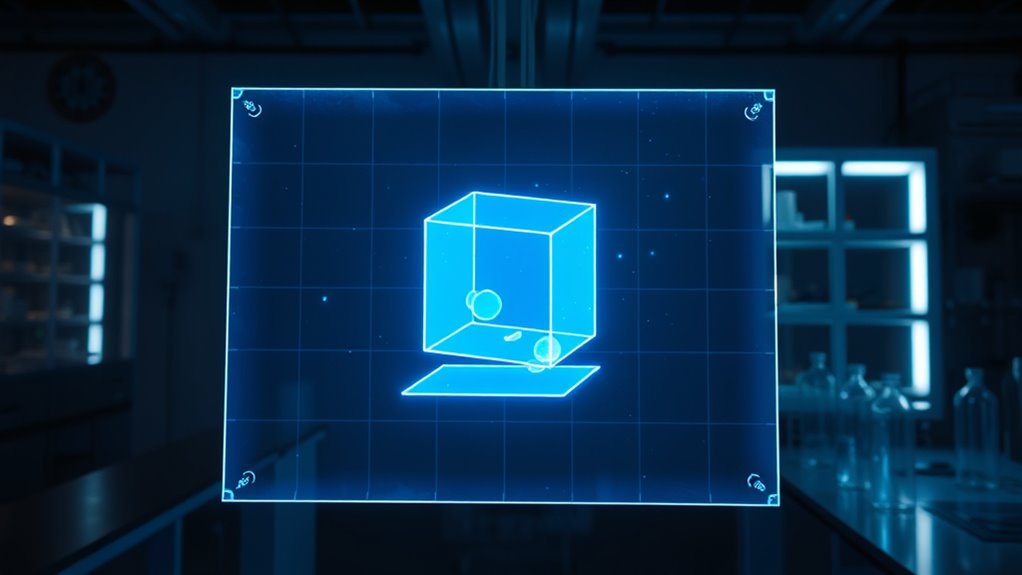
Have you ever wondered how digital holography displays create stunning three-dimensional images that seem to float in space? It’s a fascinating process that hinges on precise hologram reconstruction, where the digital data encodes the light patterns needed to produce a 3D image. You might think that once the data is captured or generated, the display simply projects the hologram directly into your view. But in reality, the process involves complex beam shaping techniques that manipulate the wavefronts of light to form accurate, high-quality images. Beam shaping is vital because it ensures the light waves converge correctly, creating the illusion of depth and volume. Achieving perfect hologram reconstruction requires sophisticated algorithms and optical components that can modulate the phase and amplitude of light precisely.
Digital holography relies on complex beam shaping to create realistic 3D images that appear to float in space.
However, current digital holography displays face notable limitations in this process. One major challenge is the difficulty in generating high-resolution, real-time holograms. As the resolution increases, so does the computational burden, often resulting in latency or reduced image quality. While advances in graphics processing units have improved this, real-time, high-fidelity hologram reconstruction remains computationally intensive. Additionally, beam shaping techniques, although improved, are still constrained by the physical properties of the display hardware. Limited pixel density and the inability to manipulate light at the nanometer scale restrict the clarity and sharpness of the holographic images. This often results in images that appear blurry or lack the crispness needed for truly immersive experiences.
Another limitation stems from the coherence and stability of the light source. Digital holography relies on coherent light sources, typically lasers, which are sensitive to environmental disturbances like vibrations or temperature fluctuations. These factors can distort the wavefronts, causing flickering or ghosting effects that diminish image quality. Additionally, the size and complexity of the optical setup required for beam shaping and hologram reconstruction limit the portability and scalability of current systems. Many holographic displays are bulky, expensive, and confined to laboratory settings, making widespread adoption challenging. Furthermore, the material properties of the display components play a crucial role in the efficiency and quality of the hologram formation.
While researchers continue to develop new materials, algorithms, and optical components, these current limitations highlight the gap between the potential of digital holography displays and their practical, everyday applications. Overcoming these hurdles will require innovations in computational speed, hardware miniaturization, and more robust beam shaping techniques. Until then, the technology remains promising but not yet perfected for seamless, high-quality 3D holographic displays accessible to everyone.

EMEET C960 4K Webcam for PC, 4K UHD CMOS Sensor, PDAF Auto Focus, Dual Omnidirectional Mics, Auto Light Correction, 73° FOV, Plug&Play Webcam w/Privacy Cover, Works w/Zoom/Teams/Skype/Google Meet
Unmatched Clarity with True 4K Resolution - Experience ultra-clear video conferencing with a genuine EMEET SmartCam C960 4K...
As an affiliate, we earn on qualifying purchases.
Frequently Asked Questions
How Do Digital Holography Displays Compare to Traditional 3D Displays?
Digital holography displays offer a more immersive 3D experience compared to traditional displays. You notice better depth perception and realism, thanks to their ability to project true 3D images. However, their visual resolution can be limited, and the viewing angle is often narrower than traditional 3D displays. While they excel in creating lifelike visuals, current technology still faces challenges in delivering wide viewing angles and high resolution simultaneously.
What Are the Primary Cost Factors in Developing Holographic Display Systems?
Think of developing holographic displays like building a castle in the sky—costs mount as you lay each brick. You face steep manufacturing costs for precision components and intricate assembly, while material expenses for advanced optical elements drain your budget. These primary factors act as the weight of gold and the bricks of your palace, making the journey to high-quality holography both a financial and technical challenge you must skillfully navigate.
How Does Viewer Perspective Affect Hologram Quality?
When you view a hologram, your perspective greatly impacts its quality. If your viewpoint isn’t aligned correctly, you’ll notice viewpoint distortion, which reduces the hologram’s realism. To maintain perspective accuracy, holographic systems need precise tracking of your position, ensuring the image adjusts seamlessly. Otherwise, the hologram appears distorted or blurry from different angles, limiting the overall immersive experience. Your experience depends on how well the system manages these perspective shifts.
Are There Existing Commercial Applications of Digital Holography Displays?
You’ll find digital holography displays in niche applications like medical imaging, art, and education, where their unique 3D visualization benefits specific needs. However, technological barriers such as high costs, limited resolution, and display size restrict widespread commercial use. While some companies experiment with holographic projectors and augmented reality, mainstream adoption remains limited due to these challenges.
What Are Future Research Directions for Overcoming Current Limitations?
To overcome current limitations, you should focus on advancing research in enhanced resolution and real-time processing. Improving resolution will make holograms sharper and more detailed, while faster processing enables smoother, more realistic displays. You can explore new materials, algorithms, and hardware that boost performance. By addressing these areas, you’ll help create holography displays that are more practical for commercial use and capable of delivering immersive, high-quality visuals.

acer 4K Webcam for PC/Mac with All-Metal Unibody Sculpted, Sony 1/2" Sensor, PDAF, 2 Noise Reduction Mics, Privacy Cover, Lightweight, Fast Cooling, Streaming Camera for Live Meeting Commerce Gaming
[4K Premium Image Quality] With UHD 4K resolution and a large Sony 1/2" CMOS sensor, this acer webcam...
As an affiliate, we earn on qualifying purchases.
Conclusion
While digital holography displays hold incredible promise, they’re still tethered by current limitations like resolution, speed, and viewing angles. Think of these hurdles as mountains waiting to be climbed—each step bringing you closer to a future where holograms feel as real as the world around you. With ongoing advancements, you’ll soon see these barriers crumble, revealing a new era of immersive, lifelike visual experiences that transform how you perceive digital content.

WYRESTORM 4K AI Tracking Conference Webcam, Auto Framing & Presenter Tracking, 120° Wide Angle, Dual Noise Cancelling Mics, Privacy Cover, USB Plug & Play, Zoom Certified for Teams Meeting Rooms
【Built for Small Conference Rooms】Designed specifically for small meeting spaces, this conference room camera system ensures every participant...
As an affiliate, we earn on qualifying purchases.

Galyimage 4K Webcam with Ring Light Web Cam 4K Autofocus with TOF Computer Camera 1080P 60FPS Web Camera Built-in Privacy Cover and Microphone Streaming Webcams for Zoom/Skype/Google Meet
【4K UHD Webcam】This webcam for pc supports resolutions from 4K@30FPS to 1080P@60FPS, with frame rates that capture every...
As an affiliate, we earn on qualifying purchases.