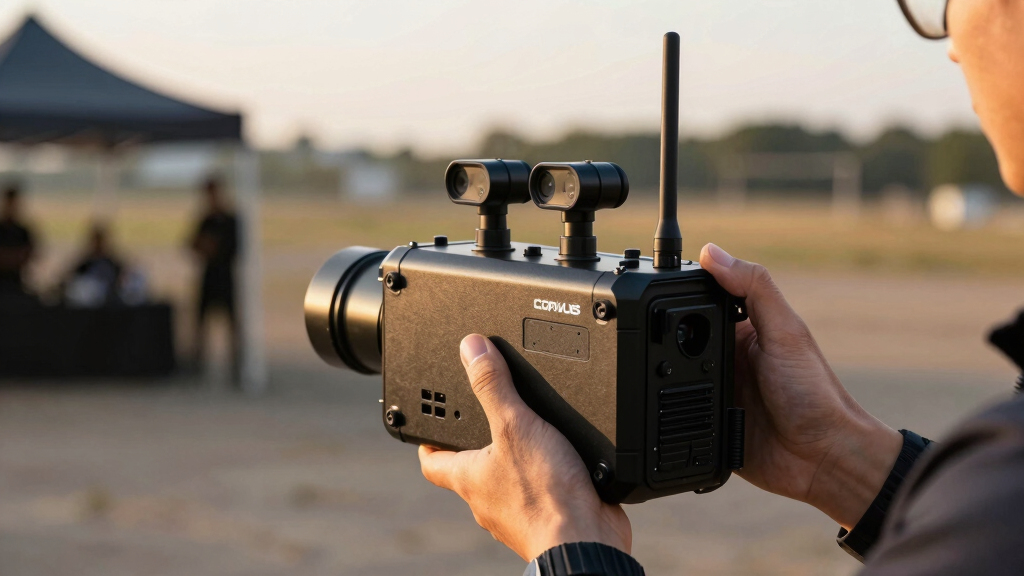

📊 Full opportunity report: Developing Corvus ISR In Front Of An Audience: Day 1 With WAMI Exploitation on ThorstenMeyerAI.com — validation score, market gap, and execution plan.

Get the latest gadgets delivered free with Prime
- Fast, free delivery on millions of items
- Prime Video, Amazon Music and more included
- Member-only deals all year
TL;DR
Corvus ISR launches its development with a synthetic wide-area motion imagery scene, demonstrating live detection and tracking in a browser. This marks the beginning of a build-in-public project aimed at closing the exploitation gap in WAMI sensor data.
Corvus ISR has publicly launched its development effort by showcasing a synthetic wide-area motion imagery (WAMI) scene with live detection and tracking capabilities. This marks the first day of a build-in-public series aimed at creating an open, configurable exploitation stack for WAMI sensors, addressing a critical gap in current ISR capabilities.
The project, initiated by Thorsten Meyer, demonstrates a browser-based synthetic WAMI scene featuring hundreds of moving vehicles, with a live detection and tracking system running in real time. This initial artifact is deliberately minimal, focusing on geometric detection without deep learning models, to establish the core pipeline.
The development emphasizes the importance of synthetic data for initial testing, benchmarking, and understanding failure modes before transitioning to real-world data. The approach allows complete control over scene parameters, perfect ground truth, and the ability to simulate challenging conditions such as occlusion and sensor jitter.
Corvus ISR aims to produce a software stack that detects, tracks, and indexes all moving objects in a scene, turning this data into a queryable motion database. It is designed to be deployed in two editions: a Sovereign version for air-gapped environments and a Governed version for EU cloud compliance, reflecting the evolving procurement preferences of European ISR buyers.
CORVUS ISR · synthetic WAMI scene — live detect & track
BUILD IN PUBLIC · DAY 1 ARTIFACTImplications of Public WAMI Exploitation Development
This development is significant because it demonstrates a move toward open, customizable exploitation software for WAMI sensors, which are traditionally characterized by closed, proprietary systems. By building in public and using synthetic data, Meyer aims to lower barriers for smaller operators and challenge established cost structures in ISR.
The focus on data sovereignty, with separate editions for air-gapped and cloud deployment, aligns with European strategic priorities and legal frameworks, potentially reshaping how ISR software is procured and operated in the region.
wide-area motion imagery (WAMI) sensor software
As an affiliate, we earn on qualifying purchases.
As an affiliate, we earn on qualifying purchases.
Background of WAMI and Exploitation Challenges
Wide-area motion imagery sensors like ARGUS-IS produce gigapixel images capturing entire cities at high frame rates, creating immense data volumes. Historically, collection has outpaced exploitation, with analysts manually reviewing footage after events occur, leading to delays and inefficiencies.
The exploitation software layer remains largely US-controlled and closed, limiting access for European and other non-US entities. Synthetic data has been underutilized in this domain due to transferability concerns, but recent efforts focus on using synthetic scenes for initial development and benchmarking.
This project builds on the recognition that software innovation is critical to closing the exploitation gap, especially as sensor proliferation accelerates across various platforms.
“The core idea is to build the exploitation pipeline first on synthetic data, then transition to real data, not the other way around.”
— Thorsten Meyer
Uncertainties About Transition to Real Data
It remains unclear how well the synthetic-based pipeline will transfer to real WAMI data, which involves complex, real-world variables not captured in simulations. The effectiveness of the system on operational data is still to be demonstrated.
Further testing, benchmarking, and real-data integration are needed before assessing its practical deployment potential.
Next Steps for Corvus ISR Development
Future milestones include integrating deep learning models for detection and tracking, transitioning from synthetic to real-world data, and expanding scene complexity. The development team plans to publish incremental updates, including more sophisticated artifacts and benchmarking results.
Engagement with potential users, especially European ISR operators, will be critical to refine the system and validate its operational readiness.
Key Questions
What is Corvus ISR aiming to achieve?
Corvus ISR aims to develop an open, configurable software stack that detects, tracks, and indexes moving objects in WAMI data, enabling queryable motion databases for ISR applications.
Why is synthetic data used in this development?
Synthetic data allows for legally clean, perfectly labeled scenes that help benchmark detection and tracking systems without the legal, privacy, or cost issues associated with real surveillance footage.
What are the main challenges in moving from synthetic to real data?
The main challenge is transferability: ensuring that models and pipelines trained on synthetic scenes perform reliably on real-world, complex WAMI data with unpredictable variables.
How does this project impact European ISR capabilities?
It offers a pathway for European operators to develop independent, compliant exploitation software, reducing reliance on US-controlled systems and aligning with legal and strategic priorities.
What are the next technical milestones?
Upcoming milestones include integrating deep learning detection models, testing on real data, and expanding scene complexity to approach operational scenarios.
Source: ThorstenMeyerAI.com
Halloween Picks
halloween
As an affiliate, we earn on qualifying purchases.