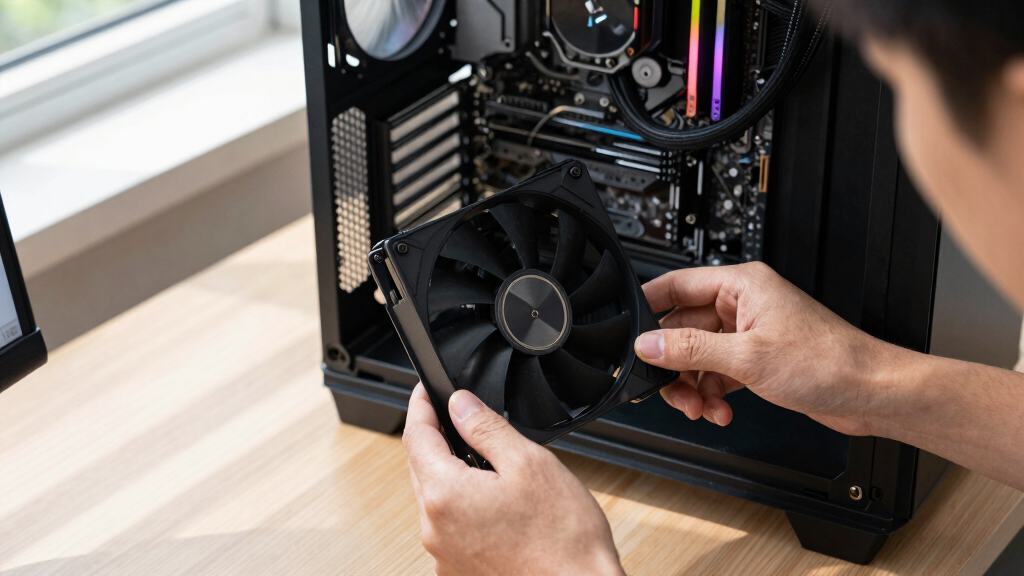

📊 Full opportunity report: Best Quiet Case Fans + the Airflow Setup That Actually Works on ThorstenMeyerAI.com — validation score, market gap, and execution plan.
TL;DR
This article identifies the best quiet case fans for 2026 and explains the airflow setup that optimizes cooling while minimizing noise. It emphasizes large, slow-moving fans and proper placement for optimal performance.
In 2026, the top recommended case fans for quiet, efficient cooling are the Noctua NF-A12x25 and NF-A14, which are praised for their high airflow, low noise, and durability. These fans, combined with an optimized airflow setup, enable high-performance workstations to stay cool without generating excessive noise, making them ideal for AI and data science workloads.
The Noctua NF-A12x25 and NF-A14 are considered the best-engineered fans for quiet operation, moving over 100 CFM at less than 16 dB, thanks to their refined bearings and motor design. Arctic P12 Pro and P14 PWM PST fans offer a high-value alternative, delivering nearly comparable airflow and static pressure performance at a fraction of the cost, making them popular among budget-conscious builders.
For maximum silence, be quiet! Silent Wings 4 fans are recommended, operating at about 17 dB with a focus on minimal noise even at higher RPMs. When cooling radiators or dense heatsinks, static-pressure fans like Arctic P12 Pro and Noctua NF-F12 are preferred for their ability to push air through restrictive fin stacks effectively. Proper placement and fan size—favoring larger 140mm fans over 120mm—are key to achieving a balance between cooling and noise reduction.
Best quiet case fans
+ the airflow that works.
The best fan won’t help if it’s pointed the wrong way. The whole recipe: big fans, running slowly, in a clean front-to-back path, with slightly more intake than exhaust. Build a config in Part 2 and watch the pressure balance respond.
Why Optimized Fan Choice and Airflow Matter in 2026
Choosing the right fans and airflow configuration is critical for maintaining high-performance AI workstations that require substantial cooling but must operate quietly in office or shared environments. Larger, slower fans reduce noise significantly while providing effective cooling, which is essential for long-term reliability and user comfort. This approach allows builders to push hardware to its limits without noise becoming a distraction or a health concern.
As an affiliate, we earn on qualifying purchases.
Evolution of Quiet Cooling Strategies for High-Power PCs
Over recent years, the emphasis on quiet computing has increased, especially for AI and data science rigs that generate substantial heat. The shift toward larger fans running at lower RPMs has become standard, supported by advances in fan engineering and noise reduction technology. In 2026, these principles remain the foundation of effective airflow design, with a focus on matching fan size and type to specific cooling needs—intake, exhaust, or radiator cooling.
"Big and slow beats small and fast when it comes to quiet, effective airflow. Larger fans moving air gently are the key to a silent, well-cooled workstation."
— Thorsten Meyer, tech reviewer
Remaining Questions About Long-Term Performance and Compatibility
While these fans are highly rated in current testing, long-term durability under continuous high loads, compatibility with all case sizes, and performance in various ambient conditions remain to be fully confirmed. Additionally, the optimal airflow configuration may vary based on specific case layouts and hardware setups, and new fan models could emerge as competition advances.
Next Steps for Builders and Users in 2026
Manufacturers will likely release updated fan models with further noise reduction and efficiency improvements. Builders should monitor new testing data and firmware updates that optimize fan curves and airflow patterns. For users, experimenting with fan placement—such as larger intake fans at the front and exhaust at the rear—remains essential to fine-tune cooling and noise levels for their specific setups.
Key Questions
Are larger fans always quieter than smaller ones?
Generally, yes. Larger fans can move the same amount of air at lower RPMs, which results in less noise. However, proper placement and fan quality also influence overall noise levels.
Should I prioritize static-pressure fans for all components?
No, static-pressure fans are best suited for radiators and dense heatsinks. For case intake and exhaust, airflow fans with open blades are more effective.
Is it worth paying extra for premium fans like Noctua?
For continuous, high-load workloads where silence and reliability are priorities, premium fans offer better longevity and quieter operation, making them a worthwhile investment.
Can I achieve quiet operation with 120mm fans, or should I always go for 140mm?
While 140mm fans are generally more effective at lower RPMs and quieter, high-quality 120mm fans can also be effective if properly tuned and used in suitable configurations.
Source: ThorstenMeyerAI.com