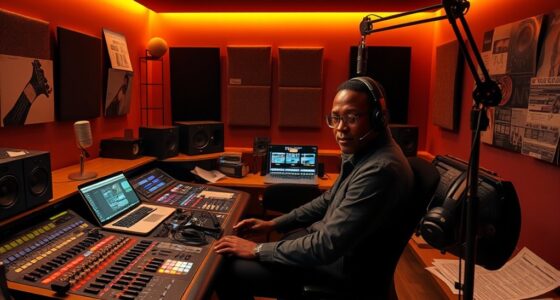
Behind the scenes of bilingual film productions involve tackling challenges like finding actors fluent in both languages and authentic in their cultural portrayal. Directors often use bilingual rehearsals, language coaching, and cultural consultants to guarantee natural performances and respectful adaptation. Creative solutions help bridge language gaps and cultural nuances, making the story feel genuine in both versions. Keep exploring to discover even more about how filmmakers craft these culturally rich, seamless films.
Key Takeaways
- Casting bilingual actors who authentically represent diverse cultural backgrounds is a major challenge.
- Scripts are culturally adapted beyond translation to ensure sensitivities and norms are respected.
- Rehearsals often involve bilingual practices and language coaching to achieve natural dialogue flow.
- Collaboration with cultural consultants helps navigate nuances and avoid stereotypes.
- Continuous communication among the production team ensures cultural accuracy and maintains authenticity in both languages.

Creating a bilingual film involves more than just translating dialogue; it requires careful coordination between writers, directors, and actors to guarantee cultural authenticity and seamless storytelling. One of the most significant hurdles you’ll face is casting challenges. Finding actors who are fluent in both languages and can authentically portray characters from diverse backgrounds isn’t easy. You need performers who can naturally switch between languages without sounding forced, and who truly understand the cultural nuances behind their characters’ words and actions. This often means auditioning beyond your local talent pool, seeking bilingual actors with genuine cultural roots. Sometimes, you might even have to cast non-professional actors who live and breathe the cultures you’re depicting, ensuring their performances resonate with authenticity.
Alongside casting, cultural adaptation plays a critical role. When you’re developing a bilingual film, it’s not enough to simply translate scripts; you must adapt scenes to align with cultural sensitivities and norms. What works in one culture might be misunderstood or even offensive in another. As a filmmaker, you’ll need to work closely with cultural consultants or local experts to navigate these differences. This process involves rewriting dialogue, adjusting humor, and sometimes altering story elements to make sure they resonate across audiences. It’s about balancing fidelity to the original story with respect for cultural contexts, so viewers feel connected and understood regardless of their language or background.
You’ll find that managing these aspects demands meticulous planning and an open mind. Casting challenges may require creative solutions, like bilingual rehearsals or language coaching for actors, to help them deliver authentic performances. Meanwhile, cultural adaptation calls for ongoing dialogue with your team and potential test screenings with diverse audiences. Both elements are crucial to avoid stereotypes, misrepresentations, or alienating viewers. Additionally, understanding the cultural nuances behind the languages used can significantly enhance the authenticity of your film. Remember, your goal is to create a film that feels natural in both languages, with characters whose words and actions reflect real cultural identities. By paying close attention to these details, you guarantee your bilingual film isn’t just a translation but a genuine cross-cultural experience that engages audiences on multiple levels.

Arnbz Spanish English Bilingual Sound Book, Interactive Toddler Book
- Bilingual Vocabulary: 13 themes and 300 words
- Interactive Learning Activities: Piano, quizzes, volume control
- Touch-Activated Toy: Responsive to little fingers
As an affiliate, we earn on qualifying purchases.
As an affiliate, we earn on qualifying purchases.
Frequently Asked Questions
How Do Actors Memorize Lines in Multiple Languages?
You memorize lines in multiple languages by working closely with language coaching, which helps you understand pronunciation and cultural nuances. Repetition and practice are key, and script adaptation guarantees your lines fit naturally in each language. You might break down the script into smaller parts, rehearse them repeatedly, and use recordings to reinforce your memory. This approach makes switching between languages smoother and more authentic during filming.
What Challenges Do Translators Face During Filming?
During filming, you face challenges like script adaptation, where translations must match the original tone and timing. Casting bilingual actors helps, but you still need precise communication to avoid misinterpretations. You also deal with ensuring dialogue fits scenes naturally across languages. Balancing cultural nuances and technical constraints demands flexibility. You must stay alert to maintain consistency, making sure the story flows seamlessly, regardless of language differences.
How Is Voice Dubbing Integrated Into Production?
Imagine the magic of seamless storytelling—voice dubbing is integrated into production by carefully synchronizing lip movements with dialogue. You focus on achieving perfect lip sync accuracy and precise dubbing timing, ensuring viewers feel immersed, not distracted. This delicate process involves meticulous editing and coordination, transforming performances into a harmonious blend of voices that captures the essence of each scene, making the film resonate authentically across languages.
What Equipment Is Essential for Bilingual Film Shoots?
You need essential equipment for bilingual film shoots, including reliable camera stabilization tools to ensure steady shots in multiple languages. Proper lighting setups are crucial to maintain consistent visual quality across scenes, regardless of language differences. Additionally, consider using dual-language audio recorders and soundproof booths for clear dialogue capture. This equipment helps you seamlessly manage diverse language requirements while maintaining professional production standards.
How Do Directors Ensure Cultural Accuracy in Dialogue?
You guarantee cultural accuracy in dialogue by prioritizing cultural consultation and language adaptation. You engage experts to review scripts, ensuring cultural nuances are respected and authentic. You adapt language to reflect regional dialects and idioms, making conversations believable. You listen actively to feedback, refine dialogue accordingly, and stay aware of cultural sensitivities. By combining consultation, adaptation, and ongoing review, you create dialogues that resonate genuinely with diverse audiences.
Conclusion
As you step back from these bilingual productions, remember that behind every scene, there’s a meticulous dance of language, culture, and technology—much like trying to program a dial-up modem in today’s streaming era. You realize that balancing two languages isn’t just about subtitles; it’s about creating a seamless experience that bridges worlds. So next time you watch a bilingual film, appreciate the behind-the-scenes magic that makes it all possible—without needing a time machine.