📊 Full opportunity report: Voice AI Helps Home Service Teams Answer Calls And Book Jobs on IdeaNavigator AI — validation score, market gap, and execution plan.

Get the latest gadgets delivered free with Prime
- Fast, free delivery on millions of items
- Prime Video, Amazon Music and more included
- Member-only deals all year
TL;DR
A business concept from IdeaNavigator AI proposes voice AI that answers calls for plumbing, HVAC and electrical contractors, gathers job details and books appointments. The concept is framed as a narrow pilot, not a proven product or a verified finding that voice AI has reached a particular reliability threshold.
IdeaNavigator AI has proposed a voice AI service that would answer calls for plumbing, HVAC and electrical businesses, gather details about the work and book appointments, aiming to capture jobs owners may miss while working. The concept recommends testing the service with five shops over one month, but provides no results from a pilot or evidence that a specific product is operating.
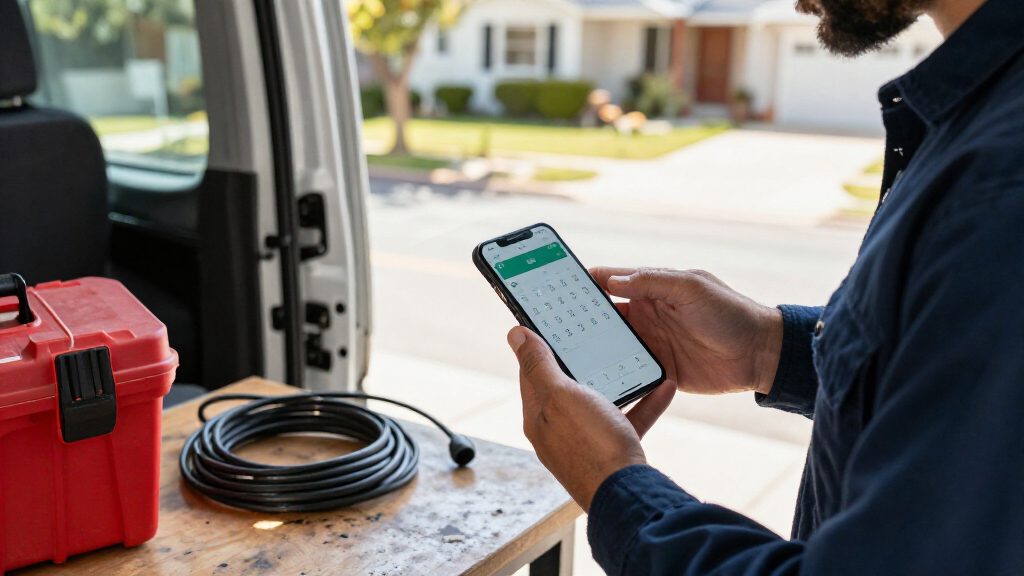
The proposed system would use a dedicated phone number or handle calls forwarded from a business. It would ask callers about the problem, service address and urgency, then schedule the job in the shop’s calendar or connect with platforms such as ServiceTitan or Jobber. It would also text the owner a call summary and transfer emergencies to a person in real time.
The intended customers are owner-operators in the plumbing, heating and cooling, and electrical trades who may be unable to answer while on a job. IdeaNavigator AI describes a missed call as a potential lost booking, since a customer seeking service may contact another contractor. The proposal does not quantify how often calls are missed or how many would otherwise become paid jobs.
The suggested pricing combines a monthly fee per phone line with a charge for each booked job. To test whether that model works, the plan is to forward after-hours calls for five businesses for a month, count jobs booked that owners say they would otherwise have missed, and compare the resulting revenue opportunity with each business’s average ticket. No prices, customer commitments or measured outcomes are supplied.
Answering calls for home service teams
IdeaNavigator AI proposes a voice AI service to collect job details and book appointments for plumbing, HVAC and electrical businesses. The workflow is a concept, not a proven product.
How the call flow works
The proposed service focuses on after-hours call intake and booking.
Ask about the problem, service address and urgency.
Schedule a visit in the shop’s calendar or connect the caller to a person for emergencies.
Text a summary of the call to the business owner.
Who may benefit
The concept targets owner-operators who cannot always answer while working on a job.
Catch service requests
A caller may choose another contractor if a working owner cannot pick up.
Capture after-hours demand
The proposed workflow aims to turn calls into scheduled appointments.
Keep owners informed
Call summaries could help small teams follow up on requests.
What the pilot should measure
Counting calls answered alone would not show whether the service creates useful work.
Proposed pricing
The concept suggests a monthly fee per phone line plus a charge for each booked job.
- More calls could reach the business while owners are on jobs.
- Bookings could create revenue opportunities.
- Rates and rules for counting a successful booking are unspecified.
- A booking may cancel or never become completed work.
A Test for Missed Trade Calls
The business case rests on a practical problem: a contractor doing hands-on work cannot always answer the phone, and a caller may choose a competing business instead of leaving a message. If an automated system can reliably gather the right information and arrange a visit, it could help a small shop respond outside office hours without staffing a live answering service around the clock.
But the value depends on more than picking up. The system must distinguish routine requests from urgent situations, avoid booking appointments the business cannot fulfill, and accurately pass details to the owner. An incorrectly handled emergency or a calendar error could undermine customer trust. The proposed pilot’s emphasis on booked jobs that would otherwise have been missed is a more useful test than counting calls answered alone.
For trade businesses, the result would also shape whether a per-booking fee is worthwhile. A booking is not necessarily completed work or revenue: customers may cancel, the problem may be outside the shop’s service area, or the job may not proceed. The concept does not define how success pricing would handle those cases, so a trial would need clear rules for what counts as a successful booking.
Products Worth Considering

Sony WH-1000XM4C (M4 2nd Gen) Wireless Noise-Cancelling Headphones, Black

Bose QuietComfort Wireless Noise-Cancelling Headphones, Twilight Blue

Apple MacBook Air 13-inch with M5 Chip, 16GB Memory, 512GB SSD, Sky Blue
As an affiliate, we earn on qualifying purchases.
From Call Intake to Scheduling
Voice AI call answering is presented here as a specific front-office use, rather than a general-purpose assistant: collect a short set of service details, place a job on a schedule, notify the owner, and hand off emergencies. That narrow workflow could be easier to evaluate than a system expected to manage every customer interaction.
IdeaNavigator AI says voice AI reached a reliability threshold for structured intake calls in 2025–2026, making 24-hour answering economically viable at a lower cost than a human answering service. This is a claim in the proposal; it is not accompanied by benchmark results, cost figures, an independent evaluation or a named product. The actual performance of any system would depend on its handling of accents, noisy calls, unusual requests and integrations with each shop’s scheduling tools.
The suggested trial would focus on after-hours calls at five shops for one month. That scope could show whether the service can capture demand in a limited setting, but it would not by itself establish performance across different trades, regions, call volumes or business schedules.
Pilot Results and Reliability
No pilot results are reported. The proposal does not identify participating businesses, a product vendor, a launch date or technical performance data. It also gives no baseline for how many calls the businesses currently miss, how many calls typically turn into jobs, or what an answering service would cost them.
It remains unclear how the system would verify caller information, handle callers who want a human, manage double bookings, or respond when a calendar or software integration is unavailable. Emergency escalation is part of the proposed feature set, but no definition of an emergency or handoff procedure is provided. The claim that voice AI has crossed a reliability threshold should therefore be treated as a proposal’s rationale, not as independently established proof.
Privacy and data handling are also unspecified. The concept would involve collecting contact details, addresses and descriptions of service problems, but it does not say how call recordings or transcripts would be stored, who could access them, or how long they would be retained.
Measure Bookings in a Trial
The next step described is a one-month test with five shops, using forwarded after-hours calls. To make the findings useful, the businesses would need to compare calls handled with appointments actually booked and identify which bookings would likely have been lost without the system. They would also need to track cancellations, completed jobs, emergency handoffs and scheduling mistakes.
No trial date or results have been announced in the material provided. Until a test reports those measures alongside costs and customer outcomes, the service remains a proposed workflow rather than a demonstrated source of incremental revenue for contractors.
Source: IdeaNavigator AI. The proposed features, pilot design, pricing approach and reliability rationale described in this article are attributed to that concept; no independent test results or other sources are cited.
Key Questions
What would the proposed voice AI do?
It would answer calls, ask about the service problem, address and urgency, book a job in a calendar or supported scheduling system, and text a summary to the owner. The concept also calls for live escalation of emergencies.
Who is the service intended for?
The proposal targets owner-operated plumbing, HVAC and electrical businesses whose owners may miss calls while working at a job site.
Has the service been tested?
No test results are included. IdeaNavigator AI recommends a one-month pilot with five shops, but does not say that such a trial has taken place.
How would the service charge customers?
The proposed pricing is a monthly fee per phone line plus a fee for each booked job. Actual rates and the rules for counting a booking are not specified.
What is still unknown about reliability?
The proposal does not provide independent benchmarks or real-world results. Performance with urgent calls, unusual requests, scheduling integrations and callers who need a person remains to be tested.
Source: IdeaNavigator AI