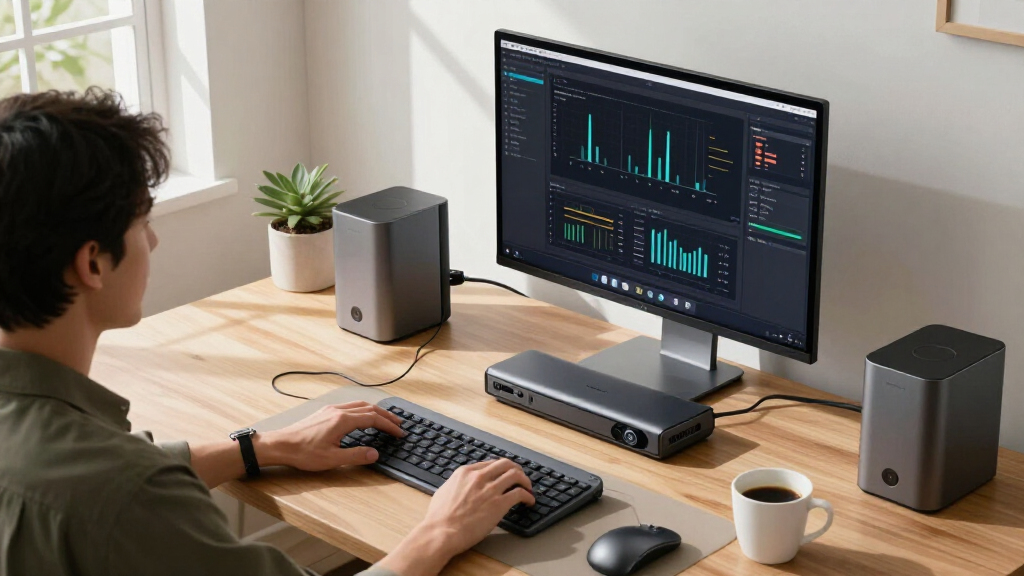

📊 Full opportunity report: What Makes 512GB Storage A Game-Changer For AI On The M5 Ultra Mac Studio on ThorstenMeyerAI.com — validation score, market gap, and execution plan.

Get the latest gadgets delivered free with Prime
- Fast, free delivery on millions of items
- Prime Video, Amazon Music and more included
- Member-only deals all year
TL;DR
Apple’s upcoming M5 Ultra Mac Studio will feature a 512GB unified memory configuration, dramatically improving its ability to run large AI models locally. This development emphasizes the importance of memory capacity and bandwidth for AI workloads, making the Mac Studio a more capable tool for AI researchers and developers.
Apple has confirmed that the upcoming M5 Ultra Mac Studio will offer a 512GB unified memory configuration, a significant increase over previous models. This upgrade directly impacts the machine’s ability to run large AI models locally, addressing a key bottleneck in AI deployment on desktop hardware. The 512GB option is set to be available by mid-October 2023, with pricing estimated in the mid-teens of thousands of dollars, marking a major development for AI professionals seeking more powerful local hardware.
The M5 Ultra Mac Studio with 512GB of memory features a unified memory bandwidth of 1,200 GB/s, which is crucial for high-speed AI inference. This configuration allows users to load and run models with parameter counts exceeding 70 billion at 8-bit quantization, or larger models at lower precision, without spilling to disk. Apple has not yet disclosed the exact price, but industry estimates place it above $15,000, reflecting its positioning as a high-end AI workstation.
This development is notable because it positions the Mac Studio as a serious competitor in the AI hardware space, traditionally dominated by high-cost NVIDIA solutions. The 512GB memory tier, paired with the M5 Ultra’s robust bandwidth, enables a single-user machine capable of handling frontier-scale models for inference tasks that previously required multi-GPU setups or cloud-based solutions. The 256GB configuration remains available, but the 512GB version opens new possibilities for local AI deployment, especially for researchers and developers working with large language models.
Capacity decides what you can load. Bandwidth decides how fast it runs. Collapse them into one and every take on local-AI hardware goes wrong. Hold them apart and the field sorts itself.
Enhanced Local AI Processing with 512GB Memory
The introduction of a 512GB memory configuration for the M5 Ultra Mac Studio represents a major shift in local AI hardware capabilities. It allows for the loading and inference of larger models directly on a desktop machine, reducing reliance on cloud services and multi-GPU systems. This makes high-performance AI more accessible to individual researchers, small teams, and developers who need powerful, self-contained hardware. Additionally, the high memory bandwidth ensures faster inference speeds, making AI workflows more efficient and responsive.
For the broader AI ecosystem, this development signals a move toward more integrated, standalone solutions that combine high capacity and speed. It could accelerate AI research and deployment by lowering costs and complexity associated with multi-GPU setups, and it emphasizes the importance of memory capacity as a critical factor in AI hardware design.
Apple Mac Studio M5 Ultra 512GB RAM
As an affiliate, we earn on qualifying purchases.
As an affiliate, we earn on qualifying purchases.
Background on AI Hardware and Memory Importance
Historically, AI hardware performance has been driven by GPU core counts and raw processing power. However, recent insights from industry experts like Thorsten Meyer highlight that memory capacity and bandwidth are equally, if not more, important for large-scale AI inference. Large language models, such as those with 70 billion parameters, require significant memory to load weights and caches, and sufficient bandwidth to read data quickly during inference. Prior to this, high-capacity models often depended on multi-GPU clusters or cloud solutions.
Apple's move to include 512GB of unified memory in the Mac Studio aligns with this understanding, providing a machine capable of handling large models locally. This is a notable departure from previous Mac configurations, which lacked the capacity for such workloads. The new configuration leverages the M5 Ultra's high bandwidth, making it a more viable option for AI professionals seeking a self-contained, high-performance workstation.
"Memory capacity and bandwidth are the two critical factors that determine what large models can do locally. The new 512GB configuration for the M5 Ultra is a game-changer because it combines both at an unprecedented level for a desktop machine."
— Thorsten Meyer
Unanswered Questions About Pricing and Availability
Apple has not yet announced the official price for the 512GB configuration of the M5 Ultra Mac Studio, though estimates place it above $15,000. The exact release date remains targeted for mid-October 2023, but availability could vary by region. It is also unclear how this configuration will compare in real-world AI performance against dedicated GPU solutions, especially for multi-GPU or cloud-based setups. The specific performance metrics for large models at this capacity are still to be tested and verified by independent benchmarks.
Next Steps for Buyers and Developers
Apple is expected to formally announce the pricing and detailed specifications of the 512GB Mac Studio in the coming weeks. Industry experts anticipate benchmarks and performance tests to emerge shortly thereafter, providing clearer insights into its capabilities. For AI developers and researchers, the key next step is to evaluate whether this configuration can meet their workload demands, especially for large language models and inference tasks. Additionally, users should monitor software updates and compatibility improvements that optimize AI workflows on the new hardware.
Key Questions
How does 512GB of memory improve AI performance on the Mac Studio?
It allows larger models to be loaded entirely into memory, enabling faster inference without spilling to disk, and supports bigger context windows for language models, significantly enhancing performance and usability.
Will the 512GB Mac Studio be suitable for training large AI models?
No, the Mac Studio is primarily designed for inference and development work. Training large models typically requires multi-GPU setups or cloud resources, which are beyond the scope of this machine.
When will the 512GB version be available for purchase?
Apple has announced a mid-October 2023 release window, but exact availability may vary by region and retailer.
How does this compare to NVIDIA's AI hardware options?
The Mac Studio offers high memory capacity and bandwidth in a compact, standalone desktop, whereas NVIDIA's options include add-in cards and multi-GPU systems with higher raw bandwidth but at greater cost and complexity.
What are the main limitations of the Mac Studio for AI workloads?
While the 512GB configuration significantly boosts local AI capabilities, it still may not match the raw processing power of multi-GPU or cloud solutions for training large models or running extremely high-throughput inference at scale.
Source: ThorstenMeyerAI.com
Halloween Picks
halloween
As an affiliate, we earn on qualifying purchases.