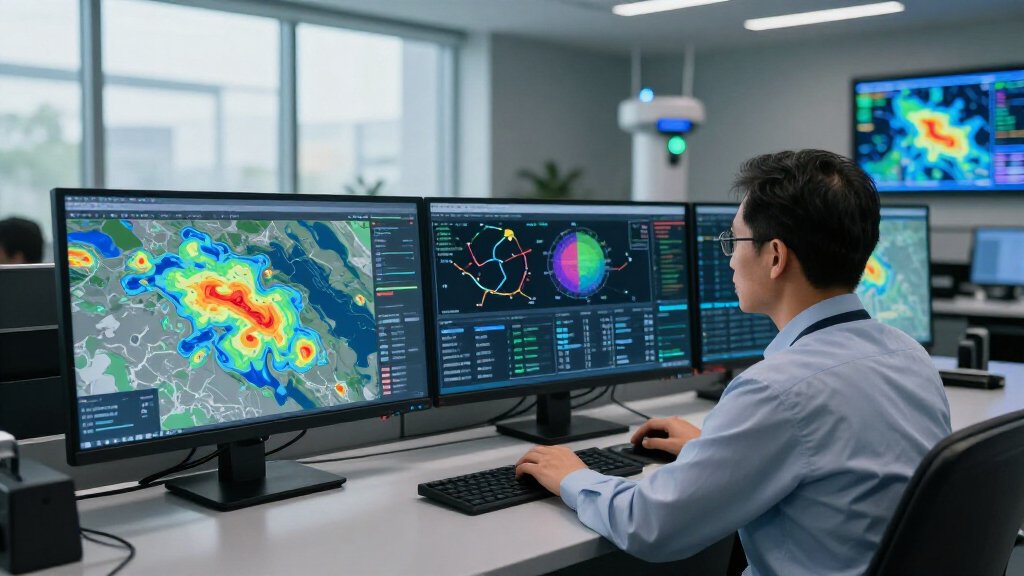

📊 Full opportunity report: The Rise Of AI In Weather Forecasting: Towards More Reliable Extreme Weather Alerts on ThorstenMeyerAI.com — validation score, market gap, and execution plan.

Get the latest gadgets delivered free with Prime
- Fast, free delivery on millions of items
- Prime Video, Amazon Music and more included
- Member-only deals all year
TL;DR
A Huawei Pangu-associated report suggests AI is revolutionizing weather forecasting, especially for extreme weather. However, key technical details and performance metrics are missing, leaving the actual impact unverified.
A report attributed to Huawei Pangu claims that AI-based weather forecasting is transforming predictions, potentially enabling faster warnings for extreme weather events. For more context, see Why AI Is A Game-Changer For Weather Forecasting In China. While the report highlights the importance of AI in addressing rising climate-related risks, it does not provide technical details or performance metrics to substantiate its claims.
The report suggests that AI systems could offer more rapid and potentially more useful forecasts for communities facing increasing threats from severe weather. This development is part of the broader AI forecasting revolution. It emphasizes the possibility of earlier detection of dangerous conditions, which could improve emergency responses and reduce harm. However, it does not specify the model version, training datasets, geographic coverage, or provide benchmark results comparing AI forecasts with existing numerical weather prediction systems.
Currently, there is no published evidence confirming that the AI system in question delivers more accurate or reliable predictions than traditional methods. For a detailed analysis, see the original analysis. The report does not include performance scores, forecast horizons, or independent evaluations, making it difficult to assess the true impact of the claimed advancements. The lack of detailed technical information leaves open whether these claims are based on tested models or general industry assertions.
Potential Impact of AI on Weather Prediction Accuracy and Speed
If validated, AI-driven forecasting could provide earlier warnings for extreme weather, giving authorities and communities more time to prepare and respond. Faster and more reliable predictions could enhance safety measures, reduce economic losses, and improve resource allocation during weather crises. However, the actual benefits depend on verified accuracy, stable performance, and clear communication of uncertainty. Without these, false alarms or missed events could undermine trust and effectiveness of warnings.
Products Worth Considering

Jackery Explorer 300 Portable Power Station, 292Wh

Sonos One Two-Room Smart Speaker Set with Alexa, Black

Anker SOLIX C1000 Gen 2 Portable Power Station
As an affiliate, we earn on qualifying purchases.
Current State of AI Integration in Weather Forecasting
Existing weather forecasting relies on a combination of physics-based models, satellite data, radar observations, and human analysis. AI techniques are increasingly integrated to assist in pattern recognition and data processing, often complementing traditional methods. Prior developments include machine learning models trained on historical data to improve short-term forecasts and identify potential extreme events. Nonetheless, comprehensive validation and operational deployment of AI systems remain ongoing challenges, with no widespread adoption of AI-based forecasts for critical decision-making.
“The report highlights the potential of AI to accelerate weather predictions, but without detailed benchmarks, we cannot confirm its effectiveness.”
— an anonymous researcher
Unverified Claims and Missing Technical Evidence
It remains unclear whether the AI system referenced is a new model, an existing product, or a theoretical approach. No independent testing, benchmark results, or deployment details have been provided. The absence of performance metrics means the claimed improvements in speed or accuracy are unconfirmed and could be industry assertions rather than verified advancements.
Need for Transparent Evaluation and Independent Testing
The next step involves publishing detailed technical documentation, benchmark results, and independent evaluations of the AI system. Verification across different regions and weather conditions, especially extreme events, is essential to confirm the system’s efficacy. Meteorological agencies and researchers will need to assess whether AI can reliably enhance operational forecasts before widespread adoption occurs.
Key Questions
Does this report prove AI forecasts are more accurate than current methods?
No. The report does not include accuracy metrics, benchmark results, or independent evaluations that confirm improved performance.
How could AI improve weather forecasting for extreme events?
If validated, AI could enable faster detection of developing storms, floods, or heatwaves, providing more lead time for emergency responses and community preparedness.
What information is needed to confirm these claims?
Published technical details, model versions, datasets, benchmark comparisons, and independent evaluations are necessary to verify the reported advances.
Are current weather models being replaced by AI?
Not yet. AI is mainly used as a supplementary tool alongside established physics-based models, pending validation of its effectiveness.
When might we see verified AI-based weather forecasts in use?
Pending further testing and validation, widespread operational use could take several years, depending on the availability of proven, reliable models.
Source: ThorstenMeyerAI.com