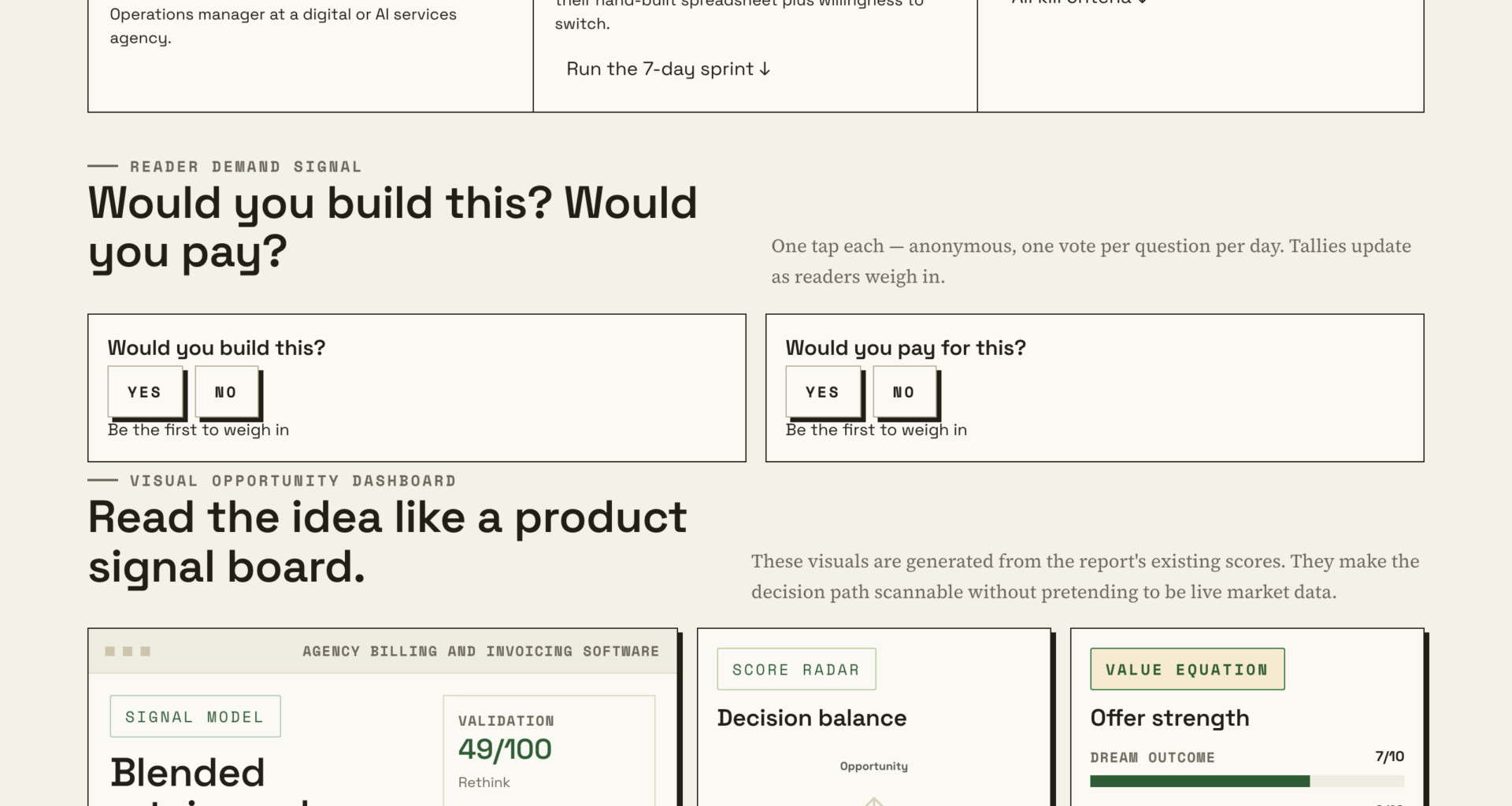

📊 Full opportunity report: Simplify Agency Invoicing With A Blended Retainer And Usage Approach on IdeaNavigator AI — validation score, market gap, and execution plan.

Get the latest gadgets delivered free — and shop member deals
- Fast, free delivery on millions of items
- Access to Prime Big Deal Days deals on October 6–7
- Prime Video, Amazon Music and more included
TL;DR

A new billing workflow for agencies merges retainer, usage, and project charges into a single invoice. Tested as a first step, it aims to simplify invoicing and reduce errors. Validation involves eight agencies and real client models.
Agencies are beginning to test a new billing workflow that consolidates retainer, usage-based, and project charges into a single automated invoice. This approach aims to reduce billing errors and save time, addressing a common challenge faced by digital and AI service agencies. The development is part of an effort to create a streamlined, flexible invoicing system tailored to the increasingly hybrid billing models used in the industry.
The new workflow, currently in pilot testing, allows an operations manager to define a client profile with a retainer line, a usage meter, and ad hoc project charges within a dedicated billing workspace. This setup then generates a consolidated monthly invoice automatically, replacing manual, spreadsheet-based processes that often lead to errors and revenue leakage.
IdeaNavigator AI is recruiting eight agencies to validate this model by modeling real hybrid-pricing clients, generating invoices, and comparing them against traditional manual invoicing methods. The goal is to confirm accuracy and assess whether agencies are willing to adopt this new system, which could significantly streamline billing operations.
Potential Impact on Agency Billing Efficiency
This new billing approach could substantially improve the accuracy and efficiency of agency invoicing processes. By automating the consolidation of multiple billing types, agencies may reduce revenue leakage, minimize manual reconciliation, and free up operational resources. If successful, this model could influence how agency billing tools evolve to better support hybrid billing arrangements, which are increasingly common as agencies bundle AI and digital services into retainers.
automated invoicing software for agencies
As an affiliate, we earn on qualifying purchases.
As an affiliate, we earn on qualifying purchases.
Growing Need for Flexible Agency Billing Models
Many digital and AI agencies currently rely on manual, spreadsheet-based invoicing to combine retainer fees, usage charges, and one-off project costs. This process is error-prone and time-consuming. As agencies increasingly bundle AI usage costs into retainers, traditional subscription billing tools fall short, unable to model complex, hybrid billing scenarios within a single invoice. The development of this new workflow responds directly to these industry challenges, aiming to create a more adaptable, automated solution.
“This new billing workflow could significantly reduce manual errors and save agencies hours each month.”
— an anonymous researcher
Uncertainties in Adoption and Effectiveness
It is not yet clear how widely agencies will adopt this workflow or whether it will fully meet their needs in diverse billing scenarios. The validation process is ongoing, and results are pending. Additionally, the impact on revenue recognition and integration with existing accounting systems remains to be seen.
Next Steps in Validation and Development
IdeaNavigator AI plans to complete testing with the eight participating agencies, analyze the accuracy and usability of the automated invoices, and gather feedback. If results are positive, the company intends to refine the workflow and prepare for broader rollout, potentially offering it as a new feature in their billing platform. Further development will also explore integration with existing agency management tools.
Key Questions
How does the blended billing model work?
The model combines a fixed retainer line, a usage meter for metered services, and ad hoc project charges into one invoice, which is generated automatically each month.
What are the main benefits of this new workflow?
It aims to reduce billing errors, save time on manual reconciliation, and improve revenue accuracy by automating the consolidation of complex billing components.
Will this system replace existing billing tools?
It is designed as a targeted solution for agencies handling hybrid billing models, and may complement or integrate with existing tools rather than replace them entirely.
When will this workflow be generally available?
The development is still in testing, with broader availability expected after validation and refinement, likely within the next few months.
Are there any limitations or risks?
Potential limitations include integration challenges with existing accounting systems and the need for agencies to adapt their workflows. Effectiveness and accuracy are still being validated.
Source: IdeaNavigator AI
Halloween Picks
halloween
As an affiliate, we earn on qualifying purchases.