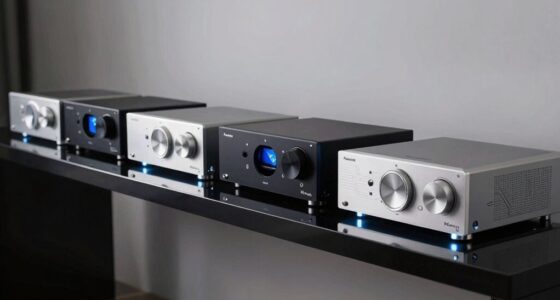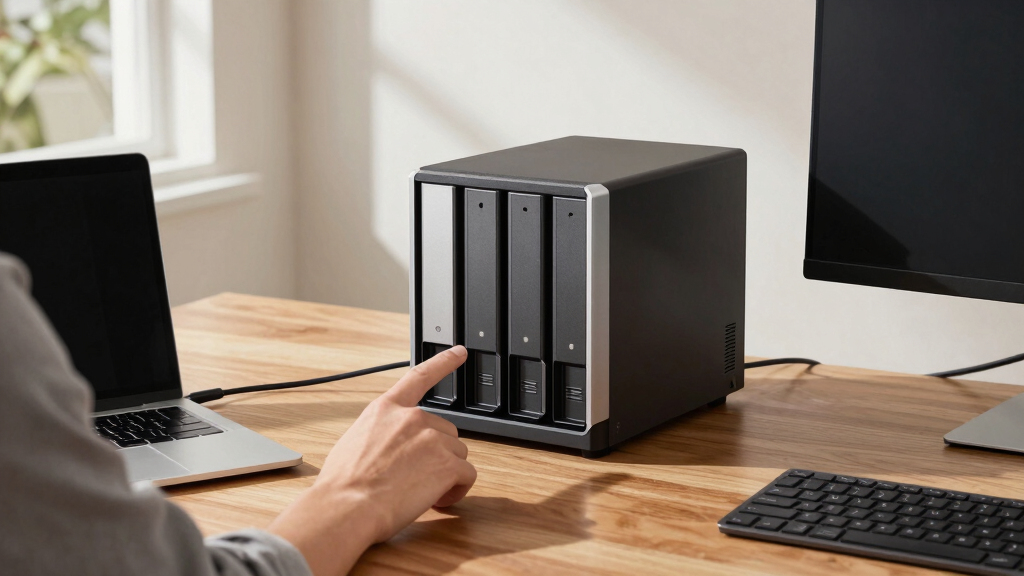
For those searching for the best 4 bay NAS devices with 2.5GbE in 2026, the challenge lies in balancing performance, ease of use, and expandability. The Ugreen NAS DXP4800 Plus stands out as the overall top pick due to its powerful Intel Pentium Gold CPU and versatile features. Asustor Drivestor 4 Pro offers excellent value for home media, while the QNAP TS-932PX provides high-speed connectivity with dual 10GbE ports. Buyers face tradeoffs between raw speed, ease of setup, and future-proofing—continue reading for the full breakdown of these options.
Key Takeaways
- Top picks balance CPU power with network speeds; higher-end models like the QNAP TS-932PX excel in throughput.
- Budget-friendly options like the BUFFALO LinkStation 220 deliver solid basic NAS functions but lack advanced features.
- Expandability varies, with models like UGREEN DXP4800 Plus offering M.2 NVMe slots for cache or storage upgrades.
- Ease of use and remote features are often linked—more advanced NAS tend to include better app ecosystems and management tools.
- Choosing between single 2.5GbE ports and dual 10GbE/2.5GbE setups depends heavily on planned network infrastructure and data throughput needs.



More Details on Our Top Picks
UGREEN NAS DXP4800 Plus 4-Bay Desktop NAS, Intel Pentium Gold 8505 5-Core CPU, 8GB DDR5 RAM, Built-in 128G SSD, 1 * 10GbE, 1 * 2.5GbE, 2 * M.2 NVMe Slots, 4K HDMI, Network Attached Storage (Diskless)
This NAS stands out for its powerful Intel Pentium Gold 8505 processor, 8GB DDR5 RAM, and multiple high-speed connectivity options, including both 10GbE and 2.5GbE ports, making it ideal for demanding small office environments. Compared to the UGREEN DH4300 Plus, it offers significantly more CPU power, supporting virtual machines and Docker containers with ease. The built-in 128G SSD accelerates system responsiveness, but the tradeoff is a higher price and increased complexity in setup. If you need a versatile, enterprise-like solution that handles large data transfers and virtualization, this model is a strong choice. However, it’s less suited for users seeking a simple, plug-and-play home NAS.
Specs: 144TB max capacity, 10GbE & 2.5GbE ports, 8GB DDR5 RAM, 128G SSD, 4 M.2 NVMe slots, HDMI output, Diskless, Metal enclosure, 2-year warranty.Pros:- High-performance Intel Pentium Gold CPU
- Dual 10GbE and 2.5GbE ports for ultra-fast transfers
- Supports Docker and virtual machines
Cons:- Higher cost and more complex setup process
- Lacks pre-installed drives, requiring additional purchase
Best for: Small business owners or tech-savvy power users needing high performance and expandability.
Not ideal for: Home users seeking an easy-to-set-up, budget-friendly NAS without virtualization needs.
Bottom line: This pick is perfect for users who need a robust, versatile NAS that can handle demanding workloads and virtualization, despite its complexity and price.
Asustor Drivestor 4 Gen 2 AS1204T, 4 Bay NAS, Quad-Core 1.7GHz CPU, 2.5GbE Port, 1GB DDR4, 3 USB 3.0, Network Attached Storage for Personal and Home Cloud Backup (Diskless)
This NAS offers a solid balance of performance with a quad-core 1.7GHz processor and a 2.5GbE port, making it suitable for home cloud and media backup. Compared to the UGREEN DH4300 Plus, it features a more straightforward user experience with pre-installed software and a built-in display, making setup easier for less experienced users. However, its 1GB RAM limits multitasking and heavy transcoding, making it less ideal for media-heavy tasks compared to other models. It’s an excellent choice for families or individuals focused on simple backups and media sharing without virtualization or advanced networking.
Specs: 4 bays, 1.7GHz quad-core CPU, 2.5GbE port, 1GB DDR4 RAM, 3 USB 3.0 ports, Diskless, Support for cloud backup, Compact design, 2-year warranty.Pros:- Simple, user-friendly setup with built-in display
- Reliable 2.5GbE network connectivity
- Good for basic cloud and media backup
Cons:- Limited RAM restricts multitasking and transcoding
- Less suitable for virtualization or intensive workloads
Best for: Home users or small families seeking reliable cloud backup and media sharing.
Not ideal for: Power users or small offices needing virtualization, extensive multitasking, or high performance.
Bottom line: This NAS is ideal for home users prioritizing straightforward cloud backups and media sharing over advanced features.
UGREEN NAS DH4300 Plus 4-Bay Desktop NASync, Support Capacity 128TB (Diskless), Remote Access, AI Photo Album, Beginner Friendly, 8GB LPDDR4X RAM, 2.5GbE, 4K HDMI, Network Attached Storage (Diskless)
This NAS makes an appealing choice for newcomers with its user-friendly interface, generous 8GB RAM, and support for remote access and AI photo management. Compared to the more advanced UGREEN DXP4800 Plus, it’s less suitable for enterprise workloads or virtualization but excels in straightforward file sharing, backups, and photo organization. Its 2.5GbE port supports fast network speeds, and the inclusion of 4K HDMI output simplifies media viewing directly from the device. The main tradeoff is the lack of support for virtual machines and Docker, limiting flexibility for power users. Nonetheless, it suits families or individuals seeking a simple, reliable NAS with intelligent photo features.
Specs: 4 bays, 8GB LPDDR4X RAM, 2.5GbE port, 128TB max capacity, 4K HDMI output, Diskless, remote access, AI photo album, 2-year warranty.Pros:- Beginner-friendly setup with clear instructions
- Large 8GB RAM for smooth operation
- Supports AI photo organization and 4K HDMI output
Cons:- Limited virtualization support
- Less suitable for heavy multitasking or server workloads
Best for: Beginners or families desiring an easy-to-use NAS with smart photo features and remote access.
Not ideal for: Advanced users needing virtualization, Docker, or enterprise-level performance.
Bottom line: This NAS suits newcomers and families seeking simple, smart storage with easy setup and multimedia features.
QNAP TS-216G-US – The Most Affordable 2-Bay 2.5GbE Desktop NAS, Equipped with ARM Cortex-A55 Quad-Core CPU, Built-in NPU and 4GB DDR4 RAM (Diskless)
The TS-216G-US stands out as an affordable 2-bay NAS with a quad-core ARM Cortex-A55 processor, 4GB DDR4 RAM, and built-in NPU for AI acceleration, making it a smart choice for budget-conscious users wanting multimedia and basic file sharing. Compared with the larger 4-bay models like the UGREEN DH4300 Plus, it offers a more compact design and lower cost but sacrifices capacity and expandability. Its AI capabilities excel at face and object recognition, ideal for family photo management, yet it’s less suited for heavy multitasking or virtualization due to limited storage bays and CPU power. This model is best for individuals or small families prioritizing affordability combined with smart features.
Specs: 2 bays, ARM Cortex-A55 quad-core CPU, 4GB DDR4 RAM, built-in NPU, 2.5GbE ports, Diskless, AI face/object recognition, budget-friendly.Pros:- Affordable price point with decent performance
- Built-in NPU for AI face and object recognition
- Supports 2.5GbE for faster network speeds
Cons:- Limited to 2 bays, restricting capacity and RAID options
- Not suitable for virtualization or extensive multitasking
Best for: Small households or individuals seeking affordable AI-enabled media and file storage.
Not ideal for: Power users requiring more storage capacity, virtualization, or enterprise features.
Bottom line: This NAS offers a cost-effective solution with smart AI features for small-scale personal or family use.
BUFFALO LinkStation 220 4TB 2-Bay NAS Network Attached Storage with HDD Hard Drives Included NAS Storage that Works as Home Cloud or Network Storage Device for Home
This model offers a straightforward setup with RAID 1 for data security, making it a solid choice for users who want simple, reliable network storage without extra fuss. Compared with the TERRAMASTER F4-425, it’s more affordable but lacks the advanced multimedia features and higher customization options. The included drives and Buffalo’s US-based support make it ideal for non-technical users who prefer peace of mind over configurability. However, its performance is modest, and it doesn’t support 2.5GbE, limiting transfer speeds for larger backups or media streaming. This pick is best suited for families or small offices prioritizing ease of use and security over speed or expandability.
Pros:- Pre-installed HDDs simplify setup
- RAID 1 for data redundancy
- 24/7 US-based support with 2-year warranty
Cons:- Limited to 1GbE network speeds, no 2.5GbE support
- Basic performance may bottleneck larger data transfers
- Lacks multimedia features of higher-end models
Best for: Home users seeking reliable, subscription-free storage with minimal setup
Not ideal for: Power users or professionals needing fast transfer speeds and advanced features
- Total Capacity:4TB (2x2TB drives included)
- RAID Support:RAID 1 (auto), can switch to RAID 0
- Network Interface:1 GbE (no 2.5GbE support)
- Compatibility:Windows, macOS
- Dimensions:8.1″D x 8.07″W x 5″H
- Weight:454 grams
Bottom line: This NAS is perfect for families or small offices prioritizing security and ease of use over raw speed.
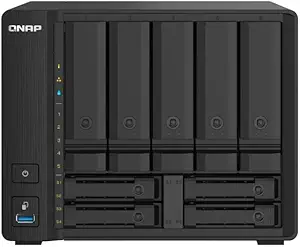
QNAP TS-932PX-4G 5+4 Bay High-Speed NAS with Two 10GbE and 2.5GbE Ports
The QNAP TS-932PX-4G stands out for its flexible network options, featuring dual 10GbE ports and two 2.5GbE ports, making it suitable for environments that demand high-speed data transfers and multiple network segments. Compared with the TERRAMASTER F4-425, it offers a more robust networking setup but at a higher price point and with added complexity. Its quad-core ARM Cortex processor and up to 16GB RAM support heavy multitasking and virtualization, making it ideal for small businesses or tech-savvy home users. The tradeoff is that its setup and management can be more involved, and it’s overkill for simple backup tasks. This NAS is best for users who need fast, multi-gigabit connections and expandability beyond basic file storage.
Pros:- Dual 10GbE ports for high-speed data transfers
- Supports up to 16GB RAM for multitasking
- Versatile network connectivity with 2.5GbE ports
Cons:- Higher cost and complexity compared to simpler NAS
- Requires more technical knowledge to set up and optimize
- Diskless design adds initial cost for drives
Best for: Small businesses or advanced home users requiring high-speed multi-network access
Not ideal for: Casual home users or those on a tight budget who don’t need multi-gigabit networking
- Number of Bays:5+4 (diskless)
- Processor:ARM Cortex-A57 quad-core 1.7GHz
- Memory:4GB DDR4 (up to 16GB supported)
- Network Ports:2 x 10GbE, 2 x 2.5GbE
- USB Ports:3 x USB 3.2 Gen 1
- Max Storage:Up to 48TB (9.6TB per bay)
Bottom line: This NAS is ideal for users who need rapid, simultaneous access across multiple network segments, such as small offices or tech enthusiasts.
TERRAMASTER F4-425 4-Bay NAS Storage – Intel x86 Quad-Core CPU, 4GB RAM, 2.5GbE LAN, Network Attached Storage Multimedia Server for Home Users (Diskless)
The TERRAMASTER F4-425 offers a powerful Intel quad-core processor and 4GB RAM, making it suitable for multimedia streaming, 4K transcoding, and multi-user access. Its support for RAID 0, 1, and hybrid arrays provides flexible redundancy options, and the 2.5GbE port ensures faster file transfers than traditional Gigabit networks. Compared to the BUFFALO LinkStation 220, it delivers significantly better performance and multimedia capabilities but involves a more complicated setup process. Its quiet operation at just 21dB makes it ideal for bedrooms or quiet environments. The main tradeoff is that it’s more expensive and requires more technical knowledge to configure fully. This NAS makes sense for home users who want media server functionality combined with reliable data redundancy.
Pros:- Quad-core Intel x86 processor for demanding tasks
- Supports 4K hardware transcoding
- Quiet operation at 21dB
Cons:- More expensive than entry-level NAS
- Requires some technical setup for optimal use
- Limited to 4 bays, less scalable for future expansion
Best for: Home multimedia enthusiasts and users seeking quiet, high-performance media storage
Not ideal for: Casual or budget-conscious users who only need basic backup functions
- Processor:Intel x86 Quad-Core
- RAM:4GB DDR4 (up to 64GB supported)
- Network Ports:1 x 2.5GbE
- Drive Bays:4
- Max Storage:Up to 120TB
- Transcoding:Hardware 4K H.265
Bottom line: This NAS is well-suited for home users focused on media streaming and quiet operation without sacrificing performance.
How We Picked
To evaluate these NAS devices, I focused on key factors that matter most to buyers: network performance, processing power, expandability, usability, and value for money. Devices were selected for their 2.5GbE support, with an emphasis on models that balance performance with practical features suitable for home and small office setups. The ranking reflects a combination of hardware specifications, user-friendliness, and overall versatility, ensuring each product serves a distinct user need. Cost considerations also played a role, especially where budget models offer compelling value despite fewer advanced features.
Factors to Consider When Choosing Best 4 Bay Nas Devices With 2.5gbe
When choosing a 4 bay NAS with 2.5GbE, consider several factors that influence performance, ease of use, and future-proofing. The right choice depends on your specific needs—whether prioritizing speed, expandability, or simplicity. Here are key considerations to help guide your decision beyond the specifications listed in product reviews.Network Connectivity and Speed
While 2.5GbE is a significant upgrade for home and small office networks, consider whether your existing infrastructure can support it. Some models also include dual 10GbE ports, which can future-proof your setup but may be unnecessary if your network hardware isn’t compatible. Think about your typical data transfer size and volume—if you handle large media files or backups regularly, investing in higher network speeds will pay off in smoother performance.
Processor Power and RAM
The CPU determines how well the NAS can handle multitasking, media transcoding, or running apps. Devices with Intel x86 processors generally perform better for heavy workloads compared to ARM-based models. RAM capacity also influences multitasking and caching—more memory allows for smoother operation when multiple users access the system simultaneously or when running demanding applications.
Expandability and Storage Options
Look for models that offer M.2 slots or USB ports for additional storage or caching, which can extend the device’s lifespan and utility. Consider whether you want a NAS that supports RAID configurations for redundancy or simple JBOD setups for maximum flexibility. Keep in mind that some models may have limitations in drive capacity or number of expansion options, impacting your future scalability.
Ease of Use and Ecosystem
User experience varies widely—some NAS devices come with intuitive apps and management interfaces, making setup and ongoing maintenance straightforward. Others may require more technical knowledge. If you plan to use your NAS for backups, media streaming, or remote access, check whether the device supports popular apps and integrations, which can save time and frustration.
Cost and Value
Higher-priced models usually include more features, faster processors, and better build quality, but that isn’t always necessary for every user. Conversely, budget models might lack advanced features but still fulfill basic storage needs effectively. Balance your budget against your performance expectations—sometimes spending a bit more results in significantly better long-term value.
Frequently Asked Questions
Is a 2.5GbE port enough for my small office network?
For most small office environments, a 2.5GbE port offers a noticeable speed boost over Gigabit Ethernet, especially when transferring large files or backing up multiple devices. However, if you regularly work with very large datasets or need faster transfer rates, consider a model with dual 10GbE ports for future scalability. Your existing network hardware also impacts whether this upgrade makes a real difference—if your switches and routers support 2.5GbE, you’ll see the benefits clearly.
Should I prioritize CPU power over network speed?
Choosing between CPU power and network speed depends on your primary use case. If you plan to run media transcoding, virtual machines, or multiple applications simultaneously, a faster processor will improve performance. Conversely, if your main need is quick file transfers and backups over the network, then a device with dual 2.5GbE or even 10GbE ports might be more beneficial. For most home users, a balanced approach tends to work best.
Do I need a NAS with M.2 slots?
M.2 slots allow for SSD caching, which can significantly speed up access to frequently used files. If you handle large media files or run applications that require quick data retrieval, this feature adds value. However, not all users need this, and some models with M.2 slots are more expensive. If your storage needs are modest, a device without M.2 slots may suffice, especially if you plan to add external drives via USB or eSATA.
Is a diskless NAS better than one with pre-installed drives?
Choosing a diskless NAS provides flexibility to select drives best suited to your needs, whether HDD or SSD, and allows for customized RAID setups. It also tends to be more cost-effective upfront. However, it requires additional effort and knowledge to install drives and configure RAID. Pre-installed drives are more convenient but often come at a premium price and less flexibility for upgrades.
How important is software ecosystem and app support?
A robust software ecosystem enhances your NAS experience, enabling seamless backups, media streaming, remote access, and more. Devices from brands like QNAP and Asustor are known for their extensive app stores and user-friendly interfaces. If you plan to use your NAS for multiple functions, prioritize models with well-supported software and regular updates to ensure compatibility and security.
Conclusion
For buyers prioritizing overall performance and future-proofing, the QNAP TS-932PX stands out, especially with its dual 10GbE ports. Those seeking the best value should consider the Asustor Drivestor 4 Pro, which offers solid features at a reasonable price for home media use. Beginners or casual users benefit from models like the BUFFALO LinkStation 220, which simplifies setup without sacrificing basic network performance. For highly demanding environments or users needing maximum speed, investing in premium options like the UGREEN DXP4800 Plus may be justified. Ultimately, your choice should align with your specific needs, network infrastructure, and budget constraints.