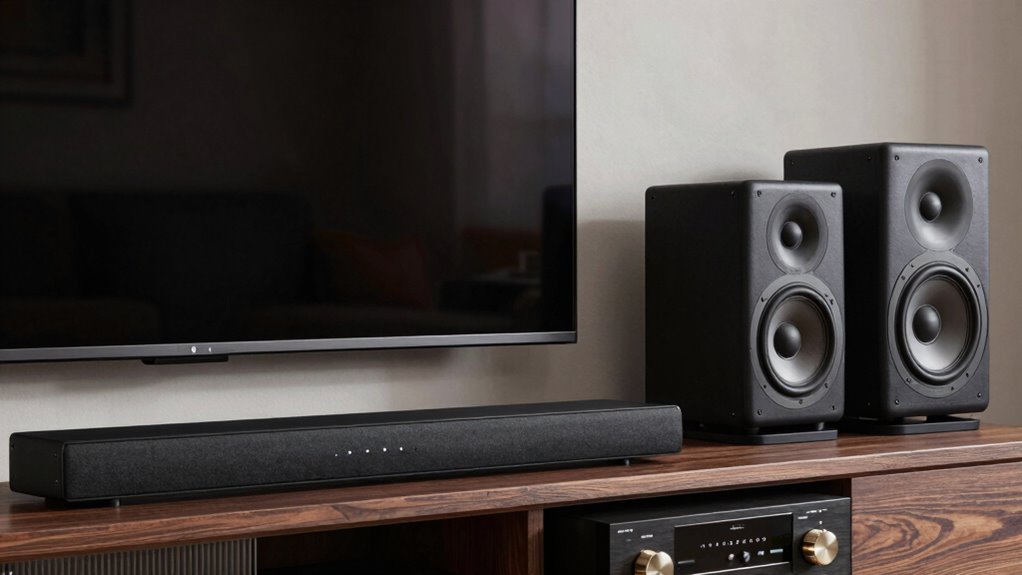

When choosing between a soundbar and an AVR with speakers, the biggest hidden tradeoff is ease versus authenticity. Soundbars are simple to set up and fit seamlessly into tight spaces, but they may not deliver true surround sound. On the other hand, AVRs with multiple speakers create a richer, more immersive experience but require extensive calibration and space. If you keep exploring, you’ll uncover how each option impacts your home theater’s overall performance.
Open a free Amazon Business account
Business pricing, bulk buying and tax-exempt orders.
As an affiliate, we earn on qualifying purchases.
Key Takeaways
- Soundbars offer quick, space-saving setup but often lack the true surround sound and customization of AVR systems.
- AVR + speakers provide a more authentic, immersive experience but require detailed calibration and more effort.
- Proper calibration significantly improves AVR performance, whereas soundbars generally do not need extensive setup.
- Soundbars excel in convenience and minimal clutter, while AVR setups deliver nuanced audio tailored to room acoustics.
- The main tradeoff is simplicity and ease versus authentic surround sound and detailed customization.
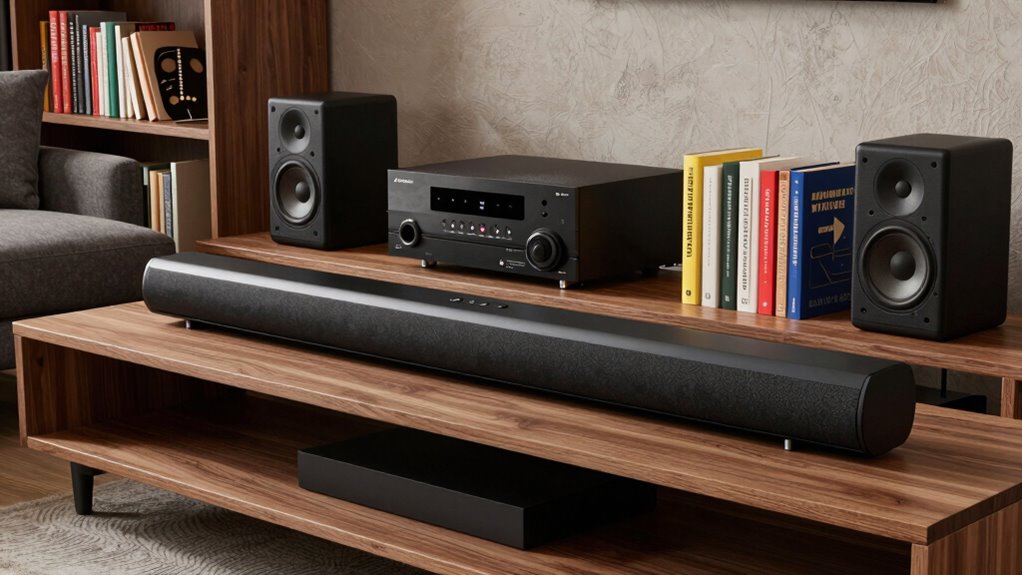
When choosing a home audio setup, you might wonder whether a sleek soundbar or a traditional AVR (audio-video receiver) paired with separate speakers is the better option. This decision often hinges on how significant surround sound and audio calibration are to you. A soundbar offers a simple, space-saving solution that can deliver surprisingly good sound, especially considering its size. It’s designed to emulate surround sound with built-in multiple drivers or virtual surround technology, making it an attractive choice for quick setup and minimal clutter. However, the effectiveness of a soundbar’s surround sound experience can vary based on the model and the room acoustics. While some high-end soundbars come with advanced audio processing to create a convincing surround sound environment, others may fall short of truly immersing you in a cinematic experience.
On the other hand, an AVR paired with separate speakers offers a different level of flexibility and potential. You can configure your system for essential surround sound by strategically placing multiple speakers around the room, creating a more authentic and enveloping experience. But achieving this isn’t just about buying good hardware; it requires proper audio calibration. During setup, you’ll need to run calibration tools—many AVRs come with built-in microphones—to automatically adjust speaker levels, distances, and EQ settings. This calibration process ensures that each speaker plays its part in delivering balanced, clear sound across the entire listening area, which is vital for a truly immersive surround sound experience. Without proper calibration, even the best equipment can sound disjointed or unbalanced, undermining the advantages of a dedicated home theater setup. Additionally, European cloud solutions emphasize the importance of advanced technology and customization, which is similar to how a calibrated AVR system can be tailored for optimal audio performance.
While a soundbar simplifies the process and reduces the need for calibration, it can’t match the detailed customization that comes with an AVR system. If you’re willing to spend the time fine-tuning your setup and have the space for multiple speakers, an AVR setup can outperform a soundbar in delivering nuanced surround sound and precise audio calibration. Conversely, if you prefer a clean, straightforward solution with minimal fuss, a quality soundbar might suffice, especially for casual viewing. Ultimately, your choice depends on how much importance you place on the authenticity of surround sound and the effort you’re willing to invest in audio calibration. Both options have their merits, but understanding the tradeoffs can help you make a smarter decision aligned with your priorities.
best soundbar with virtual surround sound
As an affiliate, we earn on qualifying purchases.
As an affiliate, we earn on qualifying purchases.
Frequently Asked Questions
Can a Soundbar Replace a Full Home Theater System?
A soundbar can replace a full home theater system for simpler setups, especially with wireless connectivity that reduces cable clutter. However, it might not deliver the same immersive sound experience or surround sound capabilities as an AVR plus speakers. Installation complexity is generally lower with a soundbar, making it ideal for quick setup, but if you crave high-quality audio and flexibility, a full system might still be the better choice.
How Does Audio Quality Compare in Large Rooms?
In large rooms, audio quality can be quite challenging. Room acoustics and speaker placement substantially impact sound clarity, volume, and richness. A soundbar may struggle to fill expansive spaces, often sounding muffled or echoey. Conversely, an AVR with strategically placed speakers delivers dynamic, detailed sound that adapts to the space. You’ll find that proper speaker placement and good acoustics are key to achieving immersive audio, no matter the room size.
Are Soundbars Better for Gaming Than AVR Setups?
Soundbars are generally better for gaming if you prioritize surround sound and easy wireless connectivity, especially in smaller spaces. They offer quick setup and integrate seamlessly with gaming consoles, providing immersive audio without the complexity of traditional AVR setups. However, if you want richer, more customizable soundscapes for larger rooms, an AVR with dedicated speakers might still be your best bet.
What Is the Cost Difference Over Time?
The cost difference over time is enormous—like comparing a penny to a treasure chest. Soundbars typically cost less initially and save you money on upgrades, since they don’t require frequent replacements or additions. In contrast, AVR and speaker setups can incur higher upgrade costs and maintenance, making your total long-term expenses markedly steeper. So, if you’re budget-conscious, a soundbar might be the smarter, more economical choice over time.
Do Soundbars Support Multi-Room Audio Systems?
Many soundbars do support multi-room compatibility, especially newer models with wireless integration. You can easily set up multi-room audio systems by connecting your soundbar to other compatible devices over Wi-Fi or Bluetooth. This allows you to stream music seamlessly across different rooms. However, not all soundbars have this feature, so check for multi-room compatibility and wireless integration options before choosing one if multi-room audio is a priority for you.
Conclusion
Ultimately, choosing between a soundbar and an AVR with speakers hinges on your priorities. While a soundbar offers simplicity and a sleek look, an AVR with speakers provides richer, immersive sound but demands more setup. The surprise lies in how these options challenge your expectations—one’s convenience versus the other’s depth. You might find that the tradeoff isn’t just about sound quality, but about the experience you’re willing to invest in, shaping your home theater journey in unexpected ways.
NFL season / tailgating Picks
team gear
As an affiliate, we earn on qualifying purchases.