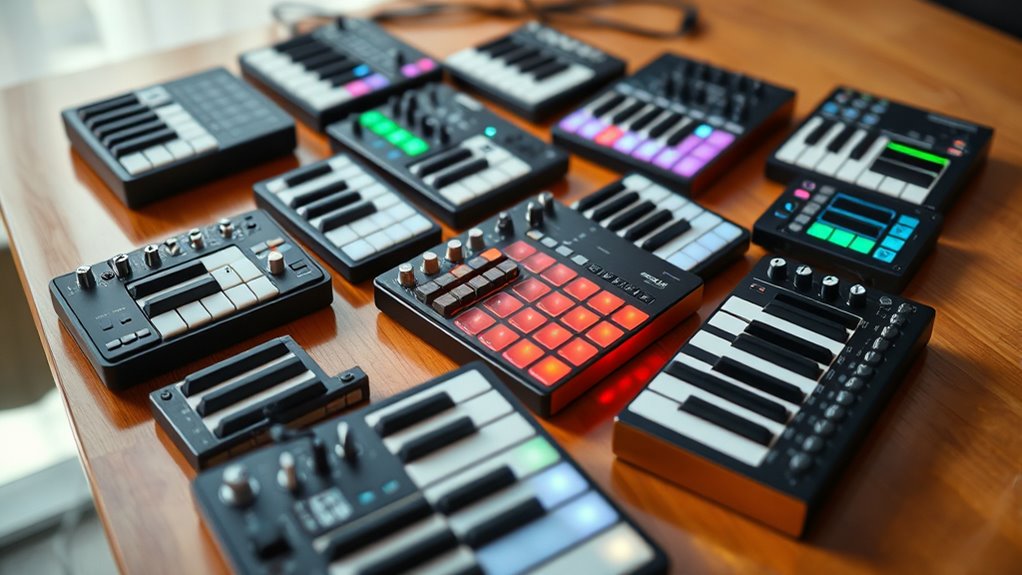

For musicians on the move, a travelready midi keyboard must combine portability with performance. The Akai Professional MPK Mini MK3 stands out as the best overall choice thanks to its compact size and versatile features. Other notable options include the DaierTek Bluetooth MIDI Controller for wireless convenience and the Novation FLkey Mini for seamless DAW integration. The main tradeoffs in this category often involve balancing size, feature set, and ease of use—smaller models may sacrifice some controls, while more feature-rich options can become bulkier. Continue reading for a detailed breakdown of each option to find your ideal travel companion.
Complete the kit



Key Takeaways
- Compact size and lightweight design are the primary factors that distinguish the best travelready midi keyboards.
- Wireless connectivity, especially Bluetooth, significantly enhances portability for on-the-go music creation.
- Built-in controls like drum pads and knobs add versatility without sacrificing portability, but often increase size and cost.
- Compatibility with major DAWs and devices is essential for seamless integration during travel.
- Price varies widely, with premium models offering more features at the cost of added bulk and complexity.


| travelready midi keyboard | Number of Keys | Connectivity |
|---|---|---|
| Donner Mini MIDI Keyboard N-25 | 25 | USB-MIDI, OTG adapter for smartphones |
| DaierTek 25-Key Portable MIDI | 25 | — |
| Donner USB-C MIDI Keyboard Con | 25 | USB-C |
| Akai Professional MPK Mini MK3 | 25 | USB |
| Korg microKEY 25 USB MIDI Keyb | 25 | — |
| Korg 25-Key MIDI Controller NA | 25 | USB-MIDI |
| M-VAVE 25-Key USB MIDI Keyboar | 25 | Wireless |
| Akai Professional MPK Mini Plu | 37 | USB, MIDI, CV/Gate I/O |
| Novation FLkey Mini | 25 | USB |
| Novation Launchkey Mini 37 MK4 | 37 | USB |
| Akai Professional MPK Mini Pla | 25 | USB MIDI, 1/8" headphone output |
| Akai Professional APC Key 25 M | 25 | — |
| 37-Key USB MIDI Controller Key | 37 | USB |
| M-AUDIO Keystation Mini 32 MK3 | 32 | USB |
| Akai Professional LPK25 | 25 | USB |
More Details on Our Top Picks
Donner Mini MIDI Keyboard N-25, 25-Key Velocity-Sensitive Controller with Light-Up Buttons and Teaching Courses
The Donner N-25 stands out for its compact size and beginner-friendly features, including velocity-sensitive keys and integrated teaching courses. Compared with the Akai MPK Mini MK3, it offers a more straightforward interface with light-up buttons that help new users learn key layouts. However, its 25 keys may limit more advanced performers or those wanting complex arrangements. The included courses and seamless DAW compatibility make it ideal for learners who want an all-in-one starter kit. Still, the absence of extensive control options means it’s less suited for live performance or intricate compositions.
Pros:- Compact, lightweight design perfect for travel
- Includes 40 teaching courses to accelerate learning
- Velocity-sensitive keys for expressive playing
- Seamless compatibility with Mac, PC, and smartphones
Cons:- Limited to 25 keys, restricting more complex compositions
- Requires OTG adapter for smartphone use, which can be inconvenient
Best for: Beginners who want an affordable, portable entry point with built-in learning tools
Not ideal for: Experienced producers or performers needing extensive control and more keys for complex works
- Number of Keys:25
- Key Type:Velocity-sensitive mini keys
- Connectivity:USB-MIDI, OTG adapter for smartphones
- Included Software:40 teaching courses
- Compatibility:Mac, iOS, PC, iPhone, iPad
- Additional Features:Light-up buttons, pitch-bend wheel, 4 user banks
Our verdict“This controller is suitable for beginners and mobile musicians who prioritize portability and learning tools.”
DaierTek 25-Key Portable MIDI Keyboard Controller with Bluetooth and USB
The DaierTek 25-Key MIDI Controller excels in versatility with its wireless Bluetooth connection, making it a top pick for mobile creators. Compared with the Donner N-25, it offers the convenience of wireless operation, along with RGB backlit drum pads and assignable knobs that enhance live performance and studio control. Yet, it’s limited to 25 keys, which may not satisfy pianists or those needing more extensive performance ranges. Its long battery life of approximately 16 hours makes it ideal for on-the-go sessions, but users must connect to a computer or DAW for sound production, adding complexity for new users. It’s best suited for those who prioritize mobility over extensive keyboard range.
Pros:- Wireless Bluetooth connectivity for convenience
- Long battery life of up to 16 hours
- Backlit pads and assignable knobs for creative control
- Compatible with multiple platforms including Android and iOS
Cons:- Requires connection to a device or DAW for sound output
- Bluetooth setup may be complex for some users
Best for: Mobile producers and performers who value wireless freedom and long battery life
Not ideal for: Studio-focused musicians requiring more keys or standalone functionality
- Number of Keys:25
- Connectivity Technology:Bluetooth, USB
- Additional Features:Backlit, RGB pads, assignable knobs
- Supported Software:Ableton Live, FL Studio, Cubase, GarageBand
- Platform Compatibility:Android, Windows, iOS
- Battery Capacity:2000 mAh
- Battery Life:Approximately 16 hours
Our verdict“Ideal for mobile musicians seeking wireless control and extended battery life, but less suited for standalone studio use.”
Donner USB-C MIDI Keyboard Controller, 25-Key Portable Mini MIDI Keyboard with 8 Drum Pads, OLED Display, 16 Smart Scales, Arpeggio, Replay, 4 DAW Software, and 40 Teaching Courses
The Donner DMK 25 Pro offers a rich set of features, including smart scale modes, arpeggio functions, and an OLED display, making it a powerful tool for both beginners and experienced producers. Compared with the Akai MPK Mini MK3, it provides more advanced features like smart scales and an OLED screen for real-time feedback, enhancing creative control. However, it relies on connection to a device or computer to produce sound, which can be limiting for those seeking standalone operation. Its portable design and extensive software bundle make it ideal for producers looking for a flexible, travel-ready device with deep customization options.
Pros:- Portable and lightweight for travel
- Includes 4 DAW software and 40 teaching courses
- Smart scale modes and arpeggio functions for creative flexibility
- OLED display for real-time control feedback
Cons:- Requires connection to a computer or mobile device to produce sound
- Mobile device compatibility may need additional adapters
Best for: Music producers and performers who want advanced control features in a portable package
Not ideal for: Users who need a fully standalone controller with built-in sounds
- Number of Keys:25
- Drum Pads:8
- Display:OLED
- Smart Scales:16
- Included Software:4 DAW software
- Teaching Courses:40
- Connectivity:USB-C
Our verdict“A versatile, feature-rich MIDI controller perfect for producers who want advanced controls in a portable form, but not for those requiring standalone operation.”
Akai Professional MPK Mini MK3 25-Key USB MIDI Keyboard Controller
The Akai MPK Mini MK3 is a favorite among serious producers for its comprehensive control set, including 8 backlit drum pads and 8 assignable knobs. It surpasses many competitors like the Korg microKEY 25 in terms of software integration, thanks to NKS support and bundled virtual instruments. Its arpeggiator and customizable mapping elevate its versatility, but the compact 25-key layout may fall short for pianists or those needing extended keyboard ranges. The learning curve for mastering all controls can be steep, making it better suited for experienced users or studio environments rather than casual musicians seeking simplicity.
Pros:- Includes comprehensive software bundle and sound library
- NKS support for seamless plugin control
- Assignable knobs and arpeggiator for expressive performance
- Compact and portable for studio and mobile use
Cons:- Limited number of keys for complex piano-style playing
- Advanced features may present a learning curve for newcomers
Best for: Professional producers and advanced hobbyists needing deep control and software integration
Not ideal for: Beginners or those seeking an ultra-simple, plug-and-play MIDI device
- Number of Keys:25
- Backlit Pads:8
- Knobs:8
- Connectivity:USB
- NKS Support:Yes
- Included Software:MPC Beats, virtual instruments
- Additional Features:Arpeggiator, 4-way thumbstick, customizable mapping
Our verdict“A highly capable MIDI controller for producers who demand detailed control and software integration, but less suitable for beginners or those needing more keys.”
Korg microKEY 25 USB MIDI Keyboard
The Korg microKEY 25 emphasizes simplicity and portability, making it a frequent choice for musicians who need a lightweight controller with essential features. Its velocity-sensitive keys and basic controls like octave shift and arpeggiator make it suitable for mobile production, but it lacks the advanced features or built-in sounds found in models like the Donner N-25. Its plug-and-play design means it’s ideal for users who want straightforward MIDI control without fuss, but those seeking extensive control options or standalone operation will find it limiting. It’s best for quick setups and basic performance needs.
Pros:- Lightweight and highly portable
- No driver installation needed, easy setup
- Versatile controls including arpeggiator and transpose
- Affordable price point
Cons:- Limited to 25 keys, not suitable for complex piano performance
- No built-in sounds or advanced controls
Best for: Travelers and casual musicians who prioritize portability and simplicity
Not ideal for: Professional studios or performers requiring extensive control and features
- Type:USB MIDI Keyboard
- Number of Keys:25
- Power:USB-powered
- Features:Velocity-sensitive keys, octave shift, arpeggiator, joystick
Our verdict“A straightforward, portable MIDI keyboard perfect for on-the-go musicians and beginners seeking simplicity.”
Korg 25-Key MIDI Controller NANOKEY2BK
The Korg NANOKEY2BK stands out for its ultra-compact, low-profile design, making it ideal for musicians who need a lightweight option for quick setup on the go. Compared with the Novation FLkey Mini, this model offers fewer features but excels in portability, fitting easily into small bags or laptop cases. Its velocity-sensitive keys and sustain button provide enough expressive control for casual play and simple production, though the limited 25 keys restrict complex arrangements. The basic feature set means it’s less suited for advanced users needing more control options. Overall, this pick makes the most sense for solo travelers or students who prioritize portability over extensive functionality.
Pros:- Extremely portable and lightweight design
- Velocity-sensitive keys for expressive play
- Includes sustain button for piano-like feel
Cons:- Limited range of 25 keys restricts complex performances
- Basic feature set may not satisfy advanced users
Best for: Travelers and students needing a highly portable MIDI controller for basic music tasks
Not ideal for: Professional producers or performers requiring extensive controls and multiple octaves
- Number of Keys:25
- Connectivity:USB-MIDI
- Color:Black
- Design:Low-profile
Our verdict“This is a great choice for those who need a simple, travel-ready MIDI keyboard for light use and portability.”
M-VAVE 25-Key USB MIDI Keyboard Controller with Backlit Drum Pads and Software
The M-VAVE 25-Key Controller is notable for its wireless capability, making it a flexible option for mobile producers who want to avoid tangled cables. Unlike the Korg NANOKEY2BK, which is wired and more basic, this model offers 8 RGB backlit drum pads and 8 assignable knobs, adding creative control for live performance and beat-making. Its semi-weighted keys deliver a more expressive feel compared to the purely synth-action keys of the NANOKEY2BK. However, reliance on wireless connectivity can introduce latency, which might hinder real-time performance for some users. The software setup might also be complex for beginners. This makes sense for producers who value mobility and visual feedback, but not for those needing ultra-low latency or simple plug-and-play operation.
Pros:- Wireless connectivity with 16-hour battery life
- Backlit drum pads enhance visual feedback
- Semi-weighted keys improve expressiveness
Cons:- Latency issues possible with wireless connection
- Limited to 25 keys for complex melodies
Best for: Mobility-focused producers wanting wireless control and visual feedback
Not ideal for: Users who prefer wired stability or are new to MIDI setups
- Number of Keys:25
- Backlit Drum Pads:8
- Connectivity:Wireless
- Battery Life:16 hours
Our verdict“Ideal for portable producers seeking wireless freedom and creative controls, but less suited for high-demand live performances.”
Akai Professional MPK Mini Plus – USB MIDI Keyboard Controller with 37 Mini Keys, 8 MPC Pads, Sequencer, MIDI/CV/Gate I/O, Native Instruments Sound Package, White Limited Edition
The Akai MPK Mini Plus offers a substantial upgrade with 37 mini keys, full-sized for more comfortable melodic play compared to the 25-key options. Its 8 RGB MPC pads and built-in 64-step sequencer make it a versatile tool for both studio and live setups, especially when compared to the more limited Novation FLkey Mini. The inclusion of MIDI, CV, and Gate I/O expands connectivity to modular gear, catering to more advanced users. The downside is its limited sequencer capacity—only one track—so it’s less suited for multi-layered compositions. No built-in speakers mean you’ll need an external device for sound output. This pick suits serious creators who need both portability and extensive connectivity, but not those seeking standalone functionality.
Pros:- Full 3-octave mini keybed for melodic flexibility
- Responsive RGB pads for dynamic playing
- Comprehensive connectivity including MIDI and CV/Gate
Cons:- Limited to one track in the sequencer
- Requires external gear for sound production
Best for: Advanced producers and performers integrating modular gear and seeking versatile control
Not ideal for: Beginners or casual users who need simple, straightforward MIDI controllers
- Number of Keys:37
- Pads:8 RGB MPC Pads
- Connectivity:USB, MIDI, CV/Gate I/O
- Included Software:MPC Beats, Native Instruments Komplete 15
Our verdict“Perfect for experienced musicians needing a portable yet highly connected MIDI controller with expanded control options.”
Novation FLkey Mini – Portable 25-Key MIDI Keyboard Controller with FL Studio Integration
The Novation FLkey Mini is tailored for FL Studio users, with seamless integration that speeds up workflow during production. Its 25 velocity-sensitive keys are complemented by 8 knobs and features like scale mode and step sequencer, which are ideal for beat-making and melodic development. Compared to the Korg NANOKEY2BK, it offers more creative features and software integration, but is heavily dependent on a computer and specifically FL Studio. Its limited 25 keys restrict performance complexity, making it less ideal for live sets or advanced arrangements. This controller is perfect for FL Studio enthusiasts who need portability and integrated controls, but less so for multi-DAW users or those seeking standalone operation.
Pros:- Seamless FL Studio integration speeds workflow
- Compact and portable design
- Velocity-sensitive pads and customizable controls
Cons:- Limited to 25 keys, restricting performance complexity
- Primarily designed for FL Studio—less compatible with other DAWs
Best for: FL Studio users seeking a compact, workflow-enhancing MIDI controller
Not ideal for: Producers working across multiple DAWs or requiring extensive keys for complex compositions
- Number of Keys:25
- Connectivity:USB
- Pads:Velocity-sensitive
- Special Features:Scale mode, step sequencer
Our verdict“Ideal for FL Studio fans who want a portable controller with integrated features, but not suited for multi-DAW setups or complex live performances.”
Novation Launchkey Mini 37 MK4 – Portable 37-Key MIDI Controller with DAW Integration
The Launchkey Mini 37 MK4 offers a more extensive 37-key layout, making it suitable for performers and producers wanting more melodic range without sacrificing portability. Its 16 responsive pads and advanced modes like Chord, Scale, and Arpeggiator provide versatile creative tools, especially when compared to the 25-key Novation FLkey Mini. The controller integrates seamlessly with popular DAWs, including Ableton Live, and comes with various software bundles. However, its mini keys may be uncomfortable for some players, and it demands external power or USB connection, which slightly reduces portability. This makes it ideal for on-the-go musicians who need deeper control but can accept a smaller key size.
Pros:- 37 keys for broader melodic possibilities
- Seamless DAW integration with major software
- Versatile controls including chord and arpeggiator modes
Cons:- Mini keys may be uncomfortable for some players
- Requires external power or USB connection, reducing true portability
Best for: Musicians seeking a portable, feature-rich MIDI controller with extended melodic range
Not ideal for: Players who prefer full-sized keys or need a standalone device without a computer
- Number of Keys:37
- Connectivity:USB
- Pads:16 FSR responsive
- Features:Chord Mode, Scale Mode, Arpeggiator
Our verdict“Best suited for mobile musicians who want more keys and advanced features in a portable form factor, accepting smaller keys for convenience.”
Akai Professional MPK Mini Play MK3 – MIDI Keyboard Controller with Built-in Speaker and Sounds
The Akai MPK Mini Play MK3 stands out for its portability and standalone capabilities, making it ideal for musicians who want to produce music anywhere without external gear. Unlike the M-AUDIO Keystation Mini 32 MK3, which requires a laptop or tablet, this model offers onboard sounds and built-in speakers, providing a true self-contained experience. Its 25 keys and MPC pads are great for sketching ideas on the move, but the limited keys may fall short for complex piano pieces. The absence of included batteries means you’ll need to buy them separately, a small inconvenience for true portability. The onboard sound library over 100 sounds is versatile, yet some users may find it insufficient without external instruments. This pick makes the most sense for traveling musicians and performers needing quick access to sounds and control without extra equipment.
Pros:- Portable design with battery operation for music anywhere
- Built-in speaker with enhanced low-end response
- Includes a wide variety of onboard sounds and software
- Versatile connectivity options
Cons:- Limited keys for complex performances
- Battery not included, requiring additional purchase
- Onboard sounds may feel limited for professional studio work
Best for: Musicians who perform or compose on the go and need a portable, all-in-one MIDI solution
Not ideal for: Pianists or producers requiring extensive keys and detailed editing, who might find 25 keys limiting
- Number of Keys:25
- Built-in Speaker:Yes
- Battery Operated:Yes
- Connectivity:USB MIDI, 1/8″ headphone output
- MIDI Controller:Yes
- Sound Library:Over 100 onboard sounds
Our verdict“This is the best choice for mobile musicians seeking a standalone, compact MIDI instrument with onboard sounds.”
Akai Professional APC Key 25 MK2 25-Key USB MIDI Keyboard Controller with RGB Pads and Rotary Knobs
The Akai APC Key 25 MK2 makes a strong case for live performers and studio users who want seamless Ableton integration. Compared with the Donner Mini MIDI Keyboard N-25, which offers basic control, the APC MK2 provides 40 RGB pads and 8 rotary knobs, offering much more control for triggering clips and manipulating parameters. Its 25 keys are sufficient for simple melodies, but not for detailed piano work, making it less suitable for classical pianists. Pre-mapped for Ableton Live, it simplifies workflow but relies heavily on Ableton software, limiting versatility with other DAWs unless re-mapped. The lack of a built-in display means users must rely on software feedback, which can slow editing. This device suits producers and performers who prioritize live control and software integration over extensive keyboard range.
Pros:- Compact and portable with extensive control surface
- 40 RGB pads for clip launching and performance
- Pre-mapped for Ableton Live, enabling quick setup
- Includes virtual instruments for creative flexibility
Cons:- Limited to 25 keys, restricting complex piano playing
- Dependent on Ableton Live for full functionality
- No built-in display for detailed control feedback
Best for: Ableton Live users and live performers who value quick, hands-on control in a compact format
Not ideal for: Pianists or composers needing extensive keys or standalone functionality without a computer
- Number of Keys:25
- Pad Matrix:40 RGB pads
- Rotary Knobs:8
- Compatibility:Ableton Live Lite, Ableton 11+
- Power Source:USB
Our verdict“Ideal for Ableton Live enthusiasts seeking a portable, performance-oriented MIDI controller with extensive control features.”
37-Key USB MIDI Controller Keyboard with Drum Pads, Knobs, and OLED Display
The 37-Key USB MIDI Controller offers a balanced mix of portability and control, with 37 velocity-sensitive keys and an OLED display that provides real-time feedback—something fewer controllers include. This makes it a strong choice for both beginners and professionals who want more expressive playing and visual cues. Unlike the Akai MPK Mini Play MK3, which emphasizes onboard sounds, this model focuses on control and DAW integration, making it more suitable for studio work. The OLED display helps with parameter editing and live adjustments, but its basic build quality and USB-only operation may not withstand heavy touring. This controller is best for musicians who want a versatile, feedback-rich device that can handle complex production tasks.
Pros:- 37 velocity-sensitive keys for expressive playing
- OLED display for real-time control feedback
- Versatile with 8 knobs and integration with all major DAWs
- Compact enough for travel with a professional feel
Cons:- Limited keys for classical-style piano work
- Basic build quality may not suit heavy touring
- USB-only connectivity without battery option
Best for: Producers and advanced hobbyists seeking detailed control with real-time feedback for studio and stage use
Not ideal for: Travelers who need a fully standalone instrument with onboard sounds and speakers
- Number of Keys:37
- Display:OLED
- Knobs:8
- Connectivity:USB
- Material:ABS
Our verdict“A versatile, feedback-rich MIDI controller best suited for producers who demand detailed control and visual cues during studio or live use.”
M-AUDIO Keystation Mini 32 MK3 USB MIDI Keyboard Controller
The M-AUDIO Keystation Mini 32 MK3 provides a straightforward, portable MIDI solution for beginners and casual users. Its 32 velocity-sensitive mini keys make it easier to carry than full-sized controllers like the Akai MPK Mini Play MK3, but mini keys can be a downside for players used to standard-sized keys. The plug-and-play design means no external power or drivers are needed, simplifying setup, while bundled MPC Beats software offers instant creative tools. However, the limited control surface—lacking knobs or pads—limits expressive control during performances or detailed editing. This makes it ideal for students or travelers who need basic MIDI functionality without extra features or hefty price tags.
Pros:- Compact, lightweight, and highly portable
- Plug-and-play with no external power required
- Includes MPC Beats software for immediate use
- Affordable price point for beginners
Cons:- Mini keys may feel cramped for expressive playing
- Limited control options for complex production
- No onboard sounds or standalone functionality
Best for: Beginners and students seeking an affordable, portable MIDI controller for simple music creation
Not ideal for: Advanced producers or performers wanting extensive control or standalone features
- Number of Keys:32
- Key Type:Velocity-sensitive mini keys
- Connectivity:USB
- Included Software:MPC Beats
- Additional Features:Octave buttons, pitch bend, modulation
Our verdict“A practical, budget-friendly MIDI controller perfect for beginners and casual users on the move.”
Akai Professional LPK25 – USB MIDI Keyboard Controller with 25 Keys
The Akai LPK25 is a straightforward, highly portable MIDI controller, ideal for songwriting, sketching ideas, and live performances. Its 25 responsive keys are suitable for expressive playing, especially compared to smaller mini-key controllers like the M-AUDIO Keystation Mini 32 MK3. The arpeggiator and programmable presets add creative flexibility, making it a versatile tool for quick music ideas. However, with only 25 keys, it’s not suited for extensive piano practice or complex arrangements. Its plug-and-play USB connectivity ensures quick setup, compatible with most DAWs, but it offers no onboard sounds or standalone operation, requiring external software. This makes it a great option for performers and composers who want a simple, reliable MIDI keyboard for quick use.
Pros:- Compact and portable with responsive keys
- Includes arpeggiator and programmable presets
- Plug-and-play USB connectivity with broad DAW compatibility
- Ideal for songwriting and live performance
Cons:- Limited to 25 keys, not suitable for complex piano pieces
- No onboard sounds or standalone mode
- Basic feature set compared to larger controllers
Best for: Songwriters, live performers, and producers who need a compact, expressive MIDI controller without extra features
Not ideal for: Classical pianists or producers needing extensive keys or onboard sounds for detailed work
- Number of Keys:25
- Connectivity:USB
- Features:Arpeggiator, programmable presets
- Compatible Software:GarageBand, Logic, Ableton Live, Cubase, ProTools, FL Studio
Our verdict“A reliable, space-saving MIDI controller perfect for quick songwriting and live playing on the move.”

How We Picked
Products were evaluated based on portability, build quality, connectivity options, feature set, and compatibility with popular music software. Priority was given to lightweight, compact designs suitable for travel, as well as ease of use in mobile setups. We also considered additional features such as built-in pads, displays, and software bundles that add value for mobile musicians. Devices that sacrificed core functionality for size or vice versa were ranked lower. This approach ensures that the top picks balance convenience with performance, making them truly travelready.Factors to Consider When Choosing Travelready Midi Keyboards
Choosing the right travelready midi keyboard involves balancing size, features, and compatibility. Smaller models are easier to carry but may lack extensive controls, while larger options can add versatility at the expense of portability. Connectivity options like Bluetooth can simplify setup, but wired connections often offer more reliability. Consider your typical travel scenarios—whether you’ll be performing, recording, or practicing—and select a model that aligns with those needs. Durability and power options are also important factors, especially when access to power outlets is limited. Finally, think about your budget and whether additional software or hardware features are worth the extra investment.Portability and Size
The primary consideration for a travelready midi keyboard is how easily it fits into your travel setup. Compact models with 25 keys or fewer tend to be the most portable, often fitting into backpacks or gig bags without issue. However, smaller keyboards can feel cramped and limit playing expression, so consider your comfort and playing style. Look for models with a slim profile and lightweight construction—these make the biggest difference when moving between locations. However, keep in mind that extremely small devices may lack features like full-scale modulation or pitch wheels, which can be a tradeoff for portability.
Connectivity Options
Wireless connectivity, especially Bluetooth, has become a game-changer for mobile music production, eliminating the need for cumbersome cables. Bluetooth-enabled models, like the DaierTek controller, offer quick setup and greater freedom of movement. Wired USB connections, on the other hand, typically provide more stable latency and power options, especially when connecting to laptops or tablets. Some models even include MIDI out or additional ports for hardware integration. Consider your typical devices and environment—if you’re frequently performing outdoors or in crowded spaces, wireless may be worth the potential battery tradeoff.
Feature Set and Controls
Beyond keys, many portable midi controllers include features like drum pads, knobs, and arpeggiators to expand your creative options on the go. While these add versatility, they also increase size and complexity—so choose based on your workflow. If you prefer simple note input, a basic 25-key model might suffice. For producers who want more control, models like the Akai MPK Mini Plus offer built-in pads and sequencers without sacrificing too much portability. Beware of overly feature-rich models that become bulky or difficult to operate in tight spaces; focus on what enhances your music-making without unnecessary bulk.
Compatibility and Power
Ensuring your midi keyboard works seamlessly with your devices and software is essential. Most portable options support major DAWs like Ableton Live, FL Studio, and Logic, but double-check compatibility before purchasing. Battery-powered models offer the freedom to perform anywhere, while others require USB power, which can limit mobility. Some controllers can operate fully via Bluetooth or battery, making them ideal for outdoor sessions or quick setups. Consider your typical use environment—if you often perform away from power sources, prioritize models with reliable battery life and wireless options.
Budget and Value
Pricing for travelready midi keyboards varies from budget-friendly options under $100 to premium models exceeding $200. While cheaper models can be effective for basic input, they often lack advanced features or durability. Conversely, investing in a mid-range or higher-end model can provide more controls, better build quality, and software bundles that add value over time. Balance your budget with your specific needs—if portability is your main concern, prioritize size and connectivity, then consider features as secondary. For professional use or frequent travel, spending more on a durable, feature-rich model may be justified.
Frequently Asked Questions
Can I use a travel midi keyboard with my phone or tablet?
Yes, many travel midi keyboards are compatible with smartphones and tablets, especially those with Bluetooth or USB-C connections. Devices like the DaierTek controller are designed for wireless use, making them ideal for mobile setups. Just ensure your device supports MIDI over Bluetooth or USB, and check the keyboard’s compatibility with your operating system. Keep in mind that some models may require additional adapters or software to function smoothly with mobile devices. Proper setup ensures you can create music anywhere without the need for bulky equipment.
How long does the battery last on wireless travel midi controllers?
Battery life varies significantly among models, with most offering between 4 to 12 hours of continuous use. Cheaper or smaller models tend to have shorter battery life, often around 4-6 hours, which may be enough for a gig or a few practice sessions. Premium models with larger batteries or power management features can last even longer, making them suitable for extended travel or outdoor performances. Always check the manufacturer’s specifications and consider carrying a portable power bank if you plan to use the controller extensively away from power sources.
Are smaller keys comfortable for extended playing sessions?
Smaller keys are generally less comfortable for long periods, especially if you have larger hands or prefer a more expressive playing style. While 25-key models maximize portability, they can feel cramped and limit your range of motion. If you plan to play for extended sessions, consider a slightly larger model with 37 keys, which strikes a balance between size and playability. Alternatively, try to test different models in person to gauge how the key size affects your comfort and control during prolonged use.
Should I prioritize built-in features or portability when choosing?
It depends on your primary use case. If you need a simple, lightweight controller mainly for quick note input and basic control, prioritize portability and minimal features. However, if you want to incorporate pads, knobs, or onboard sequencing, a slightly larger model with built-in controls can offer more creative flexibility without sacrificing too much portability. Recognize that added features often come with increased size and weight, so weigh how much extra control you need against the convenience of a truly travel-friendly device.
What is the best way to protect my travel midi keyboard during trips?
Proper protection starts with a dedicated carrying case or padded bag designed for small midi controllers. Hard cases provide the best protection against impacts, while soft cases are more lightweight and easier to carry. Consider adding screen or key covers if your model has sensitive controls or displays. Also, avoid leaving your keyboard in extreme temperatures or exposed to moisture. Investing in a protective case ensures your device remains functional and safe throughout your travels, extending its lifespan and maintaining performance.
Conclusion
For casual musicians or travelers who want a simple, portable controller, models like the DaierTek Bluetooth MIDI Controller offer wireless convenience at an affordable price. Those seeking a balance of features and size should consider the Akai MPK Mini MK3, which provides good control without excess bulk. For professionals or users who demand the highest durability and advanced features, the Akai MPK Mini Plus or Novation FLkey Mini make excellent premium choices. Beginners will find value in straightforward, lightweight models, while seasoned performers should prioritize devices with comprehensive controls and connectivity options. Ultimately, selecting the right travelready midi keyboard hinges on your specific needs, travel habits, and budget—use this guide to find your perfect match.