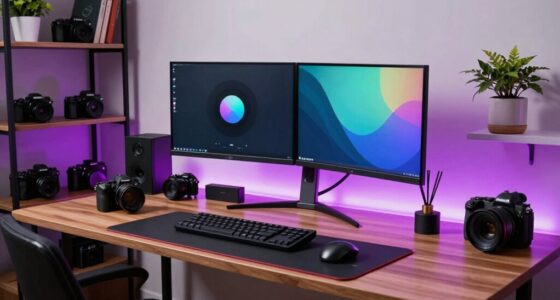
When searching for studio monitor speakers, your goal is to find a pair that provides accurate sound reproduction for mixing, mastering, or casual listening. The Yamaha HS5 stands out as the best overall, thanks to its balanced sound and durability. The JBL 305P MkII offers excellent value with impressive clarity for its price, while the PreSonus Eris E4.5 is ideal for those needing a larger near-field option. Tradeoffs often involve balancing budget against sound accuracy and size, making it essential to match your needs with the right features. Continue reading for a detailed breakdown of these picks and what sets them apart.
Listen free for 30 days with Audible
Thousands of audiobooks and originals — cancel anytime.
Start your free trialAs an affiliate, we earn on qualifying purchases.
Complete the kit



Key Takeaways
- Size matters: larger monitors like the JBL 305P MkII provide more bass but require more space, while smaller models are more compact but may struggle with low-end accuracy.
- Sound clarity and flat frequency response are key for professional work, but budget options like the PreSonus Eris 3.5 still offer decent performance for beginners.
- Build quality influences longevity—higher-end models typically feature better materials and more consistent sound over time.
- Connectivity options such as balanced TRS and RCA inputs expand compatibility with different audio setups, a crucial consideration for versatile use.
- Price often correlates with sound accuracy and durability, but some mid-range options punch above their weight, offering excellent value.
| Mackie CR3.5 Studio Monitors (Pair), 3.5″ Woofers, Tone Knob, Black |  | Best Compact Studio Monitors for Small Desktops | Speaker Size: 3.5 inches | Woofer Diameter: 3.5 inches | Tweeter Diameter: 1 inch | VIEW ON AMAZON | See Our Full Breakdown |
| Edifier MR3 Powered Studio Monitor Speakers, Hi-Res Audio Certified Bluetooth V5.4 Active Bookshelf Loudspeakers, 2.0 Computer Speaker with Headphone Output RCA AUX Balanced TRS Input – Black (Pair) |  | Best Versatile Connectivity and Hi-Res Audio for Daily Listening | Power Output: 18W*2 RMS | Frequency Response: 52Hz – 40kHz | Connectivity: Bluetooth V5.4, RCA, AUX, TRS | VIEW ON AMAZON | See Our Full Breakdown |
| Yamaha HS5 Powered Studio Monitor, Pair |  | Best for Accurate Professional Monitoring | Speaker Type: Woofer | Power Output: 70 watts | Frequency Response: 54 Hz to 30 kHz | VIEW ON AMAZON | See Our Full Breakdown |
| PreSonus Eris 3.5 Powered Studio Monitors (Pair) |  | Best for Budget-Conscious Beginners and Desk Setups | Speaker Type: Active | Size: 3.5 inches | Power Output: 50 watts | VIEW ON AMAZON | See Our Full Breakdown |
| JBL 305P MkII 5-Inch 2-Way Powered Studio Monitors (Pair) |  | Best for Accurate Sound with Wide Imaging | Woofer Size: 5 inches | Amplifier Power: 41 Watts per monitor | Peak SPL: 108 dB | VIEW ON AMAZON | See Our Full Breakdown |
| Yamaha HS4 White Powered Studio Monitor (Pair) |  | Best Compact Studio Monitor for Small Spaces | Speaker Type: Monitor | Color: White | Woofer Diameter: 4.5 inches | VIEW ON AMAZON | See Our Full Breakdown |
| M-AUDIO BX3 3.5-inch Wired Studio Monitors Pair |  | Best for Compact, Versatile Desktop Monitoring | Driver Size: 3.5 inches | Power: 120W | Inputs: 1/4-inch, 1/8-inch, RCA | VIEW ON AMAZON | See Our Full Breakdown |
| PreSonus Eris E4.5 2-Way 4.5-Inch Near Field Studio Monitor (Pair) |  | Best for Accurate Studio Monitoring in Small Rooms | Woofer Size: 4.5 inches | Power: 50 Watts | Inputs: ¼-inch TRS, RCA, ⅛-inch TRS | VIEW ON AMAZON | See Our Full Breakdown |
| Yamaha HS4 Powered Studio Monitor, Black, Pair |  | Best Trusted Brand for Clear, Balanced Sound | Type: Monitor | Color: Black | Woofer Diameter: 4.5 inches | VIEW ON AMAZON | See Our Full Breakdown |
| PreSonus Eris 3.5 Powered Desktop Studio Monitors, Pair – 50W, White |  | Best for Compact, Budget-Friendly Studio Monitoring | Power: 50W | Woofer Size: 3.5 inches | Tweeter Size: 1 inch | VIEW ON AMAZON | See Our Full Breakdown |
| Yamaha HS3 Powered Studio Monitor (Pair, Black) |  | Best for Compact Spaces and Precise Monitoring | Package Quantity: Pair | Speaker Type: Monitor | Frequency Response: 70 Hz – 22 kHz | VIEW ON AMAZON | See Our Full Breakdown |
| Edifier R1280T Powered Bookshelf Speakers – 2.0 Near Field Studio Monitor |  | Best for Versatile Home and Multi-Purpose Use | Power Output: 42 Watts RMS | Speaker Type: Bookshelf | Frequency Response: 80 Hz – (higher frequencies) | VIEW ON AMAZON | See Our Full Breakdown |
| studio monitor speaker | Power Output | Frequency Response | Inputs | Woofer Diameter |
|---|---|---|---|---|
| Mackie CR3.5 Studio Monitors | — | — | — | 3.5 inches |
| Edifier MR3 Powered Studio Mon | 18W*2 RMS | 52Hz – 40kHz | — | — |
| Yamaha HS5 Powered Studio Moni | 70 watts | 54 Hz to 30 kHz | XLR and TRS | 5 inches |
| PreSonus Eris 3.5 Powered Stud | 50 watts | 80 Hz–20 kHz | — | — |
| JBL 305P MkII 5-Inch 2-Way Pow | — | — | XLR, TRS | — |
| Yamaha HS4 White Powered Studi | 26 W + 26 W | 60 Hz – 22 kHz | XLR/TRS Combo, RCA, Stereo Mini | 4.5 inches |
| M-AUDIO BX3 3.5-inch Wired Stu | — | — | 1/4-inch, 1/8-inch, RCA | — |
| PreSonus Eris E4.5 2-Way 4.5-I | — | — | ¼-inch TRS, RCA, ⅛-inch TRS | — |
| Yamaha HS4 Powered Studio Moni | 26 W | 60 Hz – 22 kHz | XLR, TRS, RCA | 4.5 inches |
| PreSonus Eris 3.5 Powered Desk | — | — | Balanced TRS, RCA, aux | — |
| Yamaha HS3 Powered Studio Moni | 26 W | 70 Hz – 22 kHz | — | 3.5 inches |
| Edifier R1280T Powered Bookshe | 42 Watts RMS | 80 Hz – (higher frequencies) | — | 4 inches |
More Details on Our Top Picks
Mackie CR3.5 Studio Monitors (Pair), 3.5″ Woofers, Tone Knob, Black
The Mackie CR3.5 stands out for its compact size, making it ideal for small studios or desktop setups where space is limited. Compared to larger monitors like the Yamaha HS5, it sacrifices some bass depth but offers versatile connectivity and a user-friendly tone control. Its inclusion of all necessary cables and isolation pads adds value for beginners or casual users. However, the limited driver size means it may not deliver the deep low end some professionals require, and the build quality feels basic next to more substantial studio monitors. This pick makes the most sense for those prioritizing space efficiency and multi-device use over deep bass or high-end durability.
Pros:- Compact size perfect for small studios and desktops
- Versatile input options and switchable modes
- Includes isolation pads and all necessary cables
Cons:- Limited to 3.5-inch drivers, lacks deep bass for some users
- Tone control may not replace high-end studio EQs
- Build quality feels basic compared to larger monitors
Best for: Small studio owners, multimedia creators, or desktop users needing versatile, space-saving speakers
Not ideal for: Audio professionals requiring deep bass and high durability, or those working in large rooms where sound projection matters
- Speaker Size:3.5 inches
- Woofer Diameter:3.5 inches
- Tweeter Diameter:1 inch
- Enclosure Material:Metal, Plastic
- Connectivity:RCA, TRS
- Control Method:Touch
- Color:Black Vinyl Wrap
Our verdict“Best suited for users needing compact, versatile monitors for small spaces or casual work.”
Edifier MR3 Powered Studio Monitor Speakers, Hi-Res Audio Certified Bluetooth V5.4 Active Bookshelf Loudspeakers, 2.0 Computer Speaker with Headphone Output RCA AUX Balanced TRS Input – Black (Pair)
The Edifier MR3 offers a compelling combination of high-resolution audio certification and multiple connectivity options, including Bluetooth, RCA, AUX, and balanced TRS inputs. Compared to the PreSonus Eris 3.5, it provides a richer feature set with app-based EQ adjustments, making it ideal for users who want both accurate monitoring and casual listening in one package. Its MDF cabinet reduces distortion, ensuring clear sound even at higher volumes. However, it is limited to a 2.0 setup without a subwoofer option, and its power output might be insufficient for larger rooms. The reliance on app-based customization could be complex for some users, but overall, it caters well to home studios, content creators, or audiophiles seeking flexibility.
Pros:- High-Res Audio certification for accurate sound
- Multiple wired and wireless connectivity options
- App-based EQ for customized sound tuning
- Reduced distortion with MDF cabinet design
Cons:- Limited to 2.0 setup without subwoofer support
- Power output may be insufficient for large spaces
- Full customization requires using an app, which may be complex
Best for: Home studio owners, content creators, or audiophiles who value high-res audio and multiple connection options
Not ideal for: Large-room producers or those needing subwoofer support for deep bass, or users preferring simple plug-and-play solutions
- Power Output:18W*2 RMS
- Frequency Response:52Hz – 40kHz
- Connectivity:Bluetooth V5.4, RCA, AUX, TRS
- Drivers:3.5″ mid-low, 1″ tweeters
- Design:MDF cabinet
Our verdict“Ideal for users seeking flexible, high-resolution audio with versatile connectivity for home or small studio use.”
Yamaha HS5 Powered Studio Monitor, Pair
The Yamaha HS5 is a staple for professional audio work, offering highly accurate sound reproduction with its 5-inch woofer and 1-inch dome tweeter. Its flat frequency response, from 54Hz to 30kHz, ensures that what you hear is true to the source, making it ideal for mixing and mastering. Compared with the JBL 305P MkII, the HS5’s emphasis on transparency may lack the bass weight some producers prefer, but it provides a more neutral sound profile. Its bi-amplified design offers clean, powerful output, yet its size requires a dedicated space and it’s less suited for casual listening or outdoor use. It’s a clear choice for professionals prioritizing accuracy over versatility or affordability.
Pros:- Highly accurate and flat frequency response
- Bi-amplified for clear, powerful sound
- Balanced and unbalanced input options
- Reliable build quality and durability
Cons:- Large size may require significant space
- No waterproof or outdoor suitability
- Price may be high for casual users
Best for: Music producers and engineers needing precise, transparent sound for critical listening and mixing
Not ideal for: Casual listeners or those with limited studio space, as its size and neutral sound may seem too clinical
- Speaker Type:Woofer
- Power Output:70 watts
- Frequency Response:54 Hz to 30 kHz
- Woofer Diameter:5 inches
- Inputs:XLR and TRS
- Additional Features:Bi amplification
Our verdict“Best for professionals requiring precise, transparent sound for critical studio work.”
PreSonus Eris 3.5 Powered Studio Monitors (Pair)
The PreSonus Eris 3.5 offers a balanced mix of affordability and quality, making it an excellent choice for beginners or users with limited space. Its 50W power output and adjustable high- and low-frequency controls provide enough flexibility for small room monitoring. Compared to the Mackie CR3.5, it offers slightly better sound quality and more tuning options, though it still remains a compact, desk-friendly option. Its built-in headphone jack and multiple input choices add convenience, but the bass response might feel shallow for some, and it’s less suitable for larger or acoustically untreated spaces. This monitor is perfect for those just starting out or needing a reliable, budget-friendly desktop solution.
Pros:- Affordable price point for beginners
- Compact and desk-friendly design
- Multiple input options and built-in headphone jack
- Adjustable high and low-frequency controls
Cons:- Limited bass depth due to small size
- May require acoustic treatment for best sound
- Lower power output than larger monitors
Best for: Beginners, students, or content creators needing affordable, compact monitors for small spaces
Not ideal for: Professional studios or users requiring deep bass and high SPL levels, or larger room applications
- Speaker Type:Active
- Size:3.5 inches
- Power Output:50 watts
- Frequency Response:80 Hz–20 kHz
- Connectivity:TRS, RCA, Aux
- Features:Headphone jack, adjustable controls
Our verdict“Ideal for newcomers or small studio setups where budget and space are limited.”
JBL 305P MkII 5-Inch 2-Way Powered Studio Monitors (Pair)
The JBL 305P MkII excels in delivering detailed sound imaging and a broad sweet spot, making it a favorite for mixing and sound design. Its dual 41-watt amplifiers power a 5-inch woofer that provides strong, clear low end, outperforming smaller monitors like the PreSonus Eris 3.5 in depth and volume. Its room controls, including Boundary EQ and HF Trim, help tailor the sound to specific spaces, but these require calibration for optimal results. The MDF enclosure enhances durability and sound consistency, yet the setup demands proper room calibration to avoid overly bright or dull sound. This model is well-suited for users who need detailed, dynamic sound and are willing to fine-tune their environment.
Pros:- Precise imaging and wide sweet spot
- Powerful dual 41W amplifiers
- Room calibration controls for tailored sound
- Durable MDF enclosure
Cons:- Requires room calibration for best performance
- May be overpowered for small, untreated rooms
- Price may be higher than entry-level options
Best for: Sound engineers, producers, and content creators seeking precise imaging and room adaptability
Not ideal for: Casual listeners or those with minimal space requiring plug-and-play simplicity without calibration
- Woofer Size:5 inches
- Amplifier Power:41 Watts per monitor
- Peak SPL:108 dB
- Inputs:XLR, TRS
- Enclosure Material:MDF
Our verdict“Best for professionals or serious hobbyists who want accurate, customizable sound with room correction features.”
Yamaha HS4 White Powered Studio Monitor (Pair)
The Yamaha HS4 stands out for its balanced, accurate sound in a compact form, making it ideal for producers and content creators working in limited spaces. Compared with the larger Yamaha HS5, the HS4 offers a slightly softer bass response but still delivers professional clarity across the frequency spectrum. Its 4.5-inch woofer and 1-inch dome tweeter produce a natural, detailed sound that’s especially useful for mixing and editing. The multiple input options and included accessories add convenience, but its 26W power output may fall short in larger or louder environments, requiring external amplification. This monitor is best suited for individual creators in small studios or desktops who prioritize accuracy without needing high volume or deep bass.
Pros:- Compact size fits easily into small spaces
- Accurate sound reproduction suitable for critical listening
- Multiple input options for versatile connectivity
- Includes useful accessories like cables and anti-slip pads
Cons:- Limited power output may not suffice for loud or large rooms
- Not suitable for surround sound setups
- Requires external amplifier or audio interface
Best for: Producers and content creators working in small, space-constrained environments
Not ideal for: Large studios or loud environments where higher power and deeper bass are necessary
- Speaker Type:Monitor
- Color:White
- Woofer Diameter:4.5 inches
- Frequency Response:60 Hz – 22 kHz
- Power Output:26 W + 26 W
- Inputs:XLR/TRS Combo, RCA, Stereo Mini
- Dimensions:8.4″D x 5.9″W x 9.4″H
- Weight:15 pounds
Our verdict“This monitor is perfect for small-scale professional work where space and clarity are priorities.”
M-AUDIO BX3 3.5-inch Wired Studio Monitors Pair
The M-AUDIO BX3 offers a compelling mix of studio-grade sound and flexibility, making it ideal for gamers, streamers, and home producers who need a versatile, space-efficient setup. Compared with the PreSonus Eris E4.5, the BX3’s smaller 3.5-inch drivers make it more suitable for desktop use, though it sacrifices a bit of low-end depth. Its 120W power provides ample volume and punch, especially with the customizable EQ controls. Front panel headphone and AUX inputs add convenience for quick connectivity. However, its smaller size limits bass response, and it might be overkill for casual listeners who don’t need studio-level accuracy. This pick makes the most sense for those who want professional sound quality without taking up much room, especially in multi-use setups.
Pros:- High-power output for loud, clear sound
- Multiple input options for diverse devices
- Front panel headphone and AUX ports for convenience
- Includes software for immediate music production
Cons:- Small drivers limit deep bass and large-room coverage
- Requires proper placement to avoid acoustic issues
- Potential overkill for casual listening needs
Best for: Home producers, streamers, and gamers seeking versatile desktop monitoring
Not ideal for: Large, dedicated recording studios needing full-range monitors with deep bass
- Driver Size:3.5 inches
- Power:120W
- Inputs:1/4-inch, 1/8-inch, RCA
- Tweeter Type:Silk dome
- Woofer Material:Kevlar
- Cabinet Material:Acoustically-Inert MDF
- Included Software:MPC Beats
Our verdict“This monitor is a strong choice for desktop users who need professional sound in a compact footprint.”
PreSonus Eris E4.5 2-Way 4.5-Inch Near Field Studio Monitor (Pair)
The PreSonus Eris E4.5 offers a balanced, neutral sound that makes it suitable for mixing, editing, and multimedia work. Compared with the Yamaha HS4, the Eris E4.5 provides more sophisticated tuning controls, allowing users to tailor the sound for their room, which is a significant advantage for small or acoustically challenging spaces. Its 50W class AB amplifier and 4.5-inch woofer deliver clarity across the spectrum, though it may need a subwoofer for full bass extension in larger or bass-heavy projects. The versatile connectivity and headphone output make it adaptable for various setups. However, the smaller woofer limits bass depth, and the tuning controls might be complex for beginners. This monitor is ideal for those who want precise, customizable sound in tight spaces.
Pros:- Studio-quality, accurate sound with neutral response
- High- and low-frequency tuning controls
- Versatile input options including professional and consumer types
- Compact size suitable for small rooms
Cons:- Limited bass depth may require additional subwoofer
- Some users may find tuning controls complex
- Not ideal for very large or bass-intensive projects
Best for: Music producers and multimedia creators needing accurate sound with room tuning options
Not ideal for: Large or bass-heavy projects requiring deep low-end response without a subwoofer
- Woofer Size:4.5 inches
- Power:50 Watts
- Inputs:¼-inch TRS, RCA, ⅛-inch TRS
- Tweeter:1-inch silk-dome
- Additional:High- and low-frequency tuning controls
Our verdict“This monitor is well-suited for small studios where precise, customizable sound monitoring is a priority.”
Yamaha HS4 Powered Studio Monitor, Black, Pair
The Yamaha HS4 in black maintains the same reputation for dependable, transparent sound as its white counterpart, making it a reliable choice for professionals. Its 4.5-inch woofer and 1-inch dome tweeter produce accurate sound suitable for critical mixing and editing. Compared with the HS5, the HS4 offers a slightly softer high end but remains excellent for small studio setups. Its multiple input options and sturdy stainless steel enclosure make it versatile and durable. The 26W power limits volume for larger or louder environments, but for desktop or small room use, it provides clear, detailed audio. This model is ideal for users who prioritize consistent performance from a trusted brand without requiring the higher power or deeper bass of larger monitors.
Pros:- Trusted brand with proven reliability
- Excellent clarity for studio use
- Multiple input options for flexible setup
- Sturdy stainless steel enclosure
Cons:- Limited bass response due to small woofer
- No waterproofing or outdoor suitability
- Power output may be insufficient for loud environments
Best for: Producers and video editors in small to medium studios seeking reliable, neutral sound
Not ideal for: Large mixing environments needing high volume and deep bass response
- Type:Monitor
- Color:Black
- Woofer Diameter:4.5 inches
- Frequency Response:60 Hz – 22 kHz
- Power Output:26 W
- Inputs:XLR, TRS, RCA
- Mounting Type:Tabletop
- Enclosure Material:Stainless Steel
Our verdict“This monitor suits small professional setups where dependability and clarity are more critical than volume or bass depth.”
PreSonus Eris 3.5 Powered Desktop Studio Monitors, Pair – 50W, White
The PreSonus Eris 3.5 provides surprisingly accurate sound for its tiny form, making it a good option for budget-conscious creators with limited space. Compared with the larger Eris E4.5, the 3.5-inch drivers deliver less bass and overall volume, but the built-in controls for high and low frequencies help tailor the sound precisely for small rooms or nearfield listening. Its 50W total power, split between the two speakers, is enough for personal or small project use, though it might struggle in larger or louder environments. The design is very compact, but some may find it too small for professional studio setups that demand greater bass and volume. This pick makes sense for those starting out or working in tight spaces needing decent accuracy without high expenditure.
Pros:- Very compact and space-efficient
- Decent accuracy for small-scale projects
- Multiple input options for flexibility
- Built-in tone controls for easy sound adjustments
Cons:- Limited bass and volume for larger rooms
- Requires external subwoofer for deep low-end
- Design may be too small for some professional needs
Best for: Beginners, students, or hobbyists with small desks and limited budgets
Not ideal for: Large studios or users needing deep bass and high volume levels
- Power:50W
- Woofer Size:3.5 inches
- Tweeter Size:1 inch
- Frequency Range:80 Hz–20 kHz
- Inputs:Balanced TRS, RCA, aux
- Controls:High- and low-frequency tuning
- Color:White
Our verdict“This monitor is a practical entry-level choice for small spaces and casual or learning environments.”
Yamaha HS3 Powered Studio Monitor (Pair, Black)
The Yamaha HS3 earns its spot as the best choice for those working in limited spaces, thanks to its small footprint and reliable sound accuracy. Compared with larger monitors like the Yamaha HS5, the HS3’s 3.5-inch woofer delivers a more focused sound, though its frequency response of 70 Hz to 22 kHz means it lacks deep bass for bass-heavy genres or mixing. Its multiple connectivity options—including XLR, TRS, RCA, and Stereo Mini—offer versatile setup options, making it flexible for different studio environments. However, the limited power output of 26 W and absence of wireless features restrict its performance in larger rooms or wireless setups. This pick suits small home studios or mobile producers who prioritize accuracy over extended low-end response. It’s less suited for large, bass-intensive projects or those requiring wireless convenience.
Pros:- Compact size ideal for limited spaces
- Multiple connectivity options including XLR and RCA
- Trusted Yamaha brand with accurate sound reproduction
Cons:- Limited low-frequency response may not suit bass-heavy mixing
- No wireless or Bluetooth connectivity options
- Power output may be insufficient for larger rooms
Best for: Producers and musicians working in small, space-constrained studios who need accurate, reliable monitoring
Not ideal for: Engineers mixing bass-heavy genres or those needing wireless connectivity for flexible setups
- Package Quantity:Pair
- Speaker Type:Monitor
- Frequency Response:70 Hz – 22 kHz
- Woofer Diameter:3.5 inches
- Tweeter Diameter:0.75 inches
- Power Output:26 W
- Connectivity:XLR, TRS, RCA, Stereo Mini
- Size:3.5 inches
Our verdict“This monitor is perfect for small studios and mobile setups where space and accuracy are priorities.”
Edifier R1280T Powered Bookshelf Speakers – 2.0 Near Field Studio Monitor
The Edifier R1280T stands out for users seeking natural sound reproduction with flexible connectivity and style, making it an excellent choice for home studios, gaming, or casual listening. While the Yamaha HS3 prioritizes studio accuracy, the R1280T offers a broader feature set, including dual AUX inputs, remote control, and adjustable bass and treble, giving users more control over their sound environment. Its 80 Hz to higher frequencies provide a more balanced sound suitable for general use, but the starting frequency of 80 Hz means it might lack deep bass for critical mixing or bass-heavy music production. With 42 Watts RMS power, it’s more capable in larger rooms or for background music. This monitor works best for home musicians, content creators, or casual listeners who value convenience and versatile features, but less so for professional studio engineers needing ultraprecise monitoring.
Pros:- Natural, well-balanced sound reproduction
- Multiple input options for versatile connectivity
- Remote control and adjustable EQ for convenience
- Stylish wood finish complements home decor
Cons:- Limited waterproofing, not suitable for outdoor use
- Frequency response starting at 80 Hz may lack deep bass
- Impedance may require compatible amplifiers
Best for: Home users, content creators, and casual musicians who want natural sound with flexible controls
Not ideal for: Professional studio engineers requiring flat response for critical mixing or bass-heavy production
- Power Output:42 Watts RMS
- Speaker Type:Bookshelf
- Frequency Response:80 Hz – (higher frequencies)
- Tweeter Diameter:13 mm
- Woofer Diameter:4 inches
- Connectivity:Auxiliary, RCA, PC audio inputs
- Control Method:Remote Control
- Color:Wood
Our verdict“This speaker is ideal for home and casual use, offering flexibility and style over critical monitoring precision.”

How We Picked
To determine the best studio monitor speakers, I evaluated each model based on sound accuracy, build quality, connectivity options, size, and overall value. I prioritized monitors that deliver a flat frequency response, essential for audio mixing and production. Usability features like input versatility and durability were also key, as these influence long-term performance. The rankings reflect a balance between professional-grade features and affordability, ensuring each pick serves a distinct user need. By comparing these criteria across different price points, I identified options that excel in specific roles, from beginner-friendly to professional-grade monitors.Factors to Consider When Choosing Studio Monitor Speakers
Choosing the right studio monitor speakers involves several important factors. Beyond raw sound quality, considerations like size, connectivity, and build influence how well a monitor will fit into your workflow and space. Understanding these aspects can help you avoid common pitfalls—such as selecting a monitor that’s too large for your desk or lacking compatibility with your audio interface. The following sections highlight the key factors to consider so you can make an informed decision tailored to your needs.Size and Power
Monitor size directly impacts the low-end response and overall presence. Larger speakers, such as 5-inch models, tend to produce fuller bass, which is beneficial for mixing bass-heavy genres, but they occupy more space and may be overkill for small desks. Smaller monitors, like 3.5-inch models, are more compact and suitable for near-field listening, where clarity and detail are prioritized. Power handling is also important; more wattage generally means louder volume and cleaner sound at higher levels, but it’s essential to match the speaker’s capacity with your audio interface or amplifier to avoid distortion.
Frequency Response and Sound Accuracy
Look for monitors with a flat or neutral frequency response to ensure your audio is reproduced accurately. This prevents colorations that could mislead your mixing decisions. Some budget models sacrifice this neutrality, emphasizing certain frequencies to sound more impressive but potentially misleading your ears. Professional-grade monitors often include features like room correction or adjustable EQ to tailor the sound to your environment. Remember, a monitor that sounds good in isolation might not translate well to other systems, so prioritizing accuracy over sheer loudness is key.
Connectivity and Compatibility
Most studio monitors offer balanced TRS or XLR inputs, which help reduce noise and ensure clean signals. Some models also include RCA or auxiliary inputs, adding versatility for different audio sources. Consider your existing equipment—if you use a mixer or audio interface with balanced outputs, ensure your monitors support those connections. Additionally, features like headphone outputs and volume controls on the monitor itself can improve workflow. Avoid monitors with limited connectivity options if you plan to expand or change your setup later.
Build Quality and Durability
Studio monitors are an investment, so durability matters. Higher-quality materials in drivers and cabinets help maintain consistent performance over time, especially if you plan to use them regularly. Cheaper models might have flimsy enclosures or lower-grade components, leading to rattles or distortion. Well-built monitors often include features like vibration damping and sturdy stands, which contribute to clearer sound and longer lifespan. While premium options cost more, they often provide better stability and less need for replacements or repairs.
Budget and Value
Balancing budget against features is a common challenge. Entry-level monitors can serve well for beginners or casual use, but may lack the precision needed for professional mixing. Mid-range options often strike a good balance, offering accurate sound without breaking the bank. Premium monitors provide exceptional clarity and durability but are primarily suited for advanced users with specific needs. Always weigh the features you need most—such as size, accuracy, and connectivity—against your budget to avoid overspending on features you won’t use or underinvesting in quality that affects your work.
Frequently Asked Questions
Can I use bookshelf speakers as studio monitors?
While bookshelf speakers can sometimes be used for casual listening, they are not designed for the flat frequency response required in studio monitoring. Studio monitors are engineered to provide an uncolored, accurate sound, which is critical for mixing and mastering. Using regular bookshelf speakers might lead to misleading audio cues, causing issues when translating your mixes to other systems. If you plan to produce music or do professional audio work, dedicated studio monitors are the better choice for reliable, precise sound reproduction.
What size monitor should I choose for a small home studio?
For small home studios, 3.5 to 5-inch monitors are generally ideal. Smaller monitors like the Yamaha HS3 or PreSonus Eris 3.5 balance compactness with sufficient detail for near-field listening. Larger monitors, while offering more bass, can overwhelm small spaces or create acoustic issues if not properly treated. The key is to select a size that matches your space without sacrificing critical frequency response, especially in the bass range. Proper positioning and room treatment also enhance small monitors’ accuracy.
Is it worth paying extra for premium studio monitors?
Investing in premium studio monitors can significantly improve sound accuracy, long-term durability, and overall mixing confidence. Higher-end models often feature better drivers, more precise frequency response, and robust construction, which translate into more reliable performance. However, if you are a beginner or working in a less critical environment, mid-range models can offer excellent value without the higher price tag. The decision depends on your professional needs, budget, and how much you rely on accurate sound reproduction for your work.
How important is room acoustics when using studio monitors?
Room acoustics play a vital role in how studio monitors sound. Even the most accurate speaker can produce misleading results if the environment has reflective surfaces, uneven surfaces, or improper speaker placement. Treating your room with absorption panels, diffusers, and bass traps can dramatically improve sound clarity and translation. Proper positioning—such as placing monitors at ear level and forming an equilateral triangle with your listening position—also makes a significant difference. Investing in room treatment enhances the monitors’ effectiveness and ensures more reliable mixes.
Can I connect studio monitors directly to my computer?
Yes, most studio monitors can connect directly to a computer via audio interfaces, which provide clean, balanced signals and proper gain control. Many monitors support connections through TRS or XLR cables, which require an audio interface or mixer. Simply plugging monitors directly into a computer’s headphone jack is not recommended, as it can produce poor sound quality and potentially damage the speakers. For optimal performance, use a dedicated audio interface to ensure clean, accurate audio signals and protect your equipment.
Conclusion
The best choice depends on your specific needs and experience level. For professional producers or those who prioritize accuracy, the Yamaha HS5 remains the top overall pick due to its precise sound and durability. Budget-conscious creators will find great value in the PreSonus Eris E4.5, which balances size, performance, and affordability. Beginners or casual users might prefer the Edifier R1280T for its straightforward setup and decent sound. For those seeking premium quality and longevity, investing in a high-end model like the JBL 305P MkII can provide years of reliable, accurate performance. Ultimately, matching your space, budget, and professional needs will lead to the best monitoring experience.
As an affiliate, we earn on qualifying purchases.Flea & tick season Picks
flea and tick prevention