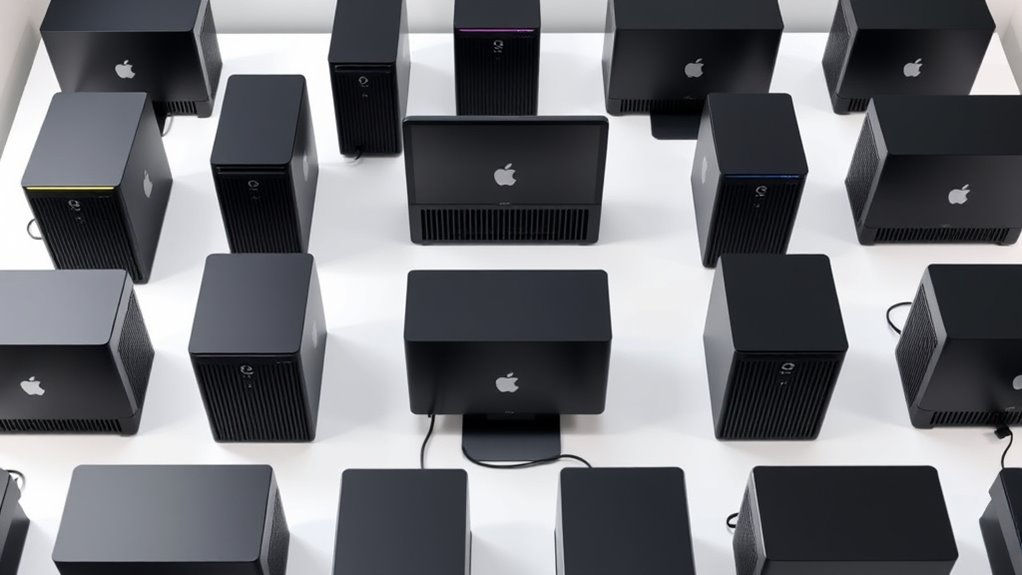

For buyers seeking renewed Mac Studio desktops, the 2022 M1 Ultra with 64GB memory is my best overall pick for demanding creative work, while the renewed M1 Max models suit lighter workloads and tighter storage needs. The M4 Max configurations offer a newer platform and up to 128GB of unified memory, with the 8TB model built for large local projects. Your main tradeoffs are chip generation, memory capacity, internal storage, and the condition and coverage attached to a renewed unit. A newer chip can help with demanding applications, while a larger memory pool or SSD may matter more to a particular workflow. Read on for how these six options compare and which one fits your work.

Get the latest gadgets delivered free — and shop member deals
- Fast, free delivery on millions of items
- Access to Prime Big Deal Days deals on October 6–7
- Prime Video, Amazon Music and more included
Complete the kit



Key Takeaways
- The M1 Ultra is the strongest renewed pick here for buyers who need substantial CPU and GPU resources plus 64GB of memory in one configuration.
- The M4 Max models lead on memory capacity with 128GB, making them better candidates for memory-heavy projects than the listed M1 systems.
- The two 2022 M1 Max options serve different storage needs: one has a 1TB SSD, while the other has 512GB and calls for more reliance on external drives.
- The 8TB M4 Max is a specialized premium choice for keeping large working libraries local; the 2TB version leaves more room for external storage.
- The M5 Max listing is underspecified compared with the detailed configurations, so buyers should verify memory, storage, ports, and included coverage before ranking it against the others.


| renewed mac studio desktop | Storage | Chip | Model | CPU |
|---|---|---|---|---|
| Apple 2022 Mac Studio with M1 | 1TB SSD | M1 Ultra | Apple Mac Studio (2022) | 20-core |
| Apple Mac Studio Desktop Compu | — | Apple M5 Max | — | — |
| Apple Mac Studio | 1TB SSD | — | Mac Studio (2022) | — |
| Apple Mac Studio | 8TB SSD | Apple M4 Max | — | 16-core |
| Apple Mac Studio with M4 Max | 2TB SSD | Apple M4 Max | — | 16-core |
| Apple Mac Studio | 512GB SSD | — | Apple Mac Studio (2022) | — |
More Details on Our Top Picks
Apple 2022 Mac Studio with M1 Ultra, 20-Core CPU, 48-Core GPU, 64GB Unified Memory, 1TB SSD (Renewed)
For buyers chasing maximum sustained performance per dollar, this renewed M1 Ultra configuration is the standout of the renewed lineup. The 20-core CPU and 48-core GPU still outpace the newer M4 Max and M5 Max chips in heavily multi-threaded rendering and video export work, because Ultra-class silicon doubles the core counts of its Max sibling. Compared with the renewed M1 Max model with 32GB of RAM, this machine’s 64GB of unified memory is the difference between comfortable 8K timeline scrubbing and constant cache pressure. The tradeoff is inherent to buying renewed: accessories may be non-original, the box may be generic, and Apple certification is absent, though the 90-day replacement window softens the risk. This pick makes the most sense for pros who want near-flagship throughput without the new-flagship outlay.
Pros:- M1 Ultra’s 20-core CPU and 48-core GPU still rival newer Max chips in multi-threaded pro workloads
- 64GB of unified memory handles 8K video and large 3D scenes comfortably
- 1TB SSD provides room for active project files without immediate external storage
- Professionally inspected, tested, and cleaned with 90-day replacement or refund eligibility
Cons:- Not Apple certified, and accessories may be non-original with generic packaging
- Older connectivity generation compared with Thunderbolt 5-equipped M4 Max and M5 Max models
Best for: Video editors and 3D artists who need workstation-class multi-core performance at a fraction of new retail pricing
Not ideal for: Buyers who want Thunderbolt 5, Wi-Fi 7, or the latest AI-accelerated features found on the M4 Max and M5 Max models
- Model:Apple Mac Studio (2022)
- Chip:M1 Ultra
- CPU:20-core
- GPU:48-core
- Unified Memory:64GB
- Storage:1TB SSD
- Condition:Renewed; professionally inspected, tested, and cleaned
- Return Eligibility:Replacement or refund within 90 days of receipt
Our verdict“The smartest renewed buy for working professionals who prioritize raw multi-core power over having the newest ports and wireless features.”
Apple Mac Studio Desktop Computer with M5 Max
This M5 Max configuration is the pick for buyers who care less about yesterday’s benchmarks and more about what the machine can grow into. With Thunderbolt 5, Wi-Fi 7, and Bluetooth 6, it outclasses every renewed option in this roundup on I/O — the M1 Ultra and M1 Max models are stuck a full generation behind on ports and wireless. Support for up to five external displays and up to 614GB/s of memory bandwidth makes this option better suited to on-device AI work and sprawling multi-monitor edit bays than anything pre-owned here. Compared with the M4 Max models, the M5 Max trades a small lead in forward-looking platform features for the fact that you’re buying new rather than renewed — no 90-day window anxiety, but no renewed discount either. The catch: it needs an external display, and top configurations can climb steeply in price.
Pros:- Thunderbolt 5, Wi-Fi 7, and Bluetooth 6 offer the most modern connectivity in this lineup
- Up to 128GB unified memory with up to 614GB/s bandwidth for AI and creative workloads
- Drives up to five external displays from a compact 5.94-pound enclosure
- Quiet thermal design suited to desk-adjacent studio environments
Cons:- Requires separate purchase of a display and peripherals
- Maximum memory and storage configurations may vary by availability, complicating planning
Best for: Tech-forward creatives and developers running on-device AI workflows who want the newest ports and wireless standards
Not ideal for: Budget-conscious buyers who could get comparable creative performance from the renewed M1 Ultra at a lower cost
- Chip:Apple M5 Max
- Maximum Unified Memory:128GB
- Memory Bandwidth:Up to 614GB/s
- Thunderbolt Ports:4 Thunderbolt 5
- Other Ports:2 USB-C, 2 USB-A, HDMI, SDXC card slot, headphone jack
- External Display Support:Up to 5 displays
- Wireless:Wi-Fi 7, Bluetooth 6
- Dimensions:7.76 x 7.76 x 3.74 inches
- Weight:5.94 pounds
Our verdict“The choice for buyers who want the newest platform features and connectivity rather than the deepest discount.”
Apple Mac Studio (2022) with M1 Max, 10-Core CPU, 24-Core GPU, 32GB RAM, 1TB SSD, Silver (Renewed)
This is the most accessible door into the Mac Studio ecosystem, and it earns its place by being the sensible floor of the lineup rather than the ceiling. The M1 Max with 10-core CPU and 24-core GPU still handles 4K editing, photography, and code compilation with headroom — it just won’t keep pace with the renewed M1 Ultra’s 48-core GPU on heavy rendering jobs. Where it beats the pricier options is practicality: 32GB of RAM and a 1TB SSD is the configuration most working professionals actually need, not the one they aspirationally configure. Compared with the M4 Max models with 128GB of memory, this machine is better suited to solo creators than teams running parallel VMs or massive sample libraries. The renewed caveats apply — non-original accessories, generic packaging, no Apple certification — but the 90-day return window covers the basics.
Pros:- M1 Max performance remains strong for 4K editing, photography, and development
- 32GB RAM and 1TB SSD is a practical, well-balanced configuration for solo professionals
- Professionally inspected, tested, and cleaned before resale
- 90-day replacement or refund eligibility reduces renewed-purchase risk
Cons:- 32GB of unified memory becomes a constraint for large 3D scenes or multi-VM workflows
- Pre-owned and not Apple certified; accessories and packaging may be non-original
Best for: Freelance editors, photographers, and developers who want Mac Studio performance without paying for cores they won’t use
Not ideal for: Professionals running 8K workflows or massive unified-memory workloads who should step up to the M1 Ultra or M4 Max models
- Model:Mac Studio (2022)
- Processor:Apple M1 Max, 10-core CPU
- Graphics:24-core GPU
- Memory:32GB
- Storage:1TB SSD
- Color:Silver
- Dimensions:10 x 7.7 x 3.7 inches
- Weight:5.9 pounds
- Condition:Renewed; professionally inspected, tested, and cleaned
Our verdict“The entry point that makes sense for solo creatives who need real Mac Studio capability at the lowest commitment level.”
Apple Mac Studio (M4 Max, 16-Core CPU / 40-Core GPU, 128GB Unified Memory, 8TB SSD)
This configuration exists for one buyer: the professional whose storage and memory ceilings are the project. The 8TB internal SSD is the headline — compared with the 2TB M4 Max model, it eliminates the external-drive shuffle entirely for VFX houses, film scorers, and 3D animators working with terabyte-scale asset libraries. Pair that with 128GB of unified memory and hardware-accelerated ray tracing, and this machine outclasses the renewed M1 Ultra on graphics features even where the Ultra’s extra cores still win some raw exports. The 7.7-inch enclosure slips under most displays while its thermal system stays quiet under sustained load — a genuine advantage over tower workstations in shared studios. But nothing here is upgradeable later, so buyers need to be certain of the spec before committing, and the premium tier reflects that inflexibility.
Pros:- 8TB internal SSD removes the need for external project storage entirely
- 128GB unified memory plus ray tracing and mesh shading handles extreme professional workloads
- Compact 7.7-inch enclosure fits under most displays
- Advanced thermal system stays quiet even under sustained heavy loads
Cons:- Premium tier pricing for the high-spec configuration
- No user-upgradable internal components — the spec you buy is permanent
Best for: VFX artists, film composers, and 3D animation studios with terabyte-scale libraries who want everything internal
Not ideal for: Buyers who don’t specifically need 8TB internal storage — the 2TB M4 Max delivers the same compute for less commitment
- Chip:Apple M4 Max
- CPU:16-core
- GPU:40-core
- Unified Memory:128GB
- Storage:8TB SSD
- Connectivity:Thunderbolt 5
- Enclosure:7.7-inch square
Our verdict“The no-compromise pick for studios whose asset libraries justify paying a premium to keep everything on one silent, compact machine.”
Apple Mac Studio with M4 Max, 16-Core CPU, 40-Core GPU, 128GB Unified Memory, and 2TB SSD
Sitting between the entry renewed models and the 8TB flagship, this M4 Max configuration is the sweet spot for serious professionals who don’t overbuy. You get the same 16-core CPU, 40-core GPU, and 128GB of unified memory as the premium 8TB model — meaning identical performance in rendering, AI work, and memory-hungry multitasking — but with a 2TB SSD that suits creators who already rely on external or NAS storage for archives. Against the renewed M1 Ultra, this option wins on Thunderbolt 5, hardware ray tracing, and the Neural Engine, making it the better machine for modern graphics and on-device AI pipelines even where raw core counts tie. The quiet cooling under load makes it livable on a desk rather than in a machine room. Just remember it’s a headless desktop: budget for a display and peripherals.
Pros:- Full M4 Max performance with 128GB unified memory matches the flagship model’s compute
- Thunderbolt 5 and hardware-accelerated graphics features support modern rendering and AI workflows
- 2TB SSD is ample for active projects without paying for unused archive capacity
- Cooling system stays quiet under demanding sustained loads
Cons:- Requires separate display and peripherals to be usable
- Fixed internal configuration with no post-purchase upgrades
Best for: Working professionals who need flagship memory and GPU capability but manage archives on external storage
Not ideal for: Studios needing all project data internal — the 8TB configuration is the better fit despite its premium tier
- Chip:Apple M4 Max
- CPU:16-core
- GPU:40-core
- Unified Memory:128GB
- Storage:2TB SSD
- Connectivity:Thunderbolt 5
- Enclosure:7.7-inch square
Our verdict“The rational flagship choice — identical compute to the top model, sized for professionals who store archives elsewhere.”
Apple Mac Studio (2022) with M1 Max, 10-Core CPU, 32GB RAM, 512GB SSD (Renewed)
The M1 Max Mac Studio pairs a 10-core CPU with 32GB of memory, giving creative professionals room for photo editing, music production, and multitasking without stepping up to an Ultra or newer Max configuration. Its 512GB SSD is the main constraint: compared with the renewed 2022 Mac Studio with M1 Max and 1TB SSD, this version leaves less room for large media libraries and active projects. The M1 Ultra model and the M4 Max systems offer more headroom for demanding graphics or heavier workloads, so I’d rank this one for buyers whose work fits comfortably within its storage and performance limits. It is professionally inspected, tested, and cleaned, with replacement or refund eligibility within 90 days. The renewed condition is not Apple certified, and included accessories may not be original.
Pros:- M1 Max 10-core CPU suits many creative and multitasking workloads
- 32GB of memory supports working across demanding apps
- Professionally inspected, tested, and cleaned
- Eligible for replacement or refund within 90 days of receipt
Cons:- 512GB SSD provides less working space than the renewed 1TB M1 Max alternative
- Renewed product is not Apple certified
- Included accessories may not be original
Best for: Editors, musicians, and photographers seeking a renewed desktop for moderate creative workloads who already use external storage.
Not ideal for: Video teams with large local project libraries or buyers running sustained, demanding graphics workloads who need the extra storage or capability of the M1 Ultra or M4 Max models.
- Model:Apple Mac Studio (2022)
- Processor:Apple M1 Max, 10-core CPU
- Memory:32GB
- Storage:512GB SSD
- Graphics:Integrated
- Operating system:macOS High Sierra
- Condition:Renewed
- Renewed coverage:Eligible for replacement or refund within 90 days of receipt
Our verdict“Choose this renewed M1 Max Mac Studio for capable everyday creative work if 512GB of internal storage is enough or you rely on external drives.”

How We Picked
I ranked these desktops around the decisions that change daily use: chip capability, unified memory, internal storage, and how clearly the listing identifies its configuration. The M1 Ultra earns the lead among the renewed models because its listed 20-core CPU, 48-core GPU, and 64GB memory form a capable package for heavier creative workloads. The M4 Max systems rank well for buyers who need more memory or local storage, though their higher-end configurations make most sense when those resources will be used. The M1 Max options sit lower for demanding work but remain credible choices for less intensive tasks, with the 1TB model ahead of the 512GB version for local project space.
I also treated renewed status as part of the purchase decision, rather than assuming every unit has the same history or support. The M5 Max could be a strong newer-chip option, but its listing does not specify enough configuration details to make a confident placement on performance or value. That uncertainty affects its ranking until a buyer confirms the exact memory, SSD, condition, and warranty terms. These recommendations compare the supplied configurations; actual renewed-unit condition and seller coverage should be checked on the specific listing.
| renewed mac studio desktop | Model | Chip | Condition |
|---|---|---|---|
| Apple 2022 Mac Studio with M1 | Apple Mac Studio (2022) | M1 Ultra | Renewed; professionally inspected, tested, and cleaned |
| Apple Mac Studio Desktop Compu | — | Apple M5 Max | — |
| Apple Mac Studio | Mac Studio (2022) | — | Renewed; professionally inspected, tested, and cleaned |
| Apple Mac Studio | — | Apple M4 Max | — |
| Apple Mac Studio with M4 Max | — | Apple M4 Max | — |
| Apple Mac Studio | Apple Mac Studio (2022) | — | Renewed |
Factors to Consider When Choosing Renewed Mac Studio Desktops
Choosing a Mac Studio is less about finding the biggest specification and more about avoiding a mismatch between your workload and the parts you cannot upgrade later. I would settle the memory and storage questions first, then compare chip generations and the renewed seller’s terms.
Match Memory to Your Heaviest Projects
Unified memory is shared across the CPU and GPU, so large images, complex timelines, and multiple demanding apps can all draw from the same pool. A common mistake is to choose a chip based on its name while overlooking how much memory the configuration includes. The 32GB and 64GB M1 listings sit at different workload thresholds, while the M4 Max options reach 128GB. More memory is useful when your projects regularly exceed a smaller system’s capacity, but it will not make every everyday task faster. Check the requirements of your main applications and the size of your typical projects before paying for extra capacity.
Treat Internal Storage as Working Space
An SSD holds applications, active projects, caches, and files you want immediately available; it is not the only way to archive work. If you handle large video or audio libraries, estimate the space used by active projects rather than relying on the advertised capacity alone. A 512GB drive can fill quickly once applications and scratch files accumulate, while 1TB or 2TB gives more room to work locally. The 8TB configuration is most compelling when frequent access to a large local library matters. External storage can lower the need for a large internal SSD, but it adds cables, backup planning, and another device to manage.
Compare Chip Generations Against Your Actual Work
A newer chip generation can bring useful performance improvements, but the product names alone do not tell you how large the gain will be in your apps. Rendering, effects, code compilation, and other sustained tasks benefit more from extra compute than basic office use does. For lighter workloads, an M1 Max may still be a sensible fit if the configuration and renewed condition suit the buyer. Buyers comparing the M5 Max listing should request its exact CPU and GPU configuration and memory before drawing conclusions. Look for benchmarks from the specific applications you use, since results vary by task.
Check the Renewed Unit’s Condition and Coverage
“Renewed” can describe units with different inspection processes, cosmetic grades, return windows, and warranty coverage. Read the seller’s definition of renewed and confirm whether the computer has been tested, what accessories are included, and how defects are handled. The device’s age and exterior condition do not reveal battery concerns in the same way they might for a laptop, but ports, fans, and storage still deserve attention. Keep the seller’s return period in mind when planning to inspect the machine and confirm its specifications on arrival. A well-documented unit can be a safer choice than a seemingly stronger configuration with vague condition details.
Plan for Ports, Displays, and Peripherals
A desktop purchase includes the surrounding setup, so check that the Studio’s ports and display support fit the monitors and storage devices you already own. If your workflow relies on fast external SSDs, audio interfaces, card readers, or several displays, map those connections before choosing a configuration. Hubs and docks can add connections, but they take desk space and may introduce compatibility or bandwidth limits. Think about where the computer will sit, too: a compact enclosure still needs room for airflow and accessible cables. This check can prevent a capable Mac from becoming an awkward fit for an established workspace.
Pay for Capacity You Will Use
The higher-capacity configurations are easiest to justify when a real workload calls for them: large local media libraries, memory-heavy scenes, or long periods between storage transfers. If those needs are occasional, external drives or a less expansive configuration may serve better. On the other hand, choosing too little memory can be harder to work around than adding external storage later. Make a list of what you cannot comfortably move to an external drive and what applications must stay open together. Use that list to decide which upgrade has a practical benefit instead of treating every maximum specification as necessary.
Frequently Asked Questions
Is the renewed M1 Ultra a better choice than an M4 Max for creative work?
It depends on the application and the kind of project. The listed M1 Ultra pairs a 20-core CPU and 48-core GPU with 64GB of memory, while the M4 Max configurations have 128GB and a newer chip generation. Memory-heavy work may favor the M4 Max, whereas the M1 Ultra can appeal to buyers whose applications benefit from its listed CPU and GPU resources. Compare benchmarks for your specific software and check the exact renewed-unit condition before choosing.
Is 32GB of unified memory enough for a renewed Mac Studio?
It can be enough for general use, development, and creative projects that stay within moderate memory demands. Large video timelines, complex 3D scenes, and several demanding applications open together can make 32GB feel limiting. The 64GB M1 Ultra provides more headroom, and the listed M4 Max models go further at 128GB. Consider your heaviest regular workload, since memory capacity is a more consequential choice than an accessory you can replace later.
Should I choose the 512GB M1 Max or the 1TB M1 Max?
Choose based on how much active work you want stored inside the computer. The 512GB version can suit a workflow that keeps media and archives on external drives, but applications, caches, and current projects all compete for that space. The 1TB model provides more working room and reduces how often you need to move files. If you use external storage, include its cost, speed, backup needs, and desk footprint in the decision.
What should I verify before buying the Mac Studio with M5 Max?
The listing provided does not state its memory or SSD capacity, so ask for the exact configuration before comparing it with the other systems. Confirm CPU and GPU details, storage, cosmetic condition, included accessories, return terms, and warranty coverage. Check that the model and serial details match the seller’s description when available. Without those answers, its newer chip label alone cannot tell you whether it fits your workload or offers the right balance of capacity.
When does the 8TB M4 Max make more sense than the 2TB model?
The 8TB configuration is most useful when large active libraries need to stay on the internal drive for fast access and simpler project management. If most footage, archives, or finished work can live on external storage, the 2TB model may leave enough space for applications and current projects. External drives also create extra steps for backups and portability, while very large internal storage reduces those demands. Estimate your current project sizes and likely growth before deciding whether the extra local capacity will see regular use.
Conclusion
For most buyers seeking a renewed desktop in this lineup, I recommend the M1 Ultra as best overall for demanding work, with the 1TB M1 Max as best value for lighter workloads that do not need extensive memory. The M4 Max with 128GB and 2TB is my premium pick for buyers who need both substantial memory and a newer platform; choose the 8TB version when large local libraries are central to the work. Beginners with everyday creative needs can start with the renewed M1 Max, provided its memory and storage match their plans. For projects that regularly outgrow 64GB or require a large local workspace, focus on the M4 Max configurations, and verify the M5 Max listing’s full specifications before treating it as a contender.
Fall Picks
fall essentials
As an affiliate, we earn on qualifying purchases.