

Get the latest gadgets delivered free with Prime
- Fast, free delivery on millions of items
- Prime Video, Amazon Music and more included
- Member-only deals all year
Complete the kit



Key Takeaways
- The top-ranked motherboards combine PCIe 5.0 and DDR5 support for future-proofing high-end gaming rigs.
- Connectivity features like Wi-Fi 7 and USB 4.0 are common among the premium picks, but not all models include both.
- Price varies significantly, with some high-end options offering more advanced features at a premium cost, while others balance performance and affordability.
- Power delivery and VRM quality are key for overclocking and stability, especially on AMD Ryzen 7000/8000 series processors.
- Form factor impacts compatibility; ATX models dominate, but some compact designs might suit specific builds.
| ASUS ROG Strix X870-A Gaming WiFi AMD AM5 X870 ATX Motherboard |  | Best Overall for Cutting-Edge Gaming Performance | Socket: AMD AM5 | Chipset: AMD X870 | Form Factor: ATX | VIEW ON AMAZON | See Our Full Breakdown |
| ASUS ROG Strix B850-F Gaming WiFi AMD Motherboard |  | Best Value for High-Performance AMD Gaming | Socket: AMD AM5 | Chipset: AMD B850 | Form Factor: ATX | VIEW ON AMAZON | See Our Full Breakdown |
| MSI MAG B850 Tomahawk MAX WiFi Motherboard |  | Best for Mid-Range High-Performance Gaming | Socket: AM5 | Supported Processors: AMD Ryzen 9000/8000/7000 | Memory Support: DDR5, overclocking up to 8400+ MT/s | VIEW ON AMAZON | See Our Full Breakdown |
| ASUS ROG Strix B850-F Gaming WiFi ATX Motherboard | 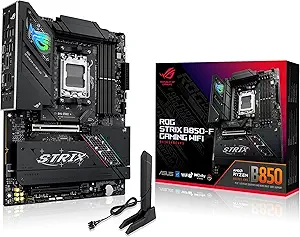 | Best for AI-Enhanced Gaming and Reliable Connectivity | Socket: AMD AM5 | Chipset: AMD B850 | Form Factor: ATX | VIEW ON AMAZON | See Our Full Breakdown |
| MSI MPG X870E Carbon WiFi Gaming Motherboard |  | Best for Customization and High-End Gaming | Socket: Socket AM5 | Chipset Family: AMD X870 | Memory Support: DDR5, up to 7800 MHz | VIEW ON AMAZON | See Our Full Breakdown |
| ASUS ROG Strix X870E-E Gaming WiFi ATX Motherboard (AMD AM5, DDR5, WiFi 7, PCIe 5.0, USB4) |  | Best Overall for High-End Gaming and Overclocking | Socket: AMD AM5 | Form Factor: ATX | Power Stages: 18+2+2 (110A per stage) | VIEW ON AMAZON | See Our Full Breakdown |
| ASUS ROG Strix X670E-F Gaming WiFi AMD X670 AM5 ATX Motherboard |  | Best for Future-Ready Gaming with Balanced Features | Socket: AM5 | Chipset: AMD X670 | Form Factor: ATX | VIEW ON AMAZON | See Our Full Breakdown |
| ASUS ROG Strix B550-F Gaming WiFi II AMD AM4 ATX Motherboard |  | Best for Budget-Conscious Gamers with Upgradable Legacy Platform | Socket: AMD AM4 | Form Factor: ATX | Memory Support: DDR4 | VIEW ON AMAZON | See Our Full Breakdown |
| GIGABYTE X870E AORUS Elite X3D AMD AM5 ATX Motherboard |  | Best for High-End Gaming and Overclocking with Advanced Connectivity | Socket: AMD AM5 | Chipset: AMD X870E | Form Factor: ATX | VIEW ON AMAZON | See Our Full Breakdown |
| premium amd motherboards for gaming | Socket | Form Factor | Memory Support | Chipset |
|---|---|---|---|---|
| ASUS ROG Strix X870-A Gaming W | AMD AM5 | ATX | — | AMD X870 |
| ASUS ROG Strix B850-F Gaming W | AMD AM5 | ATX | — | AMD B850 |
| MSI MAG B850 Tomahawk MAX WiFi | AM5 | — | DDR5, overclocking up to 8400+ MT/s | — |
| ASUS ROG Strix B850-F Gaming W | AMD AM5 | ATX | — | AMD B850 |
| MSI MPG X870E Carbon WiFi Gami | Socket AM5 | — | DDR5, up to 7800 MHz | — |
| ASUS ROG Strix X870E-E Gaming | AMD AM5 | ATX | DDR5 with AEMP | — |
| ASUS ROG Strix X670E-F Gaming | AM5 | ATX | DDR5 | AMD X670 |
| ASUS ROG Strix B550-F Gaming W | AMD AM4 | ATX | DDR4 | — |
| GIGABYTE X870E AORUS Elite X3D | AMD AM5 | ATX | DDR5, AMD EXPO | AMD X870E |
More Details on Our Top Picks
ASUS ROG Strix X870-A Gaming WiFi AMD AM5 X870 ATX Motherboard
This motherboard stands out for its exceptional power delivery system, featuring a 16+2+2 phase setup rated at 90A per stage, making it ideal for overclocking high-core AMD Ryzen processors. Its support for PCIe 5.0, DDR5 with AEMP, and WiFi 7 ensures it is future-proof for demanding gaming and productivity tasks. Compared to the ASUS ROG Strix B850-F, this model offers more advanced connectivity and tuning features, but it comes with a higher price point and overkill features for mainstream gamers on a budget. The AI Overclocking and AI Cooling II simplify performance tuning, appealing to enthusiasts who want high-end customization without extensive manual setup. However, it requires a compatible Ryzen CPU and might be excessive for users who don’t plan to push their hardware extensively.
Pros:- Exceptional 16+2+2 power delivery supports overclocking high-core Ryzen CPUs
- Supports PCIe 5.0, DDR5 with AEMP, and WiFi 7 for maximum modern connectivity
- AI Overclocking and AI Cooling II for simplified tuning and thermal management
- Four M.2 slots with Q-Release for easy GPU removal
Cons:- Premium features may be unnecessary for standard gaming builds
- Requires a compatible AMD Ryzen CPU, adding to overall cost
- Higher price compared to more modest boards, which may not suit all budgets
Best for: High-end enthusiasts and overclockers seeking maximum performance and future-proof features
Not ideal for: Casual gamers or budget builders who don’t need advanced AI tuning or extensive overclocking capabilities
- Socket:AMD AM5
- Chipset:AMD X870
- Form Factor:ATX
- Power Stages:16+2+2 (90A per stage)
- Memory:DDR5 with AEMP
- Wireless:WiFi 7
Our verdict“This board is best suited for gamers and enthusiasts who want the latest tech and maximum overclocking headroom.”
ASUS ROG Strix B850-F Gaming WiFi AMD Motherboard
This motherboard offers a compelling balance between features and price, supporting AMD Ryzen 9000, 8000, and 7000 series processors with a 16+2+2 power setup rated at 80A per stage. Its support for DDR5 memory up to 192GB at 8000 MHz, PCIe 5.0, and four M.2 slots makes it suitable for gamers who want high-speed storage and future-proof connectivity without the premium price tag of X870 boards like the ASUS ROG Strix X870-A. Unlike the MSI MAG B850 Tomahawk MAX, this model adds WiFi 7 and more USB ports, but it offers fewer SATA ports, which could limit traditional storage options. The B850 chipset’s features are slightly less advanced than the X870’s, but it still provides excellent value for high-performance gaming builds that don’t require the absolute latest in overclocking or multi-GPU setups.
Pros:- Supports latest Ryzen processors with a robust 16+2+2 power design
- High-frequency DDR5 support up to 8000 MHz and 192GB capacity
- Includes WiFi 7, 2.5 Gb Ethernet, and extensive USB port selection
- Four M.2 slots and PCIe 5.0 for fast storage and graphics
Cons:- Limited to two SATA ports, restricting legacy drive expansion
- Less feature-rich than higher-end X870 models, like ASUS ROG Strix X870-A
- Mid-range chipset may lack some advanced overclocking options
Best for: Gamers who want high-end features without paying premium for top-tier overclocking or multi-GPU support
Not ideal for: Users needing extensive SATA storage or budget-conscious builders seeking lower-cost options
- Socket:AMD AM5
- Chipset:AMD B850
- Form Factor:ATX
- Power Stages:16+2+2 (80A per stage)
- Memory:DDR5, up to 192 GB
- Wireless:WiFi 7
Our verdict“Ideal for gamers who want a feature-rich motherboard at a more accessible price point without sacrificing future-proof connectivity.”
MSI MAG B850 Tomahawk MAX WiFi Motherboard
This motherboard is tailored for gamers wanting strong overclocking capabilities and high-speed storage, supporting AMD Ryzen 9000, 8000, and 7000 series with a 14 Duet Rail VRM rated at 80A. Its overclocking support for DDR5 up to 8400+ MT/s and four M.2 slots, including Gen5 options, make it a flexible choice for demanding gaming setups. Unlike ASUS B850-F, the MSI Tomahawk MAX emphasizes cooling features with extended heatsinks and thermal pads, which benefit overclocked systems. However, it has a more modest power delivery system compared to the ASUS X870-A, limiting maximum overclocking potential. Its straightforward design makes it suitable for gamers seeking a reliable platform with room for future upgrades, but it may not appeal to extreme overclockers seeking the highest power stages.
Pros:- Supports latest AMD Ryzen processors with DDR5 overclocking up to 8400+ MT/s
- Four M.2 slots including Gen5 support, with thermal shielding
- Good cooling features with extended heatsinks and heat pipes
- Wi-Fi 7 and 5G LAN for advanced connectivity
Cons:- 14 Duet Rail VRM limits maximum overclocking compared to higher power stage boards
- Limited to AMD Ryzen processors, no compatibility with Intel CPUs
- No multi-GPU support, focusing on single GPU setups
Best for: Mid-range gamers who want solid overclocking and storage options without the premium price of top-tier boards
Not ideal for: Extreme overclockers or users requiring maximum power delivery and multi-GPU setups
- Socket:AM5
- Supported Processors:AMD Ryzen 9000/8000/7000
- Memory Support:DDR5, overclocking up to 8400+ MT/s
- VRM:14 Duet Rail
- Storage:4 M.2 slots (2 Gen5)
- Wireless:WiFi 7
Our verdict“A strong choice for gamers wanting reliable overclocking and extensive storage at a reasonable price point.”
ASUS ROG Strix B850-F Gaming WiFi ATX Motherboard
This board offers a balanced mix of power delivery and connectivity tailored for AMD Ryzen 7000, 8000, and 9000 series processors, with a 16+2+2 power setup rated at 80A. It emphasizes AI features, including AI Advisor and AI Networking II, which assist in tuning system performance, making it an appealing choice for gamers who value smart features. Its four M.2 slots, PCIe 5.0, and WiFi 7 deliver high-speed storage and seamless connectivity, but with only 2 SATA ports, traditional storage expansion is limited compared to higher-end models. Unlike the ASUS ROG Strix X870-A, this board may lack some advanced overclocking tools but compensates with AI-driven setup assistance, ideal for users prioritizing ease of use over maximum manual control.
Pros:- Supports latest Ryzen processors with robust 16+2+2 power delivery
- AI features like AI Advisor and AI Networking II simplify setup and optimization
- Includes PCIe 5.0, WiFi 7, and four M.2 slots for fast storage
- Good balance of connectivity and ease of use
Cons:- Limited SATA ports restrict traditional drive options
- Lacks advanced manual overclocking features of higher-end boards
- Single HDMI port and no DisplayPort may limit multi-display options
Best for: Gamers looking for a reliable, AI-enhanced motherboard for high-performance AMD builds with straightforward setup
Not ideal for: Overclocking enthusiasts seeking maximum manual control and multi-GPU configurations
- Socket:AMD AM5
- Chipset:AMD B850
- Form Factor:ATX
- Power Stages:16+2+2 (80A per stage)
- Memory:DDR5, up to 192 GB
- Wireless:WiFi 7
Our verdict“A smart choice for gamers who want AI-assisted setup and dependable connectivity in a high-performance AMD motherboard.”
MSI MPG X870E Carbon WiFi Gaming Motherboard
This motherboard supports AMD Ryzen 9000/8000/7000 processors with a focus on high performance and personalization. Its AMD X870 chipset, combined with PCIe 5.0, DDR5 support overclocked up to 7800 MHz, and four M.2 Gen5 slots, makes it a versatile choice for gamers who want top-tier connectivity. The extensive RGB lighting and advanced thermal design with heat pipes and heatsinks cater to high-performance builds, but its power delivery system, rated at 80A with a 14 Duet Rail VRM, may limit maximum overclocking compared to the ASUS X870-A. It’s best suited for users who want a feature-rich motherboard with room for customization and don’t need the absolute highest overclocking margins. Its more accessible price compared to ultra-premium X870 boards is a plus, but it might not satisfy the most extreme overclockers.
Pros:- Supports AMD Ryzen 9000/8000/7000 processors with DDR5 overclocking
- Multiple Gen5 M.2 slots with thermal shielding for fast storage
- Includes extensive RGB lighting and advanced thermal design
- PCIe 5.0 and WiFi 7 for future-proof connectivity
Cons:- Limited to 80A VRM, which may restrict maximum overclocking
- No multi-GPU support, focusing on single GPU configurations
- Relatively complex BIOS setup for optimal tuning
Best for: Gamers and builders seeking a customizable high-performance platform with strong connectivity
Not ideal for: Extreme overclockers or those needing multi-GPU support at the highest possible power levels
- Socket:Socket AM5
- Chipset Family:AMD X870
- Memory Support:DDR5, up to 7800 MHz
- Storage:4 x M.2 Gen5
- Supported Processors:AMD Ryzen 9000/8000/7000
- Wireless:WiFi 7
Our verdict“Perfect for gamers who want a highly customizable motherboard with excellent connectivity and aesthetics without extreme overclocking demands.”
ASUS ROG Strix X870E-E Gaming WiFi ATX Motherboard (AMD AM5, DDR5, WiFi 7, PCIe 5.0, USB4)
This motherboard stands out for its robust 18+2+2 power delivery, supporting multi-core Ryzen processors with ease, making it ideal for overclockers and enthusiasts. Its extensive connectivity—WiFi 7, 5Gb Ethernet, dual USB4 ports, and five M.2 slots—outshines many competitors like the ASUS X670E-F, especially in networking and storage. The thermal design, featuring large heatsinks and heat pipes, ensures stable operation under heavy loads, but this premium build comes with a higher price tag and requires a spacious case. This makes it less suitable for budget-conscious gamers or those with small cases. Overall, this pick is perfect for users wanting a future-proof, feature-rich platform with overclocking headroom, but it might be overkill for casual gaming setups.
Pros:- Exceptional 18+2+2 power stages support heavy overclocking and multi-core CPUs
- Extensive connectivity including WiFi 7, dual USB4, and five M.2 slots
- Advanced thermal design with large heatsinks and heat pipes
- DIY-friendly features like pre-mounted I/O shield and M.2 Q-Latch
Cons:- Premium features significantly increase the cost over mid-range options
- Large ATX form factor demands bigger cases and more space
- AI-powered overclocking features may overwhelm casual builders
Best for: High-end gamers and overclockers seeking maximum performance, connectivity, and stability.
Not ideal for: Budget builders or those with small cases who prefer simpler, more affordable motherboards.
- Socket:AMD AM5
- Form Factor:ATX
- Power Stages:18+2+2 (110A per stage)
- Memory Support:DDR5 with AEMP
- M.2 Slots:3x PCIe 5.0, 2x PCIe 4.0
- Networking:WiFi 7 (802.11be), 5Gb Ethernet
Our verdict“This motherboard is best suited for enthusiasts who demand top-tier features and overclocking capabilities, despite its higher price and size.”
ASUS ROG Strix X670E-F Gaming WiFi AMD X670 AM5 ATX Motherboard
Compared with the premium ASUS X870E-E, the X670E-F offers a solid mix of performance and value, supporting AMD Ryzen 9000, 8000, and 7000 series CPUs with a reliable 18+2 power stage design. Its four M.2 slots with heatsinks, PCIe 5.0, and WiFi 6E ensure modern connectivity, yet it remains more affordable and accessible for most gaming setups. The BIOS may require updates for Ryzen 9000 and 8000 chips, which could be a minor inconvenience for some builders. While it lacks the WiFi 7 and extensive I/O of the X870E-E, it still supports overclocking and high-speed storage, making it a smart choice for gamers who want a future-proof platform without the highest cost. This motherboard is better suited for gamers who want strong performance with a more moderate price point, but it may not satisfy users needing the absolute latest in WiFi or multiple M.2 PCIe 5.0 slots.
Pros:- Reliable 18+2 power stages support overclocking and multi-core CPUs
- Good connectivity with PCIe 5.0, four M.2 slots, and WiFi 6E
- VRM heatsinks and heatpipe for thermal stability
- BIOS update support for newer Ryzen CPUs
Cons:- Potential BIOS update requirement for latest Ryzen processors
- Fewer advanced features compared to the X870E-E
- Less future-proof with WiFi 6E instead of WiFi 7
Best for: Gamers looking for a future-proof, feature-rich motherboard that balances performance and cost.
Not ideal for: Users requiring the absolute fastest networking or multiple PCIe 5.0 M.2 slots for extensive storage arrays.
- Socket:AM5
- Chipset:AMD X670
- Form Factor:ATX
- Power Stages:18+2
- Memory Support:DDR5
- USB:USB 3.2 Gen 2×2
Our verdict“Ideal for gamers who want a durable, future-ready platform that balances features and price, but without the latest WiFi 7 or multiple PCIe 5.0 M.2 slots.”
ASUS ROG Strix B550-F Gaming WiFi II AMD AM4 ATX Motherboard
This motherboard is a practical pick for gamers on a budget who still want solid features, supporting AMD Ryzen 3000 and 5000 series processors on the AM4 socket. Its PCIe 4.0 support and dual M.2 slots make it suitable for modern gaming, while WiFi 6E and 2.5Gb Ethernet deliver reliable networking. The 12+2 power stage is less robust than its high-end counterparts like the X870E or X670E boards, meaning overclocking is more limited, especially with higher-tier CPUs. It also only supports DDR4 memory, which can be a drawback compared to DDR5 options. Still, the BIOS Flashback feature simplifies updates, making it accessible for less experienced builders. This board is a strong choice for gamers who want a capable, upgradeable platform without paying for premium features they won’t use.
Pros:- Supports AMD Ryzen 3000/5000 series processors
- Dual M.2 slots with PCIe 4.0 support
- Reliable WiFi 6E and 2.5Gb Ethernet
- BIOS Flashback for easy updates
Cons:- Limited future CPU upgrade path due to AM4 socket
- DDR4 memory support only, missing DDR5 compatibility
- Less robust power delivery for overclocking
Best for: Budget-conscious gamers seeking a capable platform with room to upgrade within the AM4 ecosystem.
Not ideal for: Enthusiasts wanting the latest DDR5 support or future-proofing for upcoming CPUs.
- Socket:AMD AM4
- Form Factor:ATX
- Memory Support:DDR4
- PCIe:PCIe 4.0
- Networking:WiFi 6E, 2.5Gb Ethernet
Our verdict“Best suited for gamers wanting a dependable, affordable motherboard that can handle current AMD CPUs and basic overclocking, but not future-proofed for upcoming platforms.”
GIGABYTE X870E AORUS Elite X3D AMD AM5 ATX Motherboard
The GIGABYTE X870E AORUS Elite X3D stands out for its digital twin 16+2+2 power phases, supporting high-end Ryzen CPUs with excellent stability. Its four M.2 slots, including two PCIe 5.0, and PCIe 5.0 x16 slot make it highly suitable for gaming PCs that demand fast storage and expansion. WiFi 7 and 5GbE networking ensure cutting-edge connectivity, and the 8-layer PCB with AMD EXPO memory support adds to its durability and performance. Compared to ASUS’s X870E-E, this board offers similar high-end features but with a focus on durability and detailed design. The tradeoff is a higher complexity and cost, making it less appealing for casual builders or those on a tight budget. It’s best for gamers who want top-tier performance and future-proofing, especially in multi-GPU or extensive storage setups.
Pros:- Digital twin 16+2+2 power phases for stable overclocking
- Supports DDR5 with AMD EXPO, up to 5200 MHz
- Dual PCIe 5.0 M.2 slots and PCIe 5.0 x16 slot
- WiFi 7 and 5 GbE networking for cutting-edge connectivity
Cons:- Higher price point may be prohibitive for some users
- Requires newer AM5 CPUs and DDR5 memory, increasing total build cost
- More complex setup compared to entry-level boards
Best for: Gaming enthusiasts and overclockers aiming for maximum performance, stability, and future expandability.
Not ideal for: Budget gamers or those with limited space and simpler needs, as it carries a higher cost and complexity.
- Socket:AMD AM5
- Chipset:AMD X870E
- Form Factor:ATX
- Power Phase:16+2+2 Digital Twin
- Memory Support:DDR5, AMD EXPO
- Networking:WiFi 7, 5 GbE
Our verdict“This motherboard is best for gamers wanting maximum future-proofing and expandability, despite its higher cost and complexity.”
How We Picked
These motherboards were selected based on their performance capabilities, feature set, and build quality relevant to gaming. Priority was given to models supporting the latest AMD Ryzen processors, with a focus on PCIe 5.0, DDR5 RAM, and advanced networking features like Wi-Fi 7. We also considered user reviews for reliability and ease of use, ensuring each option offers a balance of high-end features and value. The ranking reflects how well each motherboard supports high-performance gaming while factoring in price, future-proofing, and brand reputation. Ultimately, these selections aim to guide gamers toward motherboards that deliver both top-tier performance and dependable longevity.| premium amd motherboards for gaming | Socket | Chipset | Memory Support |
|---|---|---|---|
| ASUS ROG Strix X870-A Gaming W | AMD AM5 | AMD X870 | — |
| ASUS ROG Strix B850-F Gaming W | AMD AM5 | AMD B850 | — |
| MSI MAG B850 Tomahawk MAX WiFi | AM5 | — | DDR5, overclocking up to 8400+ MT/s |
| ASUS ROG Strix B850-F Gaming W | AMD AM5 | AMD B850 | — |
| MSI MPG X870E Carbon WiFi Gami | Socket AM5 | — | DDR5, up to 7800 MHz |
| ASUS ROG Strix X870E-E Gaming | AMD AM5 | — | DDR5 with AEMP |
| ASUS ROG Strix X670E-F Gaming | AM5 | AMD X670 | DDR5 |
| ASUS ROG Strix B550-F Gaming W | AMD AM4 | — | DDR4 |
| GIGABYTE X870E AORUS Elite X3D | AMD AM5 | AMD X870E | DDR5, AMD EXPO |
Factors to Consider When Choosing Premium Amd Motherboards For Gaming
Choosing a premium AMD motherboard for gaming involves balancing several factors. While high-end features are appealing, understanding what truly impacts gaming performance and system stability helps avoid overspending on unnecessary specs. Focusing on core elements like CPU compatibility, power delivery, and connectivity ensures your build is not only powerful but also reliable. Consider your specific gaming needs and future upgrade plans to select a motherboard that aligns with both current and upcoming hardware. The following sections highlight key considerations beyond just the specs, helping you make a smarter investment.Compatibility and CPU Support
Ensuring the motherboard supports your specific AMD Ryzen processor is vital. AMD’s AM5 socket supports Ryzen 7000 and 8000 series, while AM4 boards are limited to earlier generations. Compatibility affects CPU features, socket longevity, and upgrade paths. Investing in a board with the latest socket and chipset offers better future-proofing, but it might come at a higher price. Be aware that some motherboards support multiple generations, but this often depends on BIOS updates and specific features.Power Delivery and Overclocking
High-quality VRMs and robust power delivery are essential for stable performance, especially if you plan to overclock. Premium gaming motherboards typically feature enhanced VRM cooling and more phases, which improve stability under load. Overclocking can boost frame rates but increases strain on the CPU and motherboard. A motherboard with poor VRMs may limit your overclocking potential or lead to system instability, so investing in a model with solid power components is wise for high-end gaming setups.Connectivity and Expansion
Fast connectivity options like PCIe 5.0, DDR5 RAM, Wi-Fi 7, and USB 4.0 are hallmarks of premium motherboards. These features ensure your system stays compatible with the latest peripherals and storage devices, providing reduced bottlenecks. Consider your specific needs—if high-speed networking or multiple M.2 slots matter, choose accordingly. Be aware that more features often mean a higher price, so prioritize based on your intended use and future expansion plans.Form Factor and Compatibility
Most premium gaming motherboards come in ATX size, which fits most cases and offers more expansion slots. However, smaller form factors like microATX or mini-ITX might appeal for space-saving builds but often come with fewer features. Always check your case compatibility and whether the motherboard’s size aligns with your build plans. Compact models can be limiting if you need extensive PCIe or RAM slots, but they can still deliver high performance in smaller footprints.Price and Value Considerations
Premium motherboards vary greatly in price, often reflecting the range of features and build quality. While it might be tempting to buy the most feature-rich model, ensure you’re not paying for extras you won’t use. Conversely, opting for a less expensive model might save money but could limit future upgrade options or overclocking potential. Balance your budget against your performance needs, and remember that investing in a reliable motherboard can extend the lifespan of your entire gaming system.Frequently Asked Questions
Is PCIe 5.0 necessary for gaming right now?
Currently, PCIe 5.0 is not essential for gaming, as most games and GPUs do not yet fully utilize its bandwidth. However, supporting PCIe 5.0 future-proofs your system, allowing for faster SSDs and next-gen graphics cards that will leverage this technology. If you plan to keep your setup for several years and want the latest features, investing in a PCIe 5.0-compatible motherboard makes sense. Otherwise, PCIe 4.0 remains sufficient for most gaming needs today.How important is Wi-Fi 7 in a gaming motherboard?
Wi-Fi 7 offers higher speeds and lower latency compared to previous standards, which can benefit online gaming and streaming. For gamers who rely on wireless connections, choosing a motherboard with Wi-Fi 7 ensures your network remains fast and stable as your internet needs grow. However, if you primarily use wired connections, Wi-Fi features may be less critical. Consider your specific setup and whether you want the convenience of wireless connectivity or prioritize maximum stability through Ethernet.Should I prioritize overclocking features when choosing a motherboard?
If you plan to overclock your CPU to maximize gaming performance, select a motherboard with strong VRMs and good cooling solutions. High-quality power delivery directly impacts overclocking stability and longevity. However, if you’re not interested in overclocking, these features may be less relevant, and you can focus on other aspects like connectivity and price. Overclocking can boost performance but also introduces additional heat and power demands, so only pursue it if you’re comfortable managing those factors.Are premium motherboards worth the extra cost over mid-range options?
Premium motherboards typically offer better VRMs, more extensive connectivity, and longer-lasting build quality, which can translate into higher stability and future-proofing. For gamers who want the best performance and plan to upgrade components later, the investment often pays off. However, if your gaming needs are modest or your budget is tight, mid-range boards can deliver excellent value without sacrificing core features. The decision depends on how much you value longevity and advanced features.What should I consider if I want a compact gaming build?
For smaller builds, choosing a microATX or mini-ITX motherboard reduces space but often limits expansion options. Many premium features, like multiple PCIe slots and large heatsinks, are less common in smaller sizes. Ensure your case supports your chosen motherboard size and check if the features you need are available in that form factor. Compact boards may require compromises but can still deliver high performance if selected carefully.Conclusion
For gamers seeking the best overall experience, the ASUS ROG Strix X870-A Gaming WiFi offers outstanding performance and future-proof features. Those on a budget who still want high-end capabilities should consider the MSI MAG B850 Tomahawk MAX WiFi for excellent value. For enthusiasts aiming for maximum overclocking potential and the latest tech, the GIGABYTE X870E AORUS Elite X3D makes a compelling choice. Beginners or those with space constraints might find the ASUS ROG Strix B550-F Gaming WiFi II suitable, despite its slightly older platform. Ultimately, your choice depends on your performance needs, upgrade plans, and budget constraints.Halloween Picks
halloween
As an affiliate, we earn on qualifying purchases.