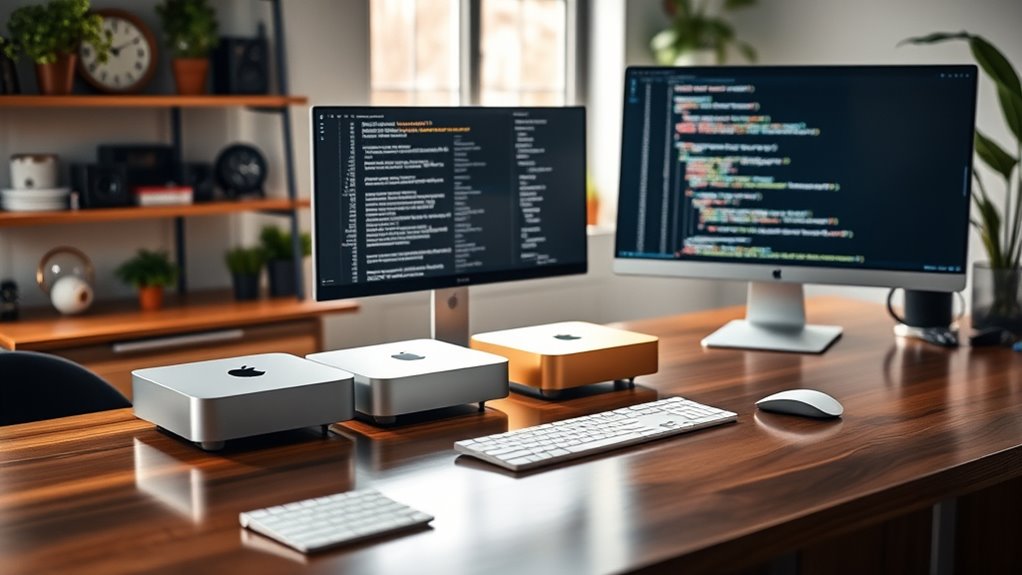

If you’re choosing the best Mac mini for software development in 2025, I recommend considering the M4 or M4 Pro models depending on your workload. The M4 offers a solid balance of performance and affordability, while the M4 Pro is perfect for demanding tasks and multitasking with higher RAM and GPU cores. Both models support extensive connectivity and multiple displays, ensuring future-proofing. Keep exploring further to find the perfect fit for your development needs.
Key Takeaways
- The M4 Pro Mac mini offers the highest performance with up to 12-core CPU and 20-core GPU, ideal for demanding development tasks.
- Standard M4 Mac mini provides a balanced setup with 16GB RAM and 512GB SSD, suitable for most developers.
- M4-based models support multiple high-resolution displays and extensive connectivity, enhancing multitasking and workflow.
- Upgrading internal storage isn’t possible post-purchase; initial configuration and external solutions are key for scalability.
- Future-proofing depends on selecting models with sufficient RAM, storage, and ports to adapt to evolving development needs.
Apple 2024 Mac mini Desktop Computer with M4 Chip
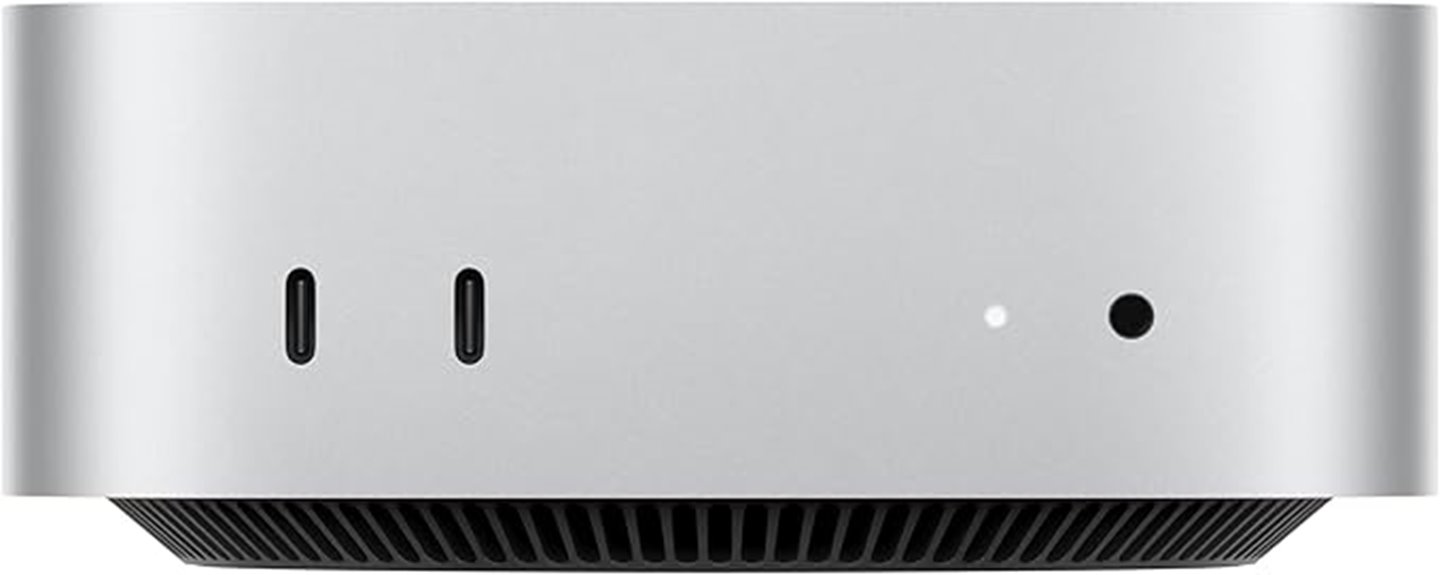
If you’re looking for a compact yet powerful desktop for software development, the Apple 2024 Mac mini with M4 chip is an excellent choice. Its five-by-five-inch size makes it incredibly space-efficient, fitting easily into any workspace. Despite its small footprint, it delivers high performance with a 10-core CPU, a 10-core GPU, and a 16-core Neural Engine, handling intensive tasks effortlessly. With 16GB of unified memory (expandable) and fast SSD storage, it supports smooth multitasking and quick data access. The Mac mini also offers extensive connectivity, supporting multiple displays and fast wireless options, making it a versatile, reliable, and sleek solution for developers.
Best For: software developers and tech enthusiasts seeking a compact, high-performance desktop with versatile connectivity and seamless integration into the Apple ecosystem.
Pros:
- Compact size fits easily in any workspace without sacrificing power
- Powerful M4 chip with a 10-core CPU and GPU handles demanding tasks effortlessly
- Extensive connectivity options support multiple displays and fast wireless connections
Cons:
- Limited internal storage may require external solutions for large projects
- Upgradable RAM is not available after purchase, so initial configuration is critical
- Slightly higher price point compared to other mini desktops with similar specs
Apple 2024 Mac mini Desktop Computer with M4 Pro chip

The Apple 2024 Mac mini with the M4 Pro chip stands out as an ideal choice for software developers who need powerful performance in a compact form factor. Its small size—just 5 by 5 inches—packs a 12-core CPU, up to 20-core GPU, and 64GB of RAM, delivering lightning-fast processing and graphics. The M4 Pro’s hardware-accelerated media engine supports demanding media workflows, while multiple Thunderbolt 5 ports enable connection to multiple 6K or 8K displays. With seamless integration into the Apple ecosystem and macOS optimization, this Mac mini offers a perfect balance of performance, versatility, and space-saving design for developers.
Best For: software developers and creative professionals seeking a compact yet powerful desktop with extensive connectivity and high-performance capabilities.
Pros:
- Compact size with a powerful M4 Pro chip delivering high-speed performance
- Supports up to three 6K or 8K displays via Thunderbolt 5 and HDMI
- Seamless integration with macOS and Apple ecosystem for enhanced productivity
Cons:
- Limited upgradeability due to its compact, integrated design
- Higher cost for top-tier configurations with maximum RAM and storage
- No dedicated GPU options beyond the built-in 16-core or up to 20-core GPU in the M4 Pro
Apple 2024 Mac mini Desktop Computer with M4 Chip
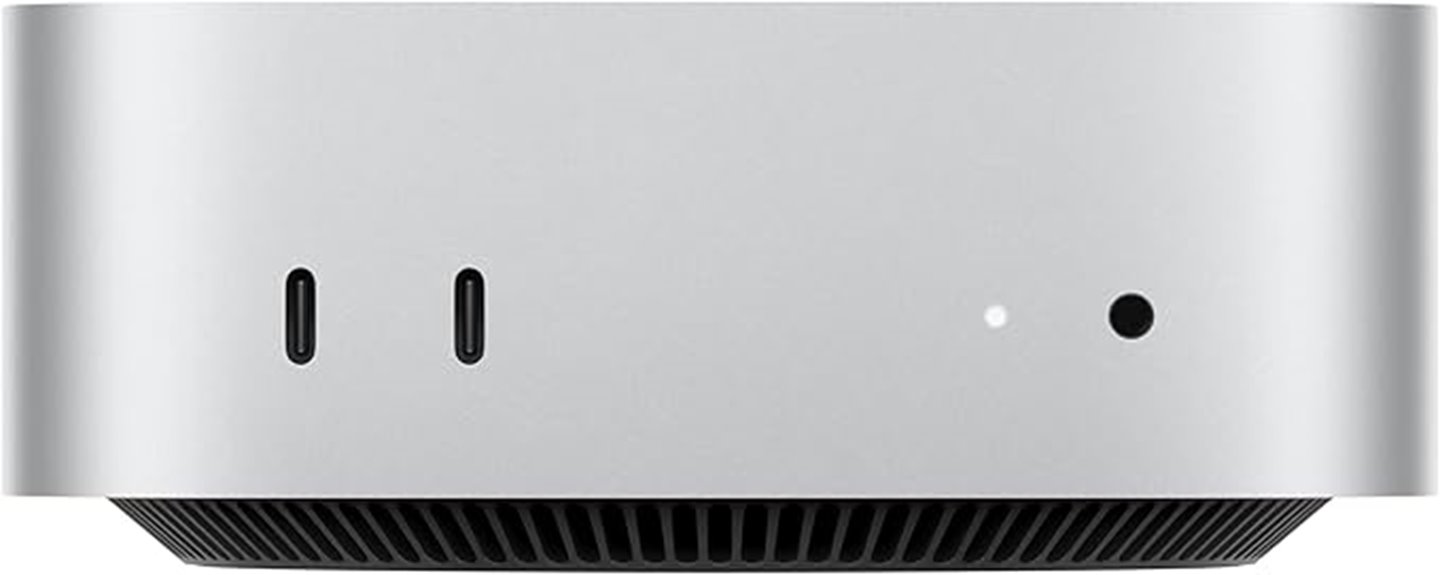
For software developers seeking powerful performance in a compact form, the Apple 2024 Mac mini with the M4 chip is an ideal choice. It packs a 10-core CPU and GPU, 16GB of unified memory, and a 512GB SSD into a tiny five-by-five-inch chassis, making it perfect for any workspace. The M4 chip delivers snappy, fluid performance, supporting demanding applications like Adobe Creative Cloud and Microsoft 365. Its extensive connectivity options—including Thunderbolt, HDMI, and Gigabit Ethernet—offer versatility. Seamlessly integrating with other Apple devices, it enhances productivity and privacy, making it a reliable, space-saving powerhouse for software developers.
Best For: software developers and creative professionals needing powerful, compact computing with seamless Apple ecosystem integration.
Pros:
- Compact design fits easily into any workspace without sacrificing performance
- Powered by the advanced M4 chip, ensuring fast, fluid operation for demanding applications
- Versatile connectivity options including Thunderbolt, HDMI, and Gigabit Ethernet
Cons:
- Limited upgradeability due to its small form factor and integrated components
- Storage options are fixed at 512GB, which may require external solutions for large files
- Premium price point may be a consideration for budget-conscious users
Apple Mac mini Desktop Computer with M4 Chip (2024)
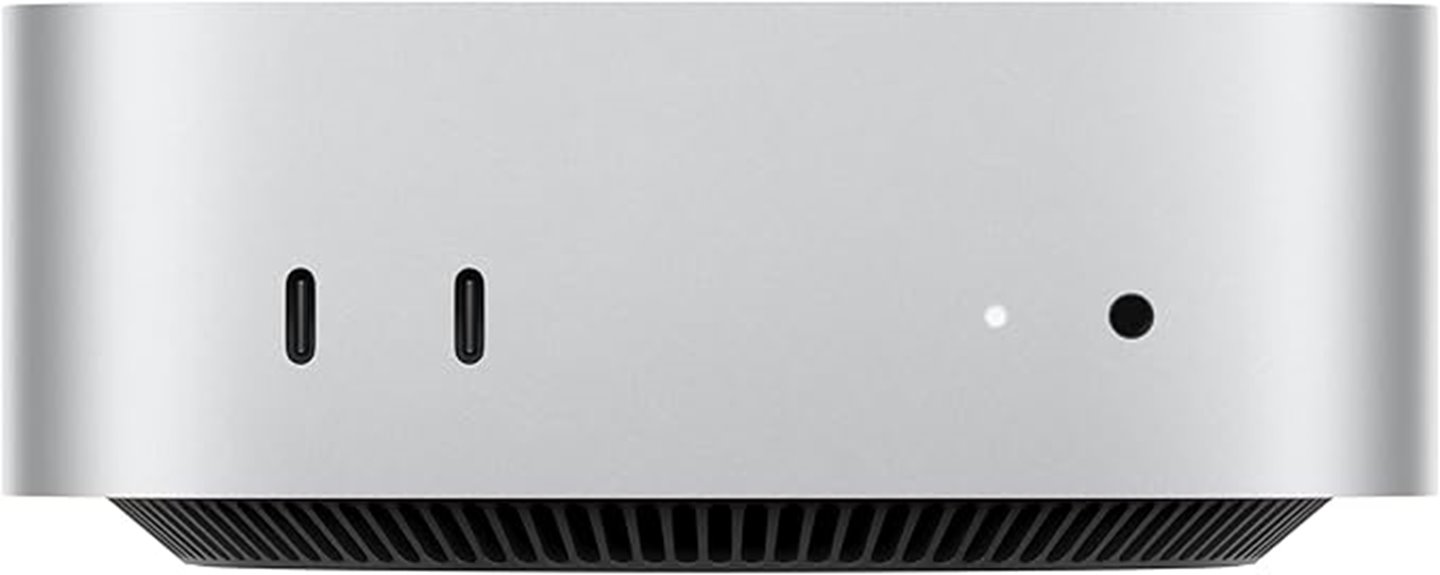
The Apple Mac mini with M4 Chip (2024) stands out as an exceptional choice for software developers who need powerful performance in a compact form factor. Its small, five-by-five-inch design easily fits beside monitors or in tight spaces, yet it packs a punch with a 10-core CPU and GPU, plus 24GB of unified memory for smooth multitasking. The 512GB SSD ensures fast access and ample storage. Connectivity is versatile with Thunderbolt, HDMI, Ethernet, and USB-C ports. Running macOS optimized for Apple Silicon, it supports essential apps and integrates seamlessly with other Apple devices, making it perfect for productivity and creative workflows.
Best For: software developers and creative professionals seeking a compact, powerful Mac mini with seamless Apple ecosystem integration.
Pros:
- Compact size fits easily into small spaces and workstations
- Powerful M4 chip with 10-core CPU and GPU delivers exceptional speed and multitasking capabilities
- Seamless compatibility with macOS and other Apple devices enhances productivity and workflow
Cons:
- Limited internal storage options beyond 512GB SSD may require external drives for large files
- May lack some high-end ports or expansion options found in larger desktops
- The small form factor might limit upgradeability or customization after purchase
Factors to Consider When Choosing a Mac Mini for Software Development
When choosing a Mac Mini for software development, I focus on processor power, memory, and storage to meet my workload. I also consider connectivity options and compatibility with my development tools to guarantee smooth workflow. Understanding these factors helps me pick a model that balances performance and future-proofing.
Processor Power and Speed
Choosing a Mac Mini with a powerful processor is crucial for efficient software development, as it directly impacts compile times and multitasking capabilities. A faster processor like the M4 Pro with up to 14 cores can considerably cut down compile times, boosting productivity. Multi-core performance is essential for running resource-heavy tools, virtual machines, or containerized environments without lag. Higher clock speeds and more cores enable smoother handling of complex code compilations and simultaneous tasks. This not only improves responsiveness in IDEs and debugging but also ensures your setup remains capable of evolving with future demands. Upgrading to a high-performance processor means you’re investing in a machine that stays relevant longer, supporting your development needs as projects grow in complexity.
Memory Capacity Needs
Adequate memory capacity is essential for smooth multitasking and handling large codebases or multiple development tools simultaneously. For most software development tasks, 16GB of RAM is the minimum I recommend, guaranteeing efficient performance without bottlenecks. If you’re working with resource-heavy applications like Android Studio, Xcode, or Docker, 24GB or more can notably reduce lag and improve build times. Developers involved in graphics-intensive or machine learning projects should consider 32GB or even 64GB of RAM to support large datasets and complex computations. It’s also wise to think about future needs; higher memory capacity can extend your Mac Mini’s lifespan by accommodating growing project demands. Balancing current requirements with future scalability ensures your investment remains viable for years to come.
Storage Options Flexibility
Selecting the right storage options for your Mac Mini is essential because it directly impacts your development workflow and future scalability. You can choose internal SSDs ranging from 256GB to 2TB or more, depending on your project needs. For larger codebases or datasets, external SSDs offer flexible expansion without sacrificing speed. Faster storage, like NVMe SSDs, can drastically cut load times and streamline your work. Configuring storage during purchase guarantees you have enough space for large files and virtual machines right from the start. Additionally, integrating cloud storage provides scalable backup, collaboration, and remote access options. This flexibility allows you to tailor your setup to your specific development requirements, guaranteeing optimal performance and growth potential as your projects evolve.
Connectivity and Ports
When setting up a Mac Mini for software development, paying attention to connectivity and port options guarantees a smooth workflow. I look for models with multiple Thunderbolt 4 or Thunderbolt 5 ports, supporting high-speed data transfer and multiple external displays. Sufficient USB-C ports supporting USB 3.0 or higher are essential for connecting peripherals like external drives, keyboards, and testing devices. An HDMI port is vital for easy connection to monitors or TVs, especially when multitasking or testing apps. I also verify if there’s a Gigabit Ethernet port or the option to upgrade to 10Gb Ethernet, ensuring fast, stable network connections during large data transfers. Additionally, I consider port placement for easy access, helping me set up a clutter-free workspace and streamline my development process.
Compatibility With Development Tools
Choosing a Mac Mini for software development means guaranteeing it can run the tools and IDEs essential for your projects. First, check that it supports key software like Xcode, Visual Studio Code, or JetBrains IDEs, which may need specific OS versions or hardware features. The processor architecture matters too—Apple Silicon M4 or M4 Pro should be compatible with most development environments, especially when working with cross-platform or legacy software. Additionally, verify that the device’s RAM and SSD storage meet your workload demands, as larger projects need more memory and faster storage. Don’t forget to confirm that external peripherals, debugging tools, and displays are compatible with the Mac Mini’s ports and standards. Finally, confirm the hardware supports emulators, simulators, or virtual machines for comprehensive testing.
Frequently Asked Questions
How Does the M4 Pro Chip Compare to Previous Mac Mini Models?
The M4 Pro chip markedly outperforms previous Mac Mini models, offering faster processing, better graphics, and improved energy efficiency. I’ve noticed smoother multitasking and quicker compilation times, which boost my productivity. Compared to older Intel-based Macs, the M4 Pro’s integrated architecture and advanced AI features give me a noticeable edge. If you’re looking for a future-proof machine, the M4 Pro is a solid upgrade, especially for demanding development tasks.
Are There Significant Performance Differences Between the M4 and M4 Pro Chips?
Yes, there are significant performance differences between the M4 and M4 Pro chips. The M4 Pro offers more cores, higher clock speeds, and better GPU performance, making it ideal for demanding tasks like software development and multitasking. I’ve found that upgrading to the M4 Pro boosts productivity, especially when handling large codebases or running multiple virtual machines, providing a smoother, faster experience overall.
What Are the Upgrade Options for RAM and Storage on These Mac Minis?
You can upgrade the RAM and storage on these Mac Minis, but options vary by model. Most newer Mac Minis allow you to configure up to 64GB of RAM at purchase, though post-purchase upgrades are limited or impossible. Storage options range from 256GB to 2TB SSD, with some models allowing external drives for extra space. I recommend choosing the highest specs within your budget to future-proof your development work.
Can These Mac Minis Support Multiple High-Resolution External Monitors?
Yes, these Mac Minis can support multiple high-resolution external monitors, but it depends on the specific model. I find that the newer M2 models handle up to two 6K displays seamlessly, perfect for multitasking in development. If you’re planning to connect more monitors or higher resolutions, make sure to check the official specs and consider using Thunderbolt or USB-C hubs to expand your setup effectively.
How Future-Proof Are These Models for Upcoming Software Development Tools?
Did you know that 80% of software developers expect tools to evolve considerably in the next five years? I believe these Mac Minis are quite future-proof, thanks to their powerful Apple Silicon chips and upgradable RAM options. They’re built to handle upcoming development environments and demanding applications. While no device is entirely future-proof, these models give me confidence they’ll remain capable for a good while, supporting my growth and new tech.
Conclusion
Choosing the right Mac mini is like planting a seed—you’ll want it to grow your ideas and projects. Whether you pick the sturdy M4 or the mighty M4 Pro, each model is a branch reaching toward your goals. Think of your choice as nurturing a future full of innovation. Whichever you select, remember it’s your foundation—your roots—that will support your software development journey for years to come.