
If you’re looking for the best GPUs for VR with ray tracing in 2026, I recommend considering models like the RTX 5050 with 8GB VRAM, a powerful upgrade for immersive experiences. The ASUS ROG Strix RTX 2070 offers excellent performance, and the PNY NVIDIA Quadro RTX 4000 blends professional quality with gaming power. The RTX 2060 Super also remains a solid choice for budget-friendly VR setups. Keep exploring to discover more about what makes each GPU stand out!
Key Takeaways
- Prioritize GPUs with high RT core counts and fast clock speeds for optimal ray tracing in VR.
- Ensure compatibility with 8K, multi-monitor setups, and high refresh rates for future-proof VR experiences.
- Look for models with at least 10GB VRAM to support detailed textures and complex virtual environments.
- Check for advanced cooling solutions and reliable power delivery to maintain performance during demanding VR workloads.
- Consider GPUs supporting PCIe 5.0, DLSS, and multiple high-bandwidth outputs for enhanced VR immersion in 2026.
| RTX 2060 8GB Super Gaming Graphics Card |  | Gaming Powerhouse | Memory Size: 8GB GDDR6 | Ray Tracing Cores: Not specified (supports ray tracing) | Display Outputs: HDMI, DisplayPort, DVI | VIEW LATEST PRICE | See Our Full Breakdown |
| PNY NVIDIA Quadro RTX 4000 – The World’S First Ray Tracing GPU | 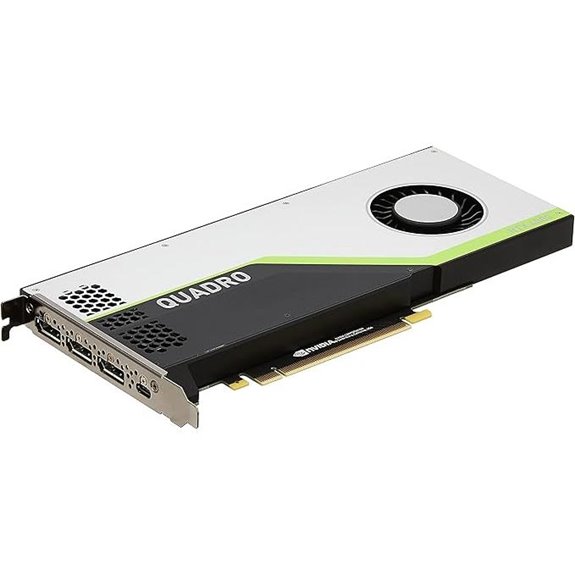 | Professional Grade | Memory Size: 8GB GDDR6 | Ray Tracing Cores: 36 RT cores | Display Outputs: 3 DisplayPort 1.4, Virtual Link (USB-C) | VIEW LATEST PRICE | See Our Full Breakdown |
| ASUS ROG Strix RTX 2070 Overclocked Gaming Card |  | Overclocked Performance | Memory Size: 8GB GDDR6 | Ray Tracing Cores: Not specified (supports ray tracing) | Display Outputs: HDMI, DisplayPort, USB Type-C (VR) | VIEW LATEST PRICE | See Our Full Breakdown |
| PNY NVIDIA GeForce RTX 5050 Graphics Card (8GB) | 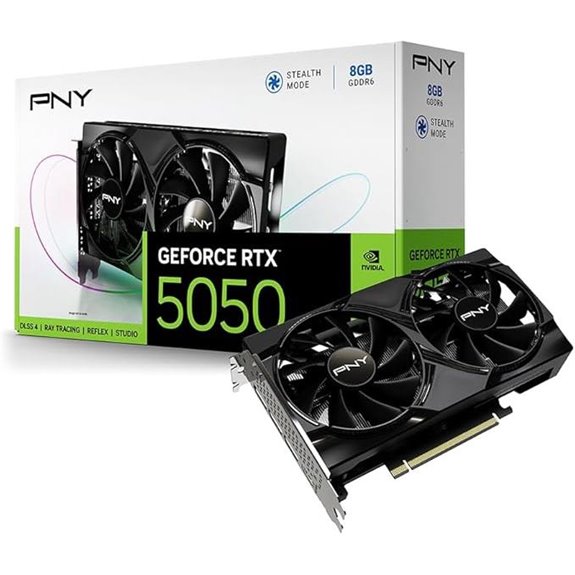 | Future-Ready | Memory Size: 8GB GDDR6 | Ray Tracing Cores: 4th-gen Ray Tracing Cores | Display Outputs: HDMI, DP 2.1 | VIEW LATEST PRICE | See Our Full Breakdown |
More Details on Our Top Picks
-

PNY NVIDIA Quadro RTX 4000 - The World’S First Ray Tracing GPU
Experience fast, interactive, professional application performance
As an affiliate, we earn on qualifying purchases.
RTX 2060 8GB Super Gaming Graphics Card
If you’re looking for a budget-friendly GPU that still delivers solid VR performance with ray tracing, the RTX 2060 8GB Super is an excellent choice. It comes with 8GB of GDDR6 memory, a 256-bit interface, and boosts up to 1650 MHz, ensuring smooth gameplay. Its dual fans keep temperatures in check, and support for up to three monitors makes multitasking easy. With real-time ray tracing, DLSS AI support, and VR readiness, it handles modern games and professional tasks well. Rated 4.4 stars by users, it offers great value for its price and is perfect for immersive VR experiences and high-resolution gaming.
- Memory Size:8GB GDDR6
- Ray Tracing Cores:Not specified (supports ray tracing)
- Display Outputs:HDMI, DisplayPort, DVI
- VR Support:VR-ready
- Performance (TFLOPS / Clock Speed):Up to 1650 MHz boost
- Compatibility / Interface:PCIe x16 3.0
- Additional Feature:Supports up to three monitors
- Additional Feature:Real-time ray tracing technology
- Additional Feature:Compact package dimensions
-
B07JFYT2KD
Amazon Product B07JFYT2KD
As an affiliate, we earn on qualifying purchases.
PNY NVIDIA Quadro RTX 4000 – The World’S First Ray Tracing GPU
The PNY NVIDIA Quadro RTX 4000 stands out as the first ray tracing GPU designed specifically for professional applications, making it an ideal choice for architects, digital artists, and designers who demand high-fidelity visuals. It’s built on NVIDIA’s Turing architecture, featuring 8 GB GDDR6 memory, 36 RT cores, and 288 Tensor cores, delivering up to 7.1 TFLOPS of performance. With support for multiple high-resolution displays and advanced rendering capabilities, it excels in real-time ray-traced rendering, immersive VR, and complex visualization tasks. Its connectivity options, including DisplayPort 1.4 and Virtual Link, make VR integration seamless, elevating the professional visual experience.
- Memory Size:8GB GDDR6
- Ray Tracing Cores:36 RT cores
- Display Outputs:3 DisplayPort 1.4, Virtual Link (USB-C)
- VR Support:Supports high-res VR via Virtual Link
- Performance (TFLOPS / Clock Speed):7.1 TFLOPS (FP32)
- Compatibility / Interface:PCIe 3.0 (supporting PCIe 5.0)
- Additional Feature:Supports large datasets
- Additional Feature:Virtual Link VR connector
- Additional Feature:Designed for professional visualization
-
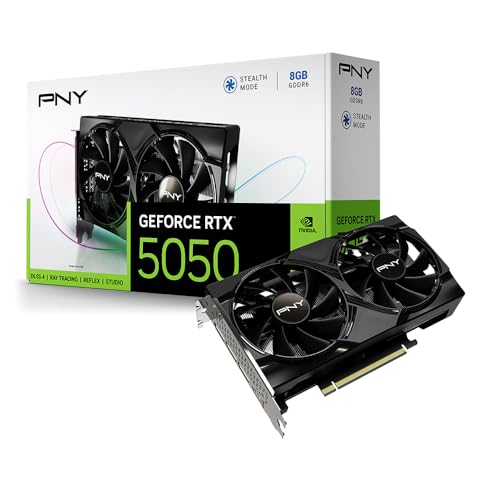
PNY NVIDIA GeForce RTX™ 5050 Dual Fan, Graphics Card (8GB GDDR6, 128-bit, SFF-Ready, PCIe® 5.0, HDMI®/DP 2.1, 2-Slot, NVIDIA Blackwell Architecture, DLSS 4)
DLSS is a revolutionary suite of neural rendering technologies that uses AI to boost FPS, reduce latency, and...
As an affiliate, we earn on qualifying purchases.
ASUS ROG Strix RTX 2070 Overclocked Gaming Card
Gamers seeking a reliable and high-performance GPU for VR experiences will find the ASUS ROG Strix RTX 2070 Overclocked to be an excellent option. Powered by NVIDIA’s Turing architecture, it offers a 1845 MHz boost clock in OC mode, 2304 CUDA cores, and 8 GB of GDDR6 memory, making it well-suited for demanding VR titles and ray tracing. Its advanced cooling with Triple Axial Tech fans guarantees stable performance during extended sessions. Plus, with customizable RGB lighting and robust build quality, this card combines aesthetics with durability. Overall, it’s a versatile choice that delivers strong performance and reliability for immersive VR gaming.
- Memory Size:8GB GDDR6
- Ray Tracing Cores:Not specified (supports ray tracing)
- Display Outputs:HDMI, DisplayPort, USB Type-C (VR)
- VR Support:Supports VR with USB Type-C
- Performance (TFLOPS / Clock Speed):1845 MHz boost (OC mode)
- Compatibility / Interface:PCIe 3.0 (assumed)
- Additional Feature:RGB lighting customization
- Additional Feature:Premium build with Super Alloy Power II
- Additional Feature:Advanced cooling with Axial Tech fans
PNY NVIDIA GeForce RTX 5050 Graphics Card (8GB)
For those seeking a compact yet powerful GPU capable of handling demanding VR experiences with ray tracing, the PNY NVIDIA GeForce RTX 5050 stands out. It features NVIDIA’s Blackwell architecture, supporting 4th-gen Ray Tracing Cores and 5th-gen Tensor Cores for advanced AI. With 8GB GDDR6 memory, PCIe 5.0 compatibility, and HDMI/DP 2.1 outputs, it’s perfect for high-performance gaming and creative tasks. DLSS 4 boosts frame rates and image quality, while Reflex tech enhances responsiveness. Its dual-fan cooling and SFF design make it ideal for compact setups. Overall, this card delivers immersive visuals and efficient workflows for VR enthusiasts in a small form factor.
- Memory Size:8GB GDDR6
- Ray Tracing Cores:4th-gen Ray Tracing Cores
- Display Outputs:HDMI, DP 2.1
- VR Support:Optimized for VR with advanced outputs
- Performance (TFLOPS / Clock Speed):Approx. 2317 MHz
- Compatibility / Interface:PCIe 5.0
- Additional Feature:PCIe 5.0 compatibility
- Additional Feature:DLSS 4 AI technology
- Additional Feature:SFF-ready dual-fan design
Factors to Consider When Choosing a GPU for VR With Ray Tracing
When choosing a GPU for VR with ray tracing, I focus on performance, compatibility, and system requirements. You’ll want to take into account how well the card handles ray tracing, whether it supports your VR headset, and if your system’s power and cooling can keep it running smoothly. These factors ensure you get the best experience without unexpected issues.
Ray Tracing Performance
Ray tracing performance in a GPU hinges mainly on the number and efficiency of RT cores, which handle realistic lighting, shadows, and reflections in VR. More RT cores mean better ability to render complex scenes with high realism. Additionally, the boost clock speed influences how quickly these scenes are rendered in real time, impacting smoothness and responsiveness. Advanced ray tracing algorithms demand significant processing power, so a GPU with high core counts and fast clock speeds can maintain immersive VR experiences without lag. Optimized memory bandwidth and capacity are also critical, ensuring detailed visuals don’t bottleneck during intense ray-traced scenes. Overall, selecting a GPU with a balanced combination of these factors will provide the best ray tracing performance for VR in 2026.
VR Compatibility Limits
Choosing a GPU for VR with ray tracing means paying close attention to its compatibility limits, which directly impact your immersive experience. VR headsets demand a minimum of 4K resolution support and high frame rates, typically 90Hz or more, to ensure smooth visuals. Your GPU’s maximum resolution and refresh rate support must match or exceed these requirements; otherwise, you’ll face stuttering or latency issues. Not all ray-tracing-capable GPUs are optimized for VR, as VR needs lower latency and higher bandwidth, which some cards may lack. Additionally, the number of displays a GPU can handle—usually up to four or more—affects multi-monitor or extended virtual environment setups. Failing to meet these compatibility factors can result in performance bottlenecks and a less immersive experience.
Memory Capacity Needs
Selecting the right GPU for VR with ray tracing hinges heavily on its memory capacity, as VR environments demand substantial VRAM to render detailed scenes smoothly. A minimum of 8GB is recommended for comfortable experiences, but 10GB or more offers better future-proofing for high-resolution textures and complex scenes. Higher VRAM allows for more detailed environments and assets, reducing the need to lower graphics settings. Insufficient VRAM can cause stuttering, frame drops, and diminished visual quality, especially at higher resolutions. For professional workloads involving large datasets or multi-monitor setups, 12GB or more may be necessary to handle complex rendering tasks efficiently. When choosing, consider both current and future demands based on your VR application’s complexity and desired visual fidelity.
Cooling and Thermals
Since VR with ray tracing demands intense GPU workloads, effective cooling solutions are essential to keep temperatures in check. High-performance GPUs often feature multiple fans or vapor chamber technology to efficiently dissipate heat during demanding VR sessions. Lower thermals prevent GPU throttling, ensuring consistent high frame rates and reducing latency in VR experiences. Adequate airflow and case ventilation are critical, especially when handling graphics with complex ray-traced effects. GPUs equipped with advanced cooling features, like direct contact heat pipes and large heatsinks, can substantially lower temperatures during sustained loads. Monitoring thermal performance with software tools helps optimize fan curves and airflow, maintaining stability and extending GPU lifespan. Good thermal management is key for a smooth, immersive VR experience without overheating concerns.
Power Supply Requirements
A essential aspect of building a VR gaming system with ray tracing is guaranteeing your power supply can handle the GPU’s demands. Modern GPUs with ray tracing features typically require at least 550W to 750W, so choosing a power supply within this range is necessary. Additionally, check that your PSU has the right connectors—like 6-pin or 8-pin PCIe cables—that match your GPU’s requirements. A stable, clean power output is important, so opt for a high 80 Plus efficiency rating to ensure reliability and reduce energy waste. Avoid adapters whenever possible, as they can cause instability. Also, consider future upgrades; selecting a power supply with extra headroom ensures you’re prepared for higher-end GPUs and ongoing performance needs.
Connectivity Options
Choosing the right connectivity options on your GPU is essential for a seamless VR experience with ray tracing. You’ll want multiple DisplayPort 1.4 or HDMI 2.1 ports to support multi-monitor setups and high resolutions, like 8K, for stunning visuals. VR-specific connectors, such as USB Type-C, are also vital for high-bandwidth data transfer and headset compatibility. Look for GPUs that include Virtual Link or similar adapters, which simplify connections by allowing a single cable to power your VR headset. Additionally, support for advanced video standards like HDR can enhance immersion by providing richer colors and contrast. Ensuring these connectivity features are in place guarantees smooth, high-quality VR experiences without lag or compatibility issues.
Price and Budget
Your budget plays a significant role in selecting the right GPU for VR with ray tracing, especially as prices vary widely across different models. High-end ray tracing GPUs can cost over $1,000, so it’s essential to deliberate on whether the performance boost matches your spending. Look for the best value by comparing the cost-to-performance ratio—sometimes a mid-range card offers excellent VR and ray tracing capabilities without breaking the bank. Keep an eye out for sales, discounts, or bundle deals that can make premium GPUs more affordable. If you’re planning for future VR advancements, investing slightly above your current budget could pay off. Remember, higher-priced GPUs generally deliver better ray tracing and VR experiences, but they’re not always necessary for casual or entry-level setups.
Future-Proofing Features
To guarantee your VR setup remains relevant as technology advances, focusing on future-proofing features when selecting a GPU is essential. Supporting the latest PCIe standards, like PCIe 5.0, ensures compatibility with upcoming motherboards and systems. Advanced ray tracing cores, such as RT cores, and AI acceleration features like Tensor cores, help maintain high performance as VR software demands grow. Compatibility with high-resolution multi-monitor setups, including 8K displays, prepares you for future immersive technologies. AI-based upscaling tech like DLSS can extend your GPU’s lifespan by optimizing performance in future titles. Additionally, choosing a GPU with ample VRAM—8GB or more—provides headroom for future updates and increasingly detailed virtual environments, securing your investment for years to come.
Frequently Asked Questions
How Does Ray Tracing Impact VR Performance and Immersion?
Ray tracing considerably boosts VR performance and immersion by creating more realistic lighting, shadows, and reflections. It makes virtual environments feel more lifelike and engaging, pulling you deeper into the experience. While it demands powerful GPUs, the enhanced visuals make gameplay smoother and more believable. I find that enabling ray tracing elevates my VR sessions, making every scene more vibrant and convincing, truly transforming the way I interact with virtual worlds.
Are There Specific GPU Features Optimized for VR With Ray Tracing?
Imagine a GPU as a painter, carefully layering realistic reflections and shadows onto a VR canvas. I see that modern GPUs optimize features like dedicated ray tracing cores, high VRAM, and low latency memory, which directly enhance VR immersion. These features guarantee smooth, lifelike visuals that draw you deeper into virtual worlds. For 2026, I believe choosing a GPU with robust ray tracing capabilities is key to opening stunning VR experiences.
What Is the Expected Lifespan of a High-End GPU for VR Use?
A high-end GPU for VR use typically lasts around 3 to 5 years, depending on how demanding the software becomes and how quickly new technology emerges. I find that investing in a top-tier card now means enjoying smooth, immersive experiences longer, but I also stay updated on new releases. Regular driver updates and system maintenance help extend the GPU’s lifespan, ensuring I get the most out of my investment.
How Do Driver Updates Affect VR Ray Tracing Compatibility?
Driver updates greatly impact VR ray tracing compatibility. I find that regularly updating my GPU drivers ensures better support, improved performance, and fewer glitches. Updates often include optimizations for new VR titles and fixes for compatibility issues, making my VR experience smoother and more immersive. So, I always keep my drivers current, because staying updated means maximizing my GPU’s potential and avoiding unnecessary technical hiccups during my VR sessions.
Can Mid-Range GPUS Sufficiently Handle VR Ray Tracing in 2026?
Yes, mid-range GPUs can handle VR ray tracing in 2026, but with some limitations. I’ve found that they perform well for most experiences, especially if you tweak settings. Modern mid-range cards are increasingly capable thanks to improved architecture and driver updates. However, if you want cutting-edge performance and the best visuals, investing in higher-end GPUs is still the way to go.
Conclusion
So, after all this talk about the latest and greatest GPUs, I can’t help but wonder—will we ever settle for less? With these powerhouses, VR with ray tracing might just be overkill, or maybe just the beginning of a new era of eye-popping visuals. Honestly, who knew that in 2026, gaming would be so advanced I’d need a small fortune just to keep up? Guess it’s a good problem to have, right?